
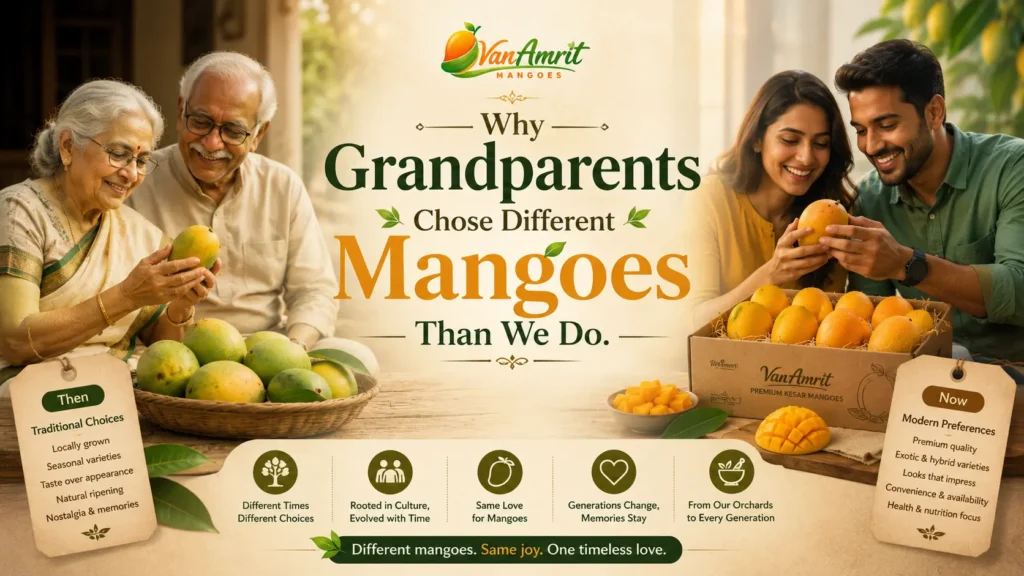
Why Grandparents Chose Different Mangoes Than We Do
The mango your dada ate over the kitchen sink in June was a completely different experience from the cubed mango in your smoothie bowl. Here’s exactly what changed — and why it matters.
That relationship with mangoes — the one your grandparents had — was completely different from the one most of us have today. And I don’t just mean nostalgia talking. The varieties were different, the ripening method was different, the buying experience was different, and — this is the part that surprises people — the actual taste and nutrition were measurably different too.
So why did grandparents choose different mangoes than we do? The answer turns out to be more interesting than just “things were better before.” It’s a story about geography, chemistry, trust, and what gets lost when convenience becomes the highest priority in how we eat.
🗺️ The Mango Your Grandparents Knew Was a Local Thing, Not a National Brand
Here’s the first and most important difference: your grandparents didn’t choose their mango the way we choose ours. They didn’t scroll through an app, compare GI tags, or read a food blogger’s recommendation. They ate the mango that grew closest to where they lived — because that was simply what a mango was.
In Lucknow and Varanasi, it was Dasheri and Langra. In Bihar’s Bhagalpur belt, it was Zardalu, eaten in season and paired with litti-chokha like a religion. In Bengal’s Malda district, it was Himsagar — an intensely sweet, thick-pulped variety that connoisseurs still whisper about but most of India has never tasted. In Gujarat, it was Rajapuri for aamras and pickling, and Kesar for those who could get it from the Gir belt. In Andhra Pradesh, it was Banginapalli, eaten fresh in generous slabs. In Karnataka and Tamil Nadu, Totapuri — not a premium eating mango, but the one that powered every mango pickle and chutney on every kitchen shelf.
None of these needed a GI tag or a packaging box to be trusted. The mango variety was the identity — “Langra lao” was a complete instruction, understood by every vendor and buyer without further explanation. Regional mango preferences ran as deep as language, food, and family tradition — passed down without documentation, without Instagram, and without a single food delivery app.
Why grandparents chose different mangoes than we do starts right here: because geography used to determine your mango. Today, e-commerce and cold-chain logistics have made it possible for Alphonso to reach Assam and Kesar to reach Kerala. That’s genuinely wonderful — and it’s also how two varieties came to dominate a country that grows over a thousand.
Want to explore the full regional diversity of Indian mangoes? We cover all 20+ major varieties across every state — season, soil, and taste profile.
Read: Types of Mangoes in India — Complete State-by-State Guide →
📊 Then and Now: The Generational Mango Shift at a Glance
Before we go deeper, let’s put the two eras side by side. Not to judge — just to see what actually shifted, and where the biggest gaps are.
| What Changed | Grandparents’ Era | Our Era (2026) | Net Effect |
|---|---|---|---|
| Variety Choice | Regional loyalty — Langra, Chausa, Himsagar, Rajapuri by location | Brand/trend-driven — Alphonso and Kesar dominate nationally | Diversity lost; quality debate gained |
| Ripening Method | Hay bed (penda), newspaper wrap, room temperature — naturally | Carbide (banned, still used), ethylene chambers, cold storage | Speed gained; flavour and nutrition compromised |
| Where They Bought | Weekly bazaar, known vendor, trusted local orchard | Supermarket, quick-commerce app, online delivery | Convenience gained; traceability and trust lost |
| How They Ate It | Sucking Chausa over the sink, aamras with puris, sliced on the veranda | Cubed in bowls, smoothies, mango desserts, food photography | Presentation gained; raw sensory experience reduced |
| Season Respect | Waited for May–June; the first mango of the season was an event | March mangoes, off-season imports, year-round availability | Availability gained; anticipation and peak flavour lost |
| Nutritional Quality | Iron 0.45 mg, zinc 0.24 mg, ascorbic acid 52.29 mg/g — naturally ripened | Carbide reduces ascorbic acid to 35.94 mg/g; flattens flavour profile | Both taste and nutrition reduced by chemical ripening |
Look at that table and tell me the nostalgia argument isn’t at least partially backed by evidence. Almost every dimension shifted — and most of the shifts traded authentic quality for convenient access. That’s not inherently wrong. But it’s worth being honest about.
🏡 The Eating Style That Quietly Died
The most vivid generational difference isn’t even the variety — it’s how they ate. Your grandparent ate a mango in a way that was completely committed to the experience of eating a mango. There was no Instagram angle. No cutting board aesthetic. No cubed-mango-in-a-bowl presentation.
They picked up a Chausa — that notoriously juicy, late-season UP variety — pressed it between both hands until the flesh softened, bit off the tip, and sucked. Standing over the kitchen sink, juice running down both wrists, occasionally wiping their face with the back of their hand. The mango wasn’t just eaten. It was consumed — completely and without self-consciousness.
Chausa, Langra, and Rajapuri were specifically suited to this eating style. Juicy enough to squeeze-and-drink. Fibrous enough to hold shape under pressure. Forgiving of a mess. The variety and the eating method were designed for each other.
Today we cube everything. We layer it in smoothie bowls. We photograph it against linen napkins. We make it into a content opportunity. When was the last time you ate a mango standing up, with both hands, in a way you absolutely couldn’t photograph and wouldn’t want to? That gap — between eating and performing eating — is the most honestly human thing that’s changed in our relationship with mangoes.
Curious which mango is actually the sweetest for eating fresh — Brix data for 8 major varieties? We ran the full comparison so you don’t have to guess.
Read: Which Mango Is the Sweetest in India? Full Brix Comparison →
🔬 Here’s the Part That’s Not Nostalgia: The Chemistry Changed
I want to be careful here, because “things tasted better before” is an extremely easy argument to dismiss. It sounds like every generation’s complaint about every food. But when it comes to mangoes, there’s a specific, scientific, verifiable reason why your grandparents’ mango might have actually tasted better — and it has nothing to do with memory.
Calcium carbide ripening became widespread in Indian fruit markets through the 1980s and 1990s. Before that, the universal method was natural ripening — hay beds, room temperature, newspaper wrapping, the traditional penda approach that Indian farmers had practised for generations. No chemical assistance. No rush.
A peer-reviewed study published in Scientific Reports (Nature Publishing Group, January 2024, PubMed indexed) directly compared naturally ripened mangoes with carbide-ripened and ethylene-ripened fruit. The findings are striking:
Ascorbic acid (Vitamin C): Naturally ripened — 52.29 mg/g. Carbide-ripened (10g/kg) — 35.94 mg/g. That’s a 31% reduction. Minerals: Naturally ripened mangoes showed significantly higher iron (0.45 mg/100g), zinc (0.24 mg/100g), and copper (0.17 mg/100g) than chemically ripened fruit. Shelf life: Carbide-ripened mangoes lasted just 3 days vs 6 days for naturally ripened. Overall: Carbide reduced moisture, fibre, protein, and carbohydrates while flattening organic acid and flavour ester profiles. (Source: Scientific Reports, Vol. 14, No. 1, January 2024, DOI: 10.1038/s41598-024-52483-9)
So when your father or grandmother says “mangoes aren’t the same anymore” — they’re right. Not because memory is unreliable (though it can be), but because the chemical intervention that became standard in the supply chain from the 1980s onwards genuinely changed what arrives in the fruit bowl. Your grandparents ate mangoes that ripened slowly, fully, and without interference. We eat mangoes that were rushed.
On April 16, 2026, FSSAI issued fresh nationwide directives ordering all State and UT Food Safety Commissioners to “intensify inspections and maintain strict vigilance over fruit markets, mandis, storage facilities, wholesalers, and distributors” specifically targeting calcium carbide use during the mango season. Enforcement teams have been authorised to use strip paper tests to detect acetylene gas on-site. Calcium carbide is banned under Regulation 2.3.5 of the Food Safety and Standards (Prohibition and Restrictions on Sales) Regulations, 2011. Despite the ban, food safety experts note that calcium carbide — sold for as little as ₹5–10 per kg — continues to be used because the infrastructure required for legal ethylene ripening is expensive and largely inaccessible to small vendors. (Source: Deccan Chronicle, IBTimes India, April 17 2026)
🏪 The Bazaar vs the App: Two Entirely Different Trust Systems
Your grandparent knew the mango seller by name. He knew which family wanted which variety, how ripe they liked it, and roughly when they’d come back for more. He told your dada — probably every single summer for a decade — “these are better than last week’s, the Dasheri from Malihabad just came in.” That was a supply chain. It was also a relationship.
We now buy mangoes in eight minutes from a quick-commerce app. The mango arrives in a dark-store cardboard box. We have no idea which orchard it came from, when it was harvested, how it was ripened, or how long it sat in cold storage before dispatch. We read the product name on the app, check the rating, and hope.
According to Mordor Intelligence’s India Mango Market Report (updated January 2026), direct-to-consumer platforms — like MangoPoint, which raised funding in August 2025 — are growing specifically because buyers want traceable, farm-fresh deliveries. The market is recognising that the trust your dada got from a known vendor is something that modern buyers are actively trying to rebuild through technology. That’s the irony: we’re using apps to recover the personal connection that apps replaced.
The personal relationship your grandparents had with their mango vendor wasn’t a quaint, old-fashioned thing. It was a highly functional trust system. GI tags, carbide-free certifications, farm-direct brands — all of these are essentially institutional replacements for the thing that existed naturally when you knew your vendor’s face.
💎 The Varieties That Got Left Behind
The rise of Alphonso and Kesar as the dominant national premium varieties has pushed some genuinely extraordinary regional mangoes into near-obscurity. Not because they’re inferior — but because they don’t travel well, photograph easily, or carry the marketing infrastructure that turns a variety into a national brand.
Himsagar (West Bengal) is probably the best example. GI-tagged from Malda district, it produces intensely sweet, thick, creamy pulp with low fibre and a short season running mid-May to mid-June. People who’ve tasted it in season — really tasted it, from a trusted Malda source — regularly describe it as the richest-flavoured mango in India. Your Bengali grandmother, if she’s from Malda, considers this self-evident. The rest of the country has largely never heard of it.
Zardalu (Bihar), GI-tagged from Bhagalpur, is intensely aromatic with a distinctive golden-honey flavour. Biharis eat it with litti-chokha in a pairing that’s as natural and inevitable to them as Alphonso aamras is to a Maharashtrian. Outside Bihar? Almost invisible in national markets.
Rajapuri (Gujarat) is a massive fruit — 400–600g per mango — that produces extraordinary pulp-to-seed ratio and was the traditional aamras mango in Gujarati households for generations before Kesar became more widely cultivated. Still grown in Valsad and Junagadh, barely known outside Gujarat.
These weren’t niche varieties in their time. They were the mainstream. It’s the definition of mainstream that changed — not the mangoes themselves.
Curious which Indian state actually produces the best mangoes? We go state by state — production data, GI tags, variety profiles, and use-case verdicts for 2026.
Read: Which State Produces the Best Mangoes in India? 2026 Guide →
⏳ The Season Mattered. We’ve Mostly Forgotten That.
For your grandparents, mango season wasn’t a product category on an app. It was a genuine annual event — a recurring summer ritual that the whole household prepared for and participated in. The season ran from May to July, and when it ended, it was over. Done. See you next year.
That scarcity created something we’ve largely lost: real anticipation. The first mango of summer was significant. It was waited for, talked about, argued over — “Is it too early? Are they sweet yet? Who’s got the best ones this year?” The mango arrived at a specific moment in the calendar and it mattered that it did.
Buying a mango in March from a quick-commerce app might scratch an immediate itch. But it doesn’t carry the emotional weight of a May morning when the mango vendor finally showed up at the door with the first crate of the season. Scarcity, it turns out, isn’t just a market condition — it’s a flavour enhancer.
Seasonal eating also meant naturally peak-quality fruit. In-season mangoes are sweeter, more aromatic, and more nutritionally dense than early-forced or off-season varieties. Per Mordor Intelligence’s 2026 India Mango Market data, Kesar mango purchases increased in Q2 2025 specifically driven by younger consumers preferring naturally ripened fruit — which suggests people are starting to reconnect with the seasonal rhythm, even if they’re reaching it through a different path than their grandparents did.
Want to know when Kesar is at its absolute best in 2026? Peak season, early vs peak pricing, and exactly when to place your order.
🌿 The Penda Method: Your Grandparents Were Right Without Knowing Why
Every old Indian household had a version of the same ritual. Mangoes came home green and hard from the bazaar. They went into a corner of the house wrapped in newspaper, or laid in a bed of hay or straw, or tucked into a warm clay pot. A few days later, they were perfect. Nobody called this a “technique.” It was just what you did with mangoes.
This is the penda method — the traditional Indian hay-bed ripening approach that farms across Gujarat, Maharashtra, and UP have practised for generations. And it turns out it’s scientifically sound in a way that the people who invented it never needed a laboratory to discover.
Here’s what’s actually happening: mangoes naturally produce ethylene gas as they ripen — a colourless, odourless plant hormone that regulates the ripening process. When you place mangoes in hay or newspaper, you’re trapping that naturally produced ethylene around the fruit, creating a warm microenvironment that accelerates the fruit’s own ripening chemistry from the inside out. The mango does the work. The hay just holds the conversation in.
Carbide ripening forces the process externally using acetylene gas — a chemical impostor that mimics ethylene but introduces arsenic and phosphorus residues and compresses a 6-day process into 2 days. The mango turns yellow on the outside while the inside chemistry never fully develops. You get colour without completion. Appearance without depth.
Your grandparents got this right without a single food science paper. At Vanamrit, we ripened our Valsad Kesar the same way — penda, hay beds, no carbide, no ethylene chambers — not because it’s nostalgic, but because the 2024 research confirms what generations of farmers already knew intuitively: slow is better, and the mango knows how to ripen itself if you give it room to.
Want to ripen your mangoes at home the traditional way? Five methods with timing, pros, and what each one does to the final flavour.
Read: How to Ripen Mangoes at Home — 5 Methods That Actually Work →
🏅 Why Kesar and Alphonso Are the “New Trust Standard” — And What That Really Means
Here’s an interesting reversal worth thinking about: your grandparents didn’t need GI tags. They needed a trusted vendor. We lost the trusted vendor somewhere between the bazaar and the app — and GI tags stepped in to fill the trust gap.
Alphonso’s GI tag (Maharashtra, 2018) and Gir Kesar’s GI tag (Gujarat, 2011) are essentially legal documentation replacing the personal word-of-mouth your dada relied on. They say: this mango is from this specific place and meets these quality standards — provenance guaranteed, even when the buyer and seller have never met and never will.
This is why Kesar and Alphonso dominate the modern premium market — not only because of superior taste (though that’s genuine), but because they arrived with institutional trust infrastructure that regional varieties like Himsagar and Zardalu never built. It’s not that Himsagar got worse. It just never had a legal framework that could travel further than Malda.
Your grandparents trusted their Langra because they trusted the person who brought it. We trust our Kesar because a government body certified its origin. Both work — but only one scales nationally.
Why exactly is Kesar called the Queen of Mangoes? The full story — from a 1931 Junagadh orchard to a GI tag and a global reputation.
🔄 What Grandparents Got Right — That We’re Quietly Coming Back To
The values your grandparents embodied around mangoes — local sourcing, seasonal eating, natural ripening, personal trust — are making a comeback in 2026. Not because of nostalgia, but because the market is responding to real demand.
Direct-to-consumer mango platforms are growing. Farm-direct brands are building audiences. “Carbide-free” has become a genuine marketing differentiator. Younger Indian consumers, per Mordor Intelligence’s 2026 market data, are specifically seeking naturally ripened Kesar for home use in desserts and milkshakes — the same use your grandmother made of it, just ordered through a phone.
Scientific Reports 2024 cross-generational research confirms that Gen Z consumers place strong emphasis on food transparency, local sourcing, and health-conscious choices — the same values that drove every Indian grandparent to their trusted weekly bazaar vendor, even though nobody called it “sustainable food practices” at the time.
The wheel is turning back. Your grandparents were accidentally right about almost everything: eat in season, buy from someone you trust, let the fruit ripen at its own pace, don’t rush the process. We’re relearning these things using data, apps, and delivery logistics. But the destination is the same.
The Old Way. The Right Way. Farm Direct.
Naturally ripened in hay beds (penda). No carbide. No ethylene chambers. Valsad Kesar from our own orchard — the same method your grandparents trusted, now delivered pan-India in 5–6 working days.
🥭 Order Vanamrit Kesar Mangoes →🛒 Which Mangoes to Buy to Reconnect with the Old Way
If you want to rebuild something of the mango experience your grandparents had, the options are more accessible than you might think. Here’s a practical guide:
- For the aamras your nani made — Valsad Kesar, naturally ripened, June–July. Smooth saffron pulp, deep aroma, no carbide. The traditional aamras mango, farm-direct.
- For the sucking experience your dada loved — Chausa (July–August from UP) or Rajapuri (Gujarat). Juicy, forgiving, best eaten standing over a sink.
- For the Bengali memory — Himsagar in season (mid-May to mid-June) from a trusted Eastern supplier. Short window, worth the effort.
- For the gourmet Alphonso experience — From a GI-certified Ratnagiri or Devgad source only, in season. Note: 2026 was a difficult year for Alphonso with major crop losses.
- For the best value right now, peak season June 2026 — Valsad Kesar, farm-direct. Priced around ₹65/kg at APMC, naturally ripened, silky pulp, extended South Gujarat season.
Kesar vs Alphonso — which one actually wins in 2026? We grow both at our Valsad farm, so we have no stake in pushing either. Here’s the honest comparison.
Read: Kesar vs Alphonso — The 2026 Comparison That Finally Ends the Debate →
📦 Storing Mangoes the Old Way Still Works
Grandparents stored mangoes in hay, wrapped in newspaper, in warm dark corners — essentially replicating the penda method at home after purchase. No refrigerator for unripe mangoes. No forced cold-storage. The rhythm was: buy green, wait patiently, eat at peak.
The modern version of this is identical. Unripe mangoes go in newspaper at room temperature. The ethylene builds naturally around the fruit. Three to six days later, they’re ready. Once ripe, the fridge gives you 5–7 more days. Frozen pulp keeps up to 6 months — the same approach grandmothers used to preserve the season into aam panna, aam papad, and mango pulp stored in clay pots.
Complete storage guide — room temperature, fridge, freezer, and pulp. USDA-verified shelf-life data and Kesar-specific tips.
Once you’ve bought Kesar, how do you know it’s genuinely naturally ripened? Five specific tests — fragrance, pulp colour, water test, texture, and source.
❓ Mango Generations — Questions Answered
🏁 The Honest Reckoning — What Changed, What We Can Recover
🥭 The Summary No One Wants to Skip
Your grandparents chose different mangoes than we do for reasons that were mostly structural — geography, supply chains, and chemical technology that didn’t exist yet. They ate regional varieties because that was all that was available. They got naturally ripened mangoes because there was no carbide yet. They knew their vendor because there was no app. None of this was a deliberate choice to live better. It just was what it was.
But the outcome of those structural defaults was a mango relationship that was richer in almost every measurable way — more nutritious, more flavourful, more seasonally aware, more personally trusted. And now that we have the data, the platforms, and the awareness to understand what was lost, we can — if we choose — rebuild some of it.
Not all of it. You can’t un-invent quick-commerce or recreate a 1970s UP bazaar in 2026 Mumbai. But you can buy in season. You can choose naturally ripened over forced. You can order from a farm you can name, and a farmer whose process you can verify. You can eat your mango standing up over the sink, juice on both wrists, not photographing anything. That’s all still available.
“The mango your dada ate over the sink in June is still out there. You just need to know where to find it — and who grew it.” 🥭🌿
📚 Read Next
Naturally Ripened. Farm Direct. The Way It’s Always Been Done.
Hay-bed ripened, no carbide, no ethylene chambers. Valsad Kesar from our own orchard, harvested at peak maturity and delivered pan-India in 5–6 working days. The mango your grandparents would recognise.
🥭 Order Vanamrit Kesar Now →Bulk orders, gifting, or farm enquiries? Contact us or WhatsApp +91 9033595016