
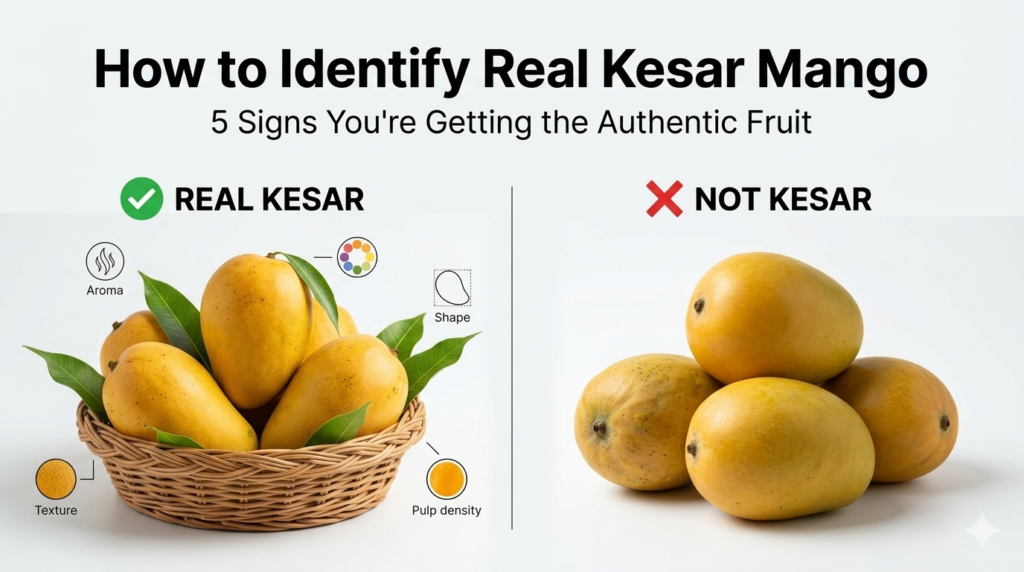
How to Identify Real Kesar Mango:
5 Signs You’re Getting the Authentic Fruit
Stop paying premium prices for sub-standard imitations. Here’s exactly what a genuine Kesar mango looks, smells, feels, and tastes like — and what the fakes get wrong every single time.
This happens every single mango season, to millions of buyers across India. The Kesar mango’s reputation is so powerful that vendors all over the country slap the name on whatever they’re selling — other regional varieties, artificially ripened ordinary mangoes, or early-season fruit that was never going to develop proper Kesar characteristics. And most buyers, without a clear reference point for what genuine Kesar looks and tastes like, have no way to tell the difference.
That changes today. We’re going to walk through five definitive signs of an authentic Kesar mango — the ones that no imitation can fake, and the ones that separate a real Queen of Mangoes from an imposter wearing her crown.
👑 Why Does This Even Matter? The Stakes Are Real
You might be thinking — it’s just a mango, right? Does it matter that much which variety it actually is? The honest answer is yes, it matters enormously. Here’s why.
The Kesar mango is GI-tagged (Geographical Indication) — a legal certification granted in 2011 by the GI Registry in Chennai, making it the first agricultural product from Gujarat and the second mango variety in India to receive this honour. That GI tag means that only mangoes grown in the Junagadh and Amreli districts of Gujarat, in the Gir region’s specific microclimate and soil conditions, can legally be called “Gir Kesar.” Every other mango, no matter how similar it looks, is an impersonation.
Under India’s Geographical Indications of Goods (Registration and Protection) Act, 1999, selling a non-Gir mango as “Gir Kesar” is a legal violation — similar to selling French Champagne made in Rajasthan. Yet the practice is rampant in markets across India. When you know what to look for, you protect yourself legally, financially, and gastronomically.
When you buy genuine Kesar, you’re not just buying a mango. You’re buying into nearly a century of cultivation history — a variety that was first grown in 1931 in the Junagadh Laal Dori farm, named in 1934 by the Nawab of Junagadh after seeing its glowing saffron pulp, and perfected by generations of Gujarati farmers who learned to work with the specific red soil, the semi-arid climate, and the Girnar mountain air of Saurashtra. That terroir — that specific combination of place, soil, and climate — produces something genuinely unique. No amount of mislabelling can replicate it.
Ready? Let’s go through the five signs one by one. Each one is a test you can do yourself, at the market, online, or the moment your delivery box arrives.
👃 Sign 1: The Fragrance That Fills the Room
An Authentic Kesar Announces Itself Before You Cut It
Here’s a question: have you ever walked into a room, and there’s a ripe mango somewhere in it, and you can smell it before you see it? That’s a Kesar mango. That is one of its most distinctive and unimitable characteristics — the fragrance is so powerful, so specific, and so deeply aromatic that experienced Kesar buyers often check this before they look at anything else.
A genuine, ripe Kesar mango has a fragrance that mango enthusiasts describe as deep, floral, saffron-sweet, and intensely tropical — a scent that’s layered and complex, not just “sweet.” When you hold a ripe Kesar near your nose and smell near the stem end, it should hit you immediately and unmistakably. The AamKesari guide on authentic Gir Kesar notes: “If a mango claimed to be Kesar lacks this powerful scent when ripe, question its authenticity.” They’re right. That one sentence is the whole test.
The fragrance of a Kesar mango is the direct product of its terroir — the unique combination of Junagadh’s red laterite soil, the dry Saurashtra heat, and the Girnar foothills air develops aromatic compounds in the fruit that simply cannot be replicated by growing the same variety elsewhere, let alone by growing a completely different variety and labelling it “Kesar.”
Pick up the mango and hold it 2–3 inches from your nose. Don’t sniff — just breathe normally. Within one or two breaths, a genuine ripe Kesar should register powerfully. If you have to press your nose right against the skin to detect anything, or if the smell is mild and generic, it’s likely not Kesar — or it’s not ripe yet. Try the stem end specifically; that’s where aroma compounds concentrate most strongly.
🧡 Sign 2: The Saffron Pulp — The Colour That Named the Mango
Cut It Open and Look for the Colour That Gave It Its Name
The name “Kesar” literally means saffron in both Hindi and Gujarati. The Nawab of Junagadh didn’t name it after the spice randomly — he named it because the pulp’s colour reminded him of the deep golden-orange glow of saffron threads. That colour is non-negotiable in a real Kesar. It’s the mango’s identity.
Slice open a genuine ripe Kesar and what greets you is a pulp that’s deep saffron-orange — vivid, vibrant, consistent, and almost luminous. It’s not pale yellow. It’s not light orange. It’s a rich, saturated saffron colour that goes all the way through the fruit without fading toward the seed. This colour develops specifically because of the mineral composition of Junagadh’s soil and the intense heat of Saurashtra’s summer — both of which concentrate carotenoids (the pigments responsible for orange colour) at levels that other growing environments simply don’t produce in the same way.
Kirshijagran’s mango identification guide puts it plainly: the Kesar mango’s most identifiable feature after its fragrance is its “saffron or Kesari-colored pulp.” If the pulp is anything other than that characteristic deep saffron-orange, the mango in your hand is not authentic Kesar — regardless of what the label says.
An authentic Kesar is also almost completely fiberless. The pulp is so smooth it glides against the seed. Varieties that are misrepresented as Kesar often have visible strings or fibers in the flesh — that’s a dead giveaway. A genuine Kesar, whether from Gir or from the Valsad coastal belt, has minimal-to-zero fiber. Slice it and the cut surface looks like polished, glossy saffron — not stringy or textured.
When ordering Kesar mangoes online, ask the seller for a photo of the cut pulp — or check their gallery for pulp photos. A legitimate farm-direct brand will proudly show you exactly what the inside of their mangoes looks like. If a seller is coy about showing pulp photos, that tells you something. At Vanamrit, the iconic “Kesari” saffron hue is literally listed as one of our core quality signatures.
The Saffron Colour, The Fragrance, The Farm — Verified.
At Vanamrit, every mango we ship from our Valsad orchard is a genuine Kesar — with that signature deep saffron pulp, the room-filling fragrance, and the smooth fiberless texture that defines the real Queen of Mangoes. No mislabelling. No market middlemen. Direct from our farm to your door.
Order Authentic Valsad Kesar at vanamrit.in →📐 Sign 3: Shape, Size & That Distinctive Curved Tip
Kesar Has a Specific Shape That Most Buyers Overlook
Mango buyers tend to fixate on colour and fragrance — which are the two most important signs — but shape is a useful secondary confirmation, especially when buying in bulk or at a market where you can’t always smell every single mango in the crate.
A genuine Kesar mango is small to medium in size with a roundish, slightly oblong shape and a distinct curved tip. According to the Good Fruit Guide’s description of Kesar: it’s “a small to medium fruit with a roundish shape and a distinct curved tip.” That curved tip — sometimes described as a gentle beak — is a consistent feature of the variety. The mango isn’t perfectly oval like an Alphonso. It has a characteristic gentle curvature toward the tip that experienced buyers learn to recognise immediately.
What does genuine Kesar not look like? It’s not the large, oblong, smooth-skinned variety you might associate with Banganapalli. It’s not perfectly round and symmetrical like a Rajapuri. And it doesn’t have the sharp, prominent beak tip of a Totapuri. Kesar is its own specific shape — the roundish-medium body with that gentle curved tip is one of nature’s consistency tests for the variety.
The red blush at the shoulders deserves special mention. When Kesar is at or near peak ripeness, many fruits develop a gentle reddish tinge at the shoulders — the area closest to the stem where the fruit attaches to the tree. This reddish colouration against the golden-yellow skin is one of the variety’s characteristic visual signatures and is noted in multiple identification guides including Curly Tales’ mango guide: “greener skin with a tinge of red on the shoulders.” It’s not always prominent, but when it’s present, it’s a positive authentication sign.
Beware of oversized “Kesar” mangoes. A genuine Kesar is medium-sized — typically 200–300g per fruit. If a vendor is showing you unusually large fruits and calling them Kesar, they may be selling Rajapuri (which is large and similar-skinned) or a generic Gujarat variety. You can tell by checking all five signs together — shape alone isn’t enough, but consistent oversizing is a flag worth noting.
👅 Sign 4: The Taste Profile — Sweet, Balanced, With That Signature Tang
An Authentic Kesar Has a Flavour That’s Balanced, Not Just Sweet
If you’ve never had a genuinely authentic Kesar before, let me describe what you should experience when you eat one at peak ripeness — because knowing the target flavour profile is how you detect when something’s off.
A real Kesar is intensely sweet — but it’s not just sweet. There’s a layered complexity to its flavour that separates it from ordinary mangoes. The Good Fruit Guide describes it as: “a deep yellow-orange flesh, smooth and fragrant with intense sweetness when they are in peak condition. There can be a slight acid edge to the flavour in less mature fruit.” That slight acidity — that gentle hint of tartness that sits underneath the sweetness — is not a defect. It’s a feature. It’s the flavour signature that makes Kesar more interesting and sophisticated than a one-note sweet mango.
In practical terms: when you eat a real Kesar, the first sensation is intense sweetness that coats your whole mouth. Then, almost immediately, there’s a subtle tangy brightness that cuts through and lifts the flavour. Then the aftertaste — which lingers for a surprisingly long time and carries that characteristic saffron-like warmth. The Berrydale Foods ripeness guide captures it well: “rely on the squeeze test. If it feels soft and smells like saffron (Kesar), it is ready to eat.”
The taste of a genuine Kesar is also the product of its soil. Junagadh’s orchards benefit from naturally mineral-rich red laterite soil that concentrates nutrients and flavour compounds in ways that alluvial or sandy soils in other regions don’t replicate. When you buy genuine Kesar from a trusted source — whether Gir Kesar from Saurashtra or Valsad Kesar from South Gujarat — that complexity in the flavour is your guarantee of authenticity. Ordinary mangoes or poorly-grown imitations simply taste flat by comparison.
Looking for authentic Kesar to experience this for yourself? Shop Vanamrit’s Valsad Kesar here — our farm-fresh mangoes are harvested at peak maturity and naturally ripened, so the flavour you taste is exactly what the mango is capable of at its best.
🌱 Sign 5: The Origin and Source — The Most Important Sign of All
Where Your Mango Comes From Is Everything
Here’s the uncomfortable truth that I want you to sit with for a moment. All four signs above — the fragrance, the saffron pulp, the shape, and the taste — can only exist in an authentic Kesar if the mango was actually grown and harvested the right way, in the right place, at the right time. You can apply every sensory test in this guide and still get fooled if you’re buying from a source that has no incentive to tell you the truth.
This is where Sign 5 becomes the most powerful authenticator of them all. Knowing your source is the only test that works 100% of the time, before the mango even arrives.
A genuine Kesar mango — whether Gir Kesar from the Saurashtra belt or Valsad Kesar from South Gujarat — comes with traceable provenance. You should be able to answer these questions about any Kesar you buy:
- Which district was it grown in? For Gir Kesar: Junagadh or Amreli (Gir-Somnath). For Valsad Kesar: Valsad, Navsari, or Pardi districts of South Gujarat
- Was it harvested green-mature from the tree? Not picked early and artificially ripened. Green-mature harvest = the mango completed its full development on the tree before being picked
- How was it ripened? Natural room-temperature ripening or traditional hay-bed (penda) method. Not calcium carbide, not ethylene injection chambers for overnight ripening
- Who is the seller? A farm-direct brand with a physical location, verified photos, customer reviews, and transparent supply chain — or a GI-certified APMC market vendor from Talala Gir
- What is the season? Gir Kesar: April to June. Valsad Kesar: May to July. A mango sold as “Kesar” in February or October is definitively not real Kesar
One of the most common ways buyers get deceived is buying “Kesar” outside the actual Kesar season. The Kesar season runs from April to July depending on region. Mangoes sold as Kesar before April or after July are either from a different variety entirely or have been cold-stored to the point where all their flavour has been compromised. If a vendor is selling “Kesar” in January or August, walk away.
The GI tag exists precisely for this reason. Only Kesar grown in the Gir sanctuary area of Junagadh and Amreli can legally carry the “Gir Kesar” name. That’s a legal fact, not a marketing claim. When you buy from a certified source — a GI-registered farm, a verified direct-to-consumer brand, or an APMC-certified market — you’re buying within that protection. When you buy from an anonymous street vendor who can’t tell you anything about where the mango came from, you’re taking a gamble.
Curious about the story behind Vanamrit’s farm and our Valsad sourcing? Our About page explains exactly where every mango we ship comes from — Chikhli, Valsad, South Gujarat — and why the alluvial coastal soil of this region produces a Kesar that’s as magnificent as anything from the Gir heartland.
⚗️ Bonus Sign: Spotting Carbide-Ripened Fake Kesar
We can’t talk about identifying authentic Kesar without addressing the specific problem of chemically ripened mangoes that get mislabelled as Kesar. This happens most frequently in early season (before late April) when genuine Kesar supply is very limited but demand is already high.
Calcium carbide is a banned chemical that unscrupulous vendors use to ripen mangoes overnight. The FSSAI (Food Safety and Standards Authority of India) has issued repeated directives under Regulation 2.3.5 of the Food Safety and Standards Act, 2011, specifically banning its use. A peer-reviewed 2024 study published in Scientific Reports (Nature) confirmed that carbide-ripened mangoes have significantly reduced levels of iron, zinc, copper, and key vitamins compared to naturally ripened ones — meaning they’re not just less delicious, they’re genuinely less nutritious.
- Uniform bright yellow skin with no green at the tip. Natural Kesar ripens unevenly — golden at the shoulders, green tinge at the tip. Carbide produces unnaturally uniform, flat-bright yellow all over
- No fragrance. This is always the biggest tell. Carbide ripening changes the skin colour but cannot replicate the natural aroma development that happens during real ripening. No smell = carbide or imitation
- Soft outside, raw inside. Slice it open: carbide affects only the outer skin. The flesh inside is pale, hard near the seed, and tastes flat or starchy
- Black blotches or white powder residue. Black spots from chemical reaction, or traces of grey-white calcium carbide powder on the skin or in the packaging
- Arrived “ripe” within 1–2 days of harvest. Naturally ripened Kesar takes 3–5 days from harvest to reach eating ripeness. Carbide does it in 24–48 hours. If your mango arrived fully ripe within a day of being picked, something was done to it
The water test is a practical field test: place the mango in a bucket of water. A naturally ripened mango tends to sink (denser, fully developed flesh). A carbide-ripened mango often floats (underdeveloped, hollow interior despite external colour). It’s not a perfect test, but it’s a useful signal alongside the smell and skin checks.
❓ Your Kesar Authentication Questions, Answered
🏁 The Bottom Line: You Now Have a Complete Authentication Toolkit
🥭 Five Signs. One Real Mango.
Let’s bring it all together. A genuine Kesar mango announces itself with a powerful saffron-sweet fragrance before you even cut it. Inside, it reveals deep saffron-orange pulp that’s smooth, fiberless, and vivid all the way through. Its shape is small-to-medium, roundish, with that characteristic gentle curved tip and red blush at the shoulders. Its taste is intensely sweet with a sophisticated tangy brightness and a lingering saffron aftertaste. And most importantly — it comes from a source you can trust, in season, harvested at the right stage and ripened naturally.
These five signs are not independent of each other. They work as a system. A mango that passes all five isn’t just probably Kesar — it is Kesar. And a mango that fails even two of these tests deserves serious questioning before you hand over your money.
The easiest solution, honestly? Buy from a farm-direct source that has staked its reputation on authenticity. Examine our gallery of real Vanamrit Kesar mangoes. Check our About page. Read the testimonials. When you know the source, you don’t need to run five tests — the fruit speaks entirely for itself.
“The real Kesar doesn’t need a label. It announces itself the moment you walk into the room.” 🥭🌿
All 5 Signs Present. Every Single Box.
Every mango we ship from our Valsad orchard is verified authentic Kesar — with the saffron colour, the room-filling fragrance, the smooth fiberless pulp, and the balanced sweet-tangy flavour that defines the real Queen of Mangoes. Farm-direct from Chikhli, Valsad. Naturally ripened in hay. Carbide-free. No middlemen, no mislabelling. Just the real thing.
🥭 Order Authentic Valsad Kesar at vanamrit.inWant to know more before ordering? Contact our team or WhatsApp us at +91 9033595016 — we’re happy to answer any questions about our farm, our mangoes, or how we ensure authenticity season after season.