
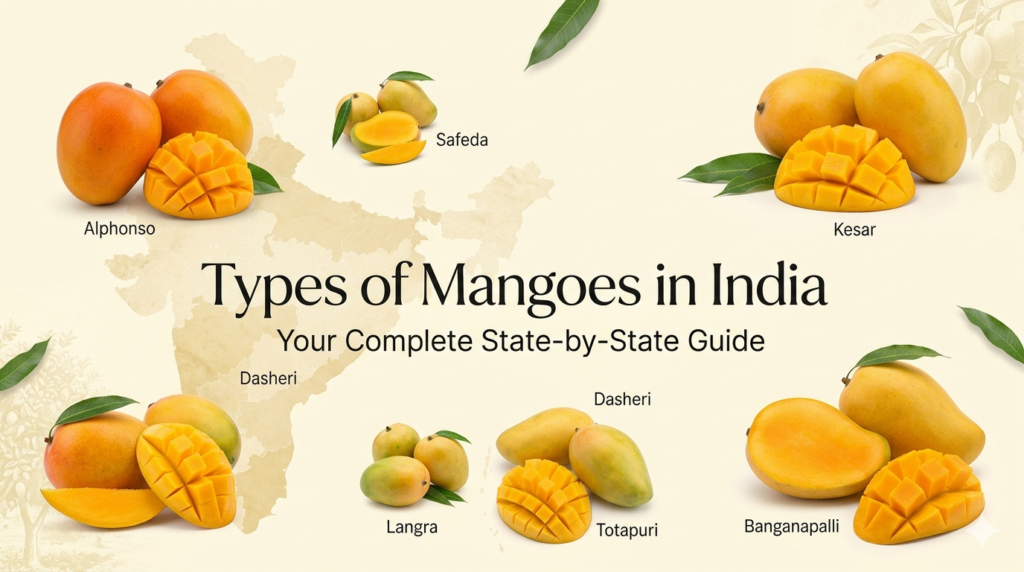
Types of Mangoes in India:
Your Complete State-by-State Guide
Over 1,500 varieties. One incredible country. Here’s everything you need to know about India’s finest mangoes — region, taste, season & more.
Here’s something that’ll blow your mind: India is home to over 1,500 varieties of mangoes — more than any other country on the planet. We grow everything from the creamy, buttery Alphonso of Maharashtra to the fragrant, honey-sweet Himsagar of West Bengal, and from the bold, saffron-coloured Kesar of Gujarat to the massive Fazli of Malda that can weigh over a kilogram. Each one is different. Each one is spectacular.
So if you’ve ever stood at a market stall wondering which mango to pick, or wondered why your Gujarati friend swears by Kesar while your UP friend won’t touch anything except Dasheri — this guide is for you. Let’s take a delicious, state-by-state tour of India’s finest mango varieties.
📜 India and the Mango: A Love Story 5,000 Years in the Making
Before we dive into the varieties, let’s take a quick moment to appreciate how deep this relationship goes. Mango cultivation in India dates back over 5,000 years. The fruit is mentioned in ancient Sanskrit texts and Vedic scriptures, and Buddhist monks are said to have been gifted mango orchards as places of rest during their travels.
Think about the Mughals for a second. Emperor Akbar — yes, the great Akbar — was so obsessed with mangoes that he planted 100,000 mango trees at Lakhi Bagh in Darbhanga. And Sher Shah Suri? He loved his mangoes so much that he named a variety after the town of Chausa in Bihar, where he won a famous battle against Humayun. Even in defeat, Humayun apparently had to enjoy Sher Shah’s mangoes. Now that’s a power move.
Then came the Portuguese in the 16th century. They brought a variety to the Konkan coast and named it after one of their own — Alfonso de Albuquerque, the Portuguese governor. Today we call it Alphonso, or “Hapus” in Marathi, and it’s arguably the most famous mango in the world.
India produces approximately 22 million metric tonnes of mangoes annually (as per NHB & Ministry of Agriculture data for 2023–24), contributing nearly 45% of total global mango production. Major export markets include UAE, UK, Saudi Arabia, Qatar, Bangladesh, and the USA. And yet, most of this treasure stays right here in India — consumed fresh, made into pulp, turned into pickles, shrikhand, aamras, ice cream, and about a thousand other things.
The reason India has such mind-boggling mango diversity is simple: we have everything. Hot, arid land in Gujarat. Humid coastal belts in Maharashtra and Kerala. Fertile river plains in UP and Bihar. Subtropical highlands in the Northeast. Each microclimate shapes a mango differently — same way terroir shapes wine grapes. The result is a fruit that tastes different in every state, on every farm, in every season.
Experience Farm-Fresh Valsad Kesar Mango
At Vanamrit, we grow the finest Kesar mangoes on our own farm in Valsad, South Gujarat — naturally ripened, carbide-free, and harvested at peak sweetness. No middlemen. No shortcuts. Just pure mango goodness, delivered to your doorstep.
Order Farm-Fresh Mangoes →🟡 Western India: Where the Queen and King Both Live
Let’s start in the west — specifically in Gujarat and Maharashtra, two states that together have probably sparked more mango arguments than any other region in India. This is the land of the Alphonso and the Kesar, two varieties so celebrated that they’ve been given Geographical Indication (GI) tags to protect their identity. Think of it like Champagne — not every sparkling wine can call itself Champagne, and not every saffron-pulp mango can call itself Gir Kesar.
Alphonso (Hapus)
King of Mangoes. Ratnagiri & Devgad. Creamy, buttery, GI-tagged. Season: April–June.
Kesar (Gir Kesar)
Queen of Mangoes. Junagadh. Saffron pulp, GI-tagged 2011. Season: April–June.
Rajapuri
Large, sweet-tart. Jamnagar. Used for aam papad & pickles. Season: May–July.
Payri (Pairi)
The season starter. Small, sweet, fibrous. First mango each year. Season: March–April.
Bite into a ripe Alphonso and you’ll understand the obsession immediately. The flesh is saffron-orange and so buttery that it practically melts before you’ve finished chewing. There’s no fiber, barely any seed, and an aroma so powerful it’ll fill the kitchen the moment you peel it. It’s the most exported Indian mango variety and a staple in Indian desserts like shrikhand, aamrakhand, and of course, the classic mango milkshake.
But here’s what many people don’t know: Kesar is also grown extensively in South Gujarat’s Valsad, Navsari, and Pardi belt — and this coastal Kesar has its own beautiful flavour profile. Vanamrit’s farm is right in this belt, and our Valsad Kesar is celebrated for its exceptional sweetness, smooth golden pulp, and a slightly extended season that lasts into July. Think of it this way: if Gir Kesar is bold and intense like an espresso, Valsad Kesar is smooth and rich like a perfectly brewed filter coffee.
Other notable western varieties include Rajapuri — a large, sweet-tart variety from Gujarat beloved for making aam papad (dried mango sheets) and pickles — and Payri (Pairi), the tiny early-season mango that arrives in March when everyone is still waiting for the “real” season to begin. Don’t underestimate Payri — its intensely sweet flavour packs a punch far bigger than its size.
🟠 Northern India: Where Mangoes Have Royal Pedigrees
If there’s one region in India where mango culture runs deepest, it’s North India — specifically Uttar Pradesh and Bihar. This is the land of Nawabs and Mughal courts, where specific mango varieties were cultivated for centuries and treated with the reverence of royal heirlooms. Some of the world’s most celebrated mango varieties come from the dusty plains of UP and Bihar, and locals will defend their favourites with a passion that would make a cricket fan blush.
Dasheri
Lucknow’s nectar. Fiberless, honey-sweet, fragrant. Season: June–August.
Langra
Green even when ripe. Varanasi’s tangy-sweet legend. Season: June–July.
Chausa (Chaunsa)
“Chusne wala aam.” Honey-rich, highest Vitamin C. Season: July–August.
Zardalu
Golden, fragrant, GI-tagged. Royalty in a fruit. Season: June–July.
Today, Malihabad near Lucknow is arguably the mango capital of India in terms of variety and volume. The Dasheri is its crown jewel — a long, oval mango with pale greenish-yellow skin, impossibly sweet flesh with no fiber, and an aroma that’s light, floral, and completely addictive. It received GI status in 2010. North Indians describe eating a ripe Dasheri as drinking nectar — and honestly, they’re not wrong.
What makes Langra really distinctive is its skin: it stays green even when fully ripe. First-time buyers often make the mistake of thinking an unripe green Langra is unripe. It’s not. Smell it near the stem — if it smells sweetly intoxicating, it’s ready. The flavour is a gorgeous sweet-tart balance with a slight acidity that makes it refreshing rather than cloying. It’s one of the most widely sold mangoes across North India and Bengal.
The story goes that Sher Shah Suri named this mango after the town of Chausa in Bihar, where he defeated Mughal Emperor Humayun in 1539. Named after a battle, eaten like honey — that’s the Chausa for you. It’s also notable for having higher Vitamin C content than most other mango varieties. Available later in the season (July–August), it’s the sweet reward for those who keep waiting even after the peak season crowds have gone.
Zardalu (Bhagalpuri Zardalu) — once reserved for royals, now a government gift. Grown in Bhagalpur, Bihar, this GI-tagged mango has lemon-yellow skin and a fragrance so powerful it announces itself before you cut it. Small in size, enormous in reputation. It was traditionally offered to kings and state guests, and even today, Bhagalpur’s Zardalu graces official government gift hampers during mango season. It remains Bihar’s most fragrant gift to India’s mango lovers.
🟢 Southern India: The Mango Powerhouse Nobody Talks About Enough
Ask a North Indian about South Indian mangoes and you might get a blank stare. Ask a South Indian, and they’ll pull up a chair and talk for two hours. South India is an absolute mango powerhouse — and it’s home to some of the most commercially important varieties in the world, varieties that fill juice cartons globally, pulp factories in AP, and mango pickle jars in every Indian home.
Banganapalli (Safeda)
AP’s official fruit. GI-tagged 2017. Large, golden, fiberless. Season: May–June.
Totapuri
Parrot-beak shape. Tangy, versatile. #1 processing mango India. Season: May–July.
Neelam
Long shelf life. Vibrant, fragrant. Excellent for export. Season: June–July.
Raspuri
Mysore’s sweet gem. Rivals Alphonso when perfectly ripe. Season: May–June.
What makes Banganapalli special is its generous size — these mangoes are large, often 350–400 grams, with thin skin, minimal fiber, and a clean, sweet flavour that’s never overpowering. They’re also one of the earliest mangoes to hit markets each season, appearing as early as April when most other varieties are still weeks away. Their long shelf life makes them a top export variety, and they’re widely available in Indian markets from Mumbai to Delhi throughout May and June.
Named “Totapuri” for its distinctive beak-shaped tip (Tota = parrot in Telugu), this elongated, greenish-yellow mango isn’t the sweetest variety on its own — but its firm flesh, high pulp yield, and tangy flavour make it India’s most commercially processed mango variety. It’s also the dominant variety in raw mango salads and pickles across South India. Don’t overlook it for fresh eating either — slice it, sprinkle some chilli salt, and you’ve got one of summer’s best snacks.
Karnataka’s Raspuri deserves a special mention here. Grown around Mysore, Bangalore, and Kolar, this oval, juicy variety is sometimes called the “Queen of Karnataka.” At peak ripeness in May–June, a perfectly ripe Raspuri is so sweet and juicy that Karnataka folks will tell you it gives even Alphonso serious competition. And then there’s Imam Pasand (Himayuddin) from Telangana and AP — rare, exclusive, large, and often described as one of India’s finest table mangoes. You’ll rarely find it in a market; it tends to stay in the orchards of those who know.
🔵 Eastern India: Bengal’s Mango Royalty
West Bengal doesn’t just play cricket and make mishti doi. It also grows some of the most exquisite, deeply prized mangoes in the entire country — and if you haven’t had a Himsagar, I genuinely feel sorry for you. The Malda district of West Bengal is a mango district unlike any other. Families here have been tending mango orchards for generations, and some trees are over a hundred years old.
Because Himsagar isn’t widely exported and its season is so short, it remains one of India’s best-kept secrets outside of Bengal. If you’re in Kolkata in late May, drop everything and find a Himsagar. You can thank me later.
Bengal’s other gems include Kishan Bhog (Kishen Bhog) — one of the oldest heirloom varieties from Malda, sweet and deeply aromatic — and Fazli, nicknamed the “Elephant Mango” because individual fruits can weigh over a kilogram. Fazli is a late-season variety (July–August) and is more mildly sweet than Himsagar, but its size and juiciness make it a unique experience.
There’s also Amrapali — a carefully developed hybrid created by IARI scientists by crossing Dasheri (UP) and Neelam (Tamil Nadu). It has vibrant deep-yellow to orange flesh, a beautiful fragrance, and is grown right across India. Think of it as the best of North and South India in a single fruit.
🌺 Other Regions: Hidden Gems Across the Map
India’s mango story doesn’t end with the well-known states. Some of the country’s most unique and cherished varieties come from places you might not expect.
Goa’s Mankurad (Mancurad) is a perfect example. Small, reddish-hued, and packed with an intense sweet-sour flavour, this is Goa’s most loved mango — and Goans will tell you it’s better than Alphonso. The name supposedly comes from the Portuguese word “malcorado” (poorly coloured) — which is deeply ironic, because its unusual reddish hue is exactly what makes it visually distinctive. This variety reflects the spirited culture of the region and remains a local favourite and a point of pride.
Mallika is another variety worth knowing — a hybrid of Neelam and Dasheri developed by IARI scientists. It has excellent shelf life, strong fragrance, and rich sweet flavour, making it increasingly popular both for export and as a table variety across India. And if you ever come across Gulabkhas from Bihar and UP — a mango named for its rose-like (gulab) fragrance — stop everything and buy a dozen. It’s one of India’s most fragrant varieties and genuinely one of the most unique sensory experiences the Indian mango world has to offer.
📊 The Master Reference: India’s Top 20 Mangoes at a Glance
Here’s your complete cheat sheet. Save this, print it, share it — whatever helps you navigate the market stalls this summer.
| Variety | State / Region | Season | Taste Profile | Best Use | GI Tag |
|---|---|---|---|---|---|
| Alphonso (Hapus) | Maharashtra | April–June | Rich, buttery, sweet | Desserts, export, fresh | ✓ Yes |
| Kesar (Gir Kesar) | Gujarat | April–July | Sweet, saffron, aromatic | Aamras, shrikhand, ice cream | ✓ Yes (2011) |
| Dasheri | UP (Lucknow) | June–August | Nectar-sweet, floral | Fresh eating, drinks | ✓ Yes (2010) |
| Langra | UP (Varanasi) | June–July | Sweet-tangy, aromatic | Fresh, salads, lassi | Regional |
| Chausa (Chaunsa) | Bihar / UP | July–August | Honey-sweet, rich | Fresh sucking, desserts | Regional |
| Banganapalli | Andhra Pradesh | April–June | Sweet, juicy, mild | Slicing, juices, export | ✓ Yes (2017) |
| Totapuri | AP / Karnataka / TN | May–July | Tangy, firm, less sweet | Pickles, pulp, processing | — |
| Neelam | Tamil Nadu / AP | June–July | Sweet-sour, fragrant | Export, processing | — |
| Raspuri | Karnataka (Mysore) | May–June | Juicy, sweet, mild tang | Fresh, ice cream | — |
| Imam Pasand | Telangana / AP | May–June | Rich, unique aftertaste | Premium fresh eating | — |
| Himsagar | West Bengal | May–June | Intensely sweet, creamy | Fresh eating only | ✓ Yes |
| Kishan Bhog | West Bengal (Malda) | June–July | Sweet, aromatic, heirloom | Fresh eating, gifting | ✓ Yes |
| Fazli | West Bengal (Malda) | July–August | Mildly sweet, massive | Fresh, smoothies | — |
| Zardalu | Bihar (Bhagalpur) | June–July | Fragrant, rich, sweet | Fresh eating, gifting | ✓ Yes |
| Amrapali (Hybrid) | Pan-India (IARI) | July–August | Rich, aromatic, sweet | Fresh, table variety | — |
| Mallika (Hybrid) | Pan-India (IARI) | June–July | Strong fragrance, firm | Export, processing | — |
| Mankurad | Goa | May–June | Sweet-sour, intense | Local fresh eating | ✓ Yes |
| Rajapuri | Gujarat | May–July | Sweet-tart, large | Pickles, aam papad | — |
| Badami | Karnataka | April–July | Sweet, creamy | Juice, fresh eating | — |
| Gulabkhas | Bihar / UP | June–July | Rose-fragrant, sweet | Gifting, fresh eating | — |
🏷️ India’s GI-Tagged Mangoes: The Hall of Fame
You’ve heard the term “GI tag” a few times in this article. Let me explain exactly what it means — because it matters more than you might think when you’re standing at a fruit stall deciding how much to pay.
A Geographical Indication (GI) tag is a legal certification that a product is genuinely from a specific geographic region and has qualities or a reputation directly linked to that origin. It’s the same concept as Champagne from France, Darjeeling tea from West Bengal, or Basmati rice from the Indo-Gangetic plains. Once a mango variety gets a GI tag, nobody outside that specific region can legally sell their mangoes under that name.
Why does this matter to you as a buyer? Because every year, particularly for premium varieties like Alphonso and Gir Kesar, unscrupulous sellers label cheaper mangoes from other regions as the GI-protected variety to charge a higher price. If you’re paying Alphonso prices, you deserve Ratnagiri Alphonso — not a similar-looking variety from elsewhere.
India’s key GI-tagged mango varieties include: Alphonso (Maharashtra), Gir Kesar (Gujarat, 2011), Banganapalli (Andhra Pradesh, 2017), Malihabadi Dasheri (Uttar Pradesh, 2010), Zardalu / Bhagalpuri Zardalu (Bihar), Himsagar and Kishan Bhog (West Bengal), and Mankurad (Goa), among others. Always look for GI certification on packaging or buy from certified, reputed farm-direct sources.
📅 When to Buy Which Mango: The Season Calendar
One of the most common questions I hear is: “When should I buy mangoes?” The answer isn’t one month — it’s a journey that runs from March all the way to August, with a different star variety shining in each phase.
A pro tip: don’t always rush to buy in the very first week of the season. The best flavour typically develops a week or two into each variety’s season, when the trees have found their rhythm and the weather has properly warmed up. Similarly, the last two weeks of a variety’s season sometimes offer the most intensely flavoured fruit — the trees are pouring everything into their final batch.
💊 What’s Actually Inside a Mango? The Nutrition Story
We love mangoes for the taste. But here’s a nice bonus: they’re genuinely good for you. Every 100g of ripe mango gives you roughly:
That deep orange-saffron colour you see in varieties like Alphonso and Kesar? That’s beta-carotene — a powerful antioxidant that the body converts into Vitamin A, supporting healthy eyesight, skin, and immune function. Mangoes also contain digestive enzymes called amylase, which help break down complex starches and explain why eating a ripe mango after a meal is such a deeply-rooted Indian tradition. Your ancestors were right — it actually helps digestion.
And with 83% water content, mangoes are one of the most hydrating fruits you can eat in the blazing Indian summer. Think of every mango as a hydration bomb wrapped in sweetness.
🍽️ Which Mango for Which Purpose?
Different varieties shine in different contexts. Here’s a quick guide to matching the mango to the moment:
- Aamras & Shrikhand (Amrakhand): Alphonso or Kesar — their intense flavour holds up beautifully against the richness of these traditional Gujarat-Maharashtrian dishes
- Mango Lassi & Smoothies: Kesar, Dasheri, or Banganapalli — smooth pulp that blends silkily without overpowering dairy
- Fresh Eating (straight from the hand): Himsagar, Chausa, Dasheri, Alphonso — these are the mango equivalents of fine wine; eat them unadorned
- Mango Ice Cream & Kulfi: Alphonso or Kesar pulp — their concentrated, aromatic sweetness survives freezing beautifully
- Raw Mango Pickle (Achar): Totapuri, Rajapuri, or raw Langra — firm flesh, high tartness, perfect acidity for long-preserved pickles
- Mango Pulp for Juices & Export: Alphonso, Totapuri, Kesar, Banganapalli — highest pulp yield and consistent flavour for processing
- Gifting & Premium Hampers: Alphonso, Gir Kesar, Zardalu, Himsagar — the prestige varieties that tell someone they’re special
- Extended Season (July onwards): Chausa, Fazli, Amrapali — for those who refuse to let mango season end gracefully
🛒 How to Buy a Good Mango: A Beginner’s Cheat Sheet
You’re at the market. There’s a pile of mangoes in front of you. How do you pick the right one? Here’s what I’ve learned from years of mango hunting in Valsad’s orchards and markets:
- Smell first, always. A ripe mango has a sweet, honey-like fragrance near the stem end. If it smells like nothing, it’s not ready or it’s been chemically ripened
- Don’t judge by colour alone. Langra stays green when ripe. Banganapalli turns golden. Alphonso gets red-blushed shoulders. Each variety has its own colour cue — learn the variety-specific signals
- Gentle press test. A ripe mango gives slightly when you press near the stem — like a ripe avocado. If it’s rock solid, wait a day or two. If it’s mushy, it’s overripe
- Beware of carbide-ripened mangoes. Uniform, unnatural bright yellow with no aroma and watery, tasteless pulp — these are signs of calcium carbide artificial ripening. Naturally ripened mangoes ripen from the stem end outward and smell intensely sweet
- Buy in-season. The same variety bought at peak season tastes dramatically better than the same variety bought a week before or after
- Buy farm-direct when possible. Farm-fresh mangoes delivered directly from the orchard — like those from Vanamrit — skip cold storage and middlemen, which means better taste and longer shelf life after delivery
100% Carbide-Free. Farm-Direct. Naturally Ripened.
At Vanamrit, every mango we deliver is grown on our own farm in Valsad, South Gujarat — harvested by hand at peak maturity and shipped directly to you. No carbide. No cold storage games. No middlemen. Just the real taste of a mango that grew the way nature intended it to — in rich South Gujarat soil, with coastal sunshine and sea air. That difference is something you can taste in every single bite.
🥭 Shop Vanamrit Mangoes at vanamrit.in❓ Your Mango Questions, Answered
🏁 The Final Word: India’s Mango Story Is Really Your Story
🥭 Every Mango Is a Region’s Soul in Fruit Form
Here’s the thing about India’s mangoes: they’re not just fruit. They’re geography, history, and culture in edible form. When you eat a Dasheri, you’re tasting the Nawabi culture of Lucknow. When you eat a Kesar, you’re tasting the sun-soaked soil of the Girnar foothills. When you eat a Himsagar, you’re tasting the fertile, river-fed earth of Bengal’s Malda district. And when you eat a Valsad Kesar from Vanamrit’s farm, you’re tasting the coastal richness of South Gujarat — clean air, loamy soil, and generations of careful cultivation.
Don’t limit yourself to one variety this summer. Try at least three or four. Buy a box of Kesar when it comes into season. Order an Alphonso for the shrikhand. Pick up a Dasheri when the North Indian season peaks in June. Get your hands on a Chausa in August and suck the life out of it like you have absolutely no care in the world.
India has 1,500 types of mangoes. Life is too short to eat just one. 🥭🌿
Loved this guide? Share it with a fellow mango lover — and help them choose their perfect variety this summer.
🌐 Shop farm-fresh Valsad Kesar mangoes: vanamrit.in