
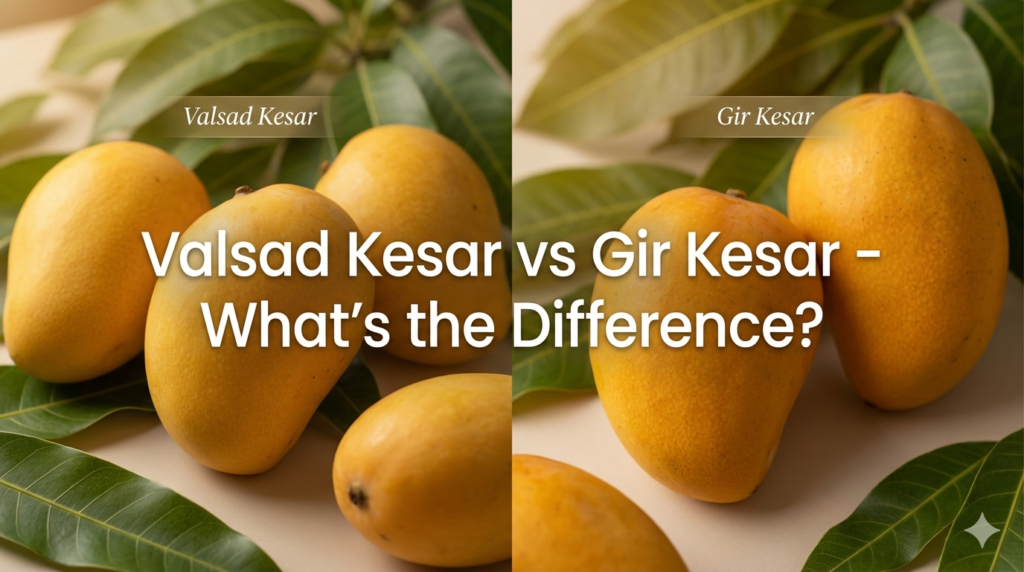
Valsad Kesar vs Gir Kesar Mango:
What’s the Real Difference?
If you’ve ever faced this dilemma, you’re not alone. The Kesar mango is Gujarat’s most beloved variety — celebrated as the “Queen of Mangoes” for its saffron-orange pulp, heavenly sweetness, and signature aroma. But here’s what most people don’t know: the same Kesar variety, when grown in two different regions of Gujarat, develops distinctly different personalities.
In this guide, we break down everything — origin, taste, soil, GI tag, price, season, and which one deserves a place in your home this summer.
🌱 The Birth of the Kesar Mango
To understand the difference between Valsad Kesar and Gir Kesar, we first need to go back to where it all began.
In 1931, a Junagadh state official named Wazir Salé Bhai cultivated a new mango variety at the Junagadh Laal Dori farm in the foothills of the Girnar mountains in Saurashtra. Around 75 grafts were planted, and the fruit that emerged was unlike anything seen before — its pulp glowed a deep, luminous saffron-orange.
In 1934, the Nawab of Junagadh, Muhammad Mahabat Khan III, tasted the fruit and declared — “This is Kesar” — referring to the saffron (kesar) color of its pulp. The name stuck forever. Today, the Kesar mango is known across the world under that very name.
Over the following decades, grafts from the original Kesar trees were distributed to mango farmers across Gujarat. The variety adapted remarkably well to different soils and climates — spreading from the dry, rocky foothills of Saurashtra all the way to the lush, humid coastal belt of South Gujarat. This is how the same Kesar variety came to be grown in two very different environments: Gir in Saurashtra, and Valsad in South Gujarat.
Taste the Finest Valsad Kesar Mango
At Vanamrit, we grow our Kesar mangoes on our own farm in Valsad — using natural, sustainable practices rooted in generations of South Gujarat farming tradition. Every mango is handpicked at peak ripeness and delivered farm-fresh to your doorstep.
Since both Gir Kesar and Valsad Kesar are delivered green-mature, they need a few days to reach their best flavour at home. Not sure how to do that? Our step-by-step guide covers how to ripen mangoes at home using 5 methods that actually work — including the traditional hay (penda) method used by Gujarati farmers.
Order Now at vanamrit.in →🟠 Gir Kesar Mango — The GI-Tagged Original
The Gir Kesar mango is the most prestigious variety of Kesar — and for good reason. It is grown exclusively in the Junagadh and Amreli districts of the Saurashtra region, in the rocky foothills of the Girnar mountain range, close to the famous Gir National Park.
Protected by Law — The GI Tag
In 2011, the Gir Kesar mango received the Geographical Indication (GI) tag from the GI Registry in Chennai. The application was filed in 2010 by Junagadh Agricultural University. This made Gir Kesar the first agricultural product from Gujarat and the second mango variety in India (after Dasheri) to earn this prestigious recognition.
What does this mean for you as a buyer? It means that only mangoes grown in the Gir region can legally be sold under the name “Gir Kesar.” It is a guarantee of geography, authenticity, and quality.
Soil & Climate
The Gir region is characterised by red, laterite-rich soil and a semi-arid climate with relatively low annual rainfall of about 70–80 cm. The mango trees here experience considerable moisture stress during the summer months — and this stress, paradoxically, is what concentrates the sugars, aroma compounds, and flavour intensity in the fruit. The elevated altitude of the Girnar foothills also plays a role in developing the mango’s dense, aromatic pulp.
Taste & Appearance
Gir Kesar mangoes are medium-sized with an oval shape. The skin is green when raw and turns golden-yellow with a distinctive reddish blush on the shoulders when ripe. Slice one open and you’ll find a deep saffron-orange pulp — dense, fiberless, with an intensely sweet flavour balanced by a slight, pleasant tartness. The fragrance is powerful — almost perfume-like — and fills the room the moment you cut the fruit.
Gir Kesar
Saurashtra, Gujarat
Valsad Kesar
South Gujarat
🟡 Valsad Kesar Mango — South Gujarat’s Hidden Gem
While Gir Kesar commands the spotlight, mango lovers in South Gujarat have long cherished another gem: the Valsad Kesar. Grown in the fertile coastal districts of Valsad, Navsari, Pardi, and Surat, this variety has quietly earned a devoted following among those who know it.
The Land That Shapes the Mango
South Gujarat’s coastal belt is a world apart from Saurashtra. The soil here is alluvial and loamy — nutrient-rich and moisture-retentive. The region receives 150–200 cm of rainfall annually, creating a lush, humid microclimate. Mango orchards in Valsad share their landscape with fields growing chickoo (sapodilla), banana, and coconut — a testament to how fertile this land is.
These conditions — abundant moisture, rich soil, and coastal air — give Valsad Kesar its own distinct character. The fruit absorbs the minerals and moisture of the land differently, producing a mango that is slightly larger, more mellow in fragrance, and deeply sweet without the sharp tartness of its Saurashtra cousin.
Just like wine grapes grown in different regions produce different tasting wines, the Kesar mango grown in Gir vs Valsad develops distinct flavour profiles due to differences in soil mineral composition, humidity, altitude, and temperature. This concept is called terroir — and it explains why the same variety tastes different in two regions.
Taste & Texture
Valsad Kesar offers a smooth, honey-like sweetness that is rich without being overpowering. The pulp is a brilliant golden-orange, fiberless, and melts on the tongue. Those who prefer a mango that is sweet-forward — without the tangy contrast — tend to love Valsad Kesar as their go-to variety for eating fresh, blending, or making mango desserts.
Season & Availability
One practical advantage of Valsad Kesar is its extended season. While Gir Kesar peaks in May and is largely off the market by mid-June, Valsad Kesar often stays in season through June and into early July — giving mango lovers a few extra precious weeks to enjoy the Queen of Mangoes.
Timing your purchase around this seasonal difference can save you money and get you the best quality. To plan exactly when to buy, check our complete guide: best time to buy Kesar mangoes in Gujarat.
⚖️ Side-by-Side Comparison: Gir Kesar vs Valsad Kesar
Here’s a complete head-to-head comparison across every key factor that matters to a mango buyer:
| Factor | 🟠 Gir Kesar | 🟡 Valsad Kesar |
|---|---|---|
| Origin | Girnar foothills, Saurashtra | South Gujarat coastal belt |
| Districts | Junagadh & Amreli | Valsad, Navsari, Pardi, Surat |
| GI Tag | ✓ Yes — 2011 | Regional variety |
| Soil Type | Red laterite, rocky, mineral-rich | Alluvial, loamy, coastal fertile |
| Rainfall | ~70–80 cm/year (semi-arid) | 150–200 cm/year (humid coastal) |
| Taste Profile | Intensely sweet, slight tang, bold | Sweet, mellow, honey-smooth, fruity |
| Aroma | Deep, powerful saffron fragrance | Fruity, smooth, lighter fragrance |
| Pulp Color | Deep saffron-orange | Bright golden-orange |
| Fiber | Completely fiberless | Completely fiberless |
| Size | Medium (200–300g typically) | Medium to large |
| Skin | Green → golden-yellow + red blush | Green → full golden-yellow |
| Season | April – June (peak: May) | May – July (extended season) |
| Shelf Life | 8–10 days after natural ripening | Similar; varies by batch |
| Price | ₹900–₹3,500/dozen (premium) | Competitive and accessible |
| Best For | Aamras, shrikhand, gifting | Fresh eating, smoothies, ice cream |
| Export | Major international export variety | Exported; growing market presence |
| Brand Recognition | Very high (GI protected globally) | Strong regionally; growing nationally |
👅 The Taste Test: Is One Actually Better?
The honest answer is: neither is objectively better. They are different expressions of the same variety, shaped by the land they grew in. Choosing between them comes down to your personal flavour preference.
Choose Gir Kesar if you love:
- A bold, complex flavour with a perfect balance of sweetness and slight tang
- An intensely powerful, room-filling aroma that announces itself the moment you peel the fruit
- The prestige of a GI-certified, globally recognised variety
- Traditional Gujarat dishes like aamras and shrikhand where the mango flavour must shine through
- Gifting to family, friends, or business contacts — Gir Kesar has unmatched brand recognition
Choose Valsad Kesar if you love:
- A sweeter, smoother, more mellow mango experience without the sharp tang
- A mango that blends beautifully into lassi, smoothies, and milkshakes
- Extended availability — enjoy your Kesar fix a few weeks longer in summer
- Supporting local South Gujarat farmers and farm-direct produce
- Exceptional value for money — world-class quality at an accessible price
🏷️ The GI Tag — Why It Matters to Every Buyer
A Geographical Indication (GI) tag is a legal certification that protects the name of a product that has a specific geographical origin and possesses qualities or a reputation due to that origin. Think of it like Champagne from France or Darjeeling tea from West Bengal — the name belongs to the region.
For mango buyers, this matters because the market has a problem: many sellers label Valsad Kesar, Kutch Kesar, or even regular Kesar as “Gir Kesar” to command a higher price. If you’re paying a premium for certified Gir Kesar, here’s how to verify it:
- Look for packaging that mentions GI Certified or carries the GI logo
- Buy from APEDA-approved farms or vendors with traceable supply chains
- Purchase directly from Talala Gir Mango Market or registered Gir Kesar cooperatives
- Be sceptical of “Gir Kesar” offered at unusually low prices during peak season
- Buy from farm-direct brands that clearly state their orchard location
The absence of a GI tag does NOT make Valsad Kesar inferior — it simply means it cannot be legally marketed under the “Gir Kesar” brand name. Valsad Kesar is a proudly distinct variety worthy of its own recognition.
No Middlemen. No Chemicals. Just Mangoes.
At Vanamrit, we believe you deserve to know exactly where your food comes from. Our Valsad Kesar mangoes are grown on our own farm, harvested by hand, and shipped directly to you — no carbide ripening, no cold storage delays, no compromises. When you order from Vanamrit, the mango travels from our tree to your table.
Shop Farm-Fresh Mangoes →💊 Nutritional Value — What’s In Every Bite?
Both Gir Kesar and Valsad Kesar share nearly identical nutritional profiles, as they are the same variety grown in different conditions. Here’s what you get in every 100g serving of ripe Kesar mango:
The deep saffron-orange color of Kesar mango pulp is a sign of its high beta-carotene content — a powerful antioxidant that the body converts to Vitamin A. Regular consumption supports healthy eyesight, skin health, and immune function. The combination of Vitamins A, C, E, and B6 makes Kesar mango one of the most nutritionally dense seasonal fruits available in India.
Kesar mangoes also contain digestive enzymes, including amylase, which help break down complex carbohydrates. This is why a ripe Kesar mango eaten after a meal is not just delicious — it actually aids digestion.
🍽️ Best Uses in the Kitchen
Both varieties shine in the kitchen, though their slightly different flavour profiles make them better suited for different preparations:
Traditional Gujarati Dishes
Aamras — the thick, sweetened mango pulp that is the centrepiece of a traditional Gujarati thali in summer — is where Kesar truly belongs. Gir Kesar’s intense aroma and tang make it the traditional choice for aamras. Shrikhand with mango (amrakhand) is another classic where Kesar’s bold flavour enhances the sweetened yoghurt beautifully.
Smoothies, Lassi & Beverages
Valsad Kesar’s smooth, mellow sweetness makes it ideal for mango lassi, smoothies, and milkshakes. The fruit blends to a silky consistency without the sharp tang that can overpower dairy-based drinks.
Desserts & Ice Cream
Both varieties are used commercially to make Kesar mango ice cream — Gujarat’s most iconic summer dessert. The pulp can also be folded into cakes, panna cotta, mousse, or simply spooned over vanilla ice cream for an instant summer treat.
Raw Mango & Pickling
Unripe Kesar mangoes are prized for making keri no athanu (raw mango pickle), raw mango chutney, and kachi keri nu pani (raw mango cooler) — a traditional summer drink beloved across Gujarat.
🛒 Where to Buy & How to Pick the Best
Where to Buy Gir Kesar
- Talala Gir Mango Market Yard — the largest dedicated Kesar market, 45 km from Gir National Park
- APEDA-approved farms and cooperatives in Junagadh and Amreli districts
- Reputed online platforms that carry GI-certified Gir Kesar with traceable sourcing
Where to Buy Valsad Kesar
- Local markets in Valsad, Pardi, Navsari, and Surat — the heart of South Gujarat’s mango belt
- Farm-direct brands like Vanamrit — order online and receive mangoes straight from the orchard
- Major cities: Mumbai, Ahmedabad, and Pune markets stock Valsad Kesar throughout the season
How to Identify a Ripe Kesar Mango
- Skin turns from green to golden-yellow — look for an even colour change
- Gently press near the stem — a ripe mango gives slightly without being mushy
- Smell the stem end — a ripe Kesar has an unmistakable sweet, saffron-like fragrance
- Avoid mangoes that are uniformly bright yellow with no aroma — likely chemically ripened with carbide
- Dark, sunken spots or fermented smell = overripe; skip these
With so many fake Kesar mangoes flooding the market every season, knowing what to look for is essential. Read our detailed guide on how to identify real Kesar mango — 5 signs you’re getting the authentic fruit, before you spend your money.
Naturally Ripened. Freshness Guaranteed.
Vanamrit grows and delivers Valsad Kesar mangoes that are 100% carbide-free, naturally ripened, and harvested at the right maturity. We are a farm-first brand from South Gujarat — rooted in the same fertile soil that gives our Kesar its signature golden sweetness. Experience the difference that honest farming makes — one mango at a time.
🥭 Order Vanamrit Kesar Mangoes❓ Frequently Asked Questions
🏁 The Verdict — Which One Should You Choose?
🟠 Choose Gir Kesar if…
You want the prestige of a GI-certified, globally recognised variety. You love bold, intense mango flavour with a complex aroma. You’re buying for gifting, traditional Gujarati cooking, or to experience the most celebrated version of the Kesar mango.
🟡 Choose Valsad Kesar if…
You want exceptional sweetness and smooth flavour at great value. You love fresh eating, mango-based beverages, and extended seasonal availability. You believe in farm-direct, South Gujarat produce that tells the story of the land it grew in.
Our honest advice? Try both. Buy a box of each. Let your palate decide. Because there is no wrong choice when both options are Kesar. 🥭
Whether you’re team Gir or team Valsad, one thing is certain — every Kesar mango is a gift from Gujarat’s land, sun, and seasons. Eat mindfully, buy from farmers you trust, and savour every golden bite of this magnificent fruit.
Share this article with a fellow mango lover 🥭 — and help them choose their perfect Kesar this season.
🌐 Shop farm-fresh Kesar mangoes at vanamrit.in
Pingback: Kesar Vs Alphonso Mango: The 2026 Comparison That Finally Ends The Debate | Vanamrit