
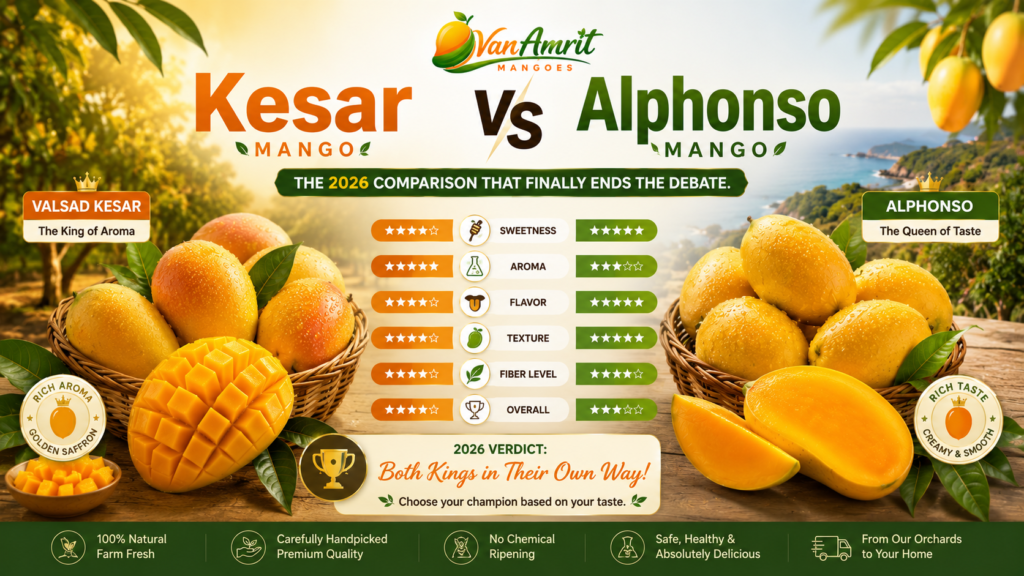
Kesar vs Alphonso Mango:
The 2026 Comparison That Finally Ends the Debate
Two extraordinary mangoes. Two very different personalities. One farm that grows both — and the only comparison that tells you exactly which one to buy and when.
But if you’re standing at the shop trying to decide where to spend your money this mango season, passionate regional loyalty isn’t particularly useful. You need a proper Kesar vs Alphonso comparison — the taste, the Brix, the season, the price, the shelf life, the best use cases, and an honest verdict that actually helps you choose.
Here’s our unique qualification for writing this: Vanamrit grows both Kesar and Alphonso at our Chikhli, Valsad farm in South Gujarat. We have no stake in pushing one over the other. We want you to love whichever you order — and we want you to order the right one.
🟠 Meet Kesar — Gujarat’s Queen of Mangoes
The name Kesar comes from the Gujarati word for saffron — and one look at the pulp tells you why that name was given and never changed. Legend has it that the Nawab of Junagadh gave this mango its name in 1934 after looking at the glowing, burning-orange flesh and simply saying: “This is Kesar.” It got a GI tag protecting its name to the Gir-Somnath and Junagadh districts of Saurashtra, Gujarat, in 2011.
But here’s what most people miss in the Kesar vs Alphonso mango conversation: Kesar isn’t just one mango. It’s a family with two distinct regional personalities. Gir Kesar grows in Saurashtra’s semi-arid Girnar foothills — mineral-rich red laterite soil, dry climate, intense sweetness, sometimes with a slightly sharp finish that makes it feel bolder. Valsad Kesar grows in South Gujarat’s coastal alluvial belt — the same genetic variety, but shaped by 150–200cm of annual rainfall, Arabian Sea humidity, and a different soil chemistry entirely. The result is slightly mellower, deeper sweetness, and a season that extends 3–4 weeks longer than Gir Kesar.
Vanamrit grows Valsad Kesar. Which means when you order from us in June or early July — long after Gir Kesar has wound down — you’re still getting genuinely peak-season naturally ripened Kesar from our own orchard.
- Origin: Gujarat — Gir/Saurashtra + Valsad coastal belt
- GI Tag: Yes (Gir Kesar, Junagadh/Gir-Somnath district)
- Brix: 18–20° average at peak (FarmSe 2026 data)
- Pulp: Deep saffron-orange, fiberless, clean
- Fragrance: Floral, saffron-sweet, room-filling
- Season: May–July (Valsad extends to July)
- Shelf life: 15–18 days post-harvest cold chain
- Origin: Ratnagiri/Devgad, Maharashtra + Valsad, Gujarat
- GI Tag: Yes (Ratnagiri & Devgad districts, Maharashtra)
- Brix: 20–22° at peak, up to 24° in premium batches
- Pulp: Golden-saffron, custard-smooth, fiberless
- Fragrance: Rich, tropical, buttery-complex
- Season: Feb–May (Ratnagiri), Apr–July (Valsad)
- Shelf life: 10–12 days post-harvest cold chain
🔵 Meet Alphonso — The King with a Portuguese Name
The Alphonso has one of the more unusual origin stories in Indian food history. It’s named after Afonso de Albuquerque — a 16th-century Portuguese viceroy of India who had nothing to do with mangoes personally, but whose Jesuit missionaries introduced advanced grafting techniques to Indian orchards that eventually produced the Alphonso cultivar. Over centuries, the variety spread from the Konkan coast of Maharashtra down through South Gujarat’s Valsad and Navsari districts. Called “Hapus” in both Gujarati and Marathi — Hapus and Alphonso are the exact same fruit, just named differently depending on where you’re standing in India.
What makes Alphonso the “King of Mangoes” in international markets isn’t just Indian pride — it’s measurable. GI tag Registration #77 is the government-backed guarantee that genuine Ratnagiri Alphonso grows in the unique laterite soil of Ratnagiri, which creates its signature honey-like sweetness. And by Brix measurement — the most objective way to measure natural sugar content — Alphonso mangoes typically register a Brix level of 20–22°, indicating very high natural sugar content. This is a key reason behind their intensely sweet and indulgent flavour profile.
The challenge with Alphonso is its fragility. It’s a mango that rewards you generously for getting the timing right, and punishes you quickly when you miss the window. Alphonso mangoes have a post-harvest shelf life of just 10–12 days under optimal cold chain conditions. That short window is part of why it commands such a premium — availability is genuinely limited even when demand is at its peak.
→ Shop Vanamrit’s Valsad Alphonso — same cultivar, South Gujarat coastal character⚖️ Kesar vs Alphonso — The Complete Side-by-Side Comparison
Before we go deep on each factor, here’s the complete Kesar vs Alphonso comparison in one table. Screenshot this. Share it on WhatsApp before you place an order.
| Factor | 🟠 Kesar Mango | 🔵 Alphonso Mango |
|---|---|---|
| Origin | Gujarat (Gir + Valsad) | Maharashtra (Ratnagiri/Devgad) + Valsad, Gujarat |
| GI Tag | Yes — Gir Kesar (Junagadh/Gir-Somnath) | Yes — Ratnagiri & Devgad (Maharashtra) |
| Brix (Sweetness) | 18–20° at peak — clean, uncomplicated | 20–22°, up to 24° premium — technically higher |
| Pulp Colour | Deep saffron-orange (richer orange tone) | Golden-saffron (warmer golden-yellow tone) |
| Fragrance | Floral, saffron-sweet, penetrating | Rich, buttery-tropical, complex layers |
| Texture | Smooth, juicy, fiberless, lighter mouthfeel | Creamy, buttery, custard-dense, fiberless |
| Acidity | Near-zero — pure honey-sweet, no tang | Moderate — subtle tangy lift at the finish |
| Season 2026 | May–July (Valsad extends to July) | Feb–May (Ratnagiri), Apr–July (Valsad) |
| Price (2026) | ₹150–₹400/kg | ₹400–₹800+/kg (Ratnagiri GI premium) |
| Shelf Life | 15–18 days post-harvest | 10–12 days post-harvest |
| Size | Small-medium (200–250g) | Small-medium (150–200g) |
| Best For | Aamras, fragrance, bulk buying, value | Gourmet fresh eating, premium gifting, desserts |
👃 Taste & Fragrance — The Heart of the Kesar vs Alphonso Debate
Numbers tell you part of the story. The Brix says Alphonso is technically sweeter. But anyone who has eaten a perfectly ripe Kesar at peak season, standing over their kitchen counter with juice running down their wrist, knows that numbers don’t capture what’s actually happening in your mouth.
How Kesar tastes
Kesar’s taste is like a perfectly composed single note — clear, pure, and completely satisfying. The sweetness is honey-clean, with almost no acidity to interrupt it. Kesar is light, honeyed, and floral. The sweetness feels pronounced due to the absence of the sharp tang, giving an overall lighter but equally satisfying sweetness. The fragrance is its most distinctive quality — a room-filling saffron-sweet aroma that you can detect through the skin before you’ve even cut it. This fragrance is what makes Kesar the undisputed choice for aamras — because when you blend it, that saffron-sweetness carries through everything.
How Alphonso tastes
Alphonso is more like a symphony than a single note — there are layers, and you discover new ones the longer you spend with it. The taste is intensely sweet with complex flavour notes including honey, apricot, and subtle floral undertones. That moderate acidity creates a sophisticated tang at the finish that lifts the sweetness rather than competing with it — making the overall experience feel more complex and indulgent. Alphonso is indulgent and complex; Kesar is light, honeyed, and floral.
Here’s the analogy that captures it best: Kesar is a perfect pop song — immediate, joyful, deeply satisfying on every listen. Alphonso is a jazz composition — more complex, more rewarding the longer you spend with it, harder to fully appreciate in a single encounter.
Which fragrance is stronger? Kesar’s fragrance is more penetrating — it announces itself faster and fills the room more immediately. Alphonso’s fragrance is more layered and complex in character. Both are extraordinary; they’re just extraordinary differently.
→ Full Brix guide: which mango is sweetest in India — 2026 comparison🎨 Colour & Appearance — Why the Pulp Is More Important Than the Skin
Both Kesar and Alphonso develop a golden-yellow skin when ripe. Neither should be judged by skin colour alone — and both are routinely faked with carbide treatment that forces the skin to turn yellow without completing the internal ripening.
Cut them open and there’s no ambiguity whatsoever. Kesar’s pulp is a deep, burning saffron-orange — the colour of the best sunsets over the Arabian Sea — vivid and consistent from skin to seed. Alphonso’s pulp is a warmer golden-saffron — deeply coloured but in a more golden-yellow tone rather than the orange-saffron of Kesar. Side by side on a plate, you’d identify them instantly by colour alone.
This colour difference is also a nutritional signal. The deeper the orange in Kesar’s pulp, the more beta-carotene — the carotenoid pigment that your body converts to Vitamin A. Kesar’s intense orange pulp makes it one of the richest sources of beta-carotene among commercial Indian mango varieties. Alphonso has its own carotenoid profile, with its golden tone reflecting a slightly different but still excellent mix of carotenoids.
Kesar is small-to-medium and roundish with a characteristic gentle curved tip — sometimes called a “distinct beak” in variety guides. Alphonso is oval, slightly elongated, with a full rounded shoulder below the stem. Learning these shapes protects you from mislabelled market fruit — both varieties are faked constantly by vendors selling inferior mangoes under premium names.
📅 Season Calendar 2026 — Who’s Available When
Season timing in the Kesar vs Alphonso mango debate matters more than most buyers realise. The “best” mango you can buy right now is almost always the one that’s in peak season — not the one with the better reputation that’s being artificially rushed to market a month early.
Alphonso’s 2026 season: Ratnagiri and Devgad Alphonso runs from mid-February to June, with peak April to May. Alphonso has a relatively short season, typically from April to early June. Its limited availability adds to its exclusivity and premium positioning. Valsad Alphonso runs slightly later — April through June to July — which is exactly the gap Vanamrit’s South Gujarat orchard fills when Maharashtra supplies wind down.
Kesar’s 2026 season: Gir Kesar arrives mid-April with peak May to June. Kesar mangoes arrive slightly later, usually from May to July. They are more widely available during their season and often last longer in the market. Valsad Kesar extends this to July — meaning Vanamrit buyers get 3–4 extra weeks of peak Kesar after Gir supply drops off.
| Month | 🟠 Kesar Availability | 🔵 Alphonso Availability | Notes |
|---|---|---|---|
| Feb–Mar | — | Early Ratnagiri | First Alphonso batches — buy cautiously |
| April | Early Gir Kesar | Alphonso peak begins | Carbide risk highest for Kesar in April |
| May | Gir Kesar peak | Alphonso peak (Ratnagiri) | Both in peak simultaneously — best month to compare |
| June | Valsad Kesar peak | Alphonso winding down | Pivot to Valsad Kesar as Alphonso season ends |
| July | Valsad Kesar extended | — | Only Kesar (Valsad) available in premium segment |
May is the golden overlap month — when both Kesar and Alphonso are simultaneously at or near their peak. If you’ve never eaten them side by side on the same day, that’s exactly what you should do this May. Order a box of each. Set them on the counter together. Do the fragrance test on both. Cut both. Compare the pulp colour. Taste them back to back. That 20-minute exercise will settle this debate for you personally, permanently.
→ Complete 2026 Kesar season guide — week-by-week quality windowsFarm-Direct Kesar & Alphonso — From Our Valsad Orchard
Carbide-free, hay-ripened, and shipped pan-India from Chikhli, Valsad. Order Alphonso (Apr–Jun) and Kesar (May–Jul). Let your kitchen — and your own palate — settle the debate once and for all.
💰 Price Comparison 2026 — Is Alphonso Worth the Premium?
Let’s talk about the money honestly, because the price gap between Kesar and Alphonso mango in 2026 is significant and it deserves a clear explanation.
GI-tagged Ratnagiri Alphonso currently retails at ₹900–₹1,500 per dozen and ₹400–₹800+ per kilogram depending on grade. Premium Kesar retails at ₹150–₹400/kg. That’s consistently a 2–3x price difference. Is it justified?
The premium exists for real, structural reasons — not just marketing. The Alphonso is more expensive due to its global brand reputation as the “King of Mangoes,” its highly restricted geographical growing region (primarily Ratnagiri/Devgad), and its lower yield per tree compared to commercial Kesar farms. Add international export demand — UK, UAE, US, Canada — that creates genuine domestic scarcity during peak season, and the economics become clear.
But does a 2–3x price difference reflect a 2–3x quality gap? That’s where reasonable people disagree. Kesar is relatively more affordable while still being a premium variety. It has strong domestic demand and is also exported, though not at the same scale as Alphonso. For aamras — arguably the most important mango application in Gujarat — Kesar’s deep saffron colour and clean sweetness arguably produces the superior result at a third of the price. For eating fresh, the complexity argument strongly favours Alphonso at those moments when you want maximum indulgence.
If you see “Alphonso” at ₹100–₹120/kg or “Kesar” at ₹80/kg from an anonymous vendor, something is wrong. Either the variety is mislabelled, the ripening method is carbide, or the quality is reject-grade damaged fruit. There is a real cost floor for genuine naturally ripened premium mangoes. Respect it — it signals quality, not greed.
🍽️ Which to Buy and When — Use-Case Guide
The most useful answer to the Kesar vs Alphonso mango question isn’t “which is better” — it’s “which is better for what you’re actually doing.” Here’s the honest breakdown.
Here’s something both varieties share: they’re both substantially better when naturally ripened rather than carbide-treated. A naturally ripened Kesar at 18–20° Brix is dramatically more satisfying than a carbide-rushed Alphonso that never completed its internal sugar development. The variety debate is secondary to the ripening method. Which is exactly why buying from a source with transparent, verifiable farming practices matters as much as which variety you’re ordering.
→ Why natural ripening matters — carbide’s effect on nutrition and taste💊 Nutrition Comparison — What You’re Actually Getting
Both Kesar and Alphonso are genuinely nutritious fruits — not just delicious ones. The comparison here isn’t good vs bad, it’s between two excellent options with different nutritional emphases.
Kesar’s deep saffron-orange pulp is a visual signal of its high beta-carotene content — the carotenoid your body converts to Vitamin A. The deep saffron-orange color of Kesar mango pulp is a sign of its high beta-carotene content — a powerful antioxidant that the body converts to Vitamin A. Regular consumption supports healthy eyesight, skin health, and immune function. The combination of Vitamins A, C, E, and B6 makes Kesar mango one of the most nutritionally dense seasonal fruits available in India.
Alphonso’s higher Brix means more natural sugar per gram — which is relevant for anyone thinking about energy density or glycemic impact. Its Vitamin C content is also notable — the moderate acidity that some tasters find sharp is partly citric acid, which contributes to Alphonso’s Vitamin C profile.
The most important nutritional point applies to both varieties equally: ripening method matters enormously for what you actually absorb. A 2024 peer-reviewed study in Scientific Reports (Nature) confirmed that carbide-ripened mangoes — of any variety — have measurably lower iron, zinc, copper, fibre, and protein than naturally ripened ones. The nutrition you’re paying for in Kesar or Alphonso only exists in the naturally ripened version.
| Nutrient (per 100g ripe mango) | 🟠 Kesar | 🔵 Alphonso |
|---|---|---|
| Calories | 60–65 kcal | 65–70 kcal (higher Brix = slightly more calories) |
| Natural Sugar (Brix proxy) | 18–20° | 20–22° (technically higher) |
| Beta-carotene (Vitamin A) | Higher — deeper orange pigment | High — but less intense orange |
| Vitamin C | High | Slightly higher — moderate acidity contributes |
| Fibre | Moderate (firmer flesh structure) | Lower (extremely soft, near-liquid pulp) |
| Shelf Life Nutrition | Better — 15–18 days, fewer oxidation losses | Lower — 10–12 days, faster degradation |
🔍 How to Spot Fake Kesar and Fake Alphonso at the Market
The Kesar vs Alphonso mango debate has a darker cousin — the Genuine vs Fake debate that every buyer in India navigates constantly. Both varieties are heavily mislabelled, for the same reason: premium price, high demand, and supply chains opaque enough to hide the substitution.
What does real Kesar look like? Roundish shape with that characteristic gentle curved beak at the tip. Deep saffron-orange pulp consistent all the way to the seed. Powerful floral-saffron fragrance before you cut it — hold the stem end to your nose and breathe. Season April–July only. A mango sold as “Kesar” in October is not Kesar. District: Junagadh/Gir-Somnath for Gir Kesar, Valsad/Navsari for Valsad Kesar.
What does real Alphonso look like? Oval shape with a full, rounded shoulder below the stem. Golden-saffron pulp — more golden than the orange-saffron of Kesar. Rich, buttery, layered fragrance — complex rather than the penetrating single-note of Kesar. Season February–July only. Ratnagiri or Devgad district for the GI-tagged benchmark, Valsad for South Gujarat Hapus.
What do both fakes have in common? No aroma whatsoever. Uniform flat yellow skin with no natural colour variation. Pale or white-near-seed pulp when cut — the ripening never reached the interior. A slightly rubbery texture. Bland, almost metallic taste. These are all classic carbide treatment signs, and they apply equally to fake Kesar and fake Alphonso. The fastest test for either: smell the stem end. No smell = walk away, regardless of what the label says.
→ 5 signs of authentic Kesar — the complete identification guide🧊 Storage & Shelf Life — A Key Practical Difference
If you’re buying in bulk for the season, or ordering online and factoring in transit time, the shelf life difference between Kesar and Alphonso in the Kesar vs Alphonso mango comparison matters enormously.
Kesar has a meaningful edge here. For US importers and distributors, shelf life represents perhaps the most important difference. Kesar mangoes can last 15–18 days under optimal cold chain conditions. Alphonso mangoes have a post-harvest shelf life of just 10–12 days. This durability advantage is why Kesar dominates India’s export volume basket — it survives the logistics of pan-India delivery better than Alphonso’s more fragile flesh.
At home, what does this mean practically? When you buy a 5 kg crate of Kesar, you have a comfortable 5–7 day eating window once individual mangoes reach peak ripeness — time to share with family, bring some to neighbours, or freeze the last few as pulp. With Alphonso, the window from peak to overripe is 2–3 days. You need to eat it, share it, or process it faster. That’s not a criticism — that’s just the nature of a very ripe, very soft, very juicy fruit.
For freezing: both Kesar and Alphonso freeze beautifully as pulp when done at peak ripeness. Kesar’s deep saffron colour is exceptionally stable frozen — a bowl of Kesar aamras from the freezer in December is genuinely close to fresh. Alphonso’s most delicate aromatic notes fade slightly with freezing, though the overall flavour remains excellent.
→ Complete storage guide — fridge, freezer, pulp, and crate management❓ Every Kesar vs Alphonso Question — Answered
🌿 The Honest Verdict on Kesar vs Alphonso Mango
Buy Kesar if: You want the most fragrant mango in India. You’re making aamras, shrikhand, lassi, or any traditional Gujarati recipe where Kesar’s saffron colour and clean sweetness defines the dish. You’re buying in volume for the season and need shelf life and storage resilience. You want extraordinary quality at a more accessible price. You’re buying in June or July after Alphonso season has ended. You’re buying for children who prefer clean sweetness.
Buy Alphonso if: You want the most complex, layered mango flavour experience India produces. You’re gifting someone who will recognise and appreciate the GI-tag prestige. You want to eat it fresh, slowly, with full attention — the way a good piece of cheese or wine deserves to be experienced. You’re in March–May and both seasons are running. You want the gourmet dessert mango.
The honest truth: The Kesar vs Alphonso mango debate has lasted decades because both sides are right. These are two different kinds of extraordinary — not a ranking. Buy both this season. Order Alphonso in April or May. Order Kesar in June. Do the side-by-side comparison in your own kitchen. Your palate will tell you exactly where your loyalty lies — and it’ll probably lie in both places, depending on the day.
“Kesar is the mango you fall in love with on first bite. Alphonso is the mango you understand more deeply every time you eat it. Both are worth having.” 🥭🌿
Order Valsad Kesar & Valsad Alphonso — Farm-Direct Pan-India
Same orchard in Chikhli, Valsad. Same carbide-free hay-ripening. Same farm-to-door promise. No middlemen, no shortcuts — just the two greatest mangoes Gujarat grows, at their genuine best.
Bulk gifting or questions? vanamrit.in/contact | WhatsApp: +91 9033595016