
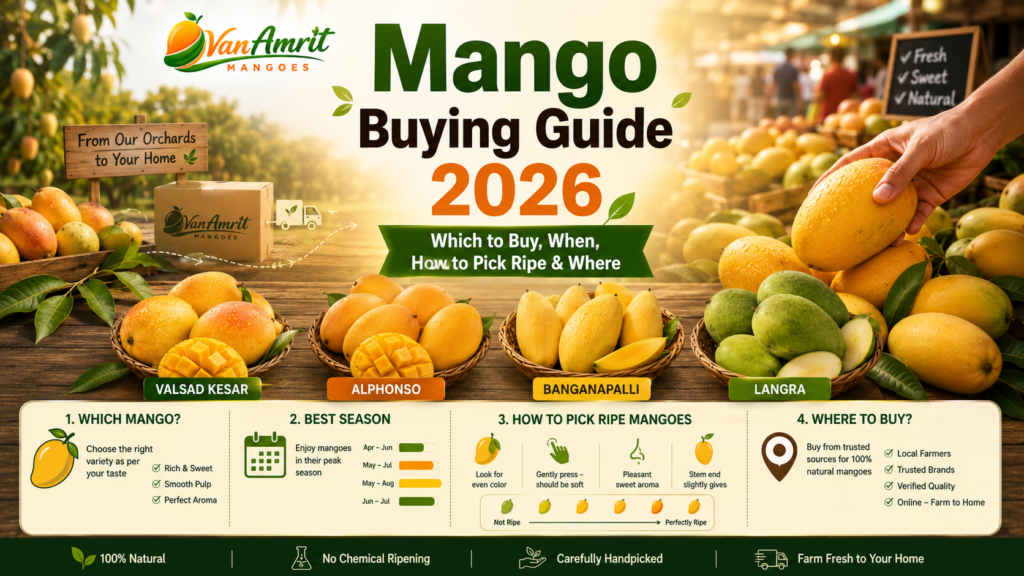
The Complete Mango Buying Guide
for India — 2026 Edition
Which variety to buy, when the season peaks, how to spot a ripe mango, what fair prices look like, and everything you need to never make a bad mango purchase again.
That’s a bad mango purchase — and it’s more avoidable than you think. The problem isn’t that India doesn’t have extraordinary mangoes. It has some of the finest fruit in the world. The problem is that most buyers walk into mango season without a framework. They go by colour, get swayed by enthusiastic vendors, buy at the wrong time, and then wonder why the mango doesn’t taste like they remembered from childhood.
This guide is your framework. By the time you finish reading, you’ll know exactly which variety fits your needs, when the season peaks in 2026, how to pick a ripe mango in under 60 seconds, how to spot carbide treatment, what fair prices look like this year, and how to store your crate so nothing goes to waste. Let’s get into it.
🗺️ India Has 1,500+ Mango Varieties. Here Are the 8 You Actually Need to Know
India produces around 20 million tonnes of mango every year — roughly 40 to 50% of the entire world’s supply, depending on the season. And the country has somewhere between 1,000 and 1,500 named varieties depending on who’s counting. But for a buyer sitting in a city in India in 2026, most of that number is irrelevant. About 8 varieties dominate what you’ll actually encounter in markets and online. Here’s the quick guide:
| Variety | Region | Season 2026 | Flavour Profile | Best For | Price Range / kg |
|---|---|---|---|---|---|
| Alphonso (Hapus) | Ratnagiri, Devgad, Maharashtra + South Gujarat | Feb–June (peak Apr–May) | Butter-rich, complex, no fibre | Fresh eating, gifting, aamras | ₹400–₹800 |
| Kesar | Gir (Saurashtra) + Valsad (South Gujarat) | May–July (Valsad to July) | Saffron-sweet, fragrant, clean | Aamras, fresh eating, desserts | ₹150–₹400 |
| Banganapalli (Safeda) | Andhra Pradesh, Telangana | April–June | Mild, gently sweet, large | Everyday fresh eating, bulk | ₹60–₹130 |
| Langra | Varanasi, UP, Bihar | June–August | Tangy-sweet, green skin even ripe | Fresh eating, North India favourite | ₹80–₹150 |
| Dasheri | Malihabad, Lucknow, UP | June–August | Aromatic, golden-yellow, fiberless | Fresh sliced eating | ₹70–₹130 |
| Rajapuri | South Gujarat (Valsad, Navsari) | June–August | Mild, excellent pulp yield | Bulk aamras, pulp-freezing, value | ₹60–₹120 |
| Himsagar | West Bengal, Odisha | May–June | Custardy, intensely sweet, no fibre | Fresh eating, East India premium | ₹120–₹200 |
| Chaunsa | UP, Bihar, Pakistan border | July–August | Honey-sweet, aromatic, late season | Late-season premium fresh eating | ₹100–₹180 |
The question you should ask yourself before buying isn’t “which mango is the best?” — it’s “what am I going to do with it?” Because the best mango for eating whole while standing over the kitchen sink (Alphonso, arguably) is not the same as the best mango for making 3 litres of frozen aamras (Kesar or Rajapuri). More on this shortly.
→ Complete state-by-state variety guide — 20+ mangoes mapped📅 The Season Calendar — When Each Mango Peaks in 2026
If there’s one thing that separates experienced mango buyers from frustrated ones, it’s this: they know when to buy. Timing isn’t just about getting the best price — it’s about getting a genuinely ripe, naturally developed fruit that hasn’t been forced with chemicals to look ready before it is.
Mango season in India 2026 began in mid-April with the first arrivals from southern and western states, according to market data from SalemMango and regional agricultural reports. But “available” and “at peak” are very different things. Early-season mangoes — especially before May — are often underdeveloped in sugar content and, as multiple food safety reports from April 2026 have noted, carry the highest risk of carbide treatment. The demand is high, the natural supply is low, and that gap is exactly where chemicals fill in.
Alphonso (Hapus): Mid-February to June, peak April–May | Kesar (Gir): Mid-April to June, peak May–June | Valsad Kesar: May to July — the extended South Gujarat advantage | Banganapalli: April to June | Langra / Dasheri: June to August | Rajapuri: June to August | Chaunsa: July to August
Here’s a counter-intuitive truth that most buyers learn the hard way: the most expensive mangoes aren’t always the best ones. Early-season Kesar in late April costs 30–60% more than peak-season June Kesar — and delivers 20–30% less flavour in return. You’re paying a premium for earliness, not quality. The sweet spot for both taste and value is the peak window: May and June for Kesar, April to early May for Alphonso.
And here’s Vanamrit’s specific advantage worth knowing about: Valsad Kesar runs through July. When Gir Kesar supply drops off by late June, buyers who want genuine Kesar still have a full month of South Gujarat coastal Kesar available. That’s not a small detail — it’s the difference between getting your mango fix in the season’s second half or settling for whatever’s left in the market.
→ Week-by-week Kesar season guide with quality windows for 2026🚨 The Carbide Problem — The Most Important Thing in This Guide
We need to talk about the pale, rubbery mango from the opening story. Because it wasn’t just a disappointing purchase — it was almost certainly a calcium carbide-ripened mango. And understanding what carbide is and how to spot it is the single most impactful thing you can do as a mango buyer in India.
Calcium carbide — called “masala” in the trade — is an industrial chemical used in welding. When it contacts moisture, it releases acetylene gas that forces the mango’s skin to turn yellow in 24–36 hours. It doesn’t complete the natural ripening biochemistry. The starch doesn’t convert to sugar properly. The aromatic compounds never form. The carotenoids don’t develop. The result is a mango that looks ripe but isn’t — and may carry traces of arsenic and phosphorus from the chemical’s impurities.
It’s illegal. FSSAI banned it in 2011. FSSAI’s April 2026 enforcement directive ordered all State Food Safety Commissioners to intensify raids on mandis, godowns, and ripening facilities. And yet, as food safety experts have noted, many traders who use it don’t fully understand they’re breaking the law. Carbide sells for ₹5–10 per kg in open markets. The economic incentive is brutally clear.
How do you spot it? Three fast checks before you buy anything:
No aroma = walk away. Hold the mango near the stem and breathe in. A naturally ripe Kesar or Alphonso has a fragrance so powerful it practically announces itself. If there’s nothing — not even a hint of fruit smell — the mango is not naturally ripe, no matter how golden it looks.
Uniform flat yellow = red flag. Natural ripening produces gradual colour change — green patches at the tip, a reddish blush at the shoulder, golden body for Kesar. Perfectly uniform, artificially bright yellow skin all over is how a carbide-treated mango announces itself visually.
White or grey powder in the crate = leave immediately. This is direct physical evidence of calcium carbide. If you see powdery residue on the fruit or inside the packaging, that crate has been treated.
→ Full carbide science guide: health risks, detection tests, FSSAI 2026👃 How to Pick a Ripe Mango — 5 Tests That Take Under 60 Seconds
You don’t need to be a mango expert to pick a good one. You need five senses and about 45 seconds. Here’s the method, in the exact order you should use it:
When your farm-direct delivery arrives, apply the fragrance test the moment you open the box. Green-mature mangoes won’t have the full fragrance yet — but you should detect the beginning of it, like a quiet introduction. By day 3 at room temperature, that introduction should have become a full conversation. If there’s absolutely nothing — no hint of aroma even after 4 days at room temperature — contact the seller immediately. That’s not a normally ripening mango.
🏆 Which Mango Should You Actually Buy? — A Decision Guide by Use Case
This is the question everyone wants answered. And the honest answer is: it depends entirely on what you’re doing with it. Picking the “best” mango without knowing your use case is like picking the “best” knife without knowing what you’re cutting. Let’s match varieties to needs.
🌿 Kesar vs Alphonso vs Rajapuri — Vanamrit’s Three Varieties Compared
We grow three varieties at our Chikhli, Valsad orchard. Here’s an honest, side-by-side look at all three — because the right choice depends on you, not on which one we’re keenest to sell.
Farm-Direct from Chikhli, Valsad — Carbide-Free, Hay-Ripened
Kesar, Alphonso, and Rajapuri. Grown on our own orchard in South Gujarat, naturally ripened in hay, and shipped pan-India. No middlemen. The fragrance test on arrival day will tell you everything.
🥭 Browse & Order at vanamrit.in →💰 Mango Price Guide 2026 — What Fair Prices Look Like
Let’s talk honestly about prices — because most buyers have no real reference point, which makes them vulnerable in two directions: overpaying for mislabelled “premium” fruit, or underpaying and getting carbide-treated stock that should have been priced differently.
As of May 2026, market data from commodity platforms shows wholesale mango rates averaging ₹61/kg across the country — but that’s a misleading average that lumps Totapuri with Alphonso. Premium varieties have a completely different price architecture.
| Variety | Market Price/kg | Farm-Direct Online | Early vs Peak Season Premium | Watch Out For |
|---|---|---|---|---|
| Alphonso (GI-tagged) | ₹200–₹400 | ₹350–₹700 (includes delivery) | Up to 40% more in March vs April | “Alphonso” under ₹100/kg is not genuine |
| Kesar (Gir) | ₹150–₹350 | ₹200–₹400 + delivery | Peak May–June is best value | Early April Kesar: very high carbide risk |
| Valsad Kesar | ₹120–₹280 | ₹150–₹350 + delivery | Prices drop slightly in July vs May | Extended season = more buying opportunities |
| Banganapalli | ₹60–₹130 | ₹80–₹150 + delivery | Minimal premium for timing | Shelf life advantage: buy slightly firm |
| Rajapuri | ₹50–₹110 | ₹80–₹130 + delivery | Best June–July value | Best pulp yield per rupee spent |
The principle that matters most here: there is a real cost floor for quality. Naturally ripened, genuinely sourced Alphonso or Kesar cannot be sold at ₹100–₹120/kg at a premium online retailer and remain authentic. The cost of farming, harvesting by hand, quality-checking, packaging, and shipping across India simply doesn’t fit at that price. When you see numbers far below market, ask what corner was cut. Usually, it’s either the variety (mislabelled), the ripening method (carbide), or the quality (damaged, oversized, or overripe reject stock).
Early-season Kesar (late April) costs 30–60% more than peak-season June Kesar but delivers measurably less sweetness, lower Brix, and significantly higher carbide risk. Unless you have a specific occasion that falls in that window, waiting for May–June delivers better fruit at a better price. Patience is almost always rewarded in mango season.
🛒 Online vs Local Market — Where Should You Actually Buy?
I want to give you an honest comparison here, not a sales pitch. Both channels have legitimate use cases. The question is which one fits your specific situation.
The case for your local market or fruit vendor
You can smell before you buy. You can pick individual fruit rather than committing to a whole crate. You get immediate access — no delivery wait. If you have a trusted vendor who knows their sourcing, a good local relationship can deliver excellent mangoes at fair prices season after season. For Banganapalli or Langra — varieties where carbide risk is lower and quality variation is less dramatic — your neighbourhood market works just fine.
The case for farm-direct online
For premium varieties where origin and ripening method determine the entire experience — Kesar, Alphonso, Rajapuri — the risk calculation changes. The supply chain for premium mangoes in retail markets is opaque by design. You don’t know which farm, which district, which ripening method. A vendor selling “Kesar” in April is almost certainly not selling genuinely naturally ripened Gir or Valsad Kesar at that price and at that time of year. You’re relying on trust without traceability.
Farm-direct online brands give you the opposite: a named farm, a declared district, a specific ripening method you can verify, customer reviews, and direct accountability if something goes wrong. That’s not a convenience advantage — that’s a food safety and quality guarantee that a market transaction simply can’t offer.
Convenient, yes. Trustworthy for premium mango varieties? Generally no. Most aggregator platform mango listings source from wholesale markets and fulfillment centres where the supply chain is identical to a retail market — just delivered to your door. Consistency is low, origin traceability is near-zero, and carbide risk is the same as at any market stall. For premium varieties, go direct to the farm.
📦 Your Box Just Arrived — What to Do Right Now
This is where first-time online mango buyers most often panic. The box arrives and the mangoes are… green. Firm. Not what you expected. Did something go wrong?
Nothing went wrong. This is exactly right. A fully ripe mango cannot survive 5–6 days of transit across India without turning to mush. Farm-direct brands ship mangoes at the green-mature stage — fully developed inside, but not yet ripe on the outside. The ripening completes in your kitchen. Here’s what to do the moment the box arrives:
🧊 Mango Storage — Making Your Crate Last the Full Season
The most common mango waste story in Indian households goes like this: a whole crate arrives, life gets busy, and four days later half of them are overripe and the other half still aren’t ready. Sound familiar? The solution is a simple sorting strategy, not complicated storage technology.
Before ripening: Room temperature, 22–28°C, single layer, not wrapped. Check daily. Sort by ripeness stage as the days progress — the most advanced go first, the firmest ones can wait.
Once ripe: Whole ripe mangoes last 5–7 days in the refrigerator crisper drawer, unwrapped (some airflow is good). Cut and stored in an airtight container: 3–5 days. For the surplus that’s ripening faster than you can eat it — freeze it.
Freezing pulp: Peel and blend at peak ripeness. Fill in freezer-safe bags or containers. Kesar pulp frozen correctly retains roughly 85–90% of its colour, aroma, and flavour profile for up to 6 months. This is the move for anyone buying a 10 kg or 15 kg box — eat fresh for the first week, freeze the rest as pulp to enjoy through Diwali and beyond.
The one rule that eliminates most crate disasters: Never wash mangoes before storage. Moisture on the skin creates the perfect environment for mould to take hold within 24–48 hours. Store dry. Wash only immediately before eating.
→ Complete storage guide — crate, fridge, freezer, and pulp instructions❓ Mango Buying Questions — Answered
🌿 The Short Version of Everything Above
Buy in-season, not before the natural season starts. Choose your variety based on use, not reputation alone. Trust your nose over your eyes — always. Know what fair prices look like so you’re not vulnerable to either end of the price spectrum. Buy from sources you can verify when you’re spending real money on premium varieties. And when your box arrives green, breathe, and give it 2–4 days. The mango knows what it’s doing.
The mango experience you get is almost entirely determined by the decisions you make before you take the first bite. Get those right and the fruit takes care of the rest.
“A good mango doesn’t need you to choose it carefully. It announces itself the moment you bring it close.” 🥭🌿
Vanamrit — Farm-Fresh Kesar, Alphonso & Rajapuri — Pan-India 2026
Three varieties. One orchard. No carbide. No middlemen. Naturally ripened in hay at our Chikhli, Valsad farm and shipped directly to your door. The fragrance test on arrival day will tell you everything you need to know.
🥭 Browse & Order at vanamrit.in →Bulk orders, corporate gifting or questions: vanamrit.in/contact | WhatsApp: +91 9033595016