
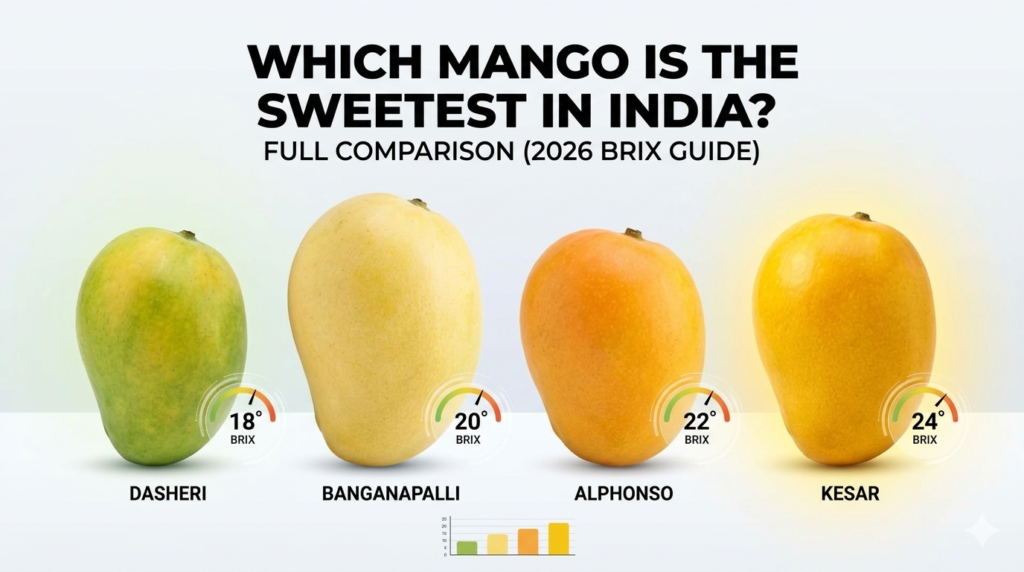
Which Mango is the Sweetest in India?
Full Comparison (2026 Brix Guide)
Alphonso, Kesar, Chausa, Himsagar, Imam Pasand — we compare India’s most beloved mangoes by Brix score, taste profile, and the kind of sweetness that actually matters at the table.
Everyone at that table is right. And that’s exactly what makes the “sweetest mango in India” question so endlessly fascinating. India grows over 1,000 mango varieties — each shaped by its own soil, its own microclimate, its own harvest tradition. Sweetness isn’t one thing. It’s a conversation between sugar, acid, aroma, texture, and the particular genius of where a mango was grown.
So let me do the comparison properly. We’re going to look at the science (Brix scores measured across varieties), the eating experience, and the verdict — so you can walk into any market this season and know exactly which mango matches your idea of the perfect sweet.
🔬 First — What Does “Sweetest” Actually Mean? The Brix Explanation
Before we start comparing varieties, I want to give you one concept that will make everything else click: the Brix scale. Think of Brix as a mango’s sugar report card. It measures the percentage of dissolved sugars in the juice — 1° Brix means 1 gram of sugar per 100 grams of liquid. The higher the Brix, the more sugar is present.
Indian mango varieties typically range from 12° to 24° Brix. Anything above 20° Brix is exceptional — you’re in intensely sweet territory. But here’s the thing that most mango guides miss: Brix alone doesn’t tell you how sweet a mango will taste.
Acidity is the other half of the equation. A mango with Brix 22 but high acidity can taste less sweet than a mango with Brix 18 and almost no acidity — because the acid cuts through the sweetness and creates a tangy balance instead. This is why Alphonso at 20–22° Brix and Kesar at 18–20° Brix can feel similarly sweet to many people, despite Alphonso technically having more sugar. Alphonso has moderate acid alongside its high sugar. Kesar has almost no acid — so every bit of its sugar lands clean on the palate with nothing interrupting it.
Think of it like a cup of tea. Two cups with the same amount of sugar — but one has lemon squeezed in. The lemon cup tastes less sweet, even though the sugar content is identical. This is exactly what happens when you compare Alphonso (high sugar + moderate acid) to Kesar (slightly lower sugar + almost no acid). The Kesar cup tastes surprisingly close to the Alphonso cup in perceived sweetness.
Aroma is the third factor that most people never consider. Our sense of smell directly amplifies perceived sweetness — that’s basic neuroscience. A mango with a powerful saffron fragrance will register as sweeter to your brain than the same Brix mango with less aroma, because the olfactory input adds to the sweetness experience. This is why Kesar’s room-filling fragrance is not just pleasant — it’s functionally making the mango taste sweeter than its Brix score alone suggests.
Temperature matters too. Cold suppresses sweetness. A ripe mango straight from the fridge will always taste less sweet than the same mango at room temperature. If you’ve been eating refrigerated mangoes and wondering why they’re not as sweet as you expected — that’s your answer. Let it come to room temperature for 20–30 minutes first. You’ll notice the difference immediately.
📊 India’s Sweetest Mangoes — Brix Scores at a Glance
Here’s your quick-reference sweetness ranking. Screenshot this. It’s based on verified 2026 data from FarmSe, American Gardener Mango ID Guide, Aam Native variety database, and ZZ Mango’s February 2026 expert articles.
| Variety | Brix Range | Sweetness Character | Acid Level | Best For |
|---|---|---|---|---|
| Alphonso (Hapus) | 20–24° | Rich, complex, dessert-like | Moderate tang | Fresh eating, gifting, aamras |
| Chausa | 20–22° | Liquid honey — pure, uncomplicated | Minimal | Immediate consumption |
| Imam Pasand | 19–22° | Honey-cream, coconut-lime finish | Very low | Premium fresh eating |
| Himsagar | 17–22° | Juice-forward, intensely sweet | Low | Immediate fresh eating |
| Kesar (Valsad/Gir) | 18–22° | Saffron-honey, floral, balanced | Very low | Aamras, gifting, delivery |
| Dasheri | 17–20° | Candy-floral, light sweetness | Low | Milkshake, fresh eating |
| Banganapalli | 16–20° | Clean, reliable, mild | Very low | Bulk buying, fresh eating |
| Langra | 15–18° | Tangy-sweet, citrus notes | Moderate-high | Palates who want balance |
Farm-Fresh Valsad Kesar — Saffron Sweetness, Delivered Across India
Experience what makes Kesar the Queen of Indian mangoes — honey-clean sweetness with virtually no acidity, amplified by that room-filling saffron fragrance. Vanamrit’s Valsad Kesar is naturally ripened, carbide-free, and farm-direct from Chikhli, Valsad.
Order Valsad Kesar Mangoes →👑 Alphonso (Hapus) — Why It’s Called the King, and Whether That Title Is Deserved
Let me start here because this is the mango that started the whole conversation. Alphonso — called Hapus in Marathi — is the most internationally famous Indian mango, the most exported, and by raw Brix measurement, the sweetest of any commercially cultivated Indian variety. FarmSe’s March 2026 comparison confirms: Alphonso typically registers 20–22° Brix, and at peak ripeness from Ratnagiri’s GI-tagged orchards, it can hit 24°. ABC Fruits puts it plainly: Alphonso is India’s sweetest and best variety because of its higher Brix content, aroma, and flavour.
But what makes Alphonso sweetness distinctive isn’t just the sugar number — it’s how that sugar presents itself. Alphonso has a moderate but present acidity alongside its high Brix. This creates what wine drinkers would call a “complex palate” — the sweetness arrives first, then a gentle tang lifts it, then a long, warm finish lingers. Eating a ripe Ratnagiri Alphonso is not like eating fruit — it’s closer to eating a premium dessert made from fruit. Every bite delivers layered richness that Desi Fresh Foods aptly describes as “sweetness and rich flavor” working together.
The terroir factor is enormous here. Alphonso grown in Ratnagiri and Devgad (the GI-tagged coastal Maharashtra belt) tastes measurably different from Alphonso grown even 100km inland. The laterite coastal soil, sea breeze, and specific humidity of the Konkan coast create carotenoid concentrations and aromatic compounds that simply don’t develop the same way in other soils. Mahindra Nursery’s 2026 commercial guide is explicit about this: Alphonso “performs best in coastal Maharashtra” and won’t match the Ratnagiri flavour profile elsewhere even with identical variety genetics.
Is it the sweetest for everyone? No — and that’s the honest answer. People who prefer clean, uncomplicated sweetness sometimes find Alphonso “too sharp” or “too rich.” Those who want pure sweetness without any tang would actually prefer Chausa or Kesar. For most palates though, Alphonso’s combination of high Brix and complex layered flavour makes it feel like the most indulgent sweet mango experience in India.
For a detailed head-to-head between Alphonso-style complexity and Kesar’s clean sweetness, our Valsad Kesar vs Gir Kesar comparison guide covers the full flavour spectrum.
👑 Chausa — The Emperor of Pure Sweetness (and Why North India Swears by It)
If sweetness were a volume knob, Alphonso would be set to 10 on a sophisticated audiophile system — rich, detailed, layered. Chausa would be one single instrument played at 11: just sweetness, maximum sweetness, no complexity interrupting it, just an uninterrupted wave of honey.
ZZ Mango’s February 2026 article by Jaidev Sharma gives Chausa the title “Emperor of Mangoes” — a step above King — specifically because it’s the sweetest mango by pure, uncomplicated experience. The key phrase: Chausa “is the sweetest mango that we import” and its premium early-season version is called Samar Bahisht — literally translated from Urdu as “Mango of Paradise.” That’s not casual naming. That’s a historical claim backed by the Mughal-era mango culture of North India.
What makes Chausa different from Alphonso is the acid — or rather, the near-absence of it. Chausa has almost zero acidity. Every gram of its 20–22° Brix lands on your palate without a single tangy note to interrupt it. It’s like Alphonso had all the acid edited out, leaving only sweetness. For people who find Alphonso slightly sharp or tangy, Chausa is the answer they’ve been looking for.
The traditional eating method — sucking the fruit directly — tells you everything about Chausa’s character. Its skin is thin, its juice content is extraordinary, and its pulp is so juicy that the North Indian way is to squeeze and suck it like nature’s most elaborate juice box. No knife, no plate, no ceremony. Just sweet, fragrant, liquid mango running freely.
The only problem with Chausa? It disappears faster than any other premium mango. Two days at room temperature after peak ripeness. Three if you’re lucky. Its extreme sweetness — those high sugars — begin fermenting rapidly once the mango peaks. Buy Chausa and eat it today. Never plan ahead with Chausa. It doesn’t reward planning.
👑 Imam Pasand — South India’s Royal Mango That Most of India Has Never Tried
Here’s the mango that will surprise anyone who hasn’t tried it. Imam Pasand — also called Himayat or Himam Pasand — is Andhra Pradesh and Tamil Nadu’s answer to Alphonso. Aam Native describes it as having “unmistakable rich, creamy texture and intense sweetness rivalling Alphonso.” The Better India’s March 2026 mango map update calls it “known for its honey-like sweetness and creamy texture — a royal favourite.”
The name itself tells the story: it means “liked by the leader” or “favourite of the Imam.” It was the fruit served in Nizam courts in Hyderabad, in royal houses in Tamil Nadu. This mango has centuries of aristocratic endorsement behind it.
What makes Imam Pasand’s sweetness unusual is its aftertaste. After the initial deep honey-cream sweetness fades, there’s a distinctive coconut-lime finish — a layered conclusion that surprises first-time eaters. India Chronicles describes it precisely: “hints of coconut and lime.” No other Indian mango has this specific flavour signature, and for those who experience it, it creates passionate devotion. Ask someone from Hyderabad or Salem which mango is sweetest — they’ll say Imam Pasand or Himaym without blinking, the same certainty a Maharashtrian gives Alphonso.
At up to 800g per fruit, it’s also one of India’s largest premium mangoes. The sheer volume of fiberless, sweet, creamy pulp in a single Imam Pasand makes it feel like an event rather than a snack. Available only in May–June — its brief window adds to the exclusivity that makes its devotees guard their seasonal supply jealously.
👸 Kesar — The Queen’s Sweetness: Why “Less Brix” Can Feel Like “More Sweet”
I want to make a case for Kesar that goes beyond its Brix number — because the number doesn’t capture the full story of how this mango actually tastes.
Kesar’s Brix range is 18–20° on average according to FarmSe’s March 2026 analysis — slightly below Alphonso’s 20–22°. On paper, Alphonso is sweeter. In practice? ZZ Mango’s Jaidev Sharma, writing in February 2026, gives Kesar the title “Queen of Mangoes” and calls it “one of the sweetest mangoes that we import.” He explains: “it does not throw tantrums like the King, Alphonso.” What he means is that Kesar’s sweetness is more reliable, more consistent, and for many palates, more satisfying precisely because it doesn’t come with Alphonso’s complexity.
The reason: Kesar has almost zero acidity. The entire Brix score — 18–20° of dissolved sugars — arrives on your palate as pure, uninterrupted sweetness. No tang cutting through it. No acid lifting the back of the palate. Just clean, honey-like, saffron-scented sweetness from first bite to last. Desi Fresh Foods captures it perfectly: Kesar’s “sweetness is often compared to that of honey.”
Then there’s the aroma factor. Kesar’s signature fragrance — that deep saffron-sweet scent that fills a room before you even cut the fruit — is neurologically amplifying the sweetness experience as you eat. Your nose and your tongue are working together. The result is that many people who eat both Kesar and Alphonso side by side will perceive similar sweetness intensity, even though the Brix scores say Alphonso should win.
Valsad Kesar specifically — grown on South Gujarat’s alluvial coastal soil with 150–200 cm annual rainfall — develops particularly well-rounded natural sugars compared to Gir Kesar. The extended growing season (May–July vs April–June for Gir Kesar) gives the fruit more time to develop its sweetness and aromatic compounds fully. When you buy peak-season Valsad Kesar in June and let it ripen naturally to exactly the right stage, you’re tasting what “honey in saffron form” actually means.
- Kesar is the most delivery-friendly sweet mango in India — firm enough to survive 5–6 day transit and arrive in perfect condition
- India’s #1 commercially produced mango pulp variety — Mahindra Nursery’s 2026 guide confirms “pulp factories in Valsad, Vapi and Chittoor pay a contract premium for Kesar”
- The only premium sweet mango that can be ordered online and reliably received in great condition across India
Want to understand exactly what authentic Kesar sweetness tastes like — and how to know if the Kesar you’re buying is the real thing? Our guide to identifying real Kesar mango explains the five signs that separate genuine saffron-sweet Kesar from imitations.
🎯 Himsagar — East India’s Most Intensely Sweet Mango (With a Catch)
In Bengal, Odisha, and Bangladesh, this is the answer to “which is the sweetest mango” — delivered with the kind of confidence that brooks no argument. Himsagar (also called Khirsapat) is Mahindra Nursery’s 2026 guide’s “Eastern India’s answer to Alphonso” — and in terms of juice sweetness intensity, it has a legitimate claim to being India’s most extraordinary sweet mango experience.
The flesh is so saturated with juice and sugar that eating Himsagar is less like eating a fruit and more like drinking intensely sweet mango nectar from a natural cup. The entire fruit seems to be held together primarily by the will of the juice inside it. Its saffron-coloured, completely fiberless pulp melts immediately on the tongue, releasing an intoxicating wave of sweetness that makes every other mango feel slightly more restrained by comparison.
The catch — and it’s a significant one — is that Himsagar has a window of approximately 24–48 hours between “perfect” and “overripe.” Its extreme juice content and high sweetness become its downfall: those sugars begin fermenting rapidly. Himsagar is not a mango you plan. It’s a mango you encounter at the right moment and eat entirely right then. If you’re in Kolkata in May and someone puts Himsagar in front of you, eat it immediately. Don’t refrigerate it for tomorrow. Tomorrow is not guaranteed with Himsagar.
It’s also essentially impossible to order reliably online — its shelf life prevents any meaningful delivery window. For most of India outside Bengal, Himsagar remains a once-or-twice-in-a-lifetime seasonal encounter. And that’s perhaps what makes it so special.
🌟 Dasheri — North India’s Candy-Floral Sweet and the Mango 70% of UP Grew Up With
If you grew up in Delhi, Lucknow, Agra, or anywhere in the Gangetic plains of North India, Dasheri is your mango. It’s the variety that frames what “mango season” means for an entire geography — the sweetness you’re calibrated to as a child, the taste your brain instinctively associates with June afternoons and summer holidays.
Dasheri’s sweetness is lighter and more candy-like than Alphonso or Kesar. It has a distinctive floral note — almost jasmine-adjacent — that sits alongside the sweetness and creates a uniquely light, ethereal flavour profile that’s impossible to mistake for any other variety. AlphonsoMango.in describes it as “grown primarily in North India, Dasheri mangoes are sweet and fragrant with fiberless pulp.” Malihabad in Lucknow produces nearly 70% of India’s Dasheri output — making it the most concentrated production of any GI-tagged mango variety in the country.
By Brix score, Dasheri is slightly below the top tier at 17–20°. But in North Indian households, this matters less than the specific flavour personality — the sweetness that comes with that floral aroma is entirely its own experience, and no amount of Brix comparison will convince a Dasheri devotee that Alphonso is more satisfying.
🌿 Langra — Not the Sweetest, But the Most Interesting (Here’s Why That Matters)
Langra is the outlier in this comparison — the mango that would score lowest on a pure sweetness scale but generates some of the most passionate advocacy of any Indian variety. And this is worth understanding, because it reveals something important about what “sweetness” actually means to different palates.
With 15–18° Brix and significant acidity, Langra’s flavour profile is tangy-sweet with distinctive citrus and spice undertones. AlphonsoMango.in describes “a deep, slightly tart flavor with slight accents of cinnamon, pepper, jackfruit.” That’s not conventionally “sweet” — but for palates that find Alphonso too rich and Chausa too one-note, Langra’s complexity is exactly what they want. It’s the mango equivalent of choosing dark chocolate over milk chocolate — technically less sweet, but more interesting in ways that simple sweetness can’t provide.
The other famous Langra peculiarity: it stays green even when fully ripe. Every year, buyers cut into an unripe-looking green Langra and discover brilliant yellow, fragrant, sweet-tangy flesh inside. Never use colour to judge Langra. Use only the press test (gentle yield near the stem) and the smell test. If the fragrance hits you, it’s ready — regardless of what the skin colour is doing.
🏆 The Verdict — Which Indian Mango Is Actually the Sweetest?
There isn’t one answer. But there are specific answers for specific questions — and this is actually more useful.
Alphonso wins — 20–24° Brix at peak from Ratnagiri’s GI-tagged orchards. If you put a refractometer on Indian mango juice, Alphonso comes out on top. ABC Fruits confirms it: “Alphonso is India’s sweetest and best variety of mangoes because of its higher Brix content.”
Chausa wins — 20–22° Brix with almost zero acidity. The emperor title from ZZ Mango (Feb 2026) isn’t accidental. For maximum sweetness with zero tang to interrupt it, nothing in India’s commercial mango range beats Chausa at its best. “Samar Bahisht” — Mango of Paradise — is the name the variety earned for a reason.
Kesar wins — 18–22° Brix with virtually no acidity, amplified by a fragrance that neurologically enhances sweetness perception. And critically: Kesar is the only variety in this list that you can order farm-fresh online and have delivered to your door across India in excellent condition. Chausa can’t survive delivery. Alphonso is fragile in transit. Himsagar disappears in 48 hours. Kesar delivers.
If you want to explore exactly when to buy Kesar at its sweetest peak, our 2026 Kesar season timing guide breaks down the month-by-month quality and price curve so you can buy at precisely the right moment.
🌿 One Factor That Affects Sweetness More Than Variety — How It Was Ripened
Here’s the thing that most sweetness guides completely ignore: the same variety can taste dramatically different depending on how it was ripened.
A naturally ripened Kesar or Alphonso goes through a complete biochemical ripening process — ethylene production converts starches to sugars over several days, developing aromatic compounds and hitting its full Brix potential. A carbide-ripened version of the same variety has its skin forced to change colour overnight by calcium carbide’s chemical reaction, without completing the internal sugar development. The result: a mango that looks ripe, might feel soft, but has only reached 12–16° Brix instead of 18–22°. It tastes flat, watery, and slightly chemical — because it is.
This is why a naturally ripened Kesar from Vanamrit’s Valsad orchard can taste sweeter than a carbide-ripened Alphonso from a market stall — even though Alphonso should theoretically have higher Brix. The ripening method determines whether the Brix potential is actually achieved.
Our guide on identifying authentic Kesar shows you exactly how to tell the difference between naturally ripened sweetness and carbide-treated disappointment — five specific signs, before you even cut the fruit.
🥣 Which Mango is Sweetest for Each Use?
- Sweetest for aamras: Kesar and Alphonso are equal champions. Kesar gives a cleaner, saffron-forward sweetness with brilliant orange colour. Alphonso gives a richer, more indulgent aamras. Both are dramatically better than Chausa for this use — Chausa’s extreme juiciness makes the aamras too watery and loose
- Sweetest for mango milkshake: Alphonso for pure richness. Kesar for fragrance. Dasheri for the classic North Indian milkshake experience that UP grew up on. Himsagar makes extraordinary milkshakes if you can get it in time — but you probably can’t
- Sweetest for eating fresh, directly: Chausa and Himsagar — their extreme juiciness and very low acidity deliver maximum sweetness per bite in the most direct way. The sucking mango experience at its finest is exclusively North Indian Chausa or Bengali Himsagar
- Sweetest for gifting: Alphonso for premium perception and international recognition. Kesar for impressive volume at excellent quality — and the practical advantage of arriving at the recipient’s door intact, which Alphonso can’t always guarantee
- Sweetest for ordering online: Kesar, by a significant margin. It’s the only premium sweet mango with the shelf life and transit resilience to survive 5–6 days of delivery across India
❓ The Sweetest Mango Questions, Answered
🏁 So — Which Mango Should You Actually Buy?
🥭 The Practical Summary
Buy Alphonso if you want the most scientifically measurable sweetness and the most internationally celebrated eating experience. Eat it the same week — don’t wait. Buy Chausa if you want pure, uncomplicated sweetness with zero tang — the closest thing India produces to drinking liquid honey. Eat it today. Buy Imam Pasand or Himsagar if you live in or near their growing regions and can eat them immediately — you’ll experience something most of India never encounters.
And buy Kesar if you want clean, reliable, aromatic honey-like sweetness that you can actually order online, have delivered to your door in five days, and eat at peak quality over a two-week season window from May through July. Kesar is the sweet mango that works in real life — the one that arrives perfectly, ripens beautifully at room temperature, and makes aamras that genuinely justifies the effort.
The sweetest mango isn’t just the one with the highest Brix score. It’s the one that’s properly grown, properly harvested, naturally ripened, and eaten at the right time. All of that — in one box from Chikhli, Valsad, South Gujarat — is exactly what Vanamrit delivers.
“The sweetest mango you’ve ever had wasn’t the most expensive one. It was the one you ate at exactly the right moment.” 🥭🌿
Valsad Kesar — Saffron-Honey Sweetness, Farm to Your Door
Naturally ripened. Carbide-free. Harvested at peak green-maturity from our own orchard in Chikhli, Valsad. The sweetest version of Kesar you can get — because the sweetness was earned the right way, on the tree, in the right soil, at the right time.
🥭 Order Valsad Kesar at vanamrit.inQuestions about which variety to order? Contact us or WhatsApp: +91 9033595016