
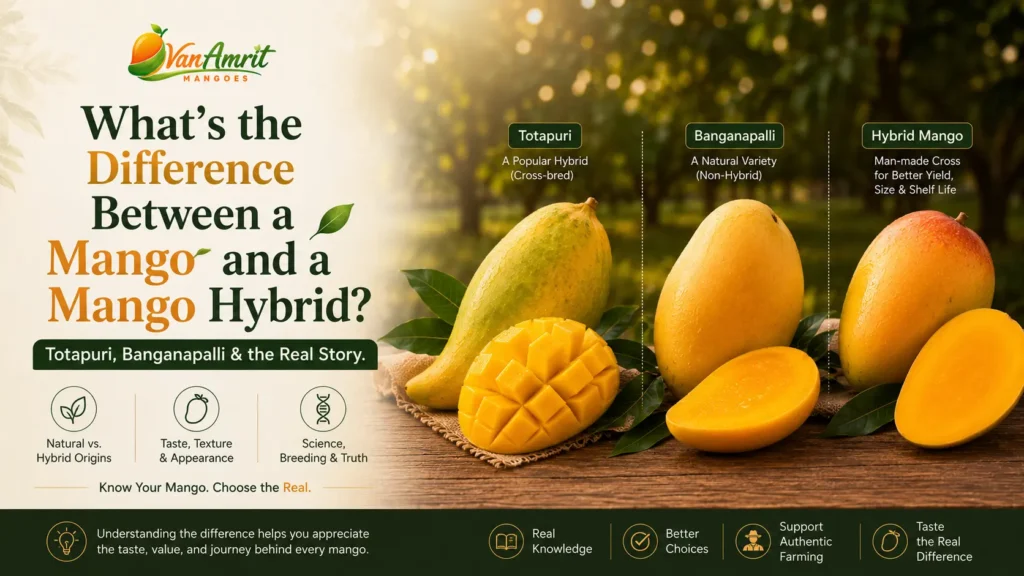
What’s the Difference Between
a Mango VS a Mango Hybrid?
Totapuri, Banganapalli & the Real Story
Most people calling Totapuri a “hybrid” are wrong. Here’s what the words actually mean — and why it changes how you think about every mango you’ve ever eaten.
The mango world has a genuine terminology problem. Words like “hybrid,” “grafted,” and “bred” get thrown around interchangeably by farmers, vendors, and even agricultural publications that should know better. And the confusion isn’t harmless — it changes how you understand why Alphonso tastes the way it does, why some mango trees fruit every year while others skip a season, and what a plant scientist in a lab coat in Lucknow has to do with the mango in your lunch box.
Let’s sort this out properly. By the time you finish reading, you’ll know exactly what a mango hybrid is (and isn’t), where Totapuri and Banganapalli actually stand, which varieties are genuine scientific crosses, and where Kesar and Alphonso — the mangoes Vanamrit grows — fit into all of this.
🧬 What Actually Makes a Mango a “Hybrid”?
Start with the definition, because everything else flows from it. A mango hybrid — in the precise, scientific sense — is a variety created by deliberately cross-pollinating two different parent varieties, with the goal of combining specific traits from both into a new, distinct variety. Scientists do this by hand: they take pollen from the flower of one variety and transfer it to the flower of another, then grow the resulting seed and evaluate the new tree over multiple years of field trials.
Think of it like arranged breeding in dogs. A Labrador and a Poodle don’t naturally seek each other out across continents — someone deliberately paired them to get a Labradoodle with specific traits. A mango hybrid works the same way: a plant breeder at IARI or IIHR looks at two varieties, identifies what each one does well, and deliberately makes them “parents” to produce offspring with a combination of both.
Why do breeders do this? The goals are almost always practical: disease resistance from one parent, sweetness from another, dwarf tree size that allows more trees per acre, regular bearing every single year instead of the frustrating biennial pattern many premium varieties follow, better shelf life, attractive skin colour for export markets. None of these traits arrive by accident. Each one is a specific breeding target.
India’s leading institutions running active mango hybrid programs as of 2026 include IARI in New Delhi, ICAR-CISH in Lucknow, and IIHR (Indian Institute of Horticultural Research) in Hessaraghatta, Bangalore — which started its mango breeding work in 1970 with exactly these goals. The first mango hybrid in India, Prabhashankar (Bombay × Kalapady), was released by Bihar Agriculture College, Sabour, in 1951 — marking the beginning of large-scale hybrid multiplication. The 1970s then brought the breakthroughs most people actually recognise today.
And what isn’t a hybrid?
Here’s the key distinction that clears up most of the confusion. The vast majority of India’s famous mango varieties — Alphonso, Kesar, Totapuri, Banganapalli, Dashehari, Langda, Neelum — are what botanists and farmers call landrace varieties. They’re ancient, regionally-developed varieties that came into existence through natural open pollination over generations — bees, wind, and centuries of farmers selecting and propagating the best trees they found, with no scientist involved at any stage.
A landrace isn’t inferior to a hybrid. It’s just different in origin. And the distinction between the two is genuinely worth understanding if you care about where your food comes from.
🌳 What’s a Landrace Variety? (And Why Most “Classic” Mangoes Are One)
Imagine a seed falls in a forest clearing in Karnataka eight hundred years ago. It grows into a mango tree that happens to produce unusually sweet, almost fibreless fruit. A farmer notices it, keeps it, and eventually takes cuttings from that tree to grow more. Over generations, the specific lineage of that tree gets propagated and named. Villages start planting it. Markets start asking for it by name. Eventually, everyone in the region knows the variety — even though no scientist ever “designed” it. That’s a landrace.
Totapuri, Banganapalli, Alphonso, Kesar, Dashehari, Langda — every single one of these classic Indian mango names is the legacy of this process. Some are hundreds of years old. They survived and spread because farmers recognised something exceptional in them, not because a breeding program engineered those traits.
India has over 1,500 named mango varieties according to APEDA — almost all of them landrace selections that developed regionally over centuries. Of these, only a small subset has been officially GI-tagged, and an even smaller subset are genuine scientific hybrids. The variety richness of Indian mangoes isn’t a product of labs — it’s a product of time, soil, and generations of farmers with very good taste.
✂️ Grafting — How Every Mango Variety Actually Gets Multiplied
This is the piece of the puzzle that confuses people most. If landrace mangoes aren’t hybrids and weren’t developed in a lab, how does every Kesar tree in Gujarat produce the same consistent Kesar taste? Why doesn’t it vary wildly from orchard to orchard?
The answer is grafting — and it’s what separates a commercial mango orchard from a random seed experiment.
Here’s the problem that grafting solves: mango seeds don’t breed true to the parent. If you plant a seed from a perfectly ripe Alphonso mango, the tree that grows from it is genetically different from its parent — a random recombination of whatever genetics went into that fruit. It might produce something good. It might produce something mediocre. You genuinely don’t know until 8–10 years later when the seed-grown tree finally fruits. That’s an expensive and heartbreaking gamble for any serious farmer.
Grafting sidesteps this entirely. Over 90% of commercial mango trees worldwide are grafted. The process joins two plant parts together: the rootstock (a sturdy seedling that provides the root system) and the scion (a cutting from the variety you want to grow). The result is a tree that combines the best of both — strong roots with great fruit.
What the scion provides is a genetic clone. Every Alphonso tree grown from a scion cutting taken from an Alphonso mother tree is genetically identical to that mother tree. This is why Alphonso tastes consistent across properly managed orchards — not because of magic, but because every grafted Alphonso tree is, in the most literal biological sense, the same tree reproduced.
What the rootstock provides is vigour, disease resistance, and adaptability to local soil. Grafting is the ideal method for commercial use because it maintains the genetic purity of the propagated variety. The rootstock affects how well the tree handles the soil and climate, but doesn’t change the fruit the scion will produce.
Here’s the commercial reality of getting grafting wrong: always request a nursery certificate confirming both the scion variety AND the rootstock. Mismatched saplings in a commercial orchard mean discovering the error 8 years later — a loss that cannot be recovered. A cheap roadside graft that turns out to be the wrong variety costs a farmer years of time and lakhs of rupees before the mistake reveals itself at first fruiting.
So when someone says “I planted a Kesar mango tree” — what they actually mean is “I planted a grafted sapling where the scion was a cutting from a Kesar mother tree.” The grafting is how the variety travels. Both landrace varieties and hybrid varieties are propagated this way.
🟢 Totapuri — The “Hybrid” That Isn’t One
Let’s deal with the elephant in the room. Totapuri is not a mango hybrid. It never was. The confusion seems to come from the fact that it’s used heavily in processing — pickles, pulp concentrate, juice — rather than being eaten fresh at the table, which makes it feel somehow “industrial” or “engineered” to people who associate those qualities with lab-made products. But the industrial use is a commercial choice, not a reflection of origin.
Totapuri — sometimes spelled Totapari and also known as Bangalora and Sandersha — is from South India, where it has been grown on major commercial scale for centuries. It was introduced to the US in 1901 under the name Sandersha and was recognised for fruiting well in South Florida. That introduction date tells you something: this variety was already well-established and documented enough to be worth bringing to America 125 years ago. That’s not the profile of a recently engineered hybrid.
The name itself comes from its most recognisable physical trait. Totapuri mangoes have an oblong shape with tapered and prominent, pointed tips — especially on the non-stem end — often referred to as a beak. The name “Totapuri” references this shape, as “tota” means parrot in Hindi and Urdu. Parrot-face mango. Ancient, named after what it looks like, grown for centuries. Not a hybrid.
Why is Totapuri used for processing and not eaten fresh?
This is the question that actually matters to most buyers. Totapuri is a key variety for processing due to its fibrous pulp — used for making pickles, pulp, and juices. The texture and tangy flavour profile that make it less appealing for fresh eating are exactly the qualities that make it valuable for concentrate manufacturers who need pulp that holds up to processing, retains colour, and delivers consistent acid-sugar balance in the final product.
The commercial scale of this is genuinely staggering. Chittoor district alone processes over 7 lakh tonnes of Totapuri annually. Seven lakh tonnes. From one district. This makes Totapuri one of India’s most economically significant mango varieties by volume — even if it never appears in a premium gift box.
Here’s the real hybrid connection: Totapuri’s heat tolerance and disease resistance made it a useful parent in breeding programs. Its genetics went into various experimental crosses — meaning Totapuri’s traits live on inside some true hybrids, even though Totapuri itself is firmly a landrace original.
🟡 Banganapalli — Andhra Pradesh’s GI-Tagged Landrace, Also Not a Hybrid
Banganapalli — also called Benishan — gets lumped into the “hybrid” category even more confidently than Totapuri, possibly because of its impressive size and yield. Big fruit, high output: must be engineered, right? Wrong.
Banganapalli has the largest acreage in Andhra Pradesh. It is high-yielding, large-sized, and ideal for pulp processing. It is GI-tagged (Kurnool, Prakasam), fruits April–May, and tolerates extreme heat. That GI tag is actually the strongest proof that Banganapalli is not a hybrid. GI Geographical Indication status, by definition, requires a product to have a genuine, traditional regional identity — it certifies that the variety developed organically in that specific location over generations. A recently engineered scientific cross can’t earn a GI tag.
What Banganapalli does have is a genuine connection to India’s hybrid breeding story — but as a parent, not an offspring. Mango breeding work was started at the Indian Institute of Horticultural Research, Hessaraghatta, Bangalore in 1970, with an objective of developing superior varieties. Crosses were made involving superior genotypes, and promising hybrids included IIHR-10 (Banganapalli × Alphonso) and IIHR-13 (Alphonso × Banganapalli).
Banganapalli and Alphonso as parents — combined in two directions — to create new hybrids with Banganapalli’s size and yield married to Alphonso’s prized flavour. That’s the actual story. Banganapalli contributed its genetics to hybrids. It didn’t come from one.
→ GI Tag Mangoes of India — Full Guide Including Banganapalli🔬 The Real Hybrids — Amrapali, Mallika & the IIHR Generation
Now we’re getting to the names that actually deserve the “hybrid” label — and interestingly, these are the ones most buyers have never heard of.
Mallika — India’s First Official Commercial Mango Hybrid
Mallika (Mangifera indica ‘Mallika’) is a hybrid cultivar officially released in 1972 by the Indian Agricultural Research Institute (IARI) in New Delhi, through the cross-breeding of Neelum and Dashehari varieties. It is India’s inaugural hybrid mango cultivar for commercial cultivation — a milestone in subtropical horticulture that introduced a semi-dwarf, regular-bearing option suitable for intensive orchards.
What does that actually mean in practice? The Neelum parent brings late-season productivity — it fruits after most varieties have finished their run. Dashehari brings the fibreless, sweet flesh that made Malihabad famous. Mallika combines both: medium to large fruit, deep yellow fiberless pulp, 20–22° Brix (that’s sweeter than most premium table varieties), and it fruits in June–July. The fact that it’s regular-bearing — meaning it produces reliably every single year — is arguably its most commercially significant trait.
Amrapali — The Dwarf That Changed Orchard Economics
Amrapali is probably the most commercially planted hybrid in India today. Amrapali is renowned for its regular bearing and excellent performance in humid areas, particularly in the coastal regions of West Bengal and Odisha. It has gained popularity in kitchen gardens and high-density orchards across the subtropics.
Amrapali is a Dashehari × Neelum cross — the reverse parentage of Mallika, producing a different result. It’s dwarf (allowing far more trees per acre), regular-bearing (fruiting every year without fail), and intensely flavoured with a vibrant carotenoid-rich pulp. It fruits in July–August, extending the season after most traditional varieties have finished. Mallika and Amrapali have the maximum area under new plantation under mango in the country — which tells you everything about how widely these hybrids have been adopted.
ICAR-IIHR developed a new double cross hybrid — Amrapali (Dashehari × Neelum) × Arka Anmol (Alphonso × Janardhan Pasand). It is medium vigorous, regular and bunch bearing, high yielding at 35–40 kg per plant after 4 years of planting, with Alphonso’s fruit shape, Amrapali’s deep orange pulp colour, TSS >22° Brix, and a shelf life of 8–10 days at room temperature. This is a “grandchild” hybrid — bred from two existing hybrids, taking genetic traits from four original parent varieties: Dashehari, Neelum, Alphonso, and Janardhan Pasand.
The PUSA Hybrids — A Family of Varieties From IARI
IARI has developed several notable hybrids, including Pusa Peetamber, Pusa Arunima, Pusa Pratibha, Pusa Shrestha, Pusa Lalima, and Pusa Manohari. Each was bred for specific market characteristics — some for red blush skin (which exports better to appearance-conscious markets), some for shelf life, some for flavour. These are the genuine results of decades of scientific plant breeding, as distinct from centuries of natural regional selection.
Valsad Kesar & Alphonso — Heirloom Landraces, Not Engineered Crops
Both varieties Vanamrit ships are traditional landrace varieties, grafted from proven trees in Chikhli, Valsad. No hybrid shortcuts. No variety engineering. Just generations of Gujarat’s best Kesar and Alphonso genetics, naturally ripened in hay and shipped to your door.
🥭 Order Farm-Direct Valsad Kesar →⚖️ Landrace vs Hybrid — The Full Comparison
Here’s everything side by side, so you have a clear reference the next time someone calls Totapuri a hybrid at a fruit stall.
| Factor | 🌳 Landrace / Traditional Variety | 🔬 True Hybrid Variety |
|---|---|---|
| Origin | Natural open pollination, centuries of farmer selection | Deliberate scientific cross between two chosen parents |
| Examples | Alphonso, Kesar, Dashehari, Totapuri, Banganapalli, Langda, Neelum | Amrapali, Mallika, Arka Anmol, Arka Suprabhath, Pusa Arunima |
| Bearing pattern | Often biennial (heavy year, light year alternating) | Regular-bearing by design — annual harvest |
| Tree size | Full-sized, often requires traditional spacing | Often dwarf, suited to high-density planting |
| Propagation | Grafted clones from proven mother trees | Also grafted — from the original hybrid tree |
| GI tag potential | Yes — many carry GI protection based on regional identity | No — too recently developed to have regional terroir status |
| Flavour depth | Often exceptional — centuries of natural selection for taste | Good, but bred with commercial traits (yield, shelf life) also in view |
| Commercial use | Premium fresh eating, gifting, regional markets | High-density orchards, urban supply chains, annual-income farming |
The key point here: both types are propagated by grafting. Both are “real” mangoes. The difference is purely in how the variety came into existence — through nature and time, or through a breeder’s deliberate hand.
❌ Hybrid Does NOT Mean GMO — Let’s Kill This One
This is worth addressing head-on, because it’s the misconception that causes the most consumer anxiety about hybrid mangoes.
A GMO — genetically modified organism — involves scientists directly editing, adding, or deleting genes in a laboratory using biotechnology tools like CRISPR or gene insertion. It’s a precise intervention at the molecular level, bypassing reproduction entirely. No commercially grown mango variety in India is GMO. No mango anywhere in the world’s major markets is currently approved for GMO sale to consumers.
Hybridization is something else entirely. It’s controlled pollination — the same thing bees and wind have been doing randomly for millions of years, but done deliberately by a scientist who has a specific goal in mind. When IARI crossed Dashehari and Neelum to create Amrapali, they used a paintbrush and patience, not a gene editor. The process is as old as agriculture itself — humans have been deliberately cross-breeding plants and animals since before recorded history.
So if someone tells you they won’t eat Amrapali or Mallika because they’re “laboratory mangoes,” the most accurate response is: they’re closer to what your grandmother did with seeds from her garden than what a pharmaceutical company does in a sterile lab.
Hybrid = two parents, controlled pollination, deliberate breeding goal. GMO = gene editing in a laboratory. These are not the same thing, and no mango you can currently buy in India is a GMO — hybrid or otherwise.
🥭 So Where Do Kesar and Alphonso Fit?
Both are traditional landrace varieties. Neither is a hybrid. Let’s be clear about that, because it matters for understanding what you’re actually buying when you order from Vanamrit.
Alphonso (Hapus) is a landrace that developed in Maharashtra’s Konkan coast — Ratnagiri, Devgad, Sindhudurg — over generations. It carries a GI tag, which by definition certifies it as a genuine regional, traditionally-developed variety. It’s propagated by grafting from Alphonso mother trees. Every Alphonso tree in a legitimate Konkan orchard is a clone of the original lineage, shaped by that specific laterite soil, sea breeze, and coastal climate over decades.
Kesar — including the Valsad Kesar that Vanamrit grows — is exactly the same category. A traditional landrace developed in Gujarat’s mango-growing belt, the Gir Kesar variety carrying GI protection for the Junagadh, Gir, and Talala belt. Valsad Kesar shares the same varietal lineage, grown in South Gujarat’s distinct terroir, propagated by grafting from proven Kesar mother trees generation after generation.
Here’s something interesting though: both Alphonso and Kesar have been used as parents in hybrid breeding programs. Promising hybrid crosses at IIHR included IIHR-10 (Banganapalli × Alphonso) and IIHR-13 (Alphonso × Banganapalli) — aimed at combining Banganapalli’s size and yield with Alphonso’s prized flavour. Alphonso as a parent doesn’t make Alphonso a hybrid — it makes Alphonso’s genetics a valuable contributor to the next generation of varieties. There’s a difference.
→ Buy Valsad Kesar — Heirloom Landrace, Farm Direct → Valsad Alphonso (Hapus) Mango🌿 Why Vanamrit Grows Heirloom Landraces — Not Hybrids
We grow three varieties at our Chikhli, Valsad orchard: Valsad Kesar, Valsad Alphonso (Hapus), and Rajapuri. All three are traditional landrace varieties. All three are grafted from proven mother trees. None of them are hybrids.
This isn’t because hybrids are bad. Amrapali and Mallika are genuinely excellent mangoes — regular-bearing, good flavour, commercially reliable. There are valid reasons why they’ve become the most-planted varieties in India. But for what Vanamrit is trying to do — deliver the authentic, deep-flavour experience of Gujarat’s traditional Kesar and Alphonso directly to buyers who care about where their food comes from — traditional landraces are the only honest answer.
Here’s the trade-off we accept to work with these varieties: Kesar and Alphonso are biennial bearers. In response to the challenges posed by biennial bearing, the ICAR has implemented several targeted measures — developing and promoting varieties and hybrids that are more consistent in their bearing patterns, such as Amrapali, Mallika, Pusa Arunima, and CISH-Ambika. Traditional varieties like Kesar don’t need that fix because they were never bred for commercial convenience — they were preserved for flavour. The biennial pattern is part of the biological cost of growing the real thing.
There’s also the grafting story itself. Every Kesar tree at our orchard is a grafted clone of a Kesar mother tree that has been producing exceptional fruit in this specific soil and climate. The rootstock carries the tree’s relationship with Chikhli’s ground. The scion carries the Kesar genetics that make the fruit what it is. When you taste a properly ripened Valsad Kesar — that saffron-orange pulp, that room-filling fragrance, that clean honey sweetness — you’re tasting the result of both parts working together, not a formula engineered in a lab.
❓ Your Questions on Mango Hybrids — Answered
🌿 The Summary That Matters
The word “hybrid” gets thrown at Totapuri and Banganapalli so often that most people treat the label as fact. It isn’t. Both are traditional landrace varieties — ancient, regionally developed, preserved by generations of farmers who knew a good tree when they saw one. The genuine hybrid mangoes — Amrapali, Mallika, and the newer IIHR and PUSA-series varieties — are the products of deliberate scientific breeding programs that began seriously in the 1970s, aimed at solving real problems like biennial bearing and commercial yield.
None of this makes hybrids worse than landraces, or landraces better than hybrids. They’re different tools for different goals. A farmer who needs consistent annual income from their orchard and a commercial buyer who needs reliable supply have very good reasons to work with Amrapali and Mallika. A buyer who wants the deepest flavour expression of a centuries-refined variety, with the terroir story behind it, is choosing something else entirely.
Grafting is what both have in common — the universal technique that turns a single exceptional tree into an entire orchard of genetic clones, faithfully reproducing whatever made that original tree worth growing in the first place.
“Every mango variety — landrace or hybrid — started as one remarkable tree that someone decided was worth remembering. The grafting knife is how we keep that memory alive.” 🥭🌿
Valsad Kesar & Alphonso — Grafted, Traditional, Farm-Direct
Centuries of Gujarat’s best Kesar and Alphonso genetics, grown at our Chikhli, Valsad orchard, hay-bed ripened without carbide. Pan-India delivery in 5–6 days. No hybrids. No shortcuts. Just the real thing.
🥭 Order at vanamrit.inBulk orders, gifting or questions: vanamrit.in/contact | WhatsApp: +91 9033595016