
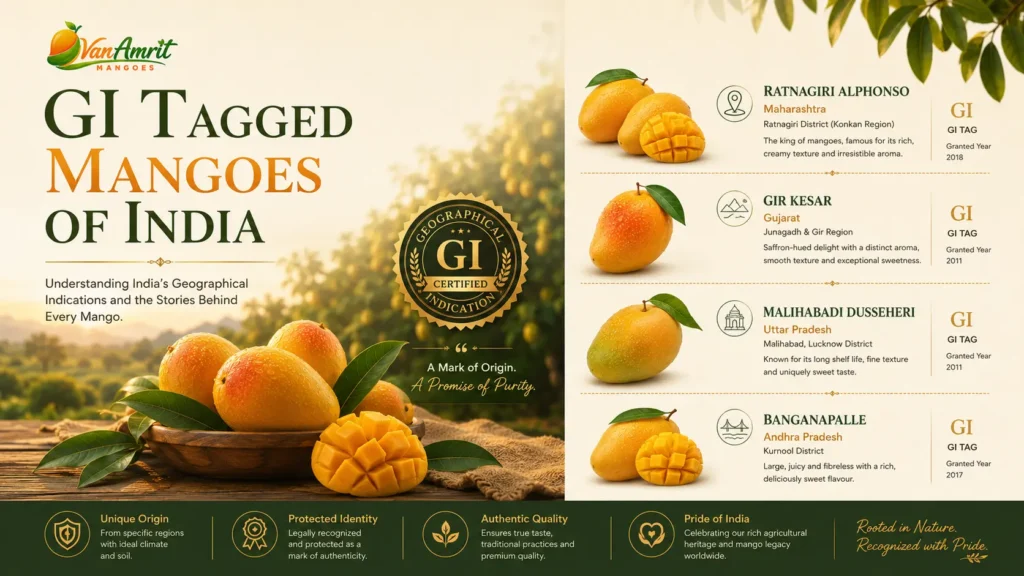
GI Tag Mangoes of India:
Kesar, Alphonso & the Ones You’ve Never Heard Of
India has 12 mango varieties with legal geographical protection. Most people can name two. Here are all twelve — and the stories behind them.
This is exactly the problem a GI tag exists to solve. A Geographical Indication is India’s legal way of saying: this name belongs to this place, and nowhere else gets to borrow it. Right now, India has 12 mango varieties carrying this protection — and chances are, you can name maybe two of them.
In this guide, we’re covering all 12. The household names like Alphonso and Kesar, the regional icons like Dashehari and Banganapalle, and the genuinely obscure ones — mangoes with thousand-fruit harvests from a single tree, mangoes named after the Persian word for apricot, mangoes that ripen in November when every other variety is long gone from the market. By the time you finish reading, you’ll know more about India’s GI mango map than most people who’ve eaten mangoes their entire lives.
🏷️ What Is a GI Tag, and Why Does It Matter for Mangoes?
Think about Champagne for a second. Real Champagne — the sparkling wine kind — can only legally carry that name if it’s made in the Champagne region of France, using specific grapes, using a specific method. Make the exact same wine in California, and legally, you can’t call it Champagne. You’d call it “sparkling wine.”
A Geographical Indication tag does the same thing for Indian agricultural products. It’s a legal certification — issued by the Geographical Indications Registry under India’s Department for Promotion of Industry and Internal Trade — that says a product’s name is protected because it comes from a specific region with genuinely unique, traceable characteristics shaped by that region’s soil, climate, and traditional methods.
For mangoes, this matters more than you’d think. “Alphonso mango” labels show up on fruit grown nowhere near Ratnagiri. “Kesar mango” gets stamped on varieties that have nothing to do with Gujarat’s Saurashtra belt. A GI tag is the closest thing to a verified certificate of origin — it tells you that the laterite soil, the sea breeze, the black cotton soil, whatever made that variety famous in the first place, actually shaped the fruit in your hand.
It also protects the farmers. When a name like “Hapus” can be slapped onto any yellow mango from anywhere, the actual farmers in Ratnagiri and Devgad — whose families have grown this fruit for generations, on soil that genuinely produces something different — lose out. A GI tag draws a legal line: this name, this place, this standard.
India’s GI registry isn’t just about mangoes — it covers everything from Darjeeling tea to Kanchipuram silk. Tamil Nadu currently leads the country with over 69 registered GI products, the highest of any state. But when it comes to mangoes specifically, the protection map stretches from Gujarat’s Saurashtra to Kerala’s Malabar coast — and that’s exactly what we’re exploring here.
🥭 The Complete List — All 12 GI-Tagged Mango Varieties of India
Here’s the full roster, region by region, with the year each one secured its GI status where that information is on record. Some of these you’ll recognise instantly. Others, honestly, might be entirely new to you — and that’s the point.
| Variety | State / Region | GI Year | Known For |
|---|---|---|---|
| Alphonso (Hapus) | Maharashtra — Ratnagiri, Devgad, Raigad, Sindhudurg | 2018 | Buttery texture, jasmine-honey aroma, the global benchmark |
| Gir Kesar | Gujarat — Junagadh, Gir, Talala | 2011 | Saffron-orange pulp, “Queen of Mangoes” |
| Malihabadi Dashehari | Uttar Pradesh — Malihabad, Lucknow | 2010 | Fibreless pulp, centuries-old orchards |
| Banganapalle | Andhra Pradesh — Kurnool, Prakasam | 2017 | Smooth skin, minimal fibre, long shelf life |
| Banarasi Langda | Uttar Pradesh — Varanasi | 2019 | Tangy-sweet, thin rind, kidney shape |
| Himsagar (Khirsapati) | West Bengal — Malda, Murshidabad, Nadia, Hooghly | 2017 | Melt-in-mouth texture, golden flesh |
| Bhagalpuri Zardalu | Bihar — Bhagalpur, Banka, Munger | 2018 | Powerful fragrance, royal heritage |
| Mancurad | Goa | 2022 | Sweet-sour balance, state pride |
| Kuttiattoor | Kerala — Kannur | 2021 | Orange-gold colour, ripens in November |
| Edayur | Kerala — Malappuram | 2021 | Distinct aroma, regional heritage |
| Kari Ishad | Karnataka — Ankola, Karwar | 2023 | Thin skin, eaten whole with the seed |
| Marathwada Kesar | Maharashtra — Marathwada region | — | Distinct from Gir Kesar, semi-arid terroir |
Notice something? GI tags for mangoes have been arriving steadily — 2010, 2011, 2017, 2018, 2019, 2021, 2022, 2023. This isn’t a list that got finalised once and forgotten. It’s an active, growing record of India formally recognising regional mango identities, one application at a time. Kerala alone picked up two GI mango tags in a single year, 2021. Karnataka’s Kari Ishad is the newest addition, granted in March 2023 and valid until 2032.
🟡 Alphonso — The World-Famous King with the Konkan Pedigree
Let’s start with the one everyone’s heard of. Alphonso — or Hapus, as it’s known across Maharashtra and Gujarat — comes from the Konkan coast: Ratnagiri, Sindhudurg, Raigad, and Devgad. And here’s the thing that makes Alphonso genuinely different from “a yellow mango that tastes nice”: the laterite soil along this coastline, combined with sea breeze and coastal humidity, produces a fibre-free, buttery texture and a jasmine-honey-citrus aroma that’s almost impossible to replicate anywhere else.
The GI tag here restricts the name “Hapus” specifically to fruit grown in these designated talukas. Ratnagiri Alphonso tends to ripen earlier — mid-February onward — while Devgad Alphonso peaks in April and May. Brix levels (that’s the measure of sugar concentration, basically how sweet the fruit actually is) typically sit between 18 and 22 percent for export-grade Alphonso, among the highest of any Indian mango.
Here’s an honest aside: Vanamrit also grows and ships Valsad Alphonso (Hapus) from our Chikhli orchard in South Gujarat. Same varietal lineage as the Konkan original, grown in a different terroir, naturally ripened using the traditional hay-bed method. It’s not claiming the Ratnagiri GI — it’s a different region’s expression of the same beloved variety, and we think it’s worth trying on its own terms.
→ Valsad Alphonso (Hapus) Mango — Vanamrit🟠 Gir Kesar — Gujarat’s Saffron Queen
If Alphonso is the king, Gir Kesar is genuinely called the “Queen of Mangoes” — and it earned that nickname honestly. Grown in the Junagadh, Gir, and Talala belt of Saurashtra, right at the foothills of the Gir forest (yes, the same Gir famous for its lions), this variety received its GI tag in 2011.
What gives Kesar its name and its identity is right there in the pulp — a deep saffron-orange colour (“kesar” literally means saffron in Hindi and Gujarati) that comes from the black cotton soil and semi-arid climate of this specific region. It’s more disease-tolerant than Alphonso, fruits from May through June, and has built genuinely strong export demand across Gulf and European markets. Some say it’s one of the few Indian mangoes auctioned directly at the source — that’s how seriously the Talala mandi takes its Kesar.
Now, here’s where we want to be completely upfront with you. Vanamrit grows and sells Valsad Kesar — from Chikhli, in South Gujarat. This is NOT the same as the Gir Kesar GI tag, which is legally specific to the Junagadh, Gir, and Talala belt of Saurashtra. What Valsad Kesar represents is Gujarat’s broader, equally celebrated Kesar-growing tradition — the same varietal DNA, grown in a different part of the state, with its own terroir and its own character. South Gujarat’s Kesar season also runs a bit longer, often extending into July, which gives buyers a wider window to enjoy this variety. If you want the full breakdown of how these two compare — taste, texture, season, everything — we’ve written a dedicated guide for exactly that.
→ Valsad Kesar vs Gir Kesar — Full Comparison → Buy Valsad Kesar Mango🔴 Malihabadi Dashehari — The Fibreless Pride of North India
Travel north, and the GI mango map points you straight to Malihabad, just outside Lucknow, Uttar Pradesh. Malihabadi Dashehari was among the earliest mango varieties to secure GI protection, back in 2010 — and it’s not hard to see why people fought to protect this name.
Dashehari’s defining trait is its completely fibreless pulp combined with a mild, clean sweetness — not the intense tropical punch of Kesar or Alphonso, but something gentler, almost elegant. It also has genuinely good shelf life compared to many premium varieties, which is part of why it travels so well across North India. The season runs June through July, arriving later than the Konkan and Gujarat varieties — which actually works out nicely, because it extends India’s mango calendar by another month or so.
There’s a heritage angle here too that’s worth knowing: the Malihabad belt has centuries-old orchards, some with trees reportedly over a hundred years old. This isn’t a variety that got commercially developed last decade — it’s a living agricultural heritage. Dashehari’s genetics were also influential in breeding programs that gave India hybrid varieties like Amrapali and Mallika, both crosses involving Dashehari and Neelum, designed to be dwarf and regular-bearing.
🟢 Banganapalle — Andhra Pradesh’s Speckled Giant
Head south to Andhra Pradesh, specifically the Kurnool and Prakasam districts, and you’ll find Banganapalle — officially recognised as the state fruit of Andhra Pradesh and GI-tagged in 2017.
You’ll spot Banganapalle instantly by its speckled skin and elongated seed — visually, it stands apart from the smooth-skinned premium varieties of the west coast. It’s large, high-yielding, tolerates extreme heat well, and arrives early in the season — April to May, often among the first GI varieties to hit markets each year. Its smooth skin, minimal fibre, and sweet juicy pulp combined with a generous size make it both a household staple across South India and a serious export pick.
Here’s the thing about Banganapalle — it doesn’t get the gifting-hamper glamour treatment that Alphonso and Kesar get, but walk into any South Indian household during mango season, and there’s a decent chance Banganapalle is what’s actually being eaten at the dinner table. Underrated isn’t the right word. Under-marketed, maybe.
🔵 The Hidden Gems — GI Varieties Most Indians Have Never Tasted
This is the part of the article that earns the title. India has over 1,500 named mango varieties — and only 12 carry GI protection. We’ve covered the famous four. Here are six more that genuinely deserve a spot on your radar, even if you’ll probably never find them at your local fruit stall.
Himsagar (Khirsapati) — West Bengal
Grown in Malda, Murshidabad, Nadia, and Hooghly districts, Himsagar — also called Khirsapati — is thin-skinned, completely fibreless, with golden flesh and a soft, almost melt-in-the-mouth consistency. GI-tagged in 2017, it hits the market around the second week of May and stays available until late June. Bengalis genuinely swear by this one, and once you taste it, you’ll understand why it’s not just regional loyalty talking.
Bhagalpuri Zardalu — Bihar
If mangoes could wear perfume, Zardalu wouldn’t need an introduction — its fragrance announces it before you even pick it up. Grown in Bhagalpur, Banka, and Munger districts of Bihar, this variety has a genuinely fascinating backstory: the first Zardalu sapling was reportedly planted between 1810 and 1820 by Maharaja Rahmat Ali Khan Bahadur of Haveli Kharagpur, and that original “mother tree” has apparently been preserved for over two centuries in Tagepur village. Once reserved for royal gifting, Zardalu received its GI tag in 2018, and in June 2021, the first export consignment — grown organically, with zero pesticides — shipped to the UK from Simri village in the Kahalgaon sub-division.
Banarasi Langda — Uttar Pradesh
Don’t let the name fool you — “Langda” might translate roughly to “limping,” but there’s nothing limping about this mango’s flavour. Discovered originally from a chance seedling, Banarasi Langda is grown in Varanasi’s fertile soil and GI-tagged in 2019. It has a thin rind, yellow-green skin even when ripe, kidney-shaped fruit, and a tangy-sweet balance that makes it the go-to choice for people who want a little zing alongside their sweetness — distinctly different from the milder Dashehari despite both hailing from UP.
Mancurad — Goa
Mancurad is, as locals put it, a matter of state pride — Goa’s best-kept secret. The name itself comes from the Portuguese “malcorado,” meaning badly or poorly coloured — which is almost ironic, because the mango’s reddish, slightly unusual hue is exactly what makes it recognisable. Small, vibrant, and bursting with a sweet-sour balance, Mancurad received its GI tag in 2022, making it one of the more recently protected varieties on this list.
Kuttiattoor — Kerala
Here’s a genuinely strange and wonderful fact: Kuttiattoor mango, grown in Kerala’s Kannur district, ripens in November. While every other variety on this list is a summer fruit, Kuttiattoor flowers as early as mid-November, putting fruit on the market months ahead of the pack. It’s known for its beautiful orange-gold colouring, no speckles or blotches on the skin, and a creamy texture with gentle sweetness. Grown primarily in home gardens rather than commercial orchards, it received its GI tag in 2021 — the same year as its Kerala neighbour, Edayur, which carries its own distinct aroma and regional following in Malappuram.
Kari Ishad — Karnataka
Grown along the Ankola and Karwar coast of Uttara Kannada district, Kari Ishad is the newest entry on this entire list — granted its GI tag on March 31, 2023, valid until 2032. What makes it special isn’t just the taste, though the thin-skinned, juice-rich pulp is genuinely excellent. It’s how it’s eaten: locals consume it whole, seed and all, which tells you something about how much they trust this fruit. A mature Kari Ishad tree can yield up to 2,000 fruits in a single season, though its short five-day shelf life keeps its market largely confined to Ankola, Karwar, and Hubballi. It really is a hidden gem of the Western Ghats — most people outside coastal Karnataka have genuinely never heard of it.
Six varieties. Six states. A mango that ripens in November in Kerala. A two-century-old “mother tree” in Bihar. A fruit eaten whole with the seed in coastal Karnataka. These aren’t marketing stories — they’re the actual diversity of India’s mango heritage, hiding in plain sight behind the four or five names that dominate every supermarket shelf.
Valsad Kesar & Alphonso — Naturally Ripened, Carbide-Free
From our Chikhli, Valsad orchard in South Gujarat — the same Kesar lineage that built Gujarat’s reputation, hay-bed ripened the traditional way. Pan-India delivery in 5–6 days.
🥭 Shop Valsad Kesar & Alphonso →⚖️ Kesar vs Alphonso — Two GI Icons, Compared
Both GI-protected. Both premium. Both genuinely deserve the hype. But Alphonso and Kesar represent two completely different terroirs — Konkan’s coastal humidity versus Saurashtra’s semi-arid black cotton soil — and that difference shows up in everything from texture to how you’d actually use them in your kitchen.
| Factor | 🟡 Alphonso | 🟠 Kesar |
|---|---|---|
| GI Region | Ratnagiri, Devgad, Konkan coast | Junagadh, Gir, Talala (Saurashtra) |
| Brix (sweetness) | 18–22° | Slightly lower, more balanced |
| Texture | Buttery, completely fibre-free, custard-like | Smooth, slightly firmer fibre structure |
| Aroma | Jasmine-honey-citrus, very potent | Saffron-sweet, room-filling |
| Season | Mid-February to May | May to June (July for South Gujarat Kesar) |
| Best for | Eating fresh, gifting, premium retail | Aamras, shrikhand, desserts where colour matters |
| Pulp colour | Golden-yellow | Deep saffron-orange |
If you’re choosing one for a gift box, Alphonso’s universal appeal and silky texture make it the safer bet. If you’re making aamras, shrikhand, or anything where that vivid saffron colour matters visually as much as the taste, Kesar wins every time. And if you genuinely can’t decide — Vanamrit ships both from Valsad, so you don’t have to.
→ Valsad Kesar vs Gir Kesar — Full Comparison → Valsad Alphonso Mango🔍 How to Verify a GI-Tagged Mango Is Genuine
Here’s the catch with GI tags: they certify origin in the legal registry, but they don’t physically travel with the fruit when you’re buying from a roadside stall or an unmarked online seller. So how do you actually know what you’re getting?
Rule one: buy from sellers who can name the specifics. A legitimate source should be able to tell you the district, the harvest date, and the farming practices without hesitation. If a vendor can’t tell you where the fruit came from beyond “it’s Alphonso, trust me” — that’s information they either don’t have or aren’t sharing.
Rule two: season matters as much as the name. This echoes something we’ve written about extensively when it comes to carbide-free ripening — an off-season “GI” claim for any variety is a red flag, full stop. Kesar in February or Alphonso in August should make you pause, regardless of how convincing the label looks.
Rule three: your senses still matter. A GI tag tells you where a mango came from. It doesn’t tell you how it was ripened. Fragrance, colour development, and pulp consistency are still your best tools for verifying that what you’re holding was naturally ripened — not rushed with chemicals. We’ve written a full breakdown of these sensory tests, and they apply across every GI variety on this list, not just Kesar.
→ Carbide-Free Ripening Explained → How to Identify Real Kesar Mango — 5 Signs🌿 Where Vanamrit Fits in India’s GI Mango Story
We’re not going to pretend Vanamrit holds a GI tag, because we don’t — and frankly, claiming one we don’t have would undermine the entire point of this article. What we will say is this: Vanamrit grows Valsad Kesar, Valsad Alphonso (Hapus), and Rajapuri from our orchard in Chikhli, Valsad, in South Gujarat.
Valsad sits within Gujarat’s broader Kesar-growing tradition — geographically adjacent to, but legally distinct from, the Junagadh/Gir/Talala GI region. What that means in practice: the same varietal heritage, the same traditional hay-bed (penda) ripening methods that originated this style of natural ripening across Gujarat, grown in a farm-direct, traceable operation where we can tell you exactly which orchard, which harvest week, and how each batch was ripened.
Here’s the honest pitch: whether you’re drawn specifically to the Gir Kesar GI tradition, or you want to explore what South Gujarat’s own Kesar and Alphonso bring to the table, what actually matters — the thing GI tags exist to protect in the first place — is knowing exactly where your mango came from and how it got to your kitchen. That transparency is something we can offer regardless of which GI box gets ticked.
📅 GI Mango Season Calendar — When Each Variety Is Genuinely in Season
One more practical tool before we wrap up. If you’ve read this far, you now know that “in season” is doing a lot of work when it comes to verifying authenticity — both for GI claims and for natural ripening. Here’s roughly when each major GI variety actually hits its stride.
| Variety | Season | Region |
|---|---|---|
| Banganapalle | April – May | Andhra Pradesh |
| Alphonso | Mid-February – May | Maharashtra (Konkan) |
| Gir Kesar / Valsad Kesar | May – July | Gujarat (Saurashtra / South Gujarat) |
| Himsagar | Mid-May – June | West Bengal |
| Malihabadi Dashehari | June – July | Uttar Pradesh |
| Bhagalpuri Zardalu | June – July | Bihar |
| Kari Ishad | Mid-May onward (short window) | Karnataka |
| Kuttiattoor | November onward | Kerala |
Notice how this calendar tells its own story — Banganapalle and Alphonso open the season, Kesar and Himsagar carry the middle, Dashehari and Zardalu close it out, and then Kuttiattoor in Kerala does its own thing entirely, showing up in November when everyone else has packed up for the year. India’s mango season, when you map it through GI varieties alone, basically never really ends.
→ Best Time to Buy Kesar Mangoes 2026❓ GI Tag Mangoes — Your Questions Answered
🌿 A Map of India, Written in Mango Flavours
Twelve GI-tagged varieties. Nine states. Grant years stretching from 2010 to 2023, with new additions still arriving. If you trace these twelve names on a map, you’ve basically drawn a flavour atlas of India — the laterite coast of Konkan, the black cotton soil of Saurashtra, the centuries-old orchards of Malihabad, the royal heritage of Bhagalpur, the Western Ghats hidden gems most people will never get to taste.
Knowing what a GI tag actually means — and which varieties carry one — turns mango shopping from a casual habit into something a bit more informed. You’re not just buying “a mango.” You’re buying a specific terroir, a specific tradition, sometimes a specific two-hundred-year-old mother tree’s lineage.
Whichever GI region’s flavour calls to you most, the thing that actually matters — the thing GI tags exist to protect — is the journey from orchard to your table being honest. Naturally ripened. Transparently sourced. With a story behind it that someone can actually tell you, if you ask.
“Twelve names. Twelve places. One country’s incredible mango heritage — most of it still waiting to be discovered.” 🥭🌿
Valsad Kesar & Alphonso — Naturally Ripened in Hay, Carbide-Free
The same Kesar lineage and traditional ripening methods that built Gujarat’s mango reputation — grown at our Chikhli, Valsad orchard, harvested at the right maturity, and shipped pan-India in 5–6 days.
🥭 Order at vanamrit.inBulk orders, gifting or questions: vanamrit.in/contact | WhatsApp: +91 9033595016