
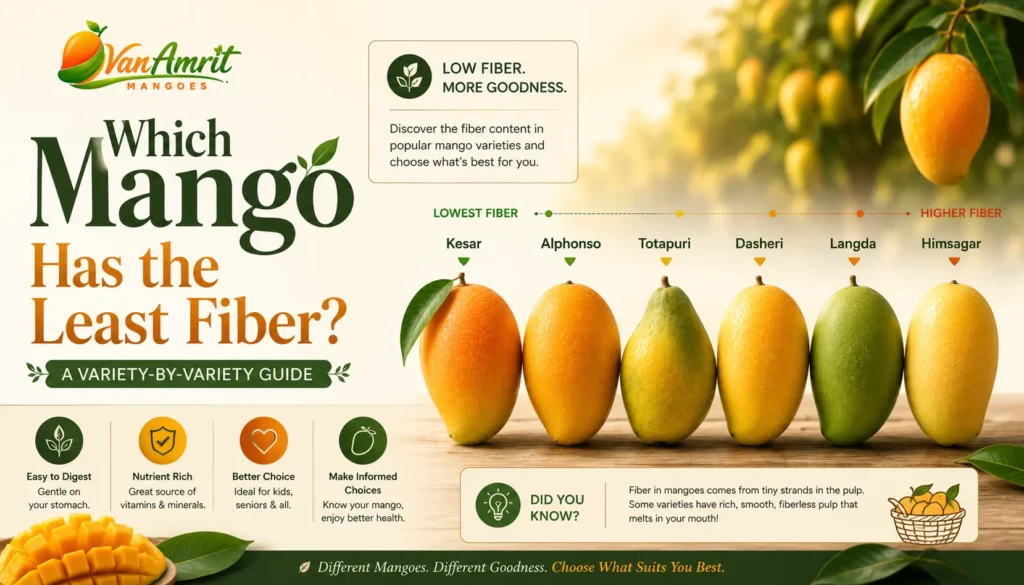
Which Mango Has the Least Fiber?
Alphonso, Kesar, Dasheri, Banginapalli — a variety-by-variety guide for Indian mango lovers who want the smoothest eating experience possible.
If you’ve ever bitten into a Totapuri and hit a wall of fibrous resistance, you know exactly what we’re avoiding in this guide. And if you’ve ever cut open an Alphonso and marvelled at how the pulp just disappears on the tongue — mango-flavoured silk, edge to edge — you know exactly what we’re chasing.
So which Indian mango has the least fiber? The short answer: Alphonso and Banginapalli lead the pack, with Kesar, Dasheri, and Himsagar following very close behind. But the full answer — the one that helps you pick the right mango for aamras, for your kids, for gifting, for freezing pulp — is what this guide covers.
🔬 First: Why Do Mangoes Have Fiber at All?
Before we compare varieties, it helps to understand what we’re actually talking about. The stringy bits in a mango aren’t random — they’re vascular bundles, the internal structures that carry water and nutrients from the tree through the fruit during development. Think of them as the mango’s plumbing system, built during growth.
Whether a mango has coarse, chewable strings or a perfectly smooth pulp is almost entirely genetic. It’s a variety-specific trait baked into the plant’s DNA — not a sign that the mango is unripe, overripe, or low quality. An Alphonso will always be smooth. A Totapuri will always have more fibre. You can’t ripen or chill your way to a different texture.
Just like soil affects wine grapes, the growing environment subtly influences mango texture. Valsad Kesar, grown in alluvial coastal soil with high moisture and gentle warmth, tends to produce a silkier, more mellow pulp than Gir Kesar from Saurashtra’s drier, mineral-rich laterite soil. Same variety. Different land. Slightly different feel on the tongue.
There are essentially three categories of mango fibre in Indian varieties: zero-to-trace fibre (Alphonso, Banginapalli — genuinely no strings), fine fibre near the seed only (Kesar, Dasheri — smooth eating flesh with whisker-thin strands only right at the stone), and fibre distributed through the pulp (Chausa, Langra, Totapuri — noticeable strings throughout). The good news? India produces several world-class fiberless varieties. Here’s how they stack up.
📊 Indian Mango Fiber Comparison — At a Glance
Bookmark this table. Share it with whoever buys the mangoes at home. The fiber ratings below are based on widely observed buyer-grower-nutritionist consensus — there’s no single standardised lab test across varieties, but the pattern is consistent and well-established across decades of cultivation.
| Variety | Region | Fiber Level | Texture Feel | Season |
|---|---|---|---|---|
| Alphonso (Hapus) | Ratnagiri, Maharashtra | Nearly Zero ●●●●● | Buttery, custard-like, melts in mouth | April – June |
| Banginapalli (Safeda) | Andhra Pradesh | Zero / Minimal ●●●●● | Clean, smooth, juicy — no strings at all | April – June |
| Imam Pasand | Andhra / Telangana | Almost Zero ●●●●● | Rich, regal, creamy — zero strings | May – July |
| Kesar (Valsad / Gir) | Valsad & Gir, Gujarat | Very Low ●●●●○ | Smooth saffron pulp; fine fibres near seed only | May – July |
| Dasheri | Lucknow, UP | Very Low ●●●●○ | Aromatic, juicy, fine-grained pulp | June – July |
| Himsagar | West Bengal | Low ●●●●○ | Thick, intensely sweet, creamy | May – June |
| Mallika (hybrid) | Pan-India | Zero / Minimal ●●●●● | Clean, sweet — engineered for smooth eating | June – July |
| Chausa | Bihar, UP | Medium ●●●○○ | Juicy, sucking-style eating, some fibre | July – Aug |
| Langra | Varanasi, UP | Medium ●●●○○ | Tangy-sweet, firmer, noticeable fibre | June – July |
| Totapuri | South India | High ●●○○○ | Firm, clearly fibrous, tangy throughout | May – July |
🥇 Alphonso (Hapus) — The Gold Standard of Fiberless
If you’ve ever tasted a properly ripe Alphonso, you already know what zero fibre feels like. The pulp is buttery, custard-like, and genuinely melts on the tongue — no strings, no chewing required, no resistance whatsoever. It’s the mango equivalent of a perfectly ripe avocado: smooth from skin to stone, rich without being heavy, dissolving before you’ve even swallowed.
Grown primarily in Ratnagiri and Devgad on Maharashtra’s Konkan coast, Alphonso owes its famously smooth texture to both genetics and the specific laterite soil and coastal microclimate of that region. It holds a GI tag (2018) — meaning only mangoes from that belt can legally carry the Alphonso name.
When to choose Alphonso
- Eating fresh where texture matters most — zero strings, pure experience
- Gourmet desserts, mango panna cotta, shrikhand, mousse
- Baby food — the safest mango for a child’s first bite
- Premium gifting — the most universally recognised mango in India
- Aamras where you want bold complexity over sweetness alone
Alphonso is expensive (₹900–₹3,500/dozen at peak), has a short season (April–June only), and is easy to fake. Many vendors sell ordinary yellow mangoes as “Hapus.” A genuine Alphonso has an unmistakable deep, apricot-honey fragrance before you even cut it. No fragrance = not authentic. For more on spotting the real thing, see our guide on how to identify authentic premium mangoes →
🌟 Kesar — Gujarat’s Fiberless Queen
Here’s what most articles get wrong about Kesar: they call it “slightly fibrous” and leave it at that. The truth is far more nuanced — and far more flattering to the Queen of Mangoes. The eating flesh of a ripe Kesar is smooth, clean, and practically string-free. The only place you’ll find fine fibres is right at the seed — and that’s not where you’re eating from anyway.
Cut open a ripe Kesar and scoop the pulp into a bowl for aamras. Blend it. What you get is a smooth, deep saffron-orange purée without a single visible thread. That’s not an accident — that’s exactly why Kesar has been Gujarat’s aamras mango for nearly a century. If it were genuinely stringy throughout, every Gujarati grandmother would have switched to something else generations ago.
Valsad Kesar — Even Silkier
Valsad Kesar specifically tends to produce an even silkier, more mellow pulp than Gir Kesar. The alluvial coastal soil of South Gujarat — nutrient-rich, moisture-retentive, and deeply loamy — encourages a fruit that’s smooth-forward rather than tangy-bold. The honey-sweet texture that results is why Valsad Kesar is the preferred choice for aamras, shrikhand, and mango lassi among South Gujarat’s mango community.
- All scoopable eating flesh
- Blends into aamras perfectly
- Fine pulp for lassi and shrikhand
- Deep saffron colour throughout
- Silkier in Valsad’s coastal soil
- Thin layer right at the seed only
- Not in scoopable or sliceable pulp
- Invisible in any blended preparation
- Not encountered when cutting cheeks
- Best for: Traditional aamras, shrikhand, mango lassi, eating fresh, freezing pulp
- Season: May–July — longer than Alphonso, better value for repeated buyers
- Price: Accessible and competitive — world-class quality without the Alphonso premium
- Vanamrit’s Kesar is naturally ripened in hay beds (penda) — no carbide, no ethylene chambers
Curious about what separates Valsad Kesar from Gir Kesar? Soil, season, taste, GI tag, price — we cover every detail in our deep-dive comparison.
Read: Valsad Kesar vs Gir Kesar — What’s the Real Difference? →
🌞 Banginapalli (Safeda) — The Everyday Fiberless Hero
Banginapalli is Andhra Pradesh’s crown jewel — and one of the most consistently fiberless large mangoes in India. No strings. No chewy bits. Just clean, smooth, golden-yellow flesh from skin to stone. It’s what people mean when they say the “everyday eating mango” — consistent sweetness, a generous size (250–400g per fruit), and absolutely zero fibre drama.
Unlike Alphonso, Banginapalli isn’t aggressively aromatic or intensely complex. The sweetness is straightforward and refreshing — more like a beautifully ripe, clean fruit than a gourmet flavour experience. Which makes it ideal for anyone who wants a reliable, smooth mango without paying premium prices. Called Safeda in North India.
- Zero strings — the most reliably fiberless large mango in India
- Excellent for daily eating, family packs, and kids
- Affordable — accessible quality at every budget
- Great for fresh juice, smoothies, and milkshakes
- High Vitamin C — one fruit covers close to your full daily requirement
🌾 Dasheri — North India’s Aromatic Fiberless Favourite
Dasheri is Lucknow’s gift to the mango world — one of India’s oldest cultivated varieties, celebrated for its distinctive floral fragrance and fine-grained, very-low-fibre pulp. It’s not custard-like the way Alphonso is; the texture is more juicy and refreshing than rich and dense. But the eating flesh? Smooth, aromatic, and without the strings that complicate the less refined varieties.
The season runs June–July, making Dasheri an excellent late-season choice when Alphonso and early Kesar have wound down. If you want a smooth mango in July without resorting to fibrous varieties, Dasheri is your answer. Best for: milkshakes, fresh eating, mango lassi, and sucking straight from the skin — it lends itself beautifully to that experience.
💎 Two More Low-Fiber Gems Worth Knowing
Himsagar is West Bengal’s finest — a short-season (mid-May to mid-June) variety with intensely sweet, thick, creamy pulp and very low fibre. People who’ve tasted Himsagar often say it’s the richest-flavoured mango in India — a bold claim when Alphonso is in the conversation, but one many would agree with. If you’re in Eastern India during peak season, it’s worth hunting down.
Mallika is a Neelam × Dasheri hybrid — developed with excellent shelf life and fiberless pulp engineered right into its genetics. Available June–July, ships well, and delivers a clean sweet eating experience that makes it one of the better online-order choices when the early-season premium varieties are gone.
And a connoisseur’s honourable mention: Imam Pasand from Andhra Pradesh and Telangana — called the “Mango of the Nawabs” — has almost zero fibre and a rich, regal creaminess that makes it a premium gifting choice for anyone who knows their mangoes.
Want to know all Indian mango varieties — all 20+ of them? From Alphonso to Zardalu, our state-by-state guide covers season, taste, and GI tags.
🧵 The Fibrous Side: Mangoes That Own Their Strings
Let’s be fair to the fibrous varieties — fibre isn’t a flaw. It’s a different eating experience, suited to different uses, and each of these varieties is genuinely beloved for what it does.
Chausa from Bihar and UP is intensely sweet and enormously juicy — its eating style is literally sucking. You hold it, press it, and drink. The fibre is part of the experience. Langra from Varanasi has a complex tangy-sweet profile with a firmer texture and noticeable fibre; it’s prized for raw mango pickles, aam panna, and chutneys where that firmness and tang are exactly what you want. Totapuri is the most fibrous of the major varieties — grown across South India, it’s the backbone of India’s commercial mango pulp industry and fantastic for preserves, but less ideal for fresh smooth eating.
Fibre in mango also isn’t nutritionally bad. More on that shortly.
🎯 So — Is Kesar Mango Actually Fiberless?
Let’s answer the question people type most often: is Kesar mango fiberless?
The honest answer: not 100%, but close enough that it doesn’t matter for most uses. The eating flesh of a ripe Kesar — the part you scoop, slice, and blend — is smooth and clean. Fine fibres exist only right at the seed, in the thin layer between pulp and stone. You won’t encounter them unless you’re sucking the stone clean.
For aamras — the sweetened mango pulp that’s the centrepiece of a Gujarati summer thali — Kesar is the traditional and preferred choice. It blends to a perfectly smooth, deeply aromatic purée. The same goes for shrikhand, mango lassi, and frozen pulp. If Kesar were genuinely stringy, Gujarati grandmothers would have noticed centuries ago and switched to something else.
Paying Kesar prices but not getting real Kesar? Here are 5 definitive signs — fragrance, pulp colour, shape, taste, and source — that separate authentic from fake.
Order Naturally Ripened Valsad Kesar Mangoes
Every Vanamrit Kesar is harvested by hand and ripened in traditional hay beds (penda). No carbide. No ethylene chambers. Just smooth, saffron-orange Kesar at its honest best — farm-direct from our Valsad orchard to your table, pan-India.
🥭 Shop Vanamrit Kesar Mangoes →🛒 Which Fiberless Mango Should You Buy? Use-Case Guide
Different smooth mangoes suit different purposes. Here’s a quick reference so you always pick the right variety for exactly what you need:
Just ordered a crate? Don’t let any go to waste. Our complete storage guide covers room temperature, fridge, freezer, and pulp — with USDA-verified shelf-life data.
💊 Does “Fiberless” Mean Less Nutritious?
This is a really common concern — if I choose a smooth, fiberless mango, am I giving up the nutritional benefits of fibre? The answer is no, and here’s why.
When people say a mango is “fiberless,” they mean there are no visible, chewable strings. But dietary fibre — the kind that appears on nutrition labels and aids digestion — lives in the cell walls of the fruit itself, not in those vascular bundles. It’s present throughout the pulp whether you can see it or not.
Per USDA FoodKeeper data, mango delivers 1.6–2.8g of dietary fibre per 100g of fruit — consistent across smooth and fibrous varieties alike. An Alphonso or Kesar — despite feeling perfectly smooth to eat — still delivers dietary fibre, Vitamin C (54% DV), beta-carotene, Vitamin B6, and potassium with every bite. Choosing a fiberless variety changes the texture. Not the nutrition.
Mango also contains amylase — a digestive enzyme that helps break down complex carbohydrates and aids digestion. Present in all varieties, regardless of string content. It’s part of why a ripe mango after a heavy meal feels like exactly the right dessert choice.
🏆 The Verdict — Which Fiberless Mango Wins?
If you need a single answer: Alphonso is the most fiberless mango in India. There is genuinely not a single visible string from skin to stone. For anyone who wants the ultimate smooth mango experience and is willing to pay the premium, Alphonso is the answer.
But if you want smooth and aromatic and versatile and better value and a longer season — Kesar is the mango you want. It punches so close to Alphonso in eating experience that most people, in a blind tasting, would call the Kesar pulp completely smooth. And for aamras specifically — the dish most Indians actually make with their premium mangoes — Kesar is the traditional, correct answer.
🥇 Go Alphonso if…
- You want absolute zero fibre guaranteed
- You’re making gourmet desserts
- You want the most complex flavour profile
- You’re buying as a premium gift
- Budget is not the primary concern
🌟 Go Kesar (Valsad) if…
- You want smooth pulp + saffron aroma
- You’re making aamras or shrikhand
- You want a longer season (May–July)
- You want farm-direct value and quality
- You’re Gujarati and you already know
❓ Mango Fiber Questions, Answered
🏁 The Smooth Truth About Indian Mangoes
🥭 The One-Line Guide That Covers Everything
If you want absolutely zero fibre — Alphonso. If you want smooth + aromatic + affordable + a longer season + the best aamras in the world — Kesar. If you want daily smooth eating at every budget — Banginapalli. Everything else follows from those three rules.
The bonus insight: mango texture matters most when you start with genuinely good fruit. A naturally ripened, carbide-free Valsad Kesar delivers pulp that’s not only near-fiberless but tastes the way mango is supposed to taste — deep saffron colour, room-filling fragrance, and a sweetness that no artificially ripened substitute can fake.
Proper mango quality and mango texture are the same conversation. The variety matters. But it matters most when the fruit was grown and ripened honestly to begin with.
“The smoothest mango of your life is one bite away — you just need to know which crate to open.” 🥭🌿
📚 Read Next
Farm-Fresh Valsad Kesar — Naturally Smooth. Honestly Grown.
Our Kesar mangoes arrive green-mature from our Chikhli orchard, ripened in traditional hay beds, and delivered pan-India in 5–6 working days. No carbide. No cold-storage delays. Zero compromise on quality or texture.
🥭 Order Vanamrit Kesar Mangoes →Questions about bulk orders, gifting, or our farm? Contact us here or WhatsApp: +91 9033595016