
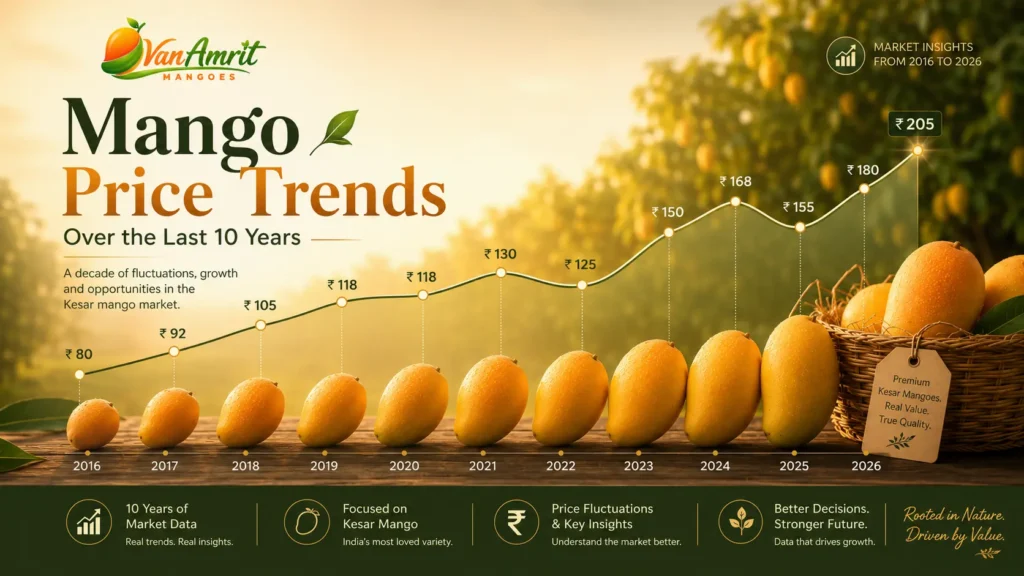
Mango Price Trends Over the Last 10 Years:
What Really Changed?
From ₹30/kg at the mandi in 2015 to ₹2,000 per dozen in 2026 — a decade of data, five structural drivers, and your smart buyer’s guide for getting the best value this season.
Something has changed. Every summer, it gets a little more expensive to love mangoes the way Indians have always loved them. And the shift isn’t just the kind of gradual, predictable price creep you see with vegetables. The mango price trend in India over the last 10 years is a story of droughts and cyclones, GI tags and export booms, carbide controversies and farm-direct revolutions. It’s more interesting — and more telling — than simple inflation.
This guide walks through the full decade, 2015 to 2026, with real data. What happened each year. Why prices moved the way they did. And what it means for how you buy mangoes right now.
Trying to time your 2026 mango purchase? Our 2026 Kesar season timing guide tells you exactly when to buy for peak quality at the best price.
📊 The Big Picture: India’s Mango Market in Numbers
Before we go year by year, it helps to understand the scale we’re talking about. India isn’t just a big mango market. It’s the mango market. India produces roughly 40 to 50 percent of the world’s mangoes — over 25 million tonnes during the 2024–25 season alone. That’s more mango than the next five largest producing countries combined.
The market is growing — projected from USD 2.30 billion in 2025 to USD 3.43 billion by 2031, at a CAGR of 6.9%. Global mango exports crossed $1.66 billion in 2024 and are growing at 8% annually. These aren’t niche numbers. The Indian mango is becoming a global commodity at the same time it’s becoming more expensive at home. Those two things are directly connected, and that connection is the central story of the last decade’s mango price trends in India.
📅 Year by Year: A Decade of Mango Price Changes (2015–2026)
Let’s go through it the way it actually happened — one year, one price shift, one cause at a time. This is the clearest way to see how the mango price trend over the last 10 years was shaped not by one big event but by a sequence of overlapping forces.
-
20152015–2016 — The Stable Base📌 Baseline YearThis is the price floor the decade launched from. Kesar mango wholesale sat at roughly ₹25–40/kg at the mandi. A dozen retail Alphonso would cost you ₹300–500 depending on grade. The D2C mango market barely existed — almost everything moved through aggregators, mandis, and wholesale channels. GI-tagging existed legally (Kesar received its GI tag in 2011) but hadn’t yet translated into a significant consumer price premium. Buyers and farmers both operated with relatively predictable seasonal pricing.Kesar wholesale: ~₹25–40/kg | Alphonso dozen: ₹300–500
-
20172017–2018 — The First Disruption🌧️ Unseasonal Rains + E-Commerce EntryUnseasonal rains and cyclone-related crop stress in Maharashtra began disrupting Alphonso yields more regularly from this period. Export price data from Selinawamucii shows India’s mango export price was $1.06/kg in 2017, rising steadily from there. More importantly: this was the period when BigBasket, Amazon Fresh, and Flipkart began entering fresh produce delivery. The idea that you could order mangoes online from a farm and receive them at home was beginning to feel like a real option rather than a novelty. Prices crept upward as e-commerce platforms added their own margins and began building consumer expectations around quality and origin.Export price: $1.06–1.04/kg | Retail prices begin rising 10–15% YoY
-
20192019 — Climate Volatility Becomes the Story🌡️ Extended Heat Reduces Gujarat Flowering2019 was the year climate-driven crop disruption stopped being an occasional problem and became a regular expectation. Extended heat across Gujarat during the critical winter-to-spring transition reduced mango flowering significantly. When trees don’t flower fully, fruit set is lower, and supply contracts sharply. Premium Kesar and Alphonso prices rose 15–20% over the previous year. For buyers, this was the first season that felt genuinely expensive without an obvious explanation beyond “the weather was bad.” But it wasn’t a one-off — it was a preview of the decade’s defining pattern.Kesar wholesale: ~₹45–65/kg | 15–20% price rise over 2018
-
20202020 — The COVID Price Paradox🔒 Lockdown Creates Farm-Gate Crash + City SpikeCOVID-19 lockdowns created one of the most dramatic pricing paradoxes the Indian mango market had ever seen. On one side: harvests were good in many regions, but transport restrictions meant fruit couldn’t move. Farm-gate prices collapsed in some districts as excess ripe mangoes piled up with no logistics to shift them. On the other side: city consumers faced extreme scarcity as mandis and supply chains shut down. The disconnect between ₹8/kg farm prices and ₹120/kg retail city prices in the same fortnight was startling. This crisis permanently accelerated one trend: farm-direct, D2C delivery. Buyers who figured out how to order from farms during lockdown didn’t go back to the mandi. The D2C mango economy was born in 2020.Farm-gate: ₹8–15/kg (glut) | City retail: ₹100–150/kg (scarcity)
-
20212021 — Cyclone Tauktae Devastates Gujarat Kesar🌀 Worst Crop Loss in a GenerationCyclone Tauktae hit the Gujarat coast in May 2021 — precisely at the peak Kesar harvest window — and destroyed orchards across Gir-Somnath, Valsad, and coastal South Gujarat districts. The damage was severe. Gujarat Kesar output fell sharply for the season. Genuine, authentically sourced Kesar became genuinely scarce and expensive. This was simultaneously the year that carbide-ripened Kesar substitutes flooded the market most aggressively — vendors filling the gap with inferior, chemically treated product at Kesar prices. For buyers who couldn’t tell real Kesar from the imitation, it was a season of paying premium prices for sub-premium fruit. The authenticity premium — the gap between verified, naturally ripened Kesar from a traceable farm and carbide-market substitutes — widened dramatically and never fully narrowed back.Genuine Kesar: record retail highs. Mislabelled market “Kesar”: cheaply available but poor quality
-
20222022–2023 — Recovery, But Prices Don’t Fall Back📈 Premiumisation Permanently Reprices KesarOrchards began recovering from Tauktae damage. Production normalised. Statledger data covering India’s Mango Price Trend (Annual Average Prices, 2015–2023) shows a consistent upward trajectory across the decade with no significant reversion after the Tauktae spike. The market had permanently repriced premium Kesar upward. D2C farm-direct brands consolidate their position. Tridge data confirms the wholesale price range climbing: 2023 wholesale prices ranged from $0.29 to $1.21 USD per kg — the wide range reflecting the massive quality difference between premium and commodity fruit. Consumer preference shift toward naturally ripened, traceable mangoes accelerates.2023 wholesale: $0.29–$1.21/kg USD (wide quality range)
-
20242024 — The Export Surge Year🌍 Global Demand Pulls India’s Prices UpwardGlobal mango exports crossed $1.66 billion in 2024. India’s fresh mango exports reached 32,104 MT valued at USD 60.14 million in FY 2023–24 — a remarkable 40% volume increase over the prior year (APEDA data). Tridge records show wholesale prices for 2024 rising to $0.37–$1.54 USD per kg, up from 2023’s range. Export request surge for Kesar hit 38% in Q2. India’s domestic buyer is now effectively competing with import buyers in Dubai, Seattle, and London when purchasing premium Kesar. That competition has a price. China’s mango prices fell 17–29% month-on-month in early 2024 due to an early harvest glut — showing how India’s market is now globally connected and can be affected by events thousands of kilometres away.2024 wholesale: $0.37–$1.54/kg USD | Exports: +40% volume YoY
-
20252025 — Volatile: Good Crop Elsewhere, Gujarat Hit Again⛈️ 50% Lower Gujarat Kesar Crop From Storms2025 opened with a good crop in Uttar Pradesh and Maharashtra — Langra and Alphonso prices relatively stable in early season. But Gujarat Kesar took another hit: the 2025 Kesar crop was 50% lower than 2024 due to unseasonal summer storms, pushing 10 kg export cartons to ₹800–1,000. Goodreturns confirmed by May 2026 that season-to-season price swings of 30–40% are now “the norm rather than the exception” for Indian consumers. D2C mango platform MangoPoint raised funding in August 2025, validating the commercial case for farm-direct delivery. Kesar purchases increased in Q2 2025 driven by younger consumers preferring naturally ripened fruit (Mordor Intelligence, January 2026).Gujarat Kesar 10 kg export carton: ₹800–1,000 | 30–40% swings now normal
-
20262026 — Alphonso Collapses 80–85%, Kesar Stabilises🌡️ Maharashtra Climate Catastrophe + Kesar Recovery2026 has brought a genuinely dramatic price story for Alphonso. The Konkan season experienced an 80–85% production collapse in Maharashtra — a December cold wave, prolonged cloudy spells, and high humidity during flowering severely damaged pollination and fruit set. Karnataka also fell ~50%. Alphonso retail prices jumped to ₹800–2,000 per dozen in Mumbai (vs ₹600–1,000 last year). Totapuri prices expected 45–50% up; Alphonso 25–30% up (Paiyur Group, April 2026). On the brighter side: Gujarat projects significantly higher Kesar output in 2026, partially offsetting the Alphonso shortage. Current live mandi rate (June 9, 2026): ₹49–52/kg average across all varieties. Indian Kesar mangoes now available in selected Costco stores in Seattle, USA — demand going global in real time.Alphonso dozen Mumbai: ₹800–₹2,000 | Mandi average: ₹49–52/kg | Kesar: recovering
🔑 Why Mango Prices Keep Rising: Five Structural Drivers
Reading through that decade, you’ll notice it’s not one thing. The mango price increase in India over the last 10 years is driven by five overlapping forces that reinforce each other. None of them are going away. All of them will continue shaping prices through the next decade.
Climate Volatility
Shorter winters mean erratic flowering. Cyclones hit during harvest. Unseasonal rains damage fruit set. Season-to-season swings of 30–40% are now “the norm” — that’s not a bug in the system, it’s the new operating condition for Indian mango farming.
Global Export Demand
India’s domestic buyer competes with Dubai, Seattle, and London when buying premium Kesar or Alphonso. As exports grow 8% annually, the global price floor pulls domestic prices upward. Costco now carries Indian Kesar in the USA.
Premiumisation of GI Varieties
Affluent Indian consumers and young urban buyers prefer GI-tagged, traceable mangoes. The Mordor Intelligence 2026 report confirms: Kesar purchases rose in Q2 2025 driven by younger consumers preferring naturally ripened fruit. The premium for authenticity has widened significantly since 2018.
D2C Platform Premium
Farm-direct delivery adds a 20–40% premium over mandi prices — but buyers pay it willingly for traceability, carbide-free guarantees, and consistent grading. MangoPoint raised funding in August 2025, validating this market commercially.
Post-Harvest & Logistics Costs
Cold-chain investment, packaging improvements, and phytosanitary compliance for exports add cost layers. Mother Dairy’s two new processing plants signal a shift from fresh-only trade to value-added processing — which adds margins at every stage.
🟠 Kesar Mango Price: What a Decade Did to the Queen of Mangoes
Out of all the Indian mango varieties, Kesar’s price journey is probably the most interesting — because it combines the general market forces above with a very specific story about authenticity, terroir, and the growing value of knowing where your food actually comes from.
| Period | Kesar Wholesale (kg) | Retail Dozen | Key Driver |
|---|---|---|---|
| 2015–2016 | ₹25–40/kg | ₹200–350 | Stable baseline — limited national awareness |
| 2017–2018 | ₹35–55/kg | ₹300–500 | E-commerce entry, first GI premium awareness |
| 2019 | ₹45–65/kg | ₹400–600 | Climate-reduced flowering, 15–20% rise |
| 2020 | ₹8–90/kg (paradox) | Variable | COVID — farm-gate crash + city retail spike |
| 2021 | Record highs | Record highs | Cyclone Tauktae — 50%+ Gujarat crop loss |
| 2022–2023 | ₹60–90/kg | ₹600–900 | Recovery — but prices don’t fall back |
| 2024 | $0.37–1.54/kg USD | ₹700–1,100 | Export surge +40% volume, global demand |
| 2025 | ₹800–1,000 / 10kg box | ₹700–1,200 | Gujarat 50% lower crop from storms |
| 2026 | Recovering | ₹700–1,200 | Gujarat higher Kesar output; Alphonso collapsed |
The most significant pricing development of the decade isn’t just the rising average — it’s the widening gap between authentic, naturally ripened Kesar from a traceable farm and carbide-ripened market substitutes. That premium exists because of exactly what Cyclone Tauktae demonstrated: when genuine Kesar supply tightens, the market floods with inferior product at Kesar prices. Buyers who pay premium prices deserve to know they’re getting the real thing.
Understanding how to tell genuine Kesar from an imitation matters more when you’re paying 2026 prices. Our 5-sign guide to identifying real Kesar mango gives you the fragrance test, colour test, and water test that separate the authentic from the fake. And why does South Gujarat’s Valsad Kesar often offer better value than Gir Kesar at comparable quality? Our Valsad vs Gir Kesar comparison breaks it down.
🏆 Alphonso Mango Price Trends: The King Gets Even More Expensive
If Kesar’s price story is about growing premiumisation, Alphonso’s is about scarcity. The 2026 season brought genuinely dramatic news: Maharashtra’s Konkan belt experienced an 80–85% production collapse — a December cold wave and prolonged cloudy spells during the critical flowering stage hammered pollination. Karnataka fell approximately 50%. The result? Alphonso retail prices reached ₹800–2,000 per dozen in Mumbai in 2026, up sharply from ₹600–1,000 the year before.
But this isn’t just a 2026 anomaly. It’s the culmination of a decade-long trend. Paiyur Group’s April 2026 India Mango Season forecast expected Alphonso prices to rise 25–30% compared to the previous season. The export-price linkage compounds this: Alphonso pulp retails at £8–12/kg in British supermarkets, and Konkan Alphonso commands India’s highest domestic prices precisely because GI protection, export demand, and strict grading combine to create a premium that doesn’t compress even in good-harvest years.
The practical implication for 2026 buyers? Kesar is now the better-value premium mango by a significant margin. At comparable sweetness (18–22° Brix for Kesar vs 20–22° for Alphonso) and with a longer season, Kesar in 2026 offers everything Alphonso delivers at 20–40% lower cost — and with Gujarat projecting higher Kesar output this season, supply is more reliable than it’s been in two years.
Curious how Valsad’s unique soil and coastal climate makes its Kesar taste different even from Gir Kesar? Our dedicated guide on why Valsad mangoes taste different explains the alluvial soil science behind the flavour.
While Alphonso Prices Soar — Valsad Kesar Delivers More for Less
With Maharashtra’s Alphonso crop down 80–85%, Valsad Kesar is the smart 2026 choice — comparable sweetness, deeper saffron colour, longer season, and transparent farm-direct pricing from our Chikhli orchard.
Order Farm-Fresh Valsad Kesar →🌍 India Grows Half the World’s Mangoes — So Why Does Mexico Earn More?
Here’s the most surprising data point in the entire Indian mango story: India is the world’s largest producer, accounting for 40–50% of global output. Yet in export earnings per kg, India consistently underperforms Mexico, Peru, and Thailand. This paradox is central to understanding why domestic mango prices are rising.
The reason is structural. India exports mostly pulp, not fresh mangoes. Despite India exporting only 55,000–70,000 metric tonnes of fresh mango annually (per APEDA), compared to Mexico’s far larger fresh volumes, the bulk of India’s export revenue comes from processed mango pulp. Saudi Arabia and the Netherlands are the biggest buyers of Indian mango pulp — which ends up in European smoothies and Middle Eastern nectars at commodity pricing, not premium retail pricing.
The gap is staggering. A kilogram of Alphonso pulp retails at £8–12 in British supermarkets. The farmgate price for the same kg in Ratnagiri is ₹120–200. The value capture — the difference between what the mango is worth at retail and what the farmer gets — is enormous, and the processors and retailers capture almost all of it.
What’s changing: APEDA’s Mango Mania 2025 initiative targets improved sea freight protocols and new markets in Japan, South Korea, and Australia. India’s fresh mango exports grew 40% in volume in FY 2023–24. Kesar mangoes are now available in selected Costco stores in the USA. This shift toward fresh premium exports will continue pulling domestic prices upward through 2031 and beyond — the global market for Indian premium mangoes is being built right now.
🧪 The Carbide Problem and the D2C Revolution — Two Pricing Stories That Define the Decade
No honest account of the last decade’s mango price trends can avoid the carbide issue. Because calcium carbide ripening creates a market distortion that affects prices across the entire mango economy — and the corrective force, the D2C farm-direct revolution, has become one of the decade’s most important commercial stories.
Here’s how the distortion works. Carbide allows unscrupulous vendors to ripen ordinary mangoes — or even poor-quality or immature fruit — cheaply and quickly, then label it “Kesar” or “Alphonso” and sell at premium prices. The result: a compressed legitimate price floor for authentic premium varieties. Buyers who can’t distinguish real Kesar from carbide-treated imitation pay premium prices for inferior fruit. After one season of disappointment, some stop buying premium mangoes entirely. The category suffers.
The D2C farm-direct counter-trend is the market’s correction to this distortion. In 2015, D2C mango delivery barely existed. By 2026, it’s a significant market segment — and buyers are paying 20–40% premiums over mandi prices for traceability, carbide-free guarantees, and consistent grading. MangoPoint raising funding in August 2025 is one data point. The growth of brands like Vanamrit is another.
What that D2C premium actually buys you: know the farm name and location. Know the variety is genuinely what’s labelled. Know the ripening method — natural hay-bed, not carbide. Know the harvest stage was correct. These aren’t luxury features. For a buyer paying ₹1,000/dozen, they’re the minimum reasonable expectation.
Once you receive your naturally ripened Kesar, knowing how to keep it at peak quality matters too. Check our guides on the best containers for mango storage and how to keep cut mango fresh — both help ensure the mango you paid for stays at its best until you eat it. And if you’re ripening mangoes at home after delivery, our complete ripening guide covers every natural method from the paper bag to the rice technique.
🛒 The Smart Mango Buyer’s Guide for 2026 — How to Get Maximum Value
Given everything above — the climate volatility, the export-driven price floor, the carbide market distortion, the Alphonso collapse, the Kesar recovery — what’s the smartest way to buy mangoes in 2026?
- Skip early-season April mangoes entirely. April prices are the highest of the year. Supply is lowest, novelty drives consumer excitement, and fruit is often below peak ripeness. You’re paying the most for the least. Unless you have a genuine reason for early-season Alphonso, wait
- Buy Kesar in May–June for best value. Peak Gir Kesar arrives in May. Peak Valsad Kesar runs June through mid-July. These windows offer highest supply, best quality, and most competitive pricing simultaneously — the three things that are almost never aligned at any other time
- Buy in bulk in June specifically for Valsad Kesar. June is the sweet spot for Valsad Kesar — peak sweetness, peak supply, most competitive per-kg pricing. This is the month to order 15–20 kg, ripen the batch, extract and freeze pulp, and extend your mango season into December at below-retail per-use cost
- Verify authenticity before paying any premium. The fragrance test, colour test, and source verification take 30 seconds and save you from paying Kesar prices for market substitutes. If the mango has no fragrance when ripe, put it back
- Choose farm-direct when the premium is reasonable. A 20–25% premium over mandi prices for a verified, carbide-free, farm-direct Kesar is genuinely justified by what you’re buying. A 60–70% premium for a brand with no traceable farm and no authenticity guarantee is not
- Store and handle properly to protect your investment. At 2026 premium prices, storage mistakes hurt. Check our mango storage container guide and cut mango freshness guide before you buy in bulk
Our 2026 Kesar season timing guide goes into even more detail on the month-by-month price and quality windows for both Gir Kesar and Valsad Kesar this season.
❓ The Mango Price Questions Everyone Is Searching For
🏁 The Price You Pay Reflects the Story Behind the Mango
📈 Ten Years of Trends — One Consistent Truth
The decade’s mango price trends in India tell a more nuanced story than simple inflation. They tell the story of a market being reshaped by climate, export demand, consumer preferences, and the growing value of authenticity. Kesar prices tripled from 2015 to 2026 not just because of inflation — but because globally, the market is learning what Gujarat’s mango farmers have always known: that a properly grown, naturally ripened Kesar is worth exactly what it costs.
In 2026, with Alphonso at record highs and Valsad Kesar returning to stronger supply, the value case for choosing farm-direct Kesar from a transparent source has never been clearer. You’re not just buying a mango — you’re buying the story, the soil, and the guarantee that what’s on the label is what’s in the box.
At Vanamrit, we price based on what it costs to grow, harvest, and deliver genuinely authentic Valsad Kesar from our own Chikhli orchard — naturally ripened in hay, harvested at the right stage, and shipped with full traceability. The premium we charge covers exactly one thing: making sure you get the real thing.
“A mango’s price is just a number. Its value is the taste of the season — and seasons this good don’t last long.” 🥭🌿
Valsad Kesar at Transparent, Fair Pricing — Delivered Across India
With Gujarat projecting stronger Kesar output in 2026, this is the season to buy farm-direct. Vanamrit’s Valsad Kesar — naturally ripened, carbide-free, handpicked, and delivered from our Chikhli orchard to your door in 5–6 days. Pan-India delivery. No middlemen. No markups beyond what honest farming actually costs.
🥭 Order Valsad Kesar at VanamritWant to know more before ordering? Learn about our farm or WhatsApp us at +91 9033595016