
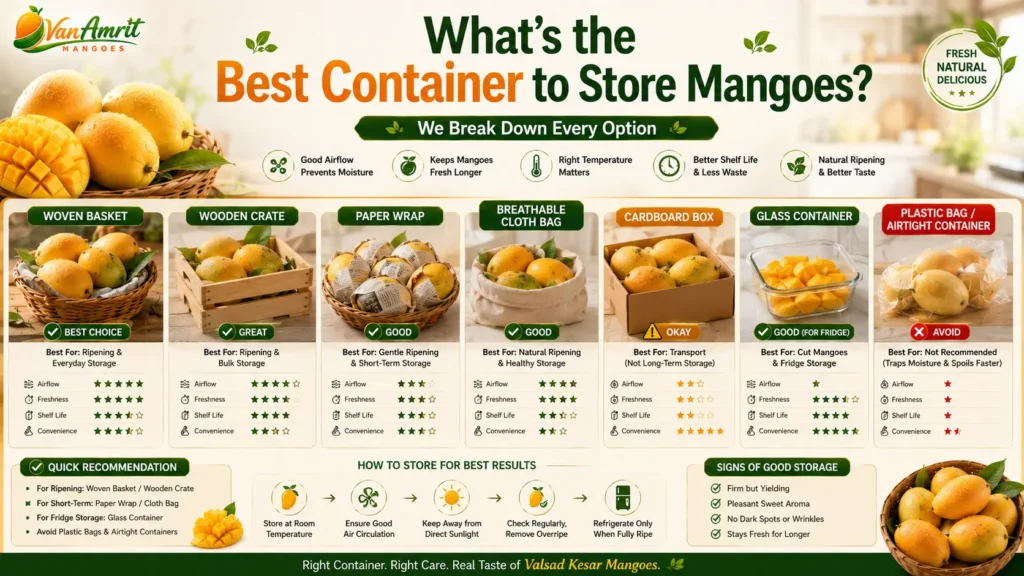
Best Containers for Mango Storage:
Glass, Steel, Plastic & More
The right container makes or breaks your mango’s shelf life. Here’s exactly what to use for whole mangoes, cut mango, pulp, and frozen batches — with an Indian kitchen lens.
They taste flat. The edges have browned. There’s a faint whiff of last night’s dal tadka on the mango. And you’ve just wasted something genuinely precious. Sound familiar?
The best containers for mango storage are not complicated — but most people genuinely don’t think about them until after something has gone wrong. This guide covers exactly what to use for every mango storage scenario: whole unripe, whole ripe, cut slices, mango pulp in the fridge, and frozen cubes or pulp for the months ahead. Not all containers work equally well, and the difference between a good choice and a bad one is the difference between 24 hours and 3 days of perfect mango.
🔬 Why the Right Mango Storage Container Actually Matters
Before we get into which containers to use, let me quickly explain what’s happening to your mango inside any container — because once you understand that, every recommendation below will make immediate, obvious sense.
The moment you cut a mango, the flesh starts reacting with oxygen in the air. This triggers enzymatic browning — the same process that turns apple slices from white to brown within minutes. The right airtight container slows this reaction dramatically by limiting oxygen contact. A container with a loose-fitting or cracked lid might as well be an open bowl.
Mangoes are also highly aromatic — which is one of their greatest qualities. But that aromatic intensity works both ways. A mango stored in a container that doesn’t seal properly will absorb every other smell in your fridge within hours. Glass with a silicone-seal lid doesn’t absorb or transfer odours. Older plastic containers that have seen better days absolutely do.
For unripe whole mangoes, the dynamic is completely different. They need to breathe, not be sealed. Unripe mangoes produce ethylene gas as part of their natural ripening process, and if you seal them in an airtight container, you’re trapping that ethylene and creating a supercharged ripening environment — pushing them from unripe to overripe in a fraction of the normal time. The goal for unripe storage isn’t sealing. It’s controlled airflow.
Consumer Reports’ 2026 lab testing of 25 food storage containers found that glass and stainless steel consistently outperformed plastic for keeping food fresh, maintaining seal integrity over time, and avoiding chemical transfer. Three of their five top-rated containers are glass, two are stainless steel. Plastic wasn’t included in their 2026 tests due to growing evidence of potential chemical leaching into acidic foods — exactly the category that mango falls into, given its citric acid content.
One more thing: if your mangoes haven’t ripened yet and you’re wondering about storage before they’re ready to eat, check our complete guide to ripening mangoes at home first. Storage containers become relevant after ripening — not before.
🌿 Storing Whole Unripe Mangoes — Skip the Container Entirely
This might surprise you, but the best “container” for whole unripe mangoes is not a container at all. It’s a flat surface with airflow, lined with newspaper or dry straw.
Whole unripe mangoes need to ripen at room temperature through the natural movement of ethylene gas around and through the fruit. Sealing them in a container traps CO₂, adds heat, and accelerates ripening in an uncontrolled way — creating soft spots on the outside while the core stays raw. Think of it like trying to force a conversation to go somewhere it isn’t ready to go yet. You can’t rush real flavour development.
What Actually Works for Whole Unripe Mangoes
- A wooden crate or flat tray lined with dry newspaper — the classic South Gujarat penda method. Arrange mangoes in a single layer, never stacked, with small gaps between them for airflow. This is exactly the method Vanamrit uses for pre-delivery ripening at our Chikhli orchard, as described on our About page
- A paper bag, loosely folded at the top — traps ethylene gently while allowing some CO₂ to escape. Accelerates ripening by 1–2 days without causing the chaos of full sealing. This is the paper bag method covered in detail in our home ripening guide
- A breathable mesh produce bag — allows full airflow, good for keeping mangoes grouped and visible without any seal
Never seal whole unripe mangoes in airtight plastic containers or zip-lock bags. Never refrigerate them before they ripen — USDA FoodKeeper data confirms that cold temperatures below 10°C permanently interrupt ethylene production, and a refrigerated unripe mango will never fully recover its natural ripening potential even when brought back to room temperature. This is the most common and most damaging mango storage mistake in Indian homes.
🧊 Storing Whole Ripe Mangoes — Fridge Yes, Sealed No
The moment your mango reaches peak ripeness — that deep saffron colour, the yielding press, the fragrance that hits you across the kitchen — it needs to go into the refrigerator. But here’s the nuance: whole ripe mangoes in the fridge still need some airflow. Sealing a whole ripe mango in an airtight container traps moisture around the skin and stem end, which accelerates mould at the stem faster than the cold can prevent it.
The best storage for whole ripe mangoes is the crisper drawer on its low-humidity setting. Place the mangoes loosely in the crisper, away from strong-smelling items like onions, garlic, or aged cheese. If you don’t have a crisper with humidity control, a large open bowl covered loosely with a kitchen towel works well — it keeps them separated from aromatic neighbours without trapping moisture.
Shelf life: according to USDA FoodKeeper data verified as of March 2026 and confirmed on vanamrit.in’s mango storage guide, whole ripe mango lasts 5–7 days in the crisper drawer at 4–8°C. The earlier you refrigerate after ripening, the closer to 7 days you’ll get. Waiting until the mango is already very soft gives you 2–3 days at best.
One final pro tip for Kesar lovers: take your refrigerated ripe Kesar out 15–20 minutes before eating and let it come back to room temperature. Cold suppresses aromatic compounds. That magnificent saffron fragrance only fully expresses at room temperature. You did all the work storing it right — don’t shortchange yourself at the eating stage.
🔪 Best Containers for Cut and Sliced Mango
This is where container choice matters most, and where the difference between a great container and a mediocre one is most visible — and most tasteable — the next day.
Once you cut a mango, you’ve broken the skin’s protective barrier. The flesh is now exposed to oxygen, fridge odours, and moisture loss all at once. The right container for cut mango needs to do three things simultaneously: block oxygen from reaching the fruit, block fridge odours from entering, and retain the mango’s natural moisture without trapping condensation on the surface. That’s a specific brief, and not all containers meet it.
A glass container with a silicone-seal airtight lid is the gold standard for storing cut mango in the refrigerator. Glass is non-porous — it doesn’t absorb smells, doesn’t stain from mango’s deep orange pigment, doesn’t leach any chemicals into acidic fruit, and doesn’t retain odours from previous meals. What you put in is what you get out. The Kitchn’s editors — after testing dozens of containers — specifically call out glass for being the material that “doesn’t hold onto that unusually strong garlic smell from three weeks ago.” Your Kesar deserves that respect.
Look for borosilicate glass specifically (brands like Pyrex, Caraway, or Urban Green use it) — it’s more resistant to thermal shock than standard soda-lime glass, which means it can go from the fridge to the microwave without cracking. The silicone or rubber seal on the lid creates a genuinely airtight barrier that keeps oxygen out and mango’s fragrance locked in.
How to use it: Layer mango slices inside, drizzle half a teaspoon of lemon juice over the cut surfaces (this slows enzymatic browning by limiting oxidation), seal the lid firmly, and refrigerate. Check it after 24 hours — peak flavour, even in a perfect glass container, is within the first day of cutting. Day 2 is still very good. Day 3 is acceptable. Beyond that, the texture begins to soften and the flavour flattens.
A good BPA-free plastic airtight container works fine for cut mango — particularly for families who prefer lighter, less breakable options. The performance is solid in the short term. The problem reveals itself over months and years: plastic is microscopically porous, which means it gradually absorbs colours (mango’s deep orange pigment will eventually stain older containers) and odours from strongly-flavoured foods.
The other critical point: always verify the container is explicitly labelled BPA-free. Mango is an acidic fruit — citric acid accelerates the leaching of bisphenol A from plastic that contains it into your food. Consumer Reports stopped including plastic in their 2026 container testing specifically because of growing evidence around this. If you use plastic, replace it every 2–3 years and store it clean and dry between seasons.
Stainless steel is non-porous, non-reactive to acids, durable, and completely safe for mango storage. The Kitchn’s comparison of steel vs glass puts it clearly: if you’re a “person on the go, steel containers are the clear winner.” For packing cut mango for a lunchbox, taking it to the office, or storing it at a picnic, stainless steel handles the job beautifully without the breakage risk of glass.
For home fridge storage, the limitation is that stainless steel is opaque — you can’t see what’s inside without opening the container, which means every time you check, you’re introducing oxygen. Not a dealbreaker, but less convenient than a transparent glass container. Not recommended for the freezer for mango — steel can cause freezer burn if not perfectly airtight, and the freezer environment is harsh on steel lids over time.
Plastic wrap or cling film alone: Not truly airtight, single-use plastic waste, and the mango will absorb fridge odours through the porous film within hours. At best it’s a short-term fix for the next 6 hours. Old, scratched plastic containers: The scratches create microscopic grooves where bacteria and odours accumulate. If your container has visible scratching on the inside surface, it’s time to retire it. Aluminium foil: Not airtight and reacts with the citric acid in mango over time, potentially affecting taste.
The Best Container Starts With the Right Mango
No storage container — glass, steel, or otherwise — can compensate for a mango that was carbide-ripened, early-picked, or poorly handled before it reached you. Vanamrit’s Valsad Kesar arrives farm-direct, naturally ripened in hay, and at exactly the right green-mature stage. Put a perfect mango in a perfect container and the result speaks entirely for itself.
🥭 Order Farm-Fresh Kesar Mangoes →🫙 Best Containers for Mango Pulp (Fridge Storage)
Mango pulp — smooth-blended Kesar extracted for aamras, mango lassi, or smoothies — is the form most Indian home cooks end up storing at some point during mango season. It’s denser than cut mango, so it holds its texture longer, but it has a vastly larger surface area (every millilitre of pulp is in contact with the container) which makes it more vulnerable to oxidation and odour absorption.
The best container for mango pulp in the fridge is a wide-mouth glass jar with an airtight screw-top or clamp lid. Mason jars — the kind with two-part lids that create a vacuum seal — are ideal. They’re inexpensive, universally available, and the wide mouth makes them easy to pour pulp into and spoon pulp out of. Glass doesn’t react with the acids in mango pulp, doesn’t stain, and creates a genuinely odour-proof environment.
How long does mango pulp last in the fridge? 2–3 days maximum in the best glass jar with the best seal. After day 3, even perfectly stored pulp begins to ferment slightly, developing a faint sour note that masks the natural saffron sweetness. This isn’t a container problem — it’s simply the nature of fresh, preservative-free mango pulp. For anything longer than 3 days, the freezer is your answer.
The Smart Portioning Trick
Here’s something most people don’t do but should: store pulp in several small jars rather than one large one. Every time you open a container, you introduce a fresh wave of oxygen into whatever’s inside. If you have 500ml of pulp in one big jar and you open it twice a day, you’re accelerating oxidation significantly. Four 125ml jars, each opened once, give you substantially fresher pulp across the same total quantity. Treat each jar like a sealed unit — once it’s open, use it the same day.
A half-teaspoon of lemon juice stirred into each jar of pulp before sealing slows oxidation further and keeps the colour vibrant. It adds a barely perceptible citrus note that actually enhances aamras rather than competing with it.
Ordering a bulk batch of Kesar this season for pulp-making? Check our 2026 Kesar season timing guide — June is when Valsad Kesar hits peak quality and most competitive pricing, which makes it the ideal window for buying in volume and freezing the rest.
🧊 Best Containers for Frozen Mango Cubes
Frozen mango cubes are the single smartest investment you can make with your peak-season Kesar. Buy in May or June when the quality is extraordinary, freeze properly, and you’ll be spooning real Kesar pulp into smoothies in October. It’s like bottling summer — except you don’t need bottles, you need good freezer bags.
The flash-freeze step before final storage is non-negotiable and the step most people skip — which is why they end up with a solid frozen mango brick that’s impossible to portion from. Before putting cubes in their final storage container, spread them in a single layer on a baking tray lined with parchment paper. Freeze for 2–3 hours until individually firm. Then transfer to the final container. This gives you free-flowing individual cubes that pour out like mango ice cubes, not a solid block requiring a chisel.
The Best Container for Frozen Mango Cubes
- Heavy-duty zip-lock freezer bags — the gold standard for frozen mango cubes, endorsed by the National Center for Home Food Preservation. Once your flash-frozen cubes are firm, pour them into a freezer bag, press out as much air as possible before sealing (the less air, the less freezer burn), and lay flat in the freezer. Label with date and contents. Flat bags stack beautifully and thaw quickly because of their uniform thickness
- Silicone freezer bags — the eco-conscious alternative to single-use zip-lock. Reusable, equally airtight when properly sealed, lay flat in the freezer. A better long-term investment if you freeze mango every season
- Freezer-safe glass containers — the key word is freezer-safe, and not all glass qualifies. Look for containers specifically labelled for freezer use, leave 1–1.5cm of headspace (liquid expands when frozen), and use for pulp rather than cubes — cubes in rigid glass containers are awkward to remove without letting too much air in each time
Shelf life: Properly stored frozen mango cubes retain excellent quality for 6–8 months. They’re technically safe to eat for up to 12 months at 0°F (−18°C), per USDA guidelines, though some quality degradation occurs after 8 months. Frozen Valsad Kesar pulp, in our experience, is genuinely excellent for 6–8 months — you won’t be able to tell a November batch from what you froze in June.
🫙 Best Containers for Frozen Mango Pulp
If frozen cubes are for smoothies and garnishes, frozen pulp is for aamras. Smooth, dense, and ready to serve after a gentle thaw, frozen Kesar pulp is the closest thing you’ll find to eating fresh mango in December. But it only works if you store it right.
The best approach combines two container types for different quantities. For regular-use portions, heavy-duty zip-lock freezer bags frozen flat are unbeatable. Pour 200–250ml of pulp per bag (one generous aamras serving), squeeze out the air before sealing, and freeze flat on a baking tray. Once solid, stack vertically like books on a shelf. They thaw in 20–30 minutes in cool water, or overnight in the fridge.
For smaller individual portions — the kind you’d add to a morning smoothie — silicone ice cube trays are the secret weapon. Pour pulp into the trays, freeze until solid, then pop the cubes out and store them in a zip-lock bag. You get perfect 30–40ml portions you can drop directly into a blender from frozen. No thawing, no measuring, no waste.
An important rule for frozen pulp: never refreeze thawed mango pulp. Once it’s thawed, the texture changes and the cell structure that gave it that silky consistency starts to break down. Thaw only what you’ll use that day. This is why the small-portion strategy matters — you’re never forced to thaw more than you need.
⚖️ Glass vs Plastic vs Stainless Steel — The Definitive Verdict for Mango
Let me give you the clear, no-fence-sitting verdict on each material for mango storage specifically — because mango’s combination of high moisture content, acidity, and deep pigment makes it a more demanding storage subject than most foods.
| Container Type | Fridge (Cut) | Freezer | Odour-Proof | Chemical-Safe | Verdict |
|---|---|---|---|---|---|
| Glass airtight (silicone seal) | ⭐ Best | ✓ Freezer-safe glass | ✓ Yes | ✓ 100% | Top Choice |
| BPA-free plastic airtight | ✓ Good | ✓ Yes | ⚠ Stains over time | ⚠ Replace every 2–3 yrs | Budget pick |
| Stainless steel airtight | ✓ Good | ⚠ With care | ✓ Yes | ✓ 100% | Best portable |
| Zip-lock freezer bags | ⚠ Short-term only | ⭐ Best for pulp/cubes | ⚠ Partial | ⚠ Choose food-grade | Freezer winner |
| Silicone bags/trays | ✓ Good | ✓ Yes | ✓ Yes | ✓ Yes | Eco choice |
| Breathable mesh bag | ⚠ Whole ripe only | ✗ Not suitable | ✗ No | ✓ Yes | Whole mango only |
| Newspaper / hay wrap | ✗ Not for fridge | ✗ No | ✗ No | ✓ Natural | Unripe ripening only |
Think of it this way: glass is like a vault for your mango — completely sealed, completely transparent, completely inert. Plastic is like a wallet — convenient and functional when new, but it wears out and starts showing its age. Stainless steel is like armour — tough, non-reactive, but you can’t see inside without opening it. Each has its place. None is perfect for every scenario.
🏺 Traditional Indian Mango Storage — What Our Grandmothers Got Right
Before we had BPA-free plastic and borosilicate glass, India had clay pots, wooden crates, and dry straw — and mango was stored extraordinarily well using all three. There’s genuine wisdom in these methods that modern containers are still trying to replicate.
Clay martaban jars have been used across India for storing raw mango pickle (aam ka achar) for months, even years. Clay is naturally porous — it breathes, maintains a stable cool temperature through evaporative cooling, and imparts absolutely nothing to the food inside. For pickled mango, clay is genuinely excellent and arguably still the best option available for long-term preservation without refrigeration.
The hay-bed or penda method — which is how we ripen and hold Kesar at Vanamrit’s Valsad orchard before delivery — is another piece of traditional brilliance. Wooden crates lined with dry straw absorb moisture, maintain even temperature through natural insulation, and allow controlled ethylene circulation. This is the original breathable produce storage, and it works magnificently for whole unripe mangoes. No modern container manufacturer has improved on it for that specific purpose.
The lesson these traditional methods teach us is the same principle behind every modern container recommendation: match the container to what the mango needs at that stage. Breathable for unripe. Sealed for ripe and cut. Airtight and flat for the freezer. The materials have changed. The principles haven’t.
📊 Quick Shelf-Life Reference by Container and Storage Location
Screenshot this table. Share it with your family’s WhatsApp group before someone puts the whole crate in an airtight container in the fridge. All shelf-life data is based on USDA FoodKeeper guidelines verified as of March 2026.
| Mango Form | Best Container | Location | Shelf Life |
|---|---|---|---|
| Whole unripe | Newspaper/hay wrap, flat tray | Room temperature | 5–8 days to ripen |
| Whole ripe | Crisper drawer (loose), breathable bag | Fridge (4–8°C) | 5–7 days |
| Cut / sliced | Glass airtight container + lemon juice | Fridge | 2–3 days |
| Mango pulp | Glass mason jar, airtight sealed | Fridge | 2–3 days max |
| Frozen mango cubes | Heavy-duty zip-lock freezer bag | Freezer (−18°C) | 6–12 months |
| Frozen mango pulp | Zip-lock bag or silicone bag, flat | Freezer | 6–8 months (peak quality) |
| Raw mango pickle | Clay martaban or sealed glass jar | Cool, dry place | 3–6 months (pickled) |
❓ Mango Storage Container Questions — Answered
🏁 The Container Is the Last Step — Start With a Great Mango
🥭 Get the Container Right. Get the Mango Right First.
Here’s the honest truth about mango storage containers: no container on the planet can make a poor-quality, carbide-ripened, or early-picked mango taste better. A great glass container is the final step in a chain that starts at the farm and ends at your table. If the mango is genuinely good — properly harvested, naturally ripened, handled carefully — then the right container simply preserves what’s already there.
For the record: glass airtight containers for cut mango and pulp, heavy-duty zip-lock freezer bags for frozen cubes and pulp, and breathable mesh or newspaper for whole unripe mangoes. That’s the entire system. It’s not complicated once you understand what the mango needs at each stage.
And if you want to make sure you’re storing genuinely authentic, farm-fresh Kesar that’s worth all this effort — check our guide to identifying real Kesar mango before you buy. The best container in your kitchen deserves the best mango in it.
“Store it right and a Kesar mango will taste just as extraordinary on day three as it did on day one. That’s the whole point.” 🥭🌿
Farm-Fresh Valsad Kesar — Worth Every Storage Decision
If you’re going to invest in great glass containers and proper freezer bags, invest in a mango that deserves it. Vanamrit’s Valsad Kesar — naturally ripened, carbide-free, farm-direct from Chikhli, Valsad — is the mango that makes the effort worthwhile. Deep saffron pulp, honey sweetness, genuine Kesar fragrance. Pan-India delivery.
🥭 Order Valsad Kesar at vanamrit.inQuestions about storage, orders, or bulk buying? Contact us or WhatsApp: +91 9033595016