
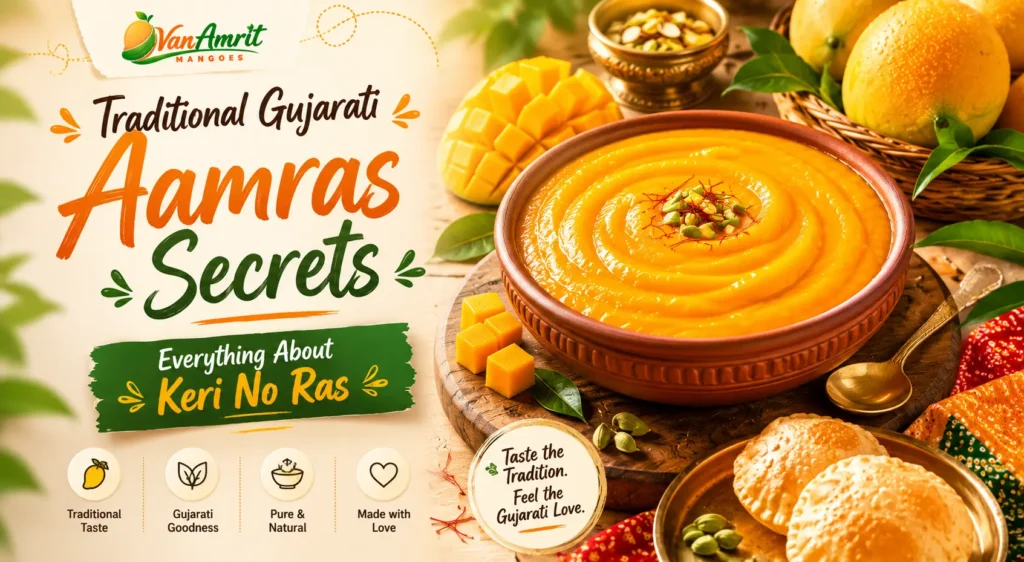
Traditional Gujarati Aamras Secrets:
Everything About Keri No Ras
The mango soak, the hand-squeeze, the sonth vs cardamom debate, the ghee drizzle — and why Kesar makes all the difference. Seven secrets your recipe app never told you.
If you grew up in a Gujarati household, that’s not just a meal. That’s the whole of summer in one image.
Traditional Gujarati aamras — known as keri no ras in Gujarati (keri = mango, ras = juice or essence) — is one of India’s oldest and most beloved seasonal foods. And yet the real secrets behind it rarely make it into recipe blogs or food apps. Most versions just say “blend mango, add sugar.” That’s technically accurate the way “add spices to water” is technically accurate for biryani. The actual thing has layers, method, seasonal intuition, and a handful of specific details that are the difference between good aamras and the kind that makes grown adults go quiet for a few seconds after their first bite.
Those details are what this article is about. Before we talk secrets, though — everything starts with the mango. Specifically, whether yours is genuinely the real thing. Read our guide on how to identify authentic Kesar mango before you buy, because no technique in the world rescues aamras made from an inferior or carbide-ripened mango.
📖 What Is Aamras, Really? — The Name, the Origin, the Culture
Aam means mango. Ras means juice or essence. So aamras translates to “mango essence” — and that word essence is doing a lot of work. This isn’t mango juice, which implies a thin, diluted liquid. Traditional Gujarati aamras is concentrated mango pulp — thick, dense, fragrant, with the flavour of the fruit turned up to full volume. It’s the mango distilled into its purest edible form.
In Gujarati, it’s called keri no ras. The word keri refers to mango in the Gujarati dialect, and the dish has been a centrepiece of Gujarat’s summer food culture for centuries. It appears at family lunches, festival thalis, and — most prominently — at Gujarati and Maharashtrian weddings during mango season, where there’s reliably a long, happy queue at the aamras station.
According to Sheetal Bhatt, a social development professional who documents Gujarat’s native foods (GOYA magazine), traditional keri no ras was originally made from fibrous mango varieties that couldn’t be cut cleanly — only squeezed. Premium varieties like Kesar and Alphonso were eaten fresh, not juiced. It was only as these fiberless, intensely fragrant varieties became more widely available that they became the gold standard for aamras. Today, Kesar is considered the ideal mango for authentic Gujarati aamras — for reasons we’ll get into at Secret #5.
The cultural weight of aamras in Gujarat is hard to overstate. This is a dish that connects generations — grandmothers who squeezed mangoes by hand in courtyards in Saurashtra, mothers who learned from them, daughters who now open a blender but still add the same pinch of sonth that’s been in the family since before anyone can remember. Every family’s keri no ras tastes slightly different, and everyone is convinced their version is the one true version. They’re all right. That’s the beauty of it.
💧 Secret #1 — Soak the Mango Before You Do Anything Else
The Mango Soak — The Step Everyone Skips
Here’s the first thing any Gujarati home cook who learned aamras from their mother will tell you: before you do anything — before you squeeze, blend, or even take the mango out of the fruit basket — you soak the mangoes whole in a tub of cool water.
Not for a few minutes. For a minimum of 30 minutes, and ideally for 1–2 hours. Traditional Saurashtra households soaked overnight. GOYA magazine’s authentic keri no ras recipe specifically calls for 1 hour of soaking before squeezing.
Why? Two reasons, and both matter. The first is rooted in Ayurvedic food wisdom: ripe mangoes have ushna virya — heating energy in the body. According to traditional Gujarati food practice, soaking in cool water neutralises this heat, making the mango easier on your digestion and reducing the chance of “gelafo” — that uncomfortable body heat, skin breakouts, or stomach irritation that some people get after eating too much mango in a single sitting. Whether you follow Ayurvedic principles or not, generations of South Gujarat households swore by this soaking practice, and that accumulated wisdom isn’t accidental.
The second reason is purely practical: soaking removes surface dust, any pesticide residue on the skin, and — critically — the natural latex sap that collects at the stem. That sap is astringent and slightly bitter. If you skip the soak and go straight to squeezing, tiny traces of it can contaminate your pulp and introduce a bitter note you’ll spend the rest of the recipe trying to hide.
Almost every blender-based aamras recipe online skips the soak entirely. You rinse the mango quickly under the tap and go straight to peeling or squeezing. The resulting aamras is fine — but it’s missing something subtle that you can’t identify unless you’ve had both versions side by side. The soaked version is cleaner, softer on the palate, and noticeably more harmonious in flavour. Twenty minutes of soaking is the cheapest improvement you’ll ever make to a recipe.
🙌 Secret #2 — The Hand-Squeeze Method That Makes Lachhedar Aamras
No Blender. Your Hands. The Traditional Way.
The most dramatic difference between traditional Gujarati aamras and the version most people make today is this: the traditional method uses no blender, no mixer, no grinder. The mango is squeezed and massaged by hand until the flesh softens into pulp, and then extracted directly from the skin and seed.
J Cooking Odyssey’s authentic keri no ras guide (April 2026) describes it beautifully: “Women would extract the mango pulp by hand (no blenders) and the air would be fragrant with mango!” That’s not nostalgia — it’s a description of a technique that produces a qualitatively different result from blending.
The result of hand-extraction is called lachhedar aamras — lachhedar meaning “with threads or ribbons.” It’s not a perfectly smooth homogenous puree. It has a slightly textured, ribbon-like quality — thick rivers of pure mango pulp suspended in concentrated mango liquid. It sounds rustic. It tastes transcendent.
The Hand-Squeeze Technique — Step by Step
- After soaking, remove a mango from the water and dry it lightly with a cloth. Hold it firmly — thumb at the stem end, fingers curled underneath the fruit
- Gently squeeze and massage the whole mango, rotating it in your hands with continuous circular pressure. You’re working the flesh away from the seed inside. Keep going until the whole mango feels uniformly soft and squashy — like a water balloon that’s been gently deflated. This takes 2–5 minutes per mango
- Once fully soft, remove the stem by twisting it off. You’ll see a small opening at the top of the mango where the stem was
- Hold the mango over a wide bowl and squeeze the pulp out through the stem opening. Rotate and press from the bottom up, like squeezing the last bit from a tube of toothpaste
- Once most of the pulp is out, turn the skin inside out and squeeze every remaining drop of juice from the skin
- Remove the seed from inside the skin and use your fingers to press every last piece of flesh off it. The seed’s flesh is often the most concentrated and fragrant part — don’t waste it
- Optional: pass the extracted pulp through a fine mesh strainer or muslin cloth to catch any fibrous bits and create an ultra-smooth consistency. With Kesar mangoes, you’ll barely need this step — their pulp is almost completely fiberless
Why does hand-extracted aamras taste different from blended? Because blending introduces two things the mango doesn’t need: heat and air. The high-speed blade warms the pulp slightly and aerates it, which subtly dilutes the flavour and changes the texture. Hand extraction is cold, gentle, and produces a denser, more concentrated result. As Binjal’s VEG Kitchen (March 2026) puts it: “It’s this painstaking process of hand-squeezing the mangoes that yields aamras incomparably rich, concentrated flavor and velvety texture.”
Is the blender version acceptable? Absolutely — especially when you’re making aamras for twelve people on a summer Sunday morning with four other dishes on the stove. But know what you’re trading. The hand-squeeze is the soul of traditional keri no ras, and if you’ve never tried it, this season is the year to do it at least once.
There’s a direct line between the hand-squeeze tradition and the way Vanamrit ripens our Valsad Kesar — in dry hay beds (penda), by hand, following the same slow and intentional South Gujarat agricultural approach. Read about our farm philosophy here →
🫚 Secret #3 — Sonth, Not Cardamom: The Spice That Makes It Gujarati
One Pinch of Dry Ginger Powder Changes Everything
If there’s one ingredient that immediately separates authentic Gujarati aamras from every other regional version, it’s sonth — dry ginger powder, also written as soonth or saunth.
Maharashtra uses cardamom. Rajasthan uses saffron strands. Gujarat uses sonth. This isn’t a casual preference — it’s a defining characteristic that Gujarati food culture takes seriously. According to J Cooking Odyssey’s authentic recipe: “She made it clear that authentic Gujarati mango ras must have a little ginger powder and ghee. That’s what separates it from normal mango pulp.”
What does sonth actually do in aamras? It doesn’t make the dish taste like ginger. Used correctly — just 1/4 teaspoon for 5–6 mangoes — it disappears into the background, contributing a gentle, grounding warmth that does three things: it lifts the sweetness of the mango, adds a subtle spice complexity that makes the flavour feel more rounded, and — by Ayurvedic tradition — aids digestion of the mango’s natural sugars.
Think of sonth in aamras the way you think of a pinch of salt in a chocolate brownie. You don’t taste it as a separate element. You just taste a better brownie. The sonth makes the mango taste more like the mango.
Sonth vs Fresh Ginger — Never Substitute
You cannot substitute fresh ginger for sonth in aamras. The drying process fundamentally changes ginger’s flavour profile — the sharp, raw, intrusive heat of fresh ginger becomes a mellower, deeper, more integrated warmth when dried and ground. Fresh ginger in aamras is overpowering and creates an unpleasant raw note. Only sonth produces the right effect. If you don’t have sonth, leave it out entirely rather than reaching for the fresh ginger piece in your fridge.
🗺️ Aamras Across India — How Three States Do It Differently
Aamras is beloved across western India, but each region has staked out its own flavour identity. Here’s the honest comparison — and a reference you’ll want to save:
| Region | Local Name | Spice | Finish | Milk? | Best Mango | Texture |
|---|---|---|---|---|---|---|
| 🟠 Gujarat | Keri No Ras | Sonth (dry ginger) | Warm ghee drizzle | No — water only if needed | Kesar or Pairi | Thick, often lachhedar |
| 🔵 Maharashtra | Aamras / Ambyacha Ras | Cardamom + black pepper | Ghee + black pepper | Yes — warm milk splash | Alphonso (Hapus) | Smooth, blended, creamy |
| 🟣 Rajasthan (Marwari) | Aamras | Saffron strands | Pistachios / almonds | Sometimes | Alphonso or Kesar | Smooth, royal presentation |
None of these three is better or more authentic in the universal sense — each is perfect within its regional food tradition. But if you’re making traditional Gujarati aamras specifically — keri no ras the way it’s made in the Valsad, Surat, and Junagadh belt — sonth and ghee are non-negotiable. Cardamom turns it Maharashtrian. Saffron strands turn it Marwari. Both are delicious. Neither is keri no ras.
✨ Secret #4 — The Ghee Drizzle: The Finishing Touch That Transforms the Bowl
Warm Ghee on Cold Aamras — Don’t Skip This
Your aamras is made. It’s chilled. It smells extraordinary. It goes on the table. And then — just before it reaches the diners — someone drizzles a thin spiral of warm ghee over the surface of each bowl. That’s it. That’s the move.
This ghee drizzle is the most distinctively Gujarati finishing touch in keri no ras, and it’s the step that most outside-Gujarat recipes omit without explanation. What does it actually do?
- Mouthfeel transformation: Warm clarified butter creates a velvety coating on the palate that changes the way you experience the mango pulp — it becomes silkier, richer, more lingering. The fat carries the aromatic compounds in the mango to your nose more effectively, amplifying the fragrance with every bite
- Temperature contrast: Warm ghee on cold aamras creates a tiny sensory shock that makes each spoonful more interesting — the brief warmth of the ghee as it hits your tongue, followed immediately by the cold, concentrated sweetness of the mango
- Flavour depth: Good ghee has its own subtle nutty-sweet flavour from the caramelised milk solids. That depth adds a quiet complexity to what would otherwise be a purely fruity dish
- Digestive tradition: In Ayurvedic food wisdom, ghee balances the heat of mango and aids the digestion of its natural sugars — a practical reason behind a traditional practice
How to do it right: The ghee should be warm and liquid — not sizzling hot. Heat it gently until it melts completely and you can smell the clarified butter fragrance. Drizzle in a slow spiral over the surface of the chilled bowl just before it goes to the table. Use about 1/2 teaspoon per serving bowl. The visual of golden ghee resting on the saffron surface is part of the experience — don’t stir it in. Let diners take their first bite through both layers simultaneously.
Your Keri No Ras Is Only as Good as Your Kesar
Every secret in this guide — the soak, the hand-squeeze, the sonth, the ghee drizzle — amplifies what’s already in the mango. Start with Vanamrit’s farm-fresh Valsad Kesar — fiberless, saffron-orange, honey-sweet, naturally ripened in hay — and the technique practically does itself.
🥭 Order Farm-Fresh Valsad Kesar for Your Aamras →🥭 Secret #5 — Why Kesar Mango Makes the Best Traditional Aamras
The Variety Isn’t Optional — It’s the Recipe
You can execute every other secret in this guide perfectly and still end up with mediocre aamras if you started with the wrong mango. The variety isn’t just one factor among many. In a dish with this few ingredients, the mango is the recipe.
Spice Up The Curry’s 2026 recipe explicitly states: “Kesar mango makes bright colored, flavorful Keri No Ras.” Multiple 2026 recipe sources confirm Kesar as the preferred Gujarati choice. And if you’ve ever had aamras made from peak-season Kesar alongside aamras made from a generic, fibrous variety, you understand immediately why.
What Makes Kesar Ideal for Aamras
- Fiberless pulp. Kesar has almost no fibrous threads — which means the hand-squeeze method produces clean, silky pulp without the muslin-straining step that fibrous varieties require. Less work, better texture
- The saffron colour. The deep saffron-orange pigment of Kesar aamras is visually stunning — the dish literally looks like liquid saffron. The colour deepens further when chilled, creating that extraordinary glow in the bowl
- Natural sweetness at peak season. Peak-season Kesar is sweet enough that you need zero added sugar. The less you interfere with good Kesar, the better the aamras
- The fragrance. Kesar’s room-filling aroma translates directly to aamras. The bowl smells extraordinary before it’s even tasted — and that fragrance is half the eating experience
Between Gir Kesar and Valsad Kesar specifically — both make excellent aamras with their own character. Gir Kesar is bolder, more intensely flavoured, with a distinctive sharp brightness. Valsad Kesar, grown in South Gujarat’s alluvial coastal belt, is more mellow and honey-smooth — sweeter and rounder in flavour, which means the aamras needs even less sugar and has a silkier finish. For South Gujarat families, Valsad Kesar is the home aamras mango. For a detailed comparison, our Valsad Kesar vs Gir Kesar guide breaks it down completely.
🍬 Secret #6 — On Sugar: Taste First, Add Nothing if You Can Help It
The Most Common Aamras Mistake Is Adding Sugar You Don’t Need
Here’s the uncomfortable truth about most aamras recipes: they call for sugar as a default ingredient, often without any caveat about whether you actually need it. And most cooks, following the recipe, add it without tasting first.
With peak-season Kesar, adding sugar is the equivalent of putting ketchup on a biryani. You’re covering the natural complexity of an already-perfect flavour with a blunt sweetness that reduces everything to one dimension. The mango had layers. The sugar erases them.
The rule is simple: taste your mango pulp before adding anything. If it’s genuinely sweet — and good Kesar in season absolutely is — skip the sugar entirely. If there’s a slight tartness (which is actually a desirable feature of Kesar; that tangy brightness is part of what makes it interesting), add sugar sparingly, 1 teaspoon at a time, until the tartness rounds out without disappearing. You want to balance it, not eliminate it.
A note on the Gujarati-specific approach: traditional keri no ras doesn’t use milk. The Maharashtrian version adds a splash of warm milk for a creamier texture. The Gujarati version is strictly pulp — sonth, a tiny amount of water if consistency needs adjusting, and ghee to finish. Adding milk to keri no ras Gujarati-style is a regional crossover, not a defect, but it’s worth knowing the distinction.
🌡️ Secret #7 — Temperature Is the Real Technique
Cold Aamras + Hot Puri = Sensory Engineering, Not Coincidence
The last secret isn’t about ingredients. It’s about temperature — and it explains why aamras puri eaten at a Gujarati lunch table tastes categorically different from aamras eaten at room temperature from a bowl you made three hours ago and forgot to chill.
The contrast of ice-cold aamras against piping-hot fresh puri is a deliberate sensory achievement. It’s the Gujarati kitchen’s version of what food scientists now call “temperature contrast eating” — though South Gujarat home cooks worked it out centuries before the terminology existed. Here’s what’s actually happening: the heat of the oil-fried puri slightly warms your mouth as you take the first bite, and that warmth triggers a release of volatile aromatic compounds in the cold aamras the moment it contacts your palate. You get the full fragrance hit of the Kesar in the split second between temperatures meeting. Then the cold aamras cools everything back down, making the next bite of puri feel just as fresh as the first.
Remove either element — serve aamras warm, or pair it with cold puri — and the experience fundamentally changes. The contrast is the technique.
How to Achieve It Properly
- Chill for minimum 1 hour, ideally 2. Place the finished aamras in a wide bowl or individual serving bowls in the fridge. The wider the surface area, the faster and more even the chilling
- Never add ice cubes to shortcut the chilling. Ice dilutes the aamras and ruins the texture. If you’re in a rush, 20 minutes in the freezer is better than 5 minutes in the fridge — but set a timer
- Time the puris with the aamras. In a traditional Gujarati household, the aamras goes to the table at the same moment the puris come out of the oil. This synchronisation is intentional. The temperature contrast depends on it
- Drizzle the ghee last. The ghee goes on just before the bowl reaches the table — never while the aamras is still in the fridge. Warm ghee on cold aamras. That sequence is the sequence
📋 The Authentic Keri No Ras — Complete Ingredient Guide
Everything you need for traditional Gujarati aamras for four people. No shortcuts, no unnecessary additions.
| Ingredient | Quantity (4 servings) | Role | Notes |
|---|---|---|---|
| Ripe Kesar or Pairi mangoes | 5–6 medium | Essential | Kesar preferred — fiberless, saffron-coloured, fragrant. Soak 30–60 min before use |
| Sonth (dry ginger powder) | ¼ tsp | Gujarati Signature | Non-negotiable in authentic keri no ras. Never substitute fresh ginger |
| Ghee (clarified butter) | ½–1 tsp per bowl | Gujarati Finish | Warm, not hot. Drizzle just before serving — do not stir in |
| Sugar | Taste-test basis only | Optional | Peak Kesar needs none. Add sparingly only if mango is tart |
| Cold water | 2–3 tbsp maximum | Optional | Only if pulp is too thick to scoop. Do not make it pourable like juice |
| Saffron strands (kesar) | 4–5 strands | Optional | Rajasthani-inspired — beautiful for festive thali or wedding presentation |
| Pistachios or almonds, slivered | 1 tsp per bowl | Garnish | Adds texture contrast — especially good for festive occasions |
Looking for farm-fresh Valsad Kesar to make this recipe? Peak season is May through July — our 2026 Kesar season timing guide tells you exactly when to order for the sweetest, most fragrant batch.
For a traditional summer treat, try making this Authentic Kesar Mango Aamras Recipe: Gujarati Method + 8 Variations.
❄️ How to Store and Freeze Aamras — Make Summer Last Into Monsoon
Kesar season is short — typically May to July for Valsad Kesar. But frozen aamras made from peak-season Kesar is genuinely excellent and allows you to spoon the taste of May into a bowl in October without much quality loss. This is the secret that makes South Gujarat families look impossibly calm about the end of mango season — they already have six months of aamras in the freezer.
- Fridge storage: Freshly made aamras lasts 2–3 days in a sealed glass jar in the refrigerator. After day 3, subtle fermentation begins. Use individual small jars rather than one large container — every time you open the jar, you introduce oxygen
- Freezer storage: Pour aamras into heavy-duty zip-lock freezer bags in 200–250ml portions (one aamras-puri serving). Squeeze out the air, seal, and freeze flat. Stack frozen flat bags like books on a shelf. Frozen Kesar aamras retains excellent quality for 6–8 months — which comfortably covers Diwali, Christmas, and New Year’s
- Silicone ice cube trays: Pour aamras into trays, freeze into cubes, transfer to a zip-lock bag. Perfect for dropping 2–3 cubes directly into mango lassi, a smoothie, or yoghurt without full thawing
- Never refreeze thawed aamras. Once it’s thawed, the texture changes irreversibly. Thaw only what you’ll use that day
For the complete guide on which containers work best for frozen mango pulp — and the flash-freeze technique that prevents the dreaded frozen mango brick — see our best containers for mango storage guide.
❓ Aamras Questions — Answered
🏁 The Aamras Bowl Is a Whole Philosophy, Not Just a Recipe
🥭 Seven Secrets. One Summer Memory.
Every secret in this guide is a small piece of why traditional Gujarati aamras — keri no ras at its best — tastes like it does. The soak removes bitterness and heat. The hand-squeeze creates lachhedar texture you can’t get from a blender. The sonth adds a background warmth that makes the mango taste more like itself. The ghee drizzle transforms the mouthfeel entirely. The Kesar variety provides the colour, fragrance, and sweetness that everything else is built on. The absence of sugar lets the mango speak for itself. And the temperature contrast between cold aamras and hot puri is the engineering that makes every bite as good as the first.
None of these is complicated. All of them require intention. Traditional Gujarati aamras is not the result of a recipe. It’s the result of accumulated seasonal wisdom, passed down from hands that learned from other hands over generations. The fact that you now have those secrets too makes this season’s keri no ras a continuation of that tradition.
Start with the best possible Kesar. Order Vanamrit’s farm-fresh Valsad Kesar while the 2026 season lasts — and make this year’s aamras the one your family talks about when December arrives.
“The best aamras anyone has ever tasted started with the best mango anyone could find. It always has.” 🥭🌿
Order Farm-Fresh Valsad Kesar — The Aamras Mango
Fiberless, saffron-orange, honey-sweet, naturally ripened in hay at our Chikhli orchard in Valsad, South Gujarat. Vanamrit’s Valsad Kesar is the mango that every secret in this guide was written for. Pan-India delivery. Carbide-free. No middlemen.
🥭 Shop Valsad Kesar Mangoes at vanamrit.inGot your own family aamras secret? Share it with us. Contact us or WhatsApp: +91 9033595016