
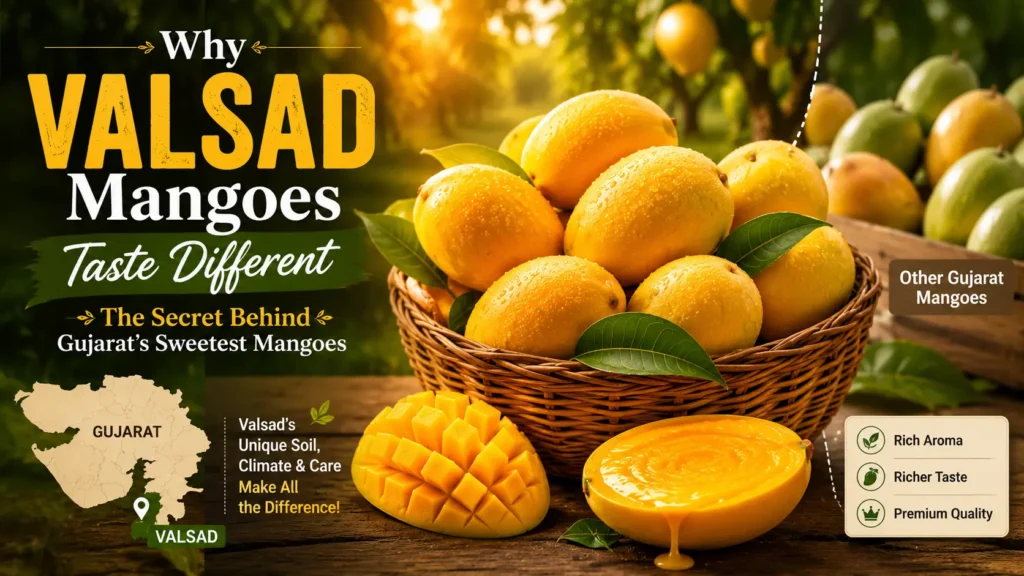
Why Valsad Mangoes Taste Different
From Other Gujarat Mangoes
The alluvial soil. The Arabian Sea breeze. The 2,300mm of rainfall. Five geographical factors that create a flavour profile no other region in Gujarat can replicate.
They taste different. Not slightly. Noticeably. One has a sharp, bold brightness — intense sweetness with a tangy edge that cuts right through. The other is mellower, rounder, honey-smooth, with a sweetness that unfolds slowly and lingers on the palate like the mango doesn’t want to leave. Same variety. Same name. Same state. Two completely different flavour experiences.
The first mango is from the Gir belt in Saurashtra. The second is from Valsad in South Gujarat. And the reason they taste different is the same reason Champagne from France tastes different from sparkling wine made in Nashik with the same grapes: the land changes everything. This article is the full explanation — five specific geographical factors that make Valsad mangoes taste uniquely different from any other Gujarat mango.
🍷 The Word That Explains Everything: Terroir
Before we dig into the five factors, let me introduce a concept that makes all of this immediately intuitive. The French word terroir — borrowed wholesale by the wine industry to explain why the same grape variety produces completely different wines in different locations — applies just as precisely to mangoes as it does to Pinot Noir.
Terroir encompasses everything about the natural environment in which a plant grows: the soil composition, the drainage, the altitude, the temperature range, the rainfall pattern, the direction of prevailing winds, the neighbouring vegetation, and even the microorganisms in the root zone. Change any one of these factors and you change the plant. Change all of them — as is the case between Saurashtra’s Gir belt and South Gujarat’s Valsad coast — and you get a fruit that is the same variety in name only.
Vanamrit’s own published guide captures this perfectly: “each microclimate shapes a mango differently — same way terroir shapes wine grapes. The result is a fruit that tastes different in every state, on every farm, in every season.” That’s not marketing language. It’s agricultural reality that anyone who’s tasted both Valsad Kesar and Gir Kesar side by side understands immediately.
Valsad’s terroir is the product of five specific factors working in combination. No other mango-growing region in Gujarat shares all five. That combination is precisely why Valsad mangoes taste different — and why the difference is consistent, year after year, across every farm in the coastal belt.
Want to see how Valsad Kesar and Gir Kesar compare across every dimension? Our complete Valsad vs Gir Kesar comparison guide breaks it all down with the full side-by-side analysis.
🗺️ Where Valsad Actually Is — The Geography Matters More Than You Think
Most people outside Gujarat could tell you that Valsad is in South Gujarat, and that Gir Kesar comes from Junagadh in Saurashtra. Most people couldn’t tell you that those two locations are not just different districts — they’re different agricultural worlds.
Valsad district sits at 20°38’N, 72°56’E, at the very southern tip of Gujarat where the state transitions into Maharashtra’s Konkan coast. The city of Valsad is 4 kilometres from the Arabian Sea (Wikipedia). The orchard belt — running through Chikhli, Pardi, Navsari, and surrounding talukas — sits within 10–30 kilometres of the coastline. Every evening, as the land cools and the sea retains its warmth, an onshore breeze pulls marine air across those orchards.
Compare that to Junagadh — where Gir Kesar grows — which is 80 to 150 kilometres inland from the nearest coast, surrounded by the semi-arid plains and scrubland of Saurashtra, with the rocky Girnar hills as the dominant geographical feature. No sea breeze. No coastal humidity. No river-deposited alluvial soil. Completely different geography.
India’s National Agricultural Research Project classifies Valsad under a specific agro-climatic zone: South Gujarat Heavy Rainfall Zone (GJ-1). Junagadh and the Gir belt fall under an entirely different designation: Gujarat Plains and Hills (Zone XIII). These aren’t arbitrary bureaucratic labels — they reflect genuinely distinct growing conditions that produce measurably different agricultural outcomes. Valsad is also officially recognised by Wikipedia as “the mango capital of Gujarat” — a title it shares with Navsari, not with Saurashtra.
The landscape confirms the difference visually. Drive through Valsad’s orchard belt and you pass mango trees growing alongside chickoo, banana, coconut, papaya, and sugarcane — all water-loving, humidity-tolerant crops. Drive through Saurashtra’s Kesar orchards and you’re in a much drier, more sparse landscape where the red soil is visible between the trees and the air is noticeably drier. Same state. Different planet, agriculturally speaking.
📊 Valsad vs Gir/Saurashtra — The Terroir Comparison at a Glance
Here’s a quick reference you can save. Every row in this table is a flavour driver — a specific way that Valsad’s growing conditions produce a different mango from Saurashtra’s.
| Terroir Factor | Valsad (South Gujarat Coast) | Gir / Saurashtra | Flavour Impact |
|---|---|---|---|
| Soil Type | Alluvial — basaltic, mineral-rich | Red laterite — iron-rich, lean | Valsad: sweeter, rounder. Gir: bold, intense |
| Annual Rainfall | 2,300mm (Wikipedia, 1991–2020) | 600–800mm (semi-arid) | Valsad: slower, more even sugar development |
| Distance to Sea | 4km from Arabian Sea | 80–150km inland | Valsad: marine minerals, sea-air aromatics |
| Average Temperature | 26.9°C stable year-round | 27–32°C (hotter summers) | Valsad: even ripening. Gir: heat-accelerated |
| Humidity | High coastal humidity | Low–medium (semi-arid) | Valsad: aromatic compounds retained longer |
| Agro-Climate Zone | GJ-1 South Gujarat Heavy Rainfall | Zone XIII Gujarat Plains and Hills | Officially distinct — different soil/climate designations |
| Mango Season | May–July (extended) | April–June | Valsad: 3–4 extra weeks of flavour development |
| Companion Crops | Chickoo, banana, coconut, sugarcane | Cotton, groundnut, wheat | Biodiversity signals soil richness and moisture |
🌱 Factor 1 — The Soil That Makes the Difference
Alluvial Soil vs Red Laterite — Two Completely Different Starting Points
The single most fundamental reason Valsad mangoes taste different from Gir mangoes is what the mango tree grows in. And the soils in these two regions couldn’t be more different from each other.
Valsad’s dominant soil is basaltic alluvial — formed over millennia from basaltic material transported and deposited by the Auranga and Wanki rivers as they carry sediment from the Western Ghats down to the Arabian Sea coast. A 2021 peer-reviewed soil characterisation study published on ResearchGate confirmed this directly: the Valsad soils “were developed from transported basaltic alluvial parent material” and crucially found that “soils under plantation such as mango have higher organic carbon and lower bulk density” — both critical indicators of exceptional fertility.
Higher organic carbon means better nitrogen availability, which means more robust photosynthesis, which means more sugar production per fruit. Lower bulk density means better root penetration — the mango tree accesses minerals from a deeper, wider column of nutrient-rich soil. Minerals from centuries of riverine deposit: calcium, magnesium, potassium, phosphorus, and a broad spectrum of trace minerals that collectively contribute to flavour complexity.
Gir Kesar grows in red laterite soil — ancient volcanic rock that has weathered over millennia into a nutrient-lean, iron-rich, well-drained medium. The tree works harder here. It’s under a kind of mild agricultural stress — searching for water, competing for nutrients, pushing resources into the fruit as a survival mechanism. That stress-induced concentration is actually what gives Gir Kesar its signature bold intensity. The fruit tastes fierce because the tree had to fight for it.
Valsad’s alluvial soil gives the mango tree everything it needs in abundance. The tree isn’t stressed. The fruit develops slowly, in comfort, building up sugars and aromatic compounds at its own natural pace without urgency. The result is a mango that tastes mellow where Gir Kesar tastes sharp, honey-sweet where Gir Kesar tastes boldly tangy, and harmonious where Gir Kesar tastes intense.
Think of it this way: red laterite soil is a lean, disciplined athlete running on minimal resources — producing something fierce and concentrated. Alluvial soil is a well-nourished garden — everything grows abundantly, slowly, and the resulting flavour is rounded and complex in a quieter way.
🌊 Factor 2 — The Arabian Sea Breeze That Rolls In Every Evening
4 Kilometres from the Sea — This Distance Matters
Valsad city sits 4 kilometres from the Arabian Sea. The orchard belt of Chikhli, Pardi, and the surrounding talukas is within 10–30 kilometres of the coastline. And every evening, as the temperature differential between the warm sea and the cooling land creates an onshore airflow, that sea breeze moves across the orchards.
This isn’t just atmospheric poetry. Marine air carries things that inland air doesn’t: mineral aerosols — tiny suspended particles of magnesium, potassium, iodine, and other sea minerals that deposit on leaf surfaces, penetrate the canopy, and get absorbed into the tree’s biological system. This is the same principle that explains why Normandy apples have a distinctive mineral character that inland-grown apples lack, or why wines grown on the coastal cliffs of Portugal have a salinity note that inland vineyards from the same grapes don’t produce.
Vanamrit’s own April 2026 published content describes it directly: “the Arabian Sea breeze drifting in every evening” as a defining characteristic of why Valsad Kesar develops its distinctive character. The sea doesn’t just provide mineral input — it also moderates temperature. Valsad’s average annual temperature is a stable 26.9°C (Wikipedia, climate data 1991–2020). The sea acts as a heat buffer, preventing the extreme temperature spikes that Saurashtra orchards experience in May — and those temperature spikes are one of the reasons Gir Kesar ripens faster and with more intensity. Stability produces mellowness. Thermal stress produces concentration.
Coastal humidity adds another dimension. High humidity during mango development prevents the skin from drying out, which allows the fruit to develop a thicker, more protective skin that retains volatile aromatic compounds inside the flesh during ripening. Those aromatic compounds are what you experience as fragrance when you cut a ripe Valsad Kesar — the powerful saffron-sweet smell that fills the room. The sea air helps build it and helps keep it there.
💧 Factor 3 — What 2,300mm of Annual Rainfall Does to a Mango
Three Times the Rainfall, a Completely Different Kind of Sweetness
Valsad receives an average of 2,300mm of annual rainfall (Wikipedia, climate data 1991–2020). The Gir and Junagadh belt receives approximately 600–800mm. That’s roughly three times the rainfall. In agricultural terms, that’s not a incremental difference — it’s the gap between a lush coastal ecosystem and a semi-arid steppe.
The immediately obvious question: doesn’t all that water make the mango bland? Diluted by moisture, washed out, watery? The answer is no — and the reason is timing. Wikipedia confirms that Valsad’s rainfall is almost entirely concentrated in the monsoon season (June–September), with “very heavy to extremely heavy rainfall from June to September when it is under the direct influence of the Arabian Sea branch of the South-west monsoon.” The mango’s critical flavour development window — March through June, when the fruit is sizing up and converting starches to sugars — mostly precedes peak monsoon.
What the mango benefits from is not the monsoon deluge itself but the residual deep soil moisture from previous monsoons, released slowly through the clay-rich alluvial soil throughout the dry growing season. The mango tree draws on this deep, consistent water supply without ever experiencing the water stress that drives Saurashtra’s mango trees to concentrate their resources.
- Deep residual moisture = no water stress. The mango doesn’t need to rush its development. Fruit sizing is slower, more even, and more complete — producing larger, denser fruit with more flesh relative to seed. Vanamrit’s April 2026 content confirms Valsad Kesar tends to be slightly larger than Gir Kesar for exactly this reason
- Slower development = more aromatic compound accumulation. Complex flavour molecules — terpenes, esters, lactones — take time to synthesise and accumulate. A fruit that takes longer to ripen has had more time to build these compounds. This is why slowly grown Valsad Kesar has a more layered flavour than heat-accelerated Gir Kesar
- Higher water availability = the extended season. Valsad Kesar’s May–July season (vs Gir’s April–June) exists partly because consistent soil moisture extends the productive window. That extra month is pure additional flavour development time
Five Geographical Factors. One Farm. Your Doorstep.
At Vanamrit, our orchard sits in Chikhli, Valsad — at the precise intersection of all five terroir factors described in this article. Alluvial soil, Arabian Sea breeze, high rainfall, extended season, rich biodiversity. Every mango we grow is the direct flavour expression of this landscape. Farm-direct. Carbide-free. Pan-India delivery.
🥭 Order Valsad Kesar — Taste the Difference →📅 Factor 4 — The Extended Season and Why Slower Means Better
Three Extra Weeks That Change the Flavour Profile
Gir Kesar season: April to June. Valsad Kesar season: May to July. That 3–4 week extension isn’t just a scheduling difference — it’s flavour science. And understanding why requires a quick look at what happens inside a mango during its final development weeks.
The last 4–6 weeks before a mango reaches eating ripeness are the period when the most complex flavour chemistry occurs. Starches convert to sugars. Aromatic terpenes accumulate. Acids mellow and integrate. Carotenoids (the pigments responsible for Kesar’s saffron colour) build up in the flesh. All of these processes happen more completely and more gradually in a cooler, moister climate — which is exactly what Valsad provides during May and June compared to the heat-accelerated environment of Saurashtra in the same months.
Vanamrit’s sweetness guide (published April 2026) is explicit about this: “the extended growing season (May–July vs April–June for Gir Kesar) gives the fruit more time to develop its sweetness and aromatic compounds fully. When you buy peak-season Valsad Kesar in June and let it ripen naturally to exactly the right stage, you’re tasting what ‘honey in saffron form’ actually means.”
The Brix measurement — a standard scale for sugar concentration in fruit — bears this out. Kesar’s overall Brix range is 18–22°, with FarmSe’s March 2026 analysis placing the average at 18–20°. Peak-season Valsad Kesar in June consistently reaches the higher end of that range, because the extended development time has allowed full sugar accumulation. You’re not tasting early-season, rushed fruit. You’re tasting the product of months of patient development reaching its natural peak.
For the best time to order Valsad Kesar in 2026 for peak quality and pricing, our Kesar season timing guide has the complete month-by-month breakdown.
🌿 Factor 5 — The Biodiverse Orchard Ecosystem of Valsad
What Grows Alongside the Mango Is as Important as the Mango Itself
This is the factor nobody talks about — and it’s one of the most powerful. Look at what Valsad district grows: mango, chickoo (sapodilla), banana, coconut, papaya, guava, cucurbits, and sugarcane (Wikipedia). These crops don’t just coexist alongside mango orchards — they share the same soil ecosystem, and that ecosystem is dramatically richer, more biologically diverse, and more productive than a monoculture orchard environment.
Why does that matter for how the mango tastes? Because the biological richness of the soil directly affects what the mango tree can absorb. In a biodiverse orchard, different plant root systems at different depths aerate and condition the soil in layered ways. Banana plants fix nutrients. Coconut palms create their own microclimate of shade and humidity. Leguminous undergrowth fixes atmospheric nitrogen into forms the mango roots can absorb. And underneath all of it, an extraordinarily rich network of mycorrhizal fungi — microorganisms that form symbiotic relationships with plant roots and dramatically improve mineral uptake — thrives in the undisturbed, biologically active soil.
Compare this to an intensively farmed monoculture mango orchard where the soil between trees is mechanically tilled, treated with synthetic fertilisers, and kept deliberately bare. The resulting mangoes are uniform and commercially predictable. They’re also typically less complex in flavour — because the biological richness of the soil that produces flavour complexity simply isn’t there.
Vanamrit’s Chikhli farm sits inside exactly this biodiverse Valsad ecosystem. The alluvial soil under our orchard is the same mineral-rich, organically active, biologically diverse medium that the characterisation studies describe. Read about our farm and growing philosophy here →
🥭 So What Does a Valsad Mango Actually Taste Like?
After five factors of geography and soil science, here’s the bottom line: what do you actually experience when you eat peak-season Valsad Kesar?
The first thing is the colour. Deep, burning-orange pulp — Vanamrit’s April 2026 guide describes it as “that deep, burning-orange flesh unlike almost any other mango you’ll find in India.” The higher organic carbon in Valsad’s soil supports greater carotenoid production in the fruit, which is what creates that vivid saffron colour. Cut a Valsad Kesar open and the cross-section looks like liquid saffron, vibrant all the way through.
The texture is completely fiberless — silky and smooth in a way that other varieties aren’t. The slow, moisture-rich development of Valsad’s growing conditions produces a dense, juicy pulp with no stringy threads. It melts rather than chews.
The sweetness is the defining character. Vanamrit’s comparison guide describes it as “honey-like sweetness that is rich without being overpowering.” This is what the alluvial soil, the sea breeze, and the extended season converge to produce: a sweetness that is rounded and full, building slowly on the palate rather than hitting you immediately with a sharp sugar note. The Brix consistently reaches 20–22° at peak season.
The acid balance is subtle. Unlike Gir Kesar — which has a distinctive pleasant tartness that cuts through the sweetness and creates brightness — Valsad Kesar has a gentler acid note that rounds into the sweetness rather than contrasting with it. Vanamrit’s own comparison between the two is perhaps the most accurate analogy available: if Gir Kesar is bold and intense like an espresso, Valsad Kesar is smooth and rich like a perfectly brewed filter coffee.
Both are excellent. They’re expressions of different terroirs. One is not better — they’re genuinely different characters. If you prefer intensity, go Gir. If you prefer that honey-smooth, mellow complexity that builds on the palate, Valsad is your mango.
For how Valsad Kesar compares to Alphonso, Langra, Himsagar, and 20+ other Indian varieties, our complete Indian mango variety guide covers the full picture.
🌟 It’s Not Just Kesar — What Else Valsad’s Terroir Produces
One thing that often surprises people outside South Gujarat: Valsad’s remarkable terroir doesn’t express itself through Kesar alone. Wikipedia confirms the district is “famous for its Alphonso mango (Valsadi Haafus)” — and the same coastal alluvial conditions that produce Valsad’s exceptional Kesar also produce an Alphonso that experts describe as having “a distinct flavour profile” and being “appreciated for its sweetness, aroma, and texture.”
Vanamrit’s April 2026 Alphonso guide explains it exactly: “so when we talk about Valsad Hapus, we’re talking about the exact same cultivar as Ratnagiri Alphonso — but grown in completely different soil, a different coastal microclimate, and by farmers with their own generations-deep relationship with the land. Think of it the way you’d think about the same grape variety grown in two different wine regions.”
The Rajapuri mango, also grown across Valsad and Navsari, benefits from the same alluvial coastal belt — Vanamrit’s April 2026 Rajapuri guide notes: “the alluvial coastal belt of Valsad grows Rajapuri with an exceptional fruit-to-seed ratio — plenty of flesh, small seed, and firm texture that holds up through cooking and pickling.” Even a utilitarian variety like Rajapuri expresses the terroir advantage in measurable, practical ways.
The pattern is consistent: whatever variety you grow in Valsad’s coastal alluvial belt, it develops with a specific character that the same variety grown elsewhere doesn’t fully replicate. That’s terroir. And Valsad has one of the strongest mango terroirs in India.
❓ Why Valsad Mangoes Taste Different — Your Questions Answered
🏁 The Five-Part Harmony That Creates Valsad’s Flavour
🌊 Five Factors. One Unique Mango.
Take any one of these five factors away and Valsad mangoes would taste different. Remove the alluvial soil and you lose the mineral richness. Remove the Arabian Sea breeze and you lose the temperature stability and marine mineral input. Remove the 2,300mm of rainfall and you lose the slow, even sugar development. Remove the extended season and you lose the extra weeks of aromatic compound accumulation. Remove the biodiverse ecosystem and you lose the soil biological richness that underpins everything.
Together, these five factors create a five-part harmony that produces the specific Valsad mango character: honey-smooth sweetness, deep saffron colour, powerful coastal fragrance, fiberless silky texture, and a mellow, rounded flavour that builds on the palate in a way that a stressed, heat-accelerated Saurashtra fruit simply cannot replicate. Neither is superior — they’re two different flavour philosophies, each the honest product of its land.
The fastest way to understand everything in this article is to taste it yourself. Order Vanamrit’s Valsad Kesar — farm-direct from our Chikhli orchard — and taste what five geographical factors, a farm family’s care, and a natural hay-bed ripening process produce when they all work together. Want to make sure your mango is the genuine article when it arrives? Check our guide to identifying authentic Kesar mango.
“You’re not just tasting a mango. You’re tasting a specific address in South Gujarat — and four kilometres of sea breeze that drifts in every evening.” 🌊🥭
Farm-Fresh Valsad Kesar — The Coastal Mango
Alluvial soil. Arabian Sea microclimate. Extended season. Naturally ripened in hay. Carbide-free. Vanamrit’s Valsad Kesar is the direct flavour expression of South Gujarat’s unique coastal terroir — handpicked from our Chikhli orchard and delivered farm-direct to your doorstep anywhere in India.
🥭 Order Valsad Kesar at vanamrit.inQuestions about our farm or our mangoes? Contact us or WhatsApp: +91 9033595016