
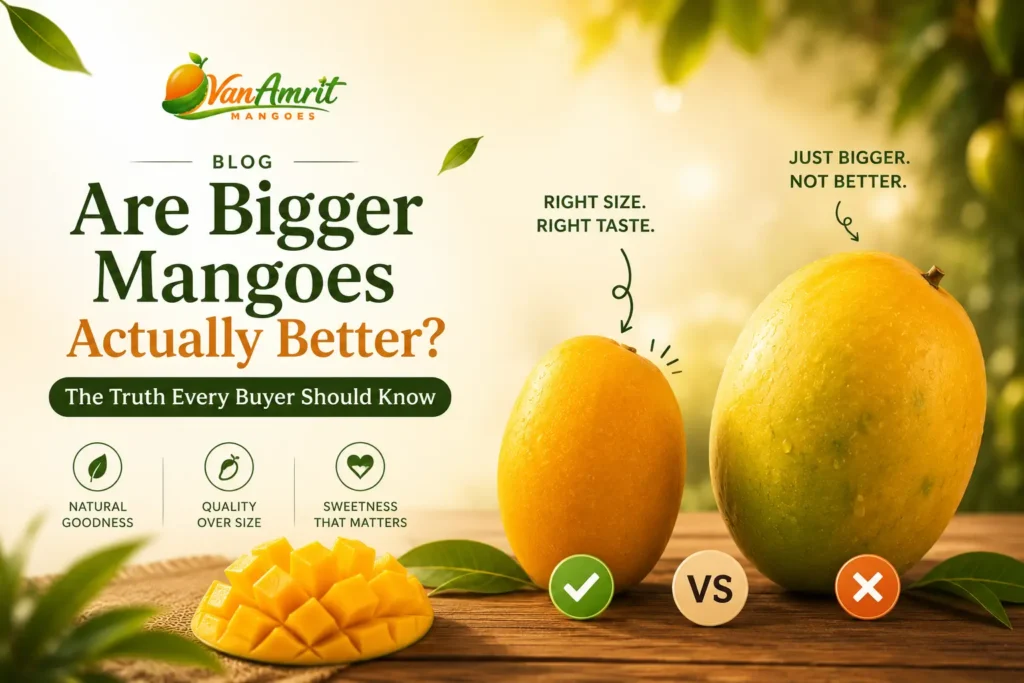
Are Bigger Mangoes Actually Better?
The Truth Every Buyer Should Know
Your hand reaches for the biggest one in the pile every time. Here’s why that’s probably the wrong move — and what actually predicts a great mango.
Here’s the part that might genuinely surprise you: that instinct is usually working against you. The mango world runs on a rule that’s almost the opposite of what your hand is telling you to do — and once you understand why, you’ll never shop for mangoes the same way again.
No, not generally. The most prized premium mango varieties in India — Alphonso, Kesar, and Himsagar — are medium-sized or smaller, not large. They consistently measure 18–24° Brix (sugar concentration), while large varieties like Banganapalli and Rajapuri typically measure 14–18° Brix. Bigger fruit usually means more water and more volume — not more sweetness. Variety, ripeness, and fragrance are far better quality indicators than size.
🔬 The Science Bit — What Actually Makes a Mango Sweet?
Before we get into which mangoes are big and which are small, let’s settle the question of what “sweet” even means in measurable terms — because once you understand this, the size debate basically answers itself.
The number that matters is called Brix. One degree Brix equals one gram of dissolved sugar per 100 grams of fruit juice. It’s measured with a refractometer — a small device that reads how light bends through a drop of mango juice. A mango at 20° Brix isn’t subjectively “a bit sweeter” than one at 10° Brix — it has, quite literally, twice the sugar concentration. This isn’t opinion. It’s chemistry, and it’s the same metric the entire food processing industry uses to grade mango pulp for ice cream, sorbet, and FMCG products.
At harvest, mango flesh is mostly starch — Brix typically sits at 9–14° depending on variety. As the fruit ripens, enzymes called amylases break that starch down into sugars: sucrose, glucose, fructose. This is what pushes Brix up to 16–20°+ at full ripeness, and varieties differ enormously here. A genuinely exceptional, tree-ripened mango can hit 20° or higher — territory that’s “often found only in tree-ripened or carefully handled fruit,” as one mango science resource puts it.
So what determines a mango’s Brix? Variety genetics is the single biggest factor — it’s baked into the fruit before it’s even pollinated. Soil and climate matter too: drier years and more sun exposure concentrate sugars, while wetter conditions mean the tree absorbs more water, which dilutes that sugar. And ripening method matters enormously — natural ripening completes the starch-to-sugar conversion; carbide treatment cuts it short.
What does not directly determine Brix? Size. And this is where it gets genuinely interesting.
📉 The Inverse Relationship — Why Smaller Often Means Sweeter
Here’s the finding that should change how you shop for mangoes forever. Research on fruit genetics — published in studies on elevated Brix breeding — has documented something called a negative association between Brix and fruit size. In plain English: as fruit size goes up, sugar concentration tends to go down. Researchers found that genetic variants that increased Brix also led to a measurable decrease in total sugar content per fruit — meaning higher Brix actually came packaged with smaller fruit, not despite it.
Felix Instruments — a company that makes the handheld devices farmers use to measure fruit ripeness in the field — states it about as plainly as science gets: “When the fruits are smaller, they are sweeter, too.”
Think about what happens when a mango grows larger. The tree is pumping more water and cell-wall material into the fruit to increase its volume. But the tree’s capacity to produce sugar isn’t increasing at the same rate. So that sugar — the same amount, roughly — is now distributed across more flesh, more water, more total mass. The sugar gets diluted. A bigger glass of lemonade made with the same amount of lemon and sugar just tastes weaker. Same principle, different fruit.
Researchers also found that wetter growing seasons cause trees to absorb more water — which means “fruits have a higher water content, which will dilute the amount of sugar in fruits.” Late-monsoon mango fruit tends to be plumper and juicier in volume, but often less concentrated in sweetness than fruit that matured during a drier stretch.
So when your hand reaches for the biggest mango in the pile, what you’re often actually selecting for is the one with the most water weight — not the one with the most flavour packed into it. It’s a completely understandable instinct. It’s also, more often than not, working against your taste buds.
⚖️ Variety by Variety — Who’s Big, Who’s Small, Who’s Sweetest?
Theory is one thing. Let’s look at how this plays out across the actual mangoes you’ll encounter in an Indian market this season.
| Variety | Typical Weight | Brix Range | Sweetness Level | Best For |
|---|---|---|---|---|
| Alphonso (Hapus) | 150–200g | 20–24° | Exceptional | Fresh eating, gifting, aamras |
| Himsagar | 200–300g | 20–24° | Exceptional | Fresh eating, East India favourite |
| Kesar | 200–280g | 18–22° | Excellent | Aamras, fresh eating, gifting |
| Chaunsa | 250–350g | 18–22° | Excellent | Late-season fresh eating |
| Dasheri / Langra | 150–250g | 16–20° | Very Good | Fresh sliced eating |
| Banganapalli | 400–600g | 14–18° | Good, mild | Everyday eating, bulk |
| Rajapuri | 400–600g | 14–17° | Good, mild | Aamras volume, pickle |
| Totapuri | 250–400g | 10–14° | Tart, mild | Salads, processing, pickle |
Look at that table for a second. Alphonso — the most expensive, most internationally celebrated mango in the world, the one that gets its own export certifications and brix index pages — weighs about as much as a tennis ball. Himsagar, the pride of Bengal, is similarly modest in size. Both sit at the very top of the Brix scale, 20–24°.
Now look at the bottom of the table. Banganapalli and Rajapuri — both excellent mangoes in their own right, both genuinely worth buying — are two to three times heavier than an Alphonso. And both sit comfortably below 18° Brix.
There’s one honest exception worth flagging: Chaunsa. It’s a medium-large mango that still manages 18–22° Brix — proof that the relationship is a strong tendency, not an iron law. But across the bulk of India’s commercial varieties, the pattern holds: the biggest fruits are rarely the sweetest ones.
→ Complete state-by-state guide to India’s mango varieties🌿 Why Smaller Mangoes Often Taste More Intense
Think about cherry tomatoes for a second. Nobody disputes that a cherry tomato, bursting in your mouth, delivers a more concentrated, intense tomato flavour than a slice cut from a giant beefsteak tomato. The beefsteak isn’t bad — it’s just built for a different purpose: bulk, slicing, sandwiches. The cherry tomato was bred, generation after generation, purely for flavour.
Mango breeding has followed a remarkably similar path. Premium cultivars like Alphonso and Kesar emerged from centuries of selection where farmers and growers prized one thing above all: how the fruit tasted. Not how big it was, not how much pulp it produced per kilo, not how well it survived a three-day truck journey. Taste. Generation after generation, the trees that produced smaller, more intensely flavoured fruit were the ones propagated through grafting.
Larger varieties like Rajapuri and Banganapalli were developed — consciously or through natural selection — with different priorities. Size means more pulp per fruit, which matters enormously for households making large batches of aamras. Size also often correlates with thicker skin, which helps the fruit survive handling and transport better. These are genuinely valuable traits. They’re just not the same traits that produce a mango that stops a conversation when you cut it open.
There’s also a practical, on-the-tree explanation. When a mango tree puts its limited seasonal resources — water, minerals, sugars — into fewer, smaller fruits, each individual fruit gets a more concentrated share. When the same tree (or a different cultivar) channels those same resources into more, larger fruits, each one ends up with comparatively less. It’s the same total “budget,” spread across more or less real estate.
💰 Okay, But When DOES Bigger Actually Win?
This article isn’t here to tell you large mangoes are bad. They’re not. They’re just optimised for a different job — and once you know what that job is, you can use size to your advantage instead of being misled by it.
Aamras and pulp — large varieties genuinely shine
If you’re making a big bowl of aamras for a family gathering, a 500g Rajapuri is going to give you significantly more usable pulp than a 180g Kesar — even if each gram of that Kesar pulp is more intensely flavoured. The seed-to-flesh ratio in larger varieties is often surprisingly favourable, meaning you’re not paying for dead weight. For volume cooking — aamras, mango lassi for a crowd, mango shrikhand — Rajapuri and Banganapalli deliver real, calculable value.
Pickle, chunda, and methia keri
For raw mango preparations, you actually want the tart, firm, large varieties. Their lower Brix and higher acidity at the unripe stage are exactly what traditional pickle recipes are built around. This is one place where “large and mild when ripe” becomes “large and perfectly tart when raw” — a genuine win for size.
Everyday family eating on a budget
Not every mango eaten needs to be a transcendent experience. Banganapalli, at ₹60–₹130/kg, offers good, reliable, mildly sweet eating at a price point that lets a family enjoy mango daily through the season without it being a luxury purchase. There’s real value in that.
→ Rajapuri Mango — Valsad’s large-format aamras champion🥭 What About Within the Same Variety — Does Size Matter Then?
Here’s a more interesting question. Forget comparing Alphonso to Rajapuri. If you’ve got ten Kesar mangoes in front of you, all the same variety, but ranging from 150g to 350g — should you grab the biggest one?
Mostly, no. For premium varieties, there’s a sweet spot — and it’s the middle, not either extreme. A Kesar that’s noticeably undersized for its variety may not have fully developed; the seed takes up a disproportionate share of a smaller fruit, leaving less flesh than expected. A Kesar that’s noticeably oversized often got that way through extra water uptake late in development — exactly the dilution effect we talked about earlier, just happening within a single variety instead of between varieties.
Export-grade mango grading systems actually reflect this. Premium grading prizes consistency — a box of uniformly sized 200–230g Kesar grades higher than a mixed box with some 150g and some 350g fruit, even if the average weight comes out the same. Uniformity signals careful harvesting at the right maturity stage across the whole batch. A few oversized outliers in an otherwise consistent box are sometimes a sign that those particular fruits sat on the tree a bit too long, absorbing extra water as the season turned wetter.
The best mango in a crate is rarely the biggest one. It’s the one that’s most fragrant at the stem, gives gently — not mushy, not rock-hard — when you press near the top, and shows even, rich colour development. Size doesn’t even make the shortlist of things worth checking.
Vanamrit Valsad Kesar — Grown for Flavour, Not for Show
Our Kesar isn’t bred to be big. It’s grown the traditional way, hay-ripened at our Chikhli orchard, and harvested at exactly the size and maturity where its flavour peaks — 18–22° Brix, room-filling fragrance, deep saffron pulp.
🥭 Order Valsad Kesar 🥭 Order Rajapuri (for aamras)🏪 Why Vendors Don’t Mind You Believing the Myth
It’s worth being honest about why “bigger is better” persists as a belief, even though it’s not really true for mango quality. Part of it is just human psychology — we’re wired to associate size with value across almost every product category, from steaks to diamonds to houses. Fruit vendors aren’t doing anything sinister by displaying their largest specimens prominently; they’re responding to the same instinct that makes you reach for them.
But there’s a less innocent angle too. Carbide-treated mangoes often look impressively large and uniformly golden — because the chemical forces a colour change on the outside without the fruit actually completing its natural ripening on the inside. The size looks generous. The colour looks “perfect.” And the Brix can sit at 12–13° while the mango looks like it should be a 20° showstopper. Visually, it’s a great-looking mango. In your mouth, it’s a letdown.
This is exactly why a fragrance check matters more than a size check. A naturally ripened mango — regardless of whether it’s a small Alphonso or a large Rajapuri — has a smell that announces itself the moment you bring it close to your nose. A carbide-treated mango, no matter how big or how golden, usually has next to nothing going on in the aroma department. Your nose doesn’t fall for the same trick your eyes do.
→ Carbide-Free Ripening Explained — the full science and how to spot it📅 Does Size Change Across the Season Too?
It does, and it’s worth knowing if you’re timing your purchases. Within the same variety, on the same trees, fruit that sets early in the season — when the tree has its full reserves concentrated on fewer fruit — tends to be smaller and often more intensely flavoured. Fruit that develops later, as the season progresses toward the monsoon, has more time to take on water and tends to come out larger but somewhat more diluted.
For Kesar specifically, the May–June window is generally where you find that sweet spot — fruit that’s reached a good, consistent medium size with full flavour development, before the late-season water uptake starts working against concentration. Valsad Kesar’s extended season into July is a genuine advantage for availability, but if peak intensity is what you’re after, the May–June window is where to focus.
→ Best Time to Buy Kesar Mangoes in Gujarat — full season calendar 2026✍️ Our Honest Side-by-Side — Small Kesar vs Large Rajapuri
We did this comparison properly — same week, same orchard, both naturally ripened with the hay-bed method, both completely carbide-free. On one side: a Valsad Kesar weighing about 220g. On the other: a Rajapuri weighing close to 500g.
The Kesar, cut open, was deep saffron-orange right through to the seed — no pale patches anywhere. The fragrance hit before the knife even finished its first cut; it’s the kind of smell that makes everyone in the kitchen turn around. Brix measured at 21°. The texture was completely fibreless, almost custard-like, and the sweetness had that distinctive honey-clean quality with barely any acidity to balance against — it didn’t need balancing.
The Rajapuri was, frankly, a beautiful piece of fruit too — golden-yellow, generous, with an enormous amount of usable pulp from a single mango. Brix came in around 15°. The taste was pleasant, gently sweet, easy to eat in quantity without feeling overwhelming. When we blended it for aamras, the volume from just two Rajapuri matched what we’d need four or five Kesar to produce.
Neither mango “lost.” But if you’d handed someone both pieces and asked which one tasted more like “the best mango I’ve ever had” — every single person picked the smaller one. And if you’d asked which one made better aamras for a party of fifteen, the answer flipped just as decisively the other way.
🎯 If Not Size, Then What Should You Actually Look For?
Here’s the priority order that genuinely predicts a great mango — ranked from most important to least.
❓ Mango Size Questions — Answered
🌿 The Short Version
Bigger mangoes aren’t bad — they’re just built for a different purpose than the one most people assume. Size correlates with volume and pulp yield, which genuinely matters for aamras, pickle, and bulk eating. It does not reliably correlate with sweetness, fragrance, or the kind of eating experience that makes someone stop mid-bite and ask where you got that mango.
The next time you’re at a market or scrolling through an online listing, try this: forget the size entirely for thirty seconds. Ask what variety it is. Ask how it was ripened. Smell the stem if you can. Those three things will tell you more about the mango on its way to your plate than its weight ever will.
“The best mango isn’t the one that fills your hand. It’s the one that fills the room with its smell before you’ve even cut it open.” 🥭🌿
Vanamrit — Valsad Kesar, Alphonso & Rajapuri, 2026 Season
Three varieties, each grown and harvested for what it does best — Kesar and Alphonso for flavour intensity, Rajapuri for aamras volume. All farm-direct from Chikhli, Valsad. Naturally ripened, carbide-free, no shortcuts.
🥭 Order Valsad Kesar 🥭 Order RajapuriBulk / gifting: vanamrit.in/contact | WhatsApp: +91 9033595016
Also read: Which Mango Is the Sweetest in India? Mango Buying Guide 2026 Types of Mangoes in India