
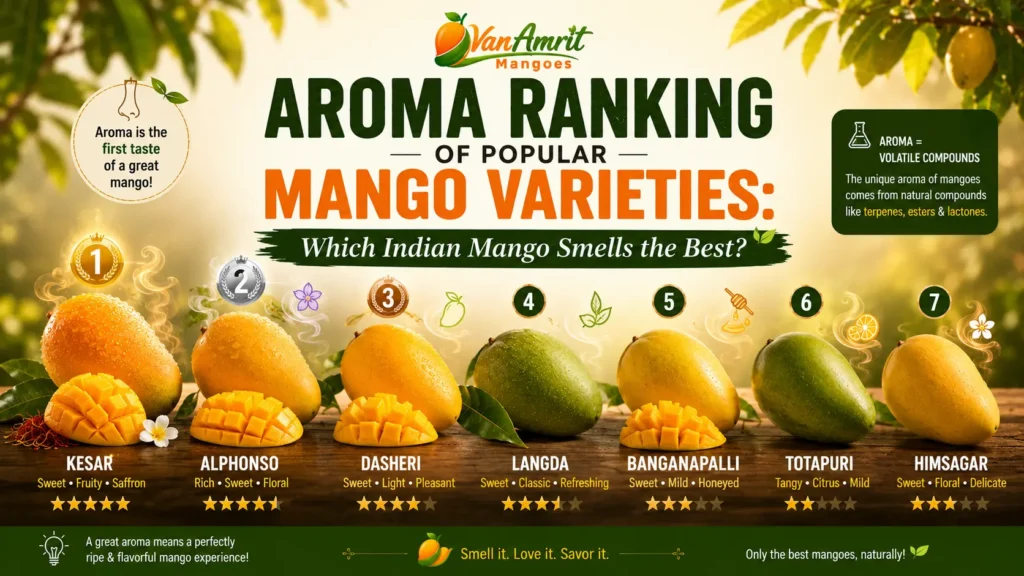
Aroma Ranking of Popular Mango Varieties:
Which Indian Mango Smells the Best?
Before the knife comes out, before the first bite — smell it. Your nose knows more about a mango’s quality than your eyes ever will. Here’s the definitive aroma ranking of India’s most beloved varieties.
What happened? If that mango is genuinely ripe and naturally ripened, you already know the answer. The fragrance announced itself before you were even fully conscious of seeking it. If nothing came to meet you — if you breathed in and got air — that mango has a story to tell, and it’s not a good one.
Aroma is the most honest thing about a mango. It can’t be faked by colour, can’t be replicated by chemical treatment, and can’t be hidden when it’s genuinely there. This aroma ranking of popular Indian mango varieties is built on that premise — and on both the science of what makes each variety smell the way it does, and the first-hand experience of growing and handling Kesar, Alphonso, and Rajapuri on our Chikhli, Valsad farm through many seasons.
Kesar tops the aroma ranking of Indian mango varieties, with a distinctive saffron-honey fragrance driven by allo-ocimene — one of the highest monoterpene concentrations (up to 91%) of any Indian cultivar (ACS Omega, 2024). Alphonso (Hapus) is a close second with a more complex, floral-layered scent. Both are powerfully aromatic when naturally ripened — and both produce essentially zero aroma when treated with calcium carbide.
🔬 The Science Behind Mango Aroma — Why Each Variety Smells Different
You don’t need a chemistry degree to appreciate a mango’s fragrance. But knowing the basics of what creates it will completely change how you think about mango quality — and why the aroma test is so much more reliable than anything visual.
Mango aroma comes from volatile organic compounds (VOCs) — molecules with low boiling points that evaporate readily at room temperature and hit your olfactory receptors as “smell.” Over 270 distinct volatile compounds have been identified across mango varieties in various studies. These belong to several chemical families: monoterpenes, sesquiterpenes, esters, alcohols, aldehydes, and lactones — each contributing different aromatic notes.
The key finding from an ACS Omega study (2024) on nontargeted metabolite profiling of 16 prominent Indian mango cultivars is worth understanding directly: monoterpenes are the primary contributors to mango aroma in almost all Indian varieties. And Kesar had the maximum monoterpene concentration — 91% of its total volatile compounds — making it the most monoterpene-dominant Indian mango studied.
A nontargeted metabolite profiling study published in ACS Omega examined 16 prominent Indian mango cultivars using SPME (Solid-Phase Microextraction) and GC-MS analysis. Key finding: allo-ocimene was the dominant compound in Kesar, while β-ocimene dominated in Alphonso. Kesar showed the highest monoterpene concentration at 91% — the highest of any cultivar studied. Dashehari and Neelum were the only varieties where sesquiterpenes (rather than monoterpenes) dominated aroma. 3-carene was reported in Langra and Dadamio — giving Langra its distinctive green-fruity character.
The dominant compound in Kesar is allo-ocimene — a monoterpene with a sweet, herbal, mildly floral character that combines with the variety’s carotenoid-rich profile (high beta-carotene) to produce that signature saffron-honey quality. Alphonso’s dominant aromatic monoterpene is β-ocimene — also sweet and floral, but with a slightly more complex, multilayered quality. Langra is uniquely distinguished by 3-carene — a compound with a distinctly fresh-green, slightly piney character that gives Langra its “green” aromatic note even when fully ripe.
Why does any of this matter practically? Because volatile compound formation happens during and only during natural ripening. A peer-reviewed study published in ResearchGate (2023) examining the impact of ripening methods on Indian mango varieties using Electronic Nose technology confirmed that natural ripening produces significantly more aromatic volatile compounds than ethylene-induced ripening — and that “natural ripening was identified as the optimal method for preserving the aroma and taste of mangoes.” Calcium carbide treatment, which bypasses the ripening biochemistry entirely, produces essentially zero VOC development.
→ How to identify naturally ripe Kesar using the aroma test🥇 Rank #1 — Kesar: India’s Most Aromatic Mango
If you’ve ever walked into a room where a ripe Kesar mango was sitting on the counter, you already understand the top position in this aroma ranking intuitively. The fragrance doesn’t wait for you to approach — it comes to find you. That’s not romance; that’s allo-ocimene doing its biochemical work at 91% monoterpene concentration.
Kesar’s name literally means “saffron” in Gujarati and Hindi — a reference both to the deep orange-saffron colour of its pulp and to the spice-like, sweet-warm quality of its fragrance. The allo-ocimene dominant profile, combined with high carotenoid-linked precursors, creates a scent that has genuine saffron character — sweet, slightly warm, honey-clean, and absolutely unmistakable.
What does it actually feel like to encounter this fragrance? Hold a peak-season Kesar — naturally ripened, at day 5 of hay-bed penda development — at arm’s length and breathe in. The saffron-honey character fills your palm immediately. Bring it closer and the warmth of the fruit intensifies the aroma into something that’s genuinely intoxicating. Hold it to the stem end and the fragrance is most concentrated — strongest, cleanest, purest Kesar. This is the stem-end test that experienced buyers use as their primary quality check.
There’s a difference in aroma between Gir Kesar and Valsad Kesar worth noting. Gir Kesar, growing in Saurashtra’s red mineral-rich laterite soil, tends to produce a sharper, more concentrated expression of the allo-ocimene character — the saffron note is more precise, almost crystalline. Valsad Kesar, grown in South Gujarat’s coastal alluvial soil on our Chikhli farm, produces a slightly rounder, mellower expression of the same compound — the saffron quality is present and powerful but with a warmer, less angular delivery. The ACS Omega research confirms that geographic growing conditions influence the relative concentration of specific compounds even within the same cultivar — soil mineral composition directly affects VOC profiles.
→ Order Valsad Kesar — naturally hay-ripened, saffron-fragrant, farm-direct → Valsad Kesar vs Gir Kesar — the full comparison🥈 Rank #2 — Alphonso (Hapus): Floral Complexity in Every Breath
If Kesar’s aroma is a single note played with extraordinary purity — think a clean, sustained tone on a stringed instrument — then Alphonso’s fragrance is a chord. Multiple aromatic threads present simultaneously, each identifiable if you pay attention, and together creating something more sophisticated than any of them alone.
Alphonso’s dominant volatile compound is β-ocimene — related to, but distinct from, Kesar’s allo-ocimene. Where allo-ocimene has a warmer, spice-adjacent character, β-ocimene is sweeter and more specifically floral. This is the compound that gives Alphonso its signature opening note — fresh, clean, and unmistakably tropical-floral. Research published in Scientia Horticulturae (2024) specifically studying geographic variation in Alphonso aroma volatiles confirmed significant differences in compound profiles between Ratnagiri and Devgad specimens, suggesting even within the same variety, growing region soil and climate conditions create measurably different fragrance expressions.
The practical sensory experience: a ripe Ratnagiri Alphonso at peak season — April to early May — has a fragrance that you notice in stages. The first breath gives you the clean tropical sweetness. Hold it longer and the floral complexity develops. The warmth from the palm amplifies the aromatic volatiles and you start to notice the caramel-sweet undertone in the finish. The aroma of peak Alphonso is arguably the most complex of any Indian mango — which is why it’s #2, not #1, on the aroma ranking. Pure intensity at the stem test gives Kesar the edge; Alphonso wins on aromatic sophistication.
→ Why Alphonso is called Hapus — history, terroir, and the fragrance connection🏅 Ranks #3–#6: Himsagar, Chausa, Dasheri, Langra
Himsagar’s aroma is a delayed revelation. At the stem end, it’s present but quiet — a gentle honey-sweet hint. The moment you cut it open, the fragrance opens up completely, flooding the air with an intensely sweet, slightly custardy honey quality that’s uniquely Himsagar. The aroma “blooms” on cutting rather than announcing itself from the outside. This is consistent with the variety’s higher ester content — these fragrant esters are released more readily when the cell walls are broken. Himsagar earns its place as #3 on pure cut-open intensity. Buyers who judge on stem-end alone may underestimate it.
Chausa is the late-season aromatic reward. Its honey-floral fragrance has remarkable persistence — a ripe Chausa cut and left on a plate will keep fragrant a room for hours. The dominant aromatic quality is a warm honey-caramel character (furanone-driven) that deepens as the fruit ripens. Because Chausa peaks in July and August — when carbide use is lower as early-season pressure has passed — buyers are more likely to encounter genuinely naturally ripened Chausa than almost any other variety. The fragrance it develops in true natural ripening is extraordinary enough that North Indian mango lovers will argue for it being the most memorable fragrance of the season.
Dasheri’s fragrance is clean, mild-sweet, and entirely its own — myrcene-dominant with lighter floral top notes and no green or sharp characters. It won’t fill a room, but it will greet you pleasantly at the stem. The aroma scales up significantly on cutting. What makes Dasheri’s fragrance specifically interesting is how cleanly it expresses myrcene’s “tropical fruity” character without any sharpness or complexity. It’s the most consistently pleasant of the mid-tier aroma varieties — exactly what you’d want in an everyday eating mango.
Langra is unique in this entire ranking for one reason: 3-carene. The ACS Omega study specifically identified 3-carene as the dominant distinguishing compound in Langra (along with Dadamio) — a monoterpene with a distinctly green, slightly piney, fresh character. This is why Langra smells “green” even when fully ripe — the variety famously retains its green skin at peak ripeness, and its volatile profile carries that green quality into the aroma. Some find this complexity fascinating; others find it unfamiliar compared to the pure sweetness of Kesar or Alphonso. It places Langra solidly at #6 — genuinely aromatic, but specifically aromatic in a way that polarises first-timers.
📊 Ranks #7–#11 — The Mid-to-Lower Tier
Every variety in this section is genuinely pleasant to smell — we’re talking about mangoes, after all, not industrial chemicals. But compared to the top six, these varieties are quieter. More of a suggestion than a declaration.
| Rank | Variety | Origin | Dominant Aroma Note | Intensity | Peak Season |
|---|---|---|---|---|---|
| #7 | Banganapalli (Safeda) | Andhra Pradesh | Mild, clean sweetness | Medium | April–June |
| #8 | Rajapuri | South Gujarat | Clean, mild-fruity | Medium-low | June–August |
| #9 | Safeda / Malda | UP, Bihar | Light, subtle sweet | Low-medium | June–July |
| #10 | Mallika (hybrid) | Maharashtra, Tamil Nadu | Fruity-mild, pleasant | Low-medium | June–August |
| #11 | Totapuri | South India | Very mild, slightly acidic | Low | April–July |
Banganapalli at #7 deserves a specific mention: it has a genuinely pleasant mild-sweet fragrance that scales nicely with variety size (these are large mangoes). The aroma is soft rather than powerful — you need to be within a few centimetres at the stem to fully appreciate it. This is consistent with its lower volatile compound concentration compared to premium aromatic varieties.
Rajapuri at #8 is our own third variety at Vanamrit, and I’ll be straightforward: Rajapuri’s strength is its extraordinary pulp yield for aamras, its late-season timing (June–August), and its value. Fragrance is not where Rajapuri competes. It has a clean, honest mango smell — nothing offensive, nothing remarkable. Its allo-ocimene and β-pinene profile (identified in the ACS Omega study as Rajapuri’s dominant monoterpenes) produces a clean-fruity quality without the intensity of Kesar.
Totapuri at #11 is technically India’s most processed variety — primarily used for pickles, amchur, and industrial juicing. Its low natural aroma is entirely consistent with its low sugar content and high-acid profile. This is a mango designed for culinary application, not for filling your kitchen with fragrance.
🚫 Rank #12 — The Carbide-Treated Mango: Zero Aroma, Last Place Always
This entry in the aroma ranking isn’t a variety — it’s a treatment. Any mango variety in this list, when treated with calcium carbide, drops immediately to last place on the aroma ranking, regardless of its natural genetic fragrance potential.
Calcium carbide forces skin colour change through acetylene gas without completing the natural ripening biochemistry. The volatile organic compound formation pathways — the exact same pathways that produce allo-ocimene in Kesar, β-ocimene in Alphonso, and 3-carene in Langra — are simply not activated. Zero compound formation. Zero fragrance. Zero aroma ranking.
The ResearchGate study (2023) on Electronic Nose analysis of Indian mango varieties confirmed this directly: ethylene-induced ripening (the legal, FSSAI-approved method) accelerated aromatic compound production but resulted in some flavor loss during storage. Natural ripening was the clear winner for both aroma and taste. The implication for carbide is even starker — carbide doesn’t even reach the levels of ethylene-induced ripening. It bypasses the chemistry entirely.
If you hold a mango described as “ripe Kesar” or “fresh Alphonso” to your nose and get nothing — no fragrance, no hint of mango sweetness, no character of any kind — that mango is not what it’s being called. Either it’s carbide-treated, or it was harvested so early that it will never develop proper aroma regardless of how long you wait. The stem-end aroma test is the most reliable 5-second quality filter any mango buyer has.
Vanamrit Valsad Kesar — The Aroma Tells You On Arrival Day
Allo-ocimene at 91% monoterpene concentration. Hay-bed (penda) ripened at our Chikhli, Valsad farm. No carbide, no ethylene chambers. When the box arrives, hold the stem end to your nose. That’s the proof — and it announces itself before you’re even ready.
🌸 Order Valsad Kesar 🥭 Order Valsad Hapus🌡️ How Ripening Method Changes the Aroma — Natural vs Ethylene vs Carbide
The same mango variety can produce radically different aromas depending entirely on how it was ripened. This is the fact that most buyers don’t know — and it’s the reason why the “which variety smells best” question is inseparable from “how was it ripened?”
Natural ripening is when a mango’s own ethylene production (it’s a climacteric fruit — it produces the hormone itself) drives the complete ripening cascade over 5–7 days. All the VOC formation pathways activate progressively. Allo-ocimene in Kesar builds to its 91% concentration. β-ocimene in Alphonso develops the multilayered floral complexity. The aroma you smell at peak natural ripeness is the full genetic expression of that variety’s fragrance potential.
Hay-bed (penda) ripening — the traditional South Gujarat method we use at Vanamrit — takes natural ripening one step further. The hay insulates the fruit, maintains even temperature, and crucially, traps the ethylene the mango produces naturally close to the fruit surface. This creates a self-reinforcing ripening environment where the mango’s own ethylene output keeps building until the cascade is fully complete. The aroma result from hay-bed ripening is the most complete volatile compound development possible — the gold standard of the mango aroma ranking.
Ethylene gas chamber ripening (FSSAI-approved, up to 100 ppm concentration) triggers the same pathway as natural ripening but at an accelerated rate. The ResearchGate study confirmed this produces good aromatic profiles but noted “flavor loss during storage” compared to natural ripening — the speed of development means the later-stage compounds are slightly less developed. Good fragrance, but not peak fragrance.
Carbide ripening: Zero. The ripening cascade is never triggered. The VOC formation pathways are never activated. This is not a matter of degree — it’s a categorical difference. You’re not getting “less aroma” with carbide-treated mangoes. You’re getting none.
→ How to ripen mangoes at home naturally — 5 methods compared📊 The Complete Aroma Ranking — All 12 in One Table
| Rank | Variety | Origin | Dominant Compound | Aroma Character | Intensity /10 | Peak Season |
|---|---|---|---|---|---|---|
| 🥇 #1 | Kesar | Gujarat (Valsad + Gir) | Allo-ocimene (91% monoterpene) | Saffron-honey, room-filling | 9.8 | May–July |
| 🥈 #2 | Alphonso (Hapus) | Maharashtra + S. Gujarat | β-ocimene + linalool | Floral-complex, layered | 9.2 | Feb–June |
| 🥉 #3 | Himsagar | West Bengal | Esters + linalool | Honey-custardy, blooms on cut | 8.4 | May–June |
| #4 | Chausa | UP / Bihar | Furanones + myrcene | Honey-caramel, persistent | 7.8 | July–Aug |
| #5 | Dasheri | Malihabad, UP | Myrcene dominant | Mild-sweet, tropical clean | 7.0 | June–Aug |
| #6 | Langra | Varanasi, UP | 3-carene (green notes) | Fresh-green, piney undertone | 6.5 | June–Aug |
| #7 | Banganapalli | Andhra Pradesh | Mixed monoterpenes | Mild-sweet, soft | 5.8 | April–June |
| #8 | Rajapuri | South Gujarat | Allo-ocimene + β-pinene | Clean, mild-fruity | 5.0 | June–Aug |
| #9 | Safeda / Malda | UP / Bihar | Light monoterpenes | Subtle sweetness | 4.4 | June–July |
| #10 | Mallika (hybrid) | Maharashtra / TN | Mixed | Fruity-mild, pleasant | 4.0 | June–Aug |
| #11 | Totapuri | South India | Very light | Very mild, acidic note | 2.8 | April–July |
| #12 | Carbide-treated (any) | Any variety | None formed | Zero aroma | 0 | N/A |
👃 How to Use the Aroma Test — The 30-Second Quality Check That Always Works
The aroma ranking tells you what each variety is capable of. The aroma test tells you whether any given fruit in front of you has actually achieved it. Here’s how to do it properly.
The stem-end hold. Point the stem end toward your nose. Hold about 2–3 centimetres away. Breathe in once, naturally — don’t force a deep inhale. A naturally ripe, aromatic mango (Kesar, Alphonso) will announce itself within that single breath. You’re not searching for it; it finds you.
What each level means: Powerful, unmistakable fragrance = peak ripeness, naturally ripe. Moderate, gentle sweetness = 1–2 days from peak. Faint, barely detectable = 2–3 days from peak. Complete silence = either very unripe, or carbide-treated and will never develop proper aroma.
Calibrate by variety. A peak Kesar should be overwhelming. A peak Dasheri or Banganapalli at the same point of ripeness will be pleasant but quiet — don’t judge them by Kesar’s standard. Know which variety you have and set appropriate expectations. Himsagar gets fuller at the cut rather than the stem — try the stem test, but also remember that this variety specifically rewards the first slice.
The cut confirmation. Once you slice open a naturally ripe aromatic mango, the fragrance floods the room within seconds. The cell walls breaking releases the volatile compounds trapped in the pulp. Carbide-treated mangoes cut open to produce almost nothing — a whisper of something vaguely sweet, quickly gone. Natural ripening means the fragrance is in the fruit, not just on the surface.
✍️ What the Farm Smells Like When the Season Is Right
There’s a specific moment at our Chikhli, Valsad farm that tells us the Kesar season has peaked. It happens in the hay-ripening shed, not the orchard. You open a crate that’s been sitting for 4–5 days in the traditional penda hay arrangement, and the fragrance hits you before the box is even fully open. Not “nice smell.” Not “that’s pleasant.” The saffron-honey quality is so concentrated in that enclosed space that it’s almost tangible — like walking into a room where someone left a warm spice cake. That’s allo-ocimene reaching 91% of the volatile compound profile, and it’s extraordinary.
The difference between opening that naturally ripened crate and opening a box of market Kesar is something you don’t need to be a food scientist to understand. The hay-bed box announces itself from a metre away. The market crate, when you hold a mango to your nose and breathe in, gives you close to nothing. Same variety. Same golden-yellow skin. Completely different experiences from the very first breath.
That first-breath difference is why aroma is the test we always come back to. Not because it’s sentimental. Because it’s the chemistry telling you the truth about what that mango is and what it went through to get to you.
🍯 Aroma and Sweetness — Are They Related?
Yes, directly — and understanding why is one of the most practically useful pieces of knowledge for a mango buyer.
Both aroma intensity and sweetness (Brix) develop through the same natural ripening biochemistry. The enzymes and pathways that convert starch to sugar are activated by the same ethylene-triggered cascade that activates volatile compound formation. They run concurrently — which is why a mango with full aroma development has almost always also completed its sugar development.
Practically: the stem-end fragrance test is your best indirect indicator of Brix without a refractometer. Powerful saffron aroma on a Kesar = 18–22° Brix almost certain. No aroma on any variety = low Brix, flat taste. It’s not a perfect correlation (Himsagar can be very sweet with a quieter stem aroma, for example), but it’s the most reliable single-variable check available to any buyer at the point of purchase.
The varieties where aroma and sweetness diverge most notably: Chausa and Himsagar score lower on aroma intensity than Kesar or Alphonso, but their Brix at peak is competitive. Chausa in particular — peak July, naturally ripened — can reach 20–22° Brix with an aroma profile that’s rich but not room-filling. Langra and Dasheri have moderate Brix for their aroma level. But for the top tier — Kesar and Alphonso — aroma intensity and Brix track together very closely. Full fragrance = full sweetness. No fragrance = no sweetness.
→ Which mango is sweetest in India — the full Brix ranking❓ Mango Aroma Questions — Answered
🌸 The Nose Knows
The aroma ranking of Indian mango varieties — with Kesar at the summit and zero-aroma carbide-treated fruit at the bottom — isn’t just a fragrance guide. It’s a quality guide. Every variety in the top six has earned its position through genetic compound profiles that produce real, specific, identifiable fragrance when the ripening chemistry is allowed to complete.
The aroma test is free. It takes one breath. It tells you more about that specific mango in your hand than any label, any price, any colour check. If it smells like saffron-honey, you have a naturally ripe Kesar. If it smells like complex tropical flowers, you have a naturally ripe Alphonso. If it smells like nothing — regardless of variety or price — put it down and walk away.
Every Kesar we ship from Chikhli, Valsad arrives fragrant at the stem within 36–48 hours of reaching room temperature. That fragrance is the proof of everything: natural ripening, complete biochemistry, genuine Kesar from a real farm. The science has a name for it — 91% allo-ocimene monoterpene concentration. We just call it mango season doing what it’s supposed to do.
“A mango that announces itself before you’re ready for it is a mango that was allowed to become what it was always meant to be.” 🌸🥭
Vanamrit Valsad Kesar — 91% Allo-Ocimene. Hay-Ripened. Carbide-Free.
Grown on our Chikhli, Valsad orchard. Ripened the traditional penda (hay-bed) way. No carbide, no shortcuts. Pan-India delivery in 5–6 days. Hold the stem end to your nose on arrival day and let the aroma ranking confirm itself.
🌸 Order Valsad Kesar → 🥭 Order Valsad Hapus →Bulk / gifting: vanamrit.in/contact | WhatsApp: +91 9033595016
Also explore: Sweetest Mango — Brix Ranking Best Time to Buy Kesar 2026 Complete Mango Buying Guide