
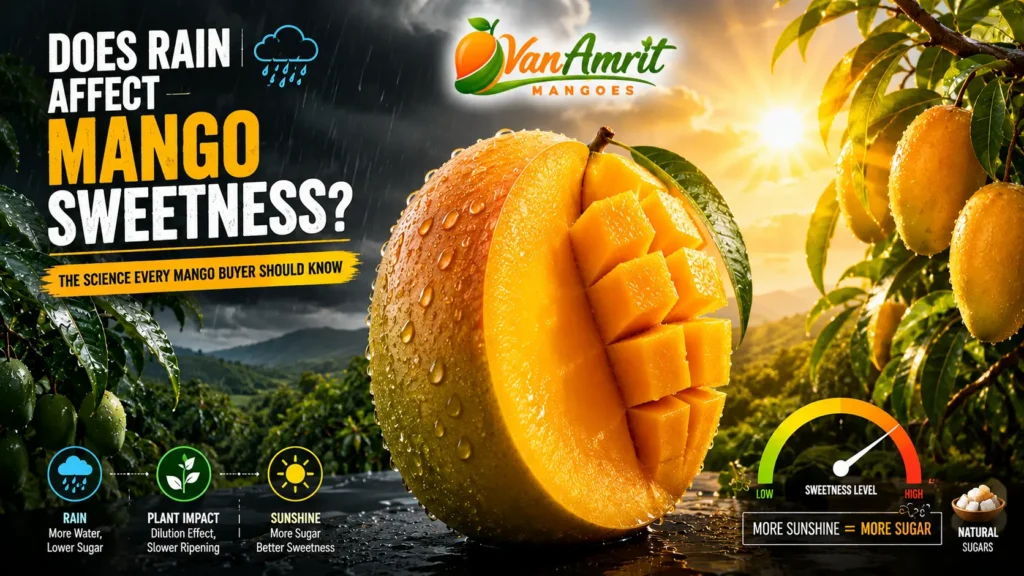
Does Rain Affect Mango Sweetness?
The Science Every Mango Buyer Should Know
Why your Kesar tastes different year to year, what dry summers actually do to sugar levels, and how Gujarat’s climate is the real secret behind that 18–22 Brix sweetness.
The answer, almost certainly, was the weather. And more specifically — the rain.
Does rain affect mango sweetness? The short answer is yes, emphatically. But the full answer is more interesting than a simple yes or no. The timing of rainfall across four distinct growth stages is what separates a legendary mango season from a disappointing one — and understanding that timing is the most useful thing you can know as a mango buyer.
At Vanamrit’s Valsad orchard, we’ve grown Kesar through brilliant seasons and difficult ones. Here’s everything we know about how weather shapes the mango in your hand.
🔬 First, How Does a Mango Become Sweet at All?
Before we get into rain, let me explain what sweetness actually means inside a mango — because once you understand the chemistry, the rain story makes complete sense.
A young, unripe mango is full of starch. Bite into one and it tastes like a raw potato or an unripe apple — dense, slightly acidic, no sweetness at all. As the mango matures, enzymes called amylases progressively break that starch down into soluble sugars: sucrose, glucose, and fructose. This starch-to-sugar conversion is the entire basis of mango sweetness, and it’s what the Brix measurement captures — the higher the Brix, the more dissolved sugar per gram of juice.
Think of a mango’s pulp like a cup of tea. Brew it strong and it’s rich, full-flavoured, concentrated. Now pour in an extra half-cup of hot water — the same amount of flavour is now diluted across more liquid. The tea tastes thinner. This is exactly what excess rain does to mango sweetness. The mango produces its sugar through the starch conversion process, but when it absorbs too much water — through rainfall or excess irrigation — that sugar is diluted across a larger volume of watery flesh. The total sugar produced hasn’t necessarily changed. But the concentration has, and that concentration is what your palate tastes.
Three things drive this starch-to-sugar conversion: heat (warmer temperatures accelerate enzyme activity), time (longer the mango stays on the tree in stable conditions, the more complete the conversion), and water availability (how much water the tree absorbs directly affects whether the resulting sugars are concentrated or diluted in the flesh). Rainfall influences all three, in different ways at different times of year.
The Kesar mango specifically registers 18–22 degrees Brix in good seasons — nearly double the 12–14 Brix of a typical supermarket mango. The Marathwada adaptation of Kesar achieves up to 24 Brix under even drier inland conditions, making it the highest-measured sweetness of any Indian mango variety. That extraordinary sweetness isn’t magic — it’s the direct product of a climate that keeps rain away during the most critical sweetness-building window.
📅 The 4 Rainfall Stages That Make or Break Mango Sweetness
Here’s the thing about rainfall and mangoes: it’s never as simple as “more rain = worse mango” or “less rain = better mango.” The same amount of rainfall can be genuinely helpful at one stage of the mango’s development and genuinely catastrophic at another. The mango’s growth cycle has four distinct phases, and rain affects mango sweetness differently at each one.
Winter Rest — November to January
The mango tree needs a cool, dry dormancy period to receive the biological signal that it’s time to flower. This is the quietest phase on the outside, but the most consequential one on the inside. Temperatures need to drop, and rain needs to stay away. A cool, dry winter forces the tree to invest its stored energy into building flower buds. Any significant rainfall or warm spell during this period disrupts that flowering signal — leading to delayed, patchy, or reduced flowering, which directly limits how many fruits develop. In Gir’s Saurashtra belt, the winter of November through January is typically dry and mild — exactly right. When it isn’t, the consequences are visible by May.
Flowering — February to March
This is when mango trees burst into those spectacular white panicles. A very light, gentle pre-monsoon shower during flowering can support the process. But heavy or sustained rain during flowering physically damages the delicate flowers, promotes fungal diseases like anthracnose and powdery mildew, and causes flower drop — reducing the number of fruits that successfully set. The sweet spot is warm, sunny, breezy conditions with no rain. Coastal breezes in Valsad help with natural pollination during this phase; heavy rain shuts it down.
Fruit Development — March to May
This is when the mango grows from marble-sized to its full size. Adequate, well-distributed moisture is genuinely essential here — a drought during this stage produces small, underdeveloped fruit that never fully builds its sugar payload. But excessive rain at this stage is where the dilution effect begins: the fruit is rapidly absorbing water, expanding, and concentrating less sugar per gram of flesh. Fruit splitting — where the skin can’t keep up with rapid internal water expansion — begins to appear in wet years.
Pre-Harvest / Ripening — May to July
This is the most sweetness-critical stage of the entire year. The 4–6 weeks before harvest, dry and warm conditions allow maximum starch-to-sugar conversion, carotenoid development (that deep saffron colour), and aromatic compound production. Any rainfall during this window dilutes sugars, slows colour development, and mutes fragrance. This is the window that separates a 22 Brix Kesar from an 18 Brix one. “Dry weather conditions are ideal for producing high-quality mangoes during the ripening stage,” confirmed AlphonsoMangoes.online in their March 2026 analysis of April rain impact.
Rainfall Impact at Each Growth Stage — Quick Reference
| Growth Stage | Period (Gujarat) | Ideal Condition | Excess Rain Effect | Drought Effect |
|---|---|---|---|---|
| Winter Rest | Nov – Jan | Dry & cool | Delayed/failed flowering | Promotes bloom signal — ideal |
| Flowering | Feb – Mar | Very light rain OK | Flower drop, fungal disease | Generally fine with moderate heat |
| Fruit Development | Mar – May | Moderate, distributed | Fruit splitting, sugar dilution | Small, underdeveloped, less sweet |
| Pre-Harvest / Ripening | May – July | Dry, warm, sunny | Diluted sweetness, pale colour, muted aroma | Concentrates sugars — sweetest fruit |
⛈️ What Excess Rain Actually Does to Your Mango’s Sweetness
Let me be specific about what happens inside a mango when it rains too much during ripening — because the dilution effect is real, measurable, and the main reason why mango quality varies so dramatically year to year.
When rainfall occurs during fruit development and ripening, the mango tree absorbs that water through its roots and distributes it throughout the fruit. The flesh cells take on more water, expanding the overall volume. But here’s the problem: the total sugar produced through enzymatic starch conversion hasn’t increased proportionally to match that extra water volume. So the same amount of sugar is now dissolved in more liquid — Brix per gram drops, and the mango tastes lighter, less intensely sweet, and less complex.
A 2025 peer-reviewed study published on ResearchGate (Impact of Climate Change on Mango Phenology, Yield and Quality) directly confirms this: erratic rainfall patterns affect “fruit quality such as size, color, and sweetness” through disrupted carbohydrate metabolism and increased water availability. GetFarms.in’s cultivation guide is equally direct: “Excessive rain dilutes the fruit’s sugar content, reducing its sweetness and flavor. Anthracnose and powdery mildew are two examples of fungi that thrive in an environment that is too wet.”
And rainfall during ripening doesn’t just reduce sweetness — it reduces everything simultaneously. The same dry-heat conditions that concentrate sugars also drive carotenoid production (the saffron-orange colour) and aromatic compound development (that room-filling fragrance). A wet ripening season delivers a paler mango, a milder fragrance, and lower sweetness, all at once. That’s why some years’ Kesar looks and smells slightly different from the best years — it’s not imagination. It’s weather chemistry.
In 2024, Talaja in Bhavnagar district — one of Gujarat’s key Kesar-producing zones — experienced abnormal post-Diwali warmth followed by unseasonal western disturbance rain in April. The disrupted winter rest phase caused premature leaf emergence instead of flowering. Farmers reported black spots on early fruit and patchy colour development. The result: Talaja Kesar production collapsed from the normal 5,000 tonnes to just 1,500–2,000 tonnes that year, a 60–70% decline. The fruit that did develop showed visibly reduced sweetness and muted saffron colour — a textbook example of what happens when the pre-harvest dry window gets wet (Free Press Journal, April 2024).
This also explains why buying Kesar before peak season in April often gives you a less sweet experience — early-season mangoes haven’t been through the full dry-heat ripening window yet. Our 2026 Kesar season timing guide shows you exactly when the sweetness peak hits and why buying at the right time makes such a visible difference.
🏜️ Not Enough Rain: The Other Side of the Problem
If you’ve been following the logic so far, you might be thinking — so the answer is just “no rain, ever”? Actually, no. While excess rain during ripening reduces sweetness, insufficient water at the right stages creates its own set of problems. The mango needs water to grow, and the relationship between rainfall and sweetness is more nuanced than a simple drought-versus-flood comparison.
Mango trees need 700–900 mm of annual rainfall to thrive — confirmed by cultivation guides from Aamboss. Below this during the growing season, the tree doesn’t have enough water to properly fill out the fruit. The result is mangoes that stay small, develop lower sugar payload overall, and sometimes drop prematurely from the tree due to stress. “Inadequate rainfall results in smaller and lighter fruits — it also affects fruit sweetness and flavor, lowering market value,” as the Aamboss guide puts it plainly.
Here’s the sweet spot that mango farmers in Gir and Valsad have been managing for generations: adequate water during fruit development (March–May), followed by a dry, hot window during ripening (May–July). It’s the transition from wet to dry — from building the fruit to concentrating the sugars — that creates the conditions for an exceptional mango.
Think of it like making caramel. You need water at the beginning of the process to dissolve the sugar and create the syrup. But at the end, you need heat and evaporation — dry conditions — to concentrate that syrup into something rich and intensely flavoured. Too much water throughout, and you never get caramelisation. No water at all, and the sugar never dissolves in the first place. It’s a precise sequence, and the Gujarat growing zones hit it naturally, year after year.
Valsad’s alluvial coastal soil has a natural advantage here: it retains soil moisture well, meaning the trees have better access to stored water during dry periods without needing as much irrigation. The coastal humidity provides gentle background moisture while the surface conditions remain relatively dry during the critical ripening months.
☀️ Why Gujarat’s Climate Is Kesar’s Real Secret Weapon
Now we can answer the bigger question that sits behind the rainfall question: why does Kesar mango from Gujarat taste the way it does? Why can’t you grow the same variety in a wetter climate and get the same result?
The answer is that Gujarat’s climate hits all four of the rainfall stages we’ve discussed in precisely the right way — not by design, but by geography. This is what the wine world calls terroir: the inseparable relationship between a place and the quality of the fruit it produces.
In Gir’s Saurashtra belt, the mango growing year looks like this: a cool, dry winter (November–January) triggers flowering beautifully. A warm, relatively dry spring (February–March) supports flowering and early fruit set. The pre-monsoon summer heat of April–June — 30–38°C, low humidity, minimal rain — drives the starch-to-sugar conversion at maximum intensity, builds carotenoid concentration (that saffron colour), and develops the terpenes and esters responsible for Kesar’s signature fragrance. Then the monsoon arrives in July — well after the June harvest is complete. It’s a near-perfect natural sequence.
Valsad’s South Gujarat coastal belt runs a slightly different schedule — but achieves the same result through a different mechanism. The alluvial coastal soil and 150–200 cm annual rainfall might sound like a recipe for diluted, less sweet mangoes. But here’s why it isn’t: Valsad’s monsoon arrives in late June to July, after the main harvest window of May–June is already complete. The pre-harvest ripening period is relatively dry. The coastal humidity provides background moisture that the alluvial soil retains, giving the trees what they need for fruit development without flooding the ripening fruit with excess water. The result is a Kesar that’s slightly more mellow and honey-sweet than the bold, intense Gir Kesar — different expression, same quality outcome.
Curious about exactly how the two growing zones produce different flavour profiles? Our Valsad vs Gir Kesar comparison guide breaks it down soil by soil, taste by taste.
🌡️ What Climate Change Is Doing to India’s Mango Seasons in 2025–26
The rainfall-sweetness relationship that Gujarati farmers have worked with for generations is now under pressure from something none of them caused: climate change. And understanding this is important for buyers trying to make sense of why quality feels more variable year to year.
A 2025 peer-reviewed study on ResearchGate confirms what farmers are seeing on the ground: rising temperatures, erratic rainfall, and increased extreme weather events are directly disrupting mango phenology — the flowering cycle, fruit set, and carbohydrate metabolism that determine sweetness and colour. The researchers note that “irregular bearing, reduced yields, and compromised fruit quality such as size, color, and sweetness” are now climate-change consequences for mango farming across India.
The most visible symptom is disruption of the winter rest phase. Warmer winters mean mango trees don’t always receive the cool-dry signal that triggers flowering. The result is delayed flowering, patchy flowering, or in severe cases no flowering at all in some orchards — even before a single drop of unseasonal rain falls. As one meteorologist observing Gujarat’s weather in April 2024 explained: “The unseasonal warmth caused the mangoes to bloom prematurely, followed by the appearance of spots on the fruit. The lack of sufficient winter chill and the early onset of heat disrupted the flowering process.”
The practical implication for buyers: a good mango season in 2026 is no longer guaranteed by buying from the right variety or the right region. You need to buy from farm-direct sources that are honest about how the specific season’s weather treated their orchard — and are willing to tell you when a year was difficult. At Vanamrit, we’re transparent about every harvest. Check our current season availability and quality notes here.
The good news for 2026: GirKesar.com reported in April 2026 that the Gir region had “good winter temperatures, strong flowering, and adequate rainfall” — a positive indicator for sweetness and colour development in the 2026 harvest. At Vanamrit’s Valsad orchard, the pre-harvest window has been adequately dry, and the Kesar is developing the deep saffron colour that signals a good season.
🌍 Does Rain Affect All Indian Mango Varieties the Same Way?
The short answer is yes — every premium Indian mango variety is weather-sensitive, and all of them are grown in regions where the monsoon arrives after harvest for exactly this reason. But each variety’s relationship with rainfall has its own nuances.
- Alphonso (Hapus) — Ratnagiri, Maharashtra: Gets 2,000–2,500 mm annual rainfall — extremely high. But harvest is March–May, before the heavy monsoon. April pre-monsoon showers during the harvest window are particularly damaging. “Unexpected rainfall during the peak ripening period can affect this natural process — mangoes develop their sweetness gradually as starch converts to sugar” (AlphonsoMangoes.online, March 2026). The 2026 Konkan season saw output drop to 10% of normal, partly due to unseasonal rain disruptions
- Dasheri — Uttar Pradesh: Grows in Gangetic plain summer heat. Benefits from a dry May–June pre-harvest period. Monsoon in July arrives just after harvest completes
- Langra — Bihar/UP: A later, more heat-tolerant variety. Still shows measurably reduced sweetness in excessively wet seasons
- Himsagar — Bengal: Short season, sensitive to pre-harvest rains. Wet May–June seasons noticeably reduce its characteristic sweetness and colour intensity
The common thread across all India’s finest mango regions is not a lack of rain — it’s the timing. Every one of these growing zones has its rainfall concentrated in a monsoon that arrives after or very late in the harvest season. This is not coincidence. It’s the fundamental geographic requirement for producing a sweet, premium mango at scale.
🛒 What You Can Do as a Buyer: Using Weather Knowledge to Order Smarter
Understanding how rain affects mango sweetness isn’t just interesting science — it gives you a practical advantage as a buyer. Here’s how to use this knowledge.
Check the Season Before You Order
Before placing an order, a quick search for “Gujarat Kesar mango season 2026” or “Kesar mango harvest news June 2026” will often turn up agricultural reports or farm updates. Good years mean sweeter, more aromatic mangoes. Difficult weather years mean buy from the most trusted farm-direct source that’s honest about quality — because quality variation is real and deserves honest acknowledgment, not marketing spin.
Order at Peak, Not Early
Early-season mangoes (before late May) haven’t been through the full dry-heat ripening window yet. You’re buying fruit that’s still building its sugar content. Peak season — late May to mid-June for Kesar — captures fruit after maximum pre-harvest dry exposure. The sweetest, most aromatic Kesar is the one that stayed on the tree through the hottest, driest days before harvest. Our 2026 Kesar season timing guide shows you exactly when peak sweetness hits.
Ask Your Seller the Direct Question
A farm worth buying from will answer honestly when you ask: “How was the weather this season? How is your Kesar tasting so far?” If they don’t know, dodge the question, or give you marketing language instead of a real answer — that tells you something. The best farm-direct brands treat buyers as partners, not just customers. Transparency about the season is a sign of integrity.
Read the Colour as a Sweetness Signal
Once you receive your Kesar, the pulp colour tells a story. Deep, vivid saffron-orange = dry-season harvest, full carotenoid development, high sweetness. Paler or lighter orange = likely wetter season, reduced sweetness and colour simultaneously. This visual test doesn’t require any tools — just cut the mango and look. You can read more about exactly what authentic Kesar looks like in our 5-sign authentication guide.
Farm Transparency You Can Actually Trust
At Vanamrit, we grow our Kesar on our own farm in Chikhli, Valsad — and we track every season’s weather, flowering quality, and harvest outcome. Our 2026 Kesar is developing strong sweetness and saffron colour through a well-timed dry pre-harvest window. No carbide. No cold storage. Just the real seasonal fruit, honestly delivered.
🥭 Order Valsad Kesar This Season →❓ Your Questions About Rain and Mango Sweetness, Answered
🏁 The Sweetest Mangoes Come From the Driest Pre-Harvest Windows
🌧️🥭 Rain + Mango Sweetness — The Full Picture
So — does rain affect mango sweetness? Absolutely. But the answer isn’t simply “rain bad.” It’s “rain at the wrong time, in excess, is bad.” The same rainfall that would ruin a ripening Kesar in June is completely harmless — even helpful — during the winter rest phase or early fruit development.
What makes Kesar mango extraordinary isn’t just the variety, the soil, or the farming skill. It’s the fact that Gujarat’s natural climate provides the four-stage rainfall sequence that every sweet mango needs: a dry winter that triggers abundant flowering, moderate spring moisture for fruit development, and a hot, dry pre-harvest summer that concentrates every gram of sugar into the ripening fruit. The mango is, in a very real sense, a product of its weather.
This is also why buying from a farm-direct brand that tracks its weather and is honest about every season matters more than it might seem. A great orchard in a great season produces something extraordinary. The same orchard in a difficult weather year will be honest about it — because transparency is a sign of a farm that genuinely cares about what arrives at your table.
“The sweetest mango you’ve ever eaten didn’t just come from a good tree. It came from a dry summer, a cool winter, and a farmer who knew how to work with the weather instead of against it.” 🌧️🥭🌿
Farm-Fresh, Naturally Sweet Kesar From Our Valsad Orchard
We’ve tracked this season’s weather from winter flowering through the pre-harvest dry window — and our 2026 Valsad Kesar is tasting exactly as it should. Carbide-free, naturally hay-ripened, farm-direct to your door across India.
🥭 Order Your Box at vanamrit.inWant to know exactly how this season is looking at our Valsad farm? Ask us directly or WhatsApp: +91 9033595016