
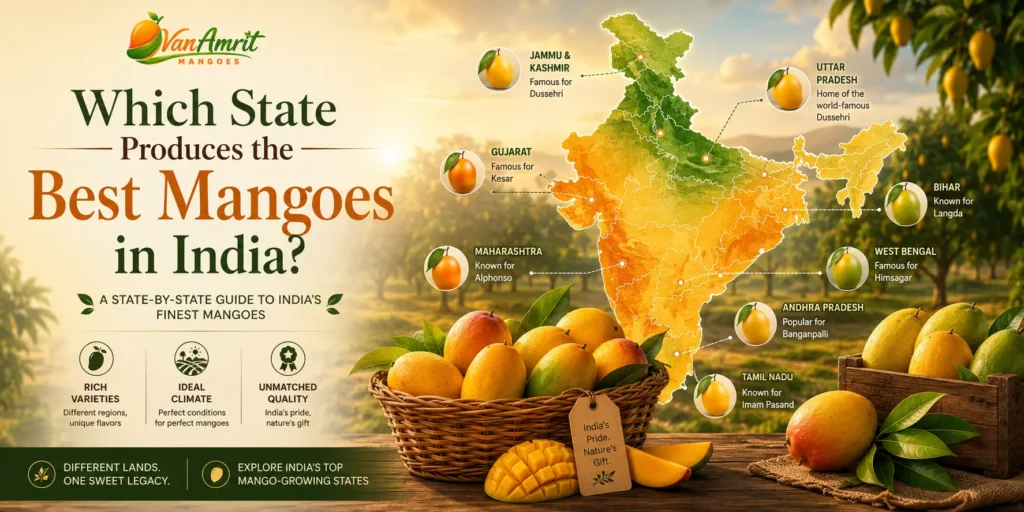
Which State Produces the Best Mangoes in India?
UP leads in volume. Maharashtra wins prestige. Gujarat owns the Queen. Here’s the honest, state-by-state answer every mango lover needs in 2026.
Everyone at that table is right. And that’s exactly what makes the question of which state produces the best mangoes in India so endlessly fascinating — and so worth answering properly.
India grows over 1,000 mango varieties across states that each have their own soil, their own microclimate, their own harvest tradition. But the answer to “best” depends entirely on what you mean by it. Best volume? Best taste? Best for aamras? Best GI-tagged variety? Best for your budget? Let’s go state by state and settle this properly.
🌍 India’s Mango Scale Is Almost Impossible to Believe
Before we dive into which state wins, let’s take a second to appreciate the sheer size of what we’re talking about. India produces roughly 26 million metric tons of mangoes annually — that’s nearly 43–50% of everything the world grows, according to FAO data. No other country comes close. Indonesia, China, and Mexico are the next largest producers, and they’re not even in the same conversation volumetrically.
And here’s the part that always surprises people: despite producing half the world’s mangoes, less than 1% of India’s total crop is exported. Per APEDA data, India exports only 55,000–70,000 metric tonnes annually. Domestic demand absorbs almost everything. Which means the extraordinary mango diversity that exists across this country is largely consumed within it — which is either a beautiful thing or a reason to feel very smug about living here, depending on how you look at it.
The OECD-FAO Agricultural Outlook 2025–2034 projects India’s mango production to reach 36 million metric tons by 2034, maintaining roughly 42% of global output. Per capita consumption is projected to rise to 23.1 kg per person annually by then. From 1991 to 2015, India’s mango cultivation area grew by 109% while production rose by 125% — productivity improvements have consistently outpaced area expansion.
According to APEDA, the major mango-producing states are Uttar Pradesh, Andhra Pradesh, Karnataka, Bihar, Gujarat, Madhya Pradesh, and Tamil Nadu. Each grows different varieties in different soils with different results. The India Mango Market was valued at USD 2.30 billion in 2025 and is projected to reach USD 2.46 billion in 2026, growing at a CAGR of 6.9% through 2031 per Mordor Intelligence data.
⚖️ Volume vs Quality: The Distinction That Changes Everything
Here’s the single most important thing to understand before comparing states: the state that produces the most mangoes is almost never the same as the state that produces the best mangoes to eat.
Think of it like wine. France doesn’t produce the most wine in the world — Italy and Spain both outproduce it. But when people say “best wine,” they usually mean French. The same logic applies to Indian mangoes. Uttar Pradesh is the France of mango volume rankings — wait, actually UP is the undisputed production leader. But Maharashtra, with far smaller output, produces the mango that restaurants in Tokyo and supermarkets in Dubai specifically request by name.
So I’m going to use four criteria throughout this guide: production volume and scale, variety prestige and GI tags, taste and texture profile, and best practical use case. No single state wins all four — and that’s what makes India’s mango geography so rich.
| State | Production Rank | Output Share | Signature Variety | GI Tag? | Famous For |
|---|---|---|---|---|---|
| Uttar Pradesh | #1 | ~23–25% | Dasheri, Langra, Chausa | Dasheri (Malihabad) | Sheer volume, aromatic varieties |
| Andhra Pradesh | #2 | ~14–15% | Banginapalli, Totapuri | Banginapalli (2017) | Largest cultivation area, export volume |
| Karnataka | #3 | ~12% | Totapuri, Badami, Alphonso | — | Pulp processing industry |
| Bihar | #4 | ~6–7% | Zardalu, Jardalu, Malda | Zardalu (Bhagalpur) | Unique Eastern varieties |
| Gujarat | #5–6 | ~6% | Kesar (Gir), Rajapuri, Valsad Kesar | Gir Kesar (2011) | Highest value per hectare, aamras |
| Maharashtra | #7–8 | ~5–6% | Alphonso (Hapus), Pairi, Ratna | Alphonso (2018) | Global prestige, gourmet market |
| West Bengal | #6–7 | ~5% | Himsagar, Fazli, Langra | Himsagar, Fazli | Eastern premium; Malda belt |
| Tamil Nadu | #6 | ~5% | Totapuri, Neelam, Alphonso | — | Krishnagiri — largest producing district |
🏆 Uttar Pradesh — India’s Mango Bowl by Every Volume Metric
UP isn’t just the largest mango-producing state in India — it’s the largest by a significant margin. With roughly 23–25% of the country’s total mango output, UP produces more mangoes annually than most countries produce of any fruit. The fertile Gangetic alluvial plains that stretch across Malihabad, Saharanpur, Lucknow, and Varanasi create ideal conditions: deep, moisture-retentive soil, hot summers, and well-distributed rainfall that mango trees absolutely love.
Muzaffarnagar alone contributes over 20% of the state’s total production and is affectionately called the “Mango Bowl of India.” The January 2026 introduction of HRMN-99 and Sadabahar saplings to Krishi Vigyan Kendras in UP by the National Innovation Foundation signals continued government investment in keeping UP at the top of the production charts.
What UP is famous for growing:
- Dasheri — GI-tagged from Malihabad, Lucknow; one of India’s most aromatic varieties, very low fibre, floral-sweet fragrance; the Lucknow mango that put UP on the premium map
- Langra — From Varanasi; complex tangy-sweet profile, firmer texture; excellent for raw mango preparations, aam panna, and pickles
- Chausa — The sucking mango; intensely juicy, honey-sweet, the kind you press and drink rather than slice; a cult favourite in Bihar-UP belt
- Amrapali — A dwarf hybrid developed at IARI Delhi; high-yield, good for dense planting, reliable commercial performance
The verdict on UP: If “best” means sheer breadth of variety and scale of production, UP wins without contest. But if you want the silkiest, most premium fresh-eating experience, UP’s mangoes — while genuinely excellent — sit one tier below Maharashtra’s Alphonso and Gujarat’s Kesar in terms of global prestige and the smoothest pulp quality.
🥇 Maharashtra — The Prestige State (Alphonso, and a Difficult 2026)
Maharashtra ranks 7th or 8th by production volume. But ask anyone from Japan, Dubai, or London which Indian mango they want, and they’ll say one word: Alphonso. That’s the Maharashtra effect — a state that produces relatively little in the grand scheme of Indian mango output but commands premium prices in every market it touches.
The Alphonso from Ratnagiri and Devgad in Maharashtra’s Konkan coast received its GI tag in 2018. International buyers in Japan, the UAE, and European markets specifically request GI-certified Ratnagiri Alphonso because the certification guarantees a traceable production ecosystem — from orchards to packhouses to export warehouses. It’s the only Indian mango that regularly clears customs with that level of documentation and trust.
What makes Konkan Alphonso so special? It comes down to laterite soil, sea breeze, and a specific coastal microclimate that creates a Brix score of 20–24°, near-zero fibre, custard-like texture, and that unmistakable honey-apricot-floral fragrance. Grow the same tree in Karnataka or Andhra Pradesh, and you get a commercially fine mango — but it will never match what Ratnagiri does to it. Geography is everything here.
Maharashtra’s Alphonso season in 2026 has been devastating. Reuters reported crop losses of 85–90% in Devgad alone — described by Maharashtra Minister Nitesh Rane as among the worst in nearly 50 years. Erratic weather, unusual cold in December 2025, followed by humidity spikes and extreme heat, caused pollination failure and poor fruit set. Dr. Vivek Bhide of the Konkan Hapus Cooperative confirmed an 80% yield reduction. Daily arrivals at the Vashi APMC nosedived from 2,000–3,000 boxes to just 150–200 in early March 2026. Alphonso retail prices in Mumbai hit ₹800–2,000 per dozen — a record. The 2026 Alphonso crisis is a direct consequence of climate variability, and agricultural scientists have linked it explicitly to climate-related environmental instability affecting flowering cycles.
None of this changes Maharashtra’s prestige or the quality of a genuine Alphonso in a good year. But the 2026 season is a sharp reminder that single-variety dependence on one geographic belt is a fragile proposition — which is exactly why Gujarat’s Kesar, with broader regional coverage and a longer season, has quietly become a more reliable premium mango choice for Indian buyers this year.
Wondering which mango is actually sweetest? We ran a full Brix comparison across 8 major Indian varieties — Alphonso, Kesar, Chausa, Imam Pasand, and more.
Read: Which Mango Is the Sweetest in India? Full Brix Comparison →
🌟 Gujarat — The Queen’s Kingdom (Kesar and Much More)
Gujarat ranks 5th or 6th in production volume — but produces the highest-value mango per hectare of any state in India. That’s not a small distinction. The state produced 1.08 million metric tons of mangoes in 2024 (up from 960,000 in 2023), across 177,514 hectares spread across Valsad, Navsari, Gir-Somnath, Surat, and Kachchh districts, per the Gujarat Horticulture Department.
The star is Kesar — specifically Gir Kesar, which earned its GI tag in 2011 from the Junagadh belt at the foothills of the Girnar mountains. The name itself tells the story: “Kesar” means saffron, and the Nawab of Junagadh famously named the variety in 1931 for the deep saffron-orange hue of its pulp. That GI tag is now a globally recognised certification — Gujarat’s Kesar exports hit 689.5 metric tonnes in 2023–24, reaching markets in Europe, North America, Japan, and the Gulf.
Two faces of Gujarat Kesar
Not all Kesar is the same, and this is where it gets interesting. Gir Kesar from Junagadh’s red laterite soil is bold, concentrated, slightly tangy — the classic expression that earned the GI tag. Valsad Kesar from South Gujarat’s alluvial coastal soil (where Vanamrit farms) is silkier, more mellow, honey-smooth — the same genetic variety expressing itself through entirely different soil chemistry and coastal moisture. Same tree. Different land. Two distinct, beautiful outcomes.
As of early June 2026, Valsad Kesar is priced at around ₹65/kg at Agmarknet — peak season, peak quality. Additional processing centres in Ahmedabad and Gir that came online in 2026 have improved logistics for Kesar, making delivery faster and more reliable. Kesar mango purchases among younger Indian consumers have increased significantly in 2025, driven by preference for naturally ripened fruit for desserts and milkshakes, per the Mordor Intelligence India Mango Market Report.
- Gir Kesar (GI tagged, 2011) — bold, concentrated saffron pulp; ideal for export and processing
- Valsad Kesar — alluvial coastal soil; silkier, mellower, extended season (May–July vs Gir’s April–June)
- Rajapuri — massive 400–600g fruit; the aamras mango that gives you extraordinary pulp-to-seed ratio; dual raw and ripe season
- Season advantage: Valsad Kesar peaks May–July — weeks after Alphonso season ends in Maharashtra
- For the Indian buyer: Gujarat Kesar at peak season (June) is quite possibly the best-value premium mango in the country right now
The verdict on Gujarat: If “best” means the highest quality-to-price ratio in the premium mango segment, the longest peak season window, and the variety most suited for aamras and traditional Indian mango preparations — Gujarat wins.
Valsad Kesar vs Gir Kesar — what actually separates them? Soil, season, taste, price, GI status — we cover every angle in our dedicated comparison.
Read: Valsad Kesar vs Gir Kesar — What’s the Real Difference? →
Valsad Kesar — Peak Season is Right Now
Naturally ripened in hay beds. No carbide, no cold-storage shortcuts. Farm-direct from our Chikhli orchard to your table, pan-India in 5–6 working days.
🥭 Order Vanamrit Kesar Now →🌾 Andhra Pradesh — South India’s Mango Powerhouse
Here’s a fact that surprises people: Andhra Pradesh has the largest total mango cultivation area of any Indian state (14.72% of the country’s total mango land), even though UP leads in total production. That difference comes down to yield per hectare — UP’s Gangetic plains are simply more productive per tree than AP’s more varied terrain.
Nuzvid in the Krishna district is one of India’s most significant mango production centres, and the state’s diverse agro-climatic zones support a wide range of varieties. Banginapalli (Banaganapalle), GI-tagged in 2017, is AP’s crown jewel — a large (250–400g), smooth, zero-fibre golden fruit known across India as Safeda in the north. It has the best shelf life of any premium Indian mango (5–7 days post-ripening), which makes it ideal for longer transit and online delivery.
Totapuri is AP’s commercial backbone — the most fibrous of the major varieties, but the backbone of India’s entire mango pulp, chutney, and pickle industry. Karnataka and Andhra together drive the processing economy that puts “mango pulp” into every supermarket in India. It’s not the mango you want to eat fresh, but without it, the processed mango industry would look very different.
The 2026 season has been mixed for AP — Chittoor region faced 50–60% crop damage after unseasonal rains and high temperatures reduced flowering. Despite that, AP remains India’s most reliable large-scale producer for the domestic market across price segments.
The verdict on AP: Best for affordable daily eating, family-size packs, and consistent supply across the season. Banginapalli is genuinely one of India’s great fiberless mangoes at an accessible price point.
💎 Bihar and West Bengal — Eastern India’s Best-Kept Mango Secrets
If you’re not from Eastern India, there’s a solid chance you’ve never tasted a Himsagar or a Zardalu. That’s your loss — and also part of their charm.
Bihar’s Zardalu (GI-tagged from Bhagalpur) is a variety of intense, honeyed aroma and distinctive golden-yellow flesh. Bhagalpur’s mango belt has been cultivating mangoes for centuries, and the Zardalu is as tied to its place as Alphonso is to Ratnagiri. Jardalu is another Bihar specialty — famously served with litti-chokha as a traditional pairing that every Bihari will tell you is one of the great food combinations of the subcontinent. Hard to argue.
West Bengal’s Himsagar is perhaps the most dramatic example of India’s regional mango diversity. GI-tagged from the Malda district, Himsagar has a short, precious season (mid-May to mid-June) and produces thick, intensely sweet, creamy pulp with low fibre. People who’ve tasted it in season — really tasted it, from a tree near Malda — often say it’s the most flavour-intense mango they’ve ever eaten. Fazli (also GI-tagged) is Bengal’s other gem: a very large, late-season variety available into August when almost everything else is done.
The reason these varieties are unknown outside their home states is distribution — they don’t travel particularly well, have short shelf lives, and haven’t been commercialised the way Alphonso or Kesar have. But in season, in their region? They’re extraordinary.
The verdict on Eastern India: Bihar and West Bengal won’t win the best state debate in a national poll, simply because most Indians haven’t tried their varieties. But in the connoisseur’s world, Himsagar gets whispered about the way great Burgundy does — the kind of thing that, once tasted, changes your reference point permanently.
🏭 Karnataka and Tamil Nadu — The Processing Backbone
Karnataka ranks #3 overall in production and is a fascinating study in mango diversity. It grows Totapuri (the fibrous commercial variety that powers the pulp industry), Badami (often called the Karnataka Alphonso, though genuine Konkan growers would push back on that name), Raspuri, and Mallika across hubs like Srinivaspur in Kolar and Ramanagara. Karnataka also hosts mango festivals and organised markets that make it a genuine mango culture destination.
The 2026 Karnataka season saw roughly 50% output decline in Raichur district due to temperature fluctuations, pest attacks, and hailstorms — a knock-on effect of the same climate instability that devastated Maharashtra’s Alphonso crop.
Tamil Nadu’s Krishnagiri district is by some measures the single largest mango-producing district in India, generating around 30,000 tonnes annually — 20% of which is Totapuri and Alphonso. The state produces for the processing economy: pulp exports, juice concentrates, and commercial canning operations that require large, consistent volumes rather than premium fresh-eating varieties.
The verdict: Karnataka and Tamil Nadu win in the industrial production and processing category. They keep India’s mango pulp industry running and power the export economy. Not the states you look to for premium fresh table mangoes, but indispensable to the broader mango system.
🔬 Why Soil and Climate Define Everything: The Science Behind State Differences
Here’s something worth really sitting with: the same mango variety grown in two different states tastes different. This isn’t marketing. It’s soil science, and it’s the reason GI tags matter.
Take Alphonso. Grow an Alphonso tree in Ratnagiri and you get 20–24° Brix, custard-smooth pulp, and a fragrance that fills the room before you’ve even cut the fruit. Grow the exact same genetic variety in Karnataka or Andhra Pradesh, and you get a commercially fine mango at a lower price — but the specific aromatic esters that define a Ratnagiri Alphonso won’t be there. The Konkan’s laterite soil, the temperature variation between cool nights and warm days, the sea breeze — these don’t exist in Kolar or Kurnool. You can’t import them.
The same principle applies to Kesar. Gir’s red laterite soil, with its mineral concentration from the Girnar foothills, produces a bold, concentrated Kesar with a slightly tangy depth. Valsad’s alluvial coastal soil, high in organic matter and coastal moisture, produces a silkier, more mellow version of the same variety. The TSS values (total soluble solids, essentially Brix) in Kesar regularly reach 22–26° at peak ripeness — among the highest of any Indian variety — but the texture, mouthfeel, and precise flavour expression change meaningfully by geography.
This is why GI tags aren’t just legal protection for farmers — they’re a genuine quality signal for buyers. When you see a verified Ratnagiri Alphonso or a certified Gir Kesar, you’re not paying for a logo. You’re paying for centuries of accumulated terroir knowledge that can’t be replicated by planting the same tree somewhere else.
How do you actually know if the Kesar you’re buying is the real thing? Five specific signs — fragrance, pulp colour, shape, taste, and source — that separate authentic Kesar from the imitations flooding the market.
🏅 India’s GI-Tagged Mangoes: The Official Quality Map
A Geographical Indication (GI) tag is India’s official certification that a product originates from a specific region and carries qualities that are genuinely attributable to that geography — the same principle as French wine appellations or Darjeeling tea. For mangoes, it’s the highest quality assurance a buyer can get.
| State | GI-Tagged Variety | Year | Region | What It Guarantees |
|---|---|---|---|---|
| Maharashtra | Alphonso (Hapus) | 2018 | Ratnagiri & Devgad | Konkan laterite soil, specific climate, traceable to certified orchards |
| Gujarat | Gir Kesar | 2011 | Junagadh / Gir-Somnath | Saffron pulp variety from Girnar foothills only |
| Andhra Pradesh | Banginapalli | 2017 | Kurnool district | Fiberless large mango from its original region |
| Bihar | Zardalu | — | Bhagalpur | Aromatic golden variety from its heritage belt |
| West Bengal | Himsagar, Fazli | — | Malda district | Eastern premium varieties from Malda’s cultivation zone |
| Uttar Pradesh | Dasheri | — | Malihabad, Lucknow | Aromatic low-fibre variety from its original orchard belt |
The key insight here is that Gujarat and Maharashtra have the two most commercially powerful and internationally traded GI mango tags — Gir Kesar (2011) and Alphonso (2018). These two certifications between them cover the premium and export segments that define India’s mango brand globally.
🎯 So Which State Wins? The Verdict by What You Actually Need
Let me give you the honest answer: there’s no single winner, and anyone who tells you otherwise is being provincial. The “best” state for mangoes depends entirely on what you’re using them for. Here’s how to read the map:
🌿 Why Gujarat (and Valsad Specifically) Is the Smart Buy in 2026
In a normal year, the debate between Gujarat Kesar and Maharashtra Alphonso is a genuine, passionate one. In 2026, it’s lopsided — because Maharashtra’s Alphonso season was effectively wiped out by climate catastrophe. Crop losses of 85–90% in core growing districts don’t recover mid-season. The Alphonso that is available is either at record-high prices (₹800–2,000 per dozen in Mumbai) or from areas outside the GI-tagged zone, which means it may not be the real thing.
Meanwhile, Gujarat’s Kesar — which had strong flowering in December 2025 across Gir-Somnath, Junagadh, and Valsad districts — entered 2026 in much better shape. As of June 2026, Valsad Kesar is priced around ₹65/kg at APMC markets, which represents exceptional value for a GI-backed premium mango at peak quality. The additional processing infrastructure in Ahmedabad and Gir that came online in 2026 has improved logistics, making delivery faster for buyers across India.
Valsad, specifically, has a geographic advantage that matters right now: its alluvial coastal soil and extended rainfall zone push the Kesar season well into July — weeks after Gir Kesar begins declining. If you’re reading this in June and still want great mangoes, Valsad Kesar is exactly where you look.
Want to know the exact timing of Kesar’s peak window in 2026? We break down the season phase by phase — from first bloom to pre-monsoon close.
Ordered a crate and not sure how to handle it? Our full storage guide covers room temperature, fridge, freezer, and pulp — with USDA-verified shelf-life data for Kesar specifically.
❓ Mango State Questions, Answered
🏁 The Honest Summary — Which State Actually Wins?
🥭 Here’s Where Each State Stands
Uttar Pradesh produces the most mangoes in India — that’s not a debate, it’s a census. But UP’s best varieties (Dasheri, Chausa, Langra) are regional favourites rather than global icons. Maharashtra produces the world’s most prestigious mango in Alphonso — a fact that a devastating 2026 crop failure hasn’t changed, even if it’s made genuine Hapus temporarily unaffordable for most buyers. Gujarat produces the mango that Gujarati families have built their summers around for generations: Kesar, the Queen of Mangoes, now available farm-direct to any home in India during its peak season.
Andhra Pradesh gives you reliable quality at scale. Bihar and West Bengal have hidden gems that deserve far more national recognition than they get. Karnataka and Tamil Nadu power the industry that puts mango in every kitchen year-round.
The real answer to “which state produces the best mangoes” is that India is the only country in the world where this question is genuinely complicated — because multiple states produce genuinely world-class mangoes that no other country can replicate. That’s not a non-answer. That’s a brag.
“Gujarat doesn’t make the most mangoes in India. It makes the mango that makes aamras taste the way it should. That’s a different kind of winning.” 🥭🌿
📚 Read Next
Farm-Fresh Valsad Kesar. In Season Right Now.
Naturally ripened in hay beds (penda), harvested by hand from our Chikhli orchard, and delivered pan-India in 5–6 working days. No carbide. No ethylene chambers. No compromises.
🥭 Order Vanamrit Kesar Mangoes →Bulk orders, gifting boxes, or enquiries? Contact us or WhatsApp +91 9033595016