
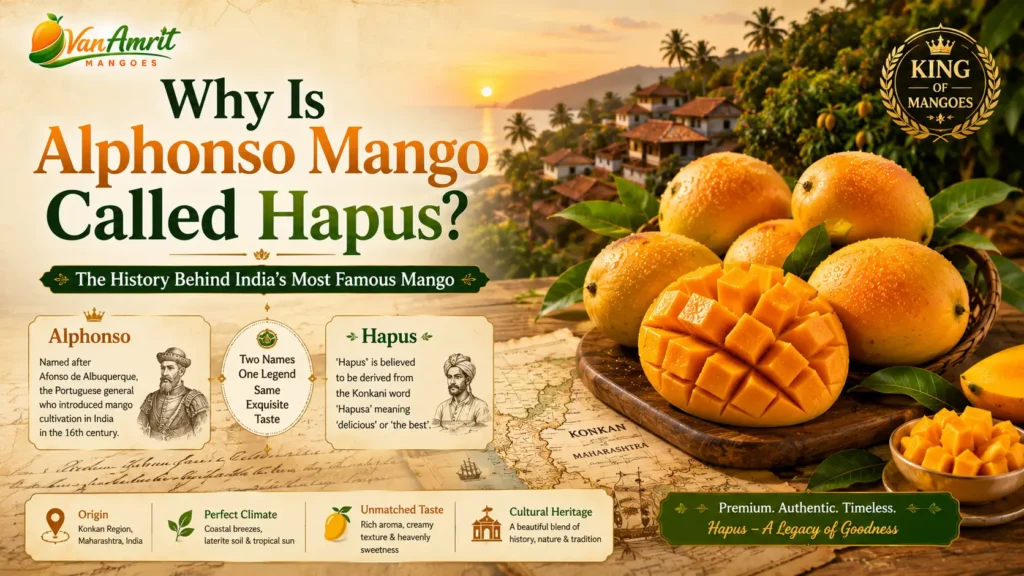
Why Is Alphonso Mango Called Hapus?
The 500-Year Story Behind the Name
Hapus, Hafus, Aphoos, Alphonso — same fruit, five names, one Portuguese general, and five centuries of language doing what language does best.
Five names. One mango. You’d be forgiven for wondering if they’re actually the same fruit — or if someone, somewhere, is simply making things up.
They’re the same fruit. And the reason why Alphonso mango is called Hapus is a 500-year story involving a Portuguese general, a revolutionary farming technique, and the natural way human beings absorb foreign names and make them their own. It’s one of the most quietly fascinating origin stories in Indian food culture — and most people eating a Hapus in May have no idea they’re biting into a piece of colonial history.
Alphonso mango is called Hapus because of a 500-year linguistic journey. The fruit was named after Afonso de Albuquerque — the Portuguese Governor of India from 1509 to 1515 — who oversaw the introduction of mango grafting techniques to the Konkan coast. Over centuries, local dialects transformed the name: Alphonso → Afonso → Afus → Hapus in Maharashtra’s Marathi, and Hafus in Gujarat’s Gujarati. The name “Hapus” is simply how Marathi speakers phonetically absorbed and naturalised a Portuguese name — and it stuck.
⚜️ The Man Who Started It All — Who Was Afonso de Albuquerque?
To understand why Alphonso mango is called Hapus, you need to understand who Afonso de Albuquerque was — and what he was doing in India in the first place.
Afonso de Albuquerque (1453–1515) was a Portuguese general, military commander, and the Governor of Portuguese India from 1509 to 1515. He’s remembered in European history primarily as a military genius who conquered Goa from the Bijapur Sultanate in 1510 and built the foundations of Portugal’s maritime empire across the Indian Ocean. He was, by all historical accounts, a man who got things done — systematically, ambitiously, and with long-term strategy.
But what most mango lovers don’t know is that Albuquerque’s administration oversaw something much more interesting than military conquest: a programme of deliberate agricultural exchange that historians call the “Columbian Food Exchange.” The Portuguese didn’t just colonise territories — they exchanged crops, techniques, and plant varieties between the regions they controlled. Red chillies, tomatoes, potatoes, maize — many of the foods we now think of as quintessentially Indian actually arrived through this Portuguese exchange network. So did, indirectly, the Alphonso mango.
Afonso de Albuquerque served as Viceroy of Portuguese India from 1509 to 1515, during which he expanded Portuguese influence across the Indian Ocean. He conquered Goa from the Bijapur Sultanate in 1510 CE, establishing the administrative centre from which agricultural exchange programmes, including mango grafting, were administered across the Konkan coast.
During this period, Jesuit missionaries and Portuguese horticulturists who accompanied the colonial administration brought advanced mango grafting techniques to the Konkan coast — and this is where the Hapus story really begins. Grafting, as a practice, was not new globally. But applying it systematically to Indian mango trees to develop specific, superior cultivars was a genuine agricultural innovation for the region at the time.
🌿 The Grafting Revolution That Created the King of Mangoes
Before the Portuguese introduced systematic grafting to western India’s mango orchards, mango trees were grown primarily from seed. And here’s the thing about seed propagation — it’s genetic lottery. Every tree grown from a mango seed can produce fruit that’s different from the parent tree. You might plant a seed from an extraordinary mango and get a tree that produces mediocre fruit. Quality was inconsistent and largely unpredictable.
Grafting works differently. You take a cutting — called a scion — from a tree that produces exceptional fruit, and you join it onto a strong local rootstock. The resulting tree produces fruit genetically identical to the parent tree, every single time. It’s like photocopying the best mango tree rather than rolling the dice with seeds.
Portuguese horticulturists applied this technique across the Konkan coast, selectively breeding for specific desirable traits: smooth, fibreless pulp that could be cut and served elegantly at table (important to the Portuguese colonial court’s dining culture), intense sweetness, a powerful aromatic profile, and deep golden colour. Over generations of careful selection and grafting, this cultivar was refined into what we now know as the Alphonso.
The variety that emerged was extraordinary enough to be named in honour of the general under whose administration the agricultural programme had flourished. The Portuguese administrators called it Alphonso — the Anglicised form of Afonso — and the name travelled with the variety as grafted trees were planted across Ratnagiri, Devgad, and eventually down the Konkan coast into Goa and beyond.
Think of it this way: naming a mango variety after Afonso de Albuquerque was the 16th century equivalent of naming a new wine after the vineyard owner who developed it. The fruit carried the name of its patron — and that name, through 500 years of use and adaptation, is still how you order it at a Mumbai fruit stall today.
Historical records note that Portuguese colonial administrators specifically wanted a mango that could be “cut and served” at the dining table — smooth, elegant, easy to slice cleanly. The fibreless pulp and clean-cutting texture of the Alphonso were design features, not accidents. The fruit was literally engineered to meet a specific dining standard. That legacy is why Alphonso remains the premium dessert mango 500 years later.
🗣️ How “Alphonso” Became “Hapus” — The Linguistic Journey Across Five States
Now for the part that answers the question most directly. How does a Portuguese name like “Alphonso” turn into “Hapus” in Marathi, or “Hafus” in Gujarati?
Language doesn’t absorb foreign words the way a photocopier duplicates a document. It adapts, softens, and reshapes foreign words through its own phonetic system — the way English turned “Jagannath” into “juggernaut” or the way French turned “William” into “Guillaume.” It’s a completely natural process, and the Alphonso → Hapus evolution is a textbook example of it.
Here’s the chain, step by step:
Alphonso — the original English/Portuguese spelling, used in administrative records and trade documentation during the colonial period.
Afonso/Affonso — the Portuguese pronunciation, which doesn’t have the same “l” sound as the English Alphonso. In European Portuguese, “Afonso” is pronounced closer to “Ah-fohn-so.” This is how it was actually spoken by Portuguese administrators and missionaries who introduced the variety.
Afus/Aafoos — as Goan and Konkani speakers adopted the name, the “n-so” ending softened and the whole word contracted. The name lost syllables the way a word always does when it’s used in fast everyday speech across multiple generations.
Aapus/Aphoos — the Kannada and coastal Goa pronunciation that you still hear today. The double-A opening reflects how Konkani and Kannada speakers naturally begin aspirated sounds.
Hapus — the Marathi phonetic adaptation. In Marathi, aspirated consonants are extremely common. The “H” at the beginning is a natural aspiration addition — the same phenomenon that turns “apple” into “haapple” in some Indian English dialects. The “oos” becomes “us” in the Marathi adaptation. The result: Hapus.
Hafus — the Gujarati equivalent of the same journey. Gujarati phonology softens the “H” slightly and keeps the “f” sound, arriving at Hafus — the word you’ll hear in Valsad, Surat, and Ahmedabad markets every mango season.
| Language / Region | Name Used | Where You’ll Hear It | Phonetic Note |
|---|---|---|---|
| English / Colonial | Alphonso | Packaging, formal trade, exports | Original form — Portuguese general’s name |
| Marathi (Maharashtra) | Hapus / Haapus | Mumbai, Pune, Nashik, Konkan | Aspirated H added; most widespread colloquial name |
| Gujarati | Hafus | Valsad, Surat, Ahmedabad, Baroda | Softer H; “f” retained from Afonso |
| Kannada / Goa | Aphoos / Aapoos | Mangalore, Goa, coastal Karnataka | Double-A aspiration; “ph” for “f” sound |
| Tamil | Aapoos / Alphonso | Chennai, Tamil Nadu markets | Varies by context — English form also common |
The reason “Hapus” became the dominant colloquial name across India? Maharashtra is the primary growing state for Alphonso, and Mumbai is the primary distribution hub. Marathi speakers set the trading vocabulary, and “Hapus” spread through trade routes faster than any other regional adaptation. By the time mangoes reached Karnataka, UP, or Bengal in crates, the paperwork and the vendors were already saying “Hapus.”
📍 Where Does Hapus Grow? — The Geography That Makes the King
Understanding where the Alphonso mango grows — and why — is essential to understanding why the name means something. Because Hapus isn’t just a variety; it’s a geographical product, the same way Champagne isn’t just wine and Darjeeling isn’t just tea.
The GI-tagged Alphonso mango grows in two specific districts of Maharashtra: Ratnagiri and Devgad. These two regions on the Konkan coast have a combination of soil, climate, and geography that happens to be almost uniquely suited to developing the Alphonso’s characteristic flavour and aroma profile.
The Konkan secret — laterite soil
The Konkan belt’s laterite (red) soil is high in iron and aluminium, well-draining, and acidic. It sounds counterintuitive — acidic, iron-rich soil doesn’t sound like the recipe for the world’s finest mango. But it is. The mineral composition of this soil, combined with the moderate altitude of Konkan orchards (100–700 metres), the constant sea breeze from the Arabian Sea, and the 2,500–3,500mm of annual monsoon rainfall, creates a growing environment that develops the Alphonso’s signature deep-saffron colour and complex aromatic intensity.
The fruit’s extraordinarily high beta-carotene content — what gives it that deep orange-saffron pulp — is directly linked to this soil’s mineral profile and the stress response of the tree growing in it. A mango tree that has to work slightly harder, in well-draining acidic soil with seasonal water stress, concentrates more secondary metabolites in its fruit. That’s the science behind Konkan Hapus’s colour intensity.
Beyond Maharashtra — Goa, Karnataka, and Valsad
The Alphonso cultivar spread from Goa and the Konkan through the coastal belt of Karnataka, and — crucially for Vanamrit’s story — into South Gujarat’s Valsad, Navsari, and Pardi districts. The coastal alluvial soil of South Gujarat shares key characteristics with the Konkan growing environment: proximity to the sea, high humidity, rich rainfall, and the alluvial deposit from river systems that gives the soil its distinctive fertility.
→ Valsad Hapus — grown in South Gujarat’s coastal heartland by Vanamrit🏅 Why Is Alphonso Called the “King of Mangoes”? — The Science Behind the Crown
People throw around “King of Mangoes” for Alphonso the way cricket fans call someone the GOAT. But unlike that debate, the Hapus’s claim to the crown is actually backed by measurable science. Let’s look at what makes it genuinely different from every other mango on the market.
Brix 18–22° — the sweetness benchmark
A Brix reading measures the concentration of dissolved sugars in the fruit’s juice. Most commercial mangoes — your everyday Banganapalli or Totapuri — sit at 12–15° Brix. A naturally ripened, peak-season Alphonso consistently hits 18–22° Brix. That’s not just a number — it’s the difference between a good mango and the best mango. At 22° Brix, the juice has a honey-thick concentration that registers as genuinely complex sweetness on the palate, not just sugar-water sweetness.
Zero fibre — the texture that changes everything
Most mango varieties have fibre — the stringy bits that get stuck in your teeth and make you reach for dental floss after dessert. Alphonso has none. Zero. The pulp is completely smooth, custardy, and clean-cutting — which is why it was originally bred this way for Portuguese colonial dining tables, and why it’s still the go-to mango for aamras, shrikhand, kulfi, and dessert applications where texture matters.
The 50-compound aroma
The Hapus’s room-filling fragrance — that floral, sweet, saffron-honey smell that announces a ripe mango from across the kitchen — comes from a complex profile of over 50 volatile aromatic compounds, including myrcene, terpinolene, and linalool. These compounds form during natural, complete ripening. This is exactly why a carbide-treated “Hapus” has almost no aroma — the chemical process doesn’t trigger the biochemistry that produces these compounds. When a mango smells extraordinary, that’s actual chemistry happening. When it smells like nothing, that chemistry was skipped.
A 2017 study published in Scientific Reports (Nature) on Alphonso mango transcriptomics documented the complexity of the variety’s aromatic profile during ripening — confirming that Alphonso’s distinctive shelf life and aroma characteristics are genetically encoded in the cultivar, not just environmental. The natural ripening process activates specific gene expression pathways that produce the aromatic compounds. Carbide treatment bypasses this activation entirely.
🏷️ GI Tag — Why Not Every “Hapus” in the Market Is Actually Hapus
Here’s a piece of information that will save you money and prevent disappointment this season. Walk through a fruit market in May and you’ll see vendors selling “Hapus” at wildly different prices — from ₹150/kg to ₹800/kg, sometimes in the same market. They can’t all be the same fruit. They’re not.
The Geographical Indication (GI) tag for Alphonso mango protects Ratnagiri and Devgad as the certified origin districts. Think of it exactly like Champagne — you can make sparkling wine anywhere in the world, but only wine made in the Champagne region of France can legally be called “Champagne.” Similarly, only Alphonso grown in the specific GI-designated districts of Ratnagiri and Devgad can be legally marketed as GI-certified Alphonso.
What this means practically for buyers: a significant proportion of mangoes sold as “Hapus” or “Alphonso” in Indian cities either come from non-GI growing regions (which can still be genuine Alphonso cultivar, just not GI-certified), or are completely different varieties mislabelled as Alphonso to command a premium price. And then there’s the carbide problem — where the mango might be the right variety but was chemically forced to look ripe before its time.
The 2026 Alphonso season has made this worse. Reports from ThePrint and ABC Fruits’ mango crop analysis for 2026 confirm that Konkan belt yields are significantly down this year — a single-flowering-cycle harvest means a shorter window, lower volumes, and intense competition for raw fruit. At Mumbai’s APMC Vashi market, only about 20,000 crates arrived at the time when 50,000–60,000 would be expected normally. That scarcity has pushed crate prices from ₹1,000–₹3,000 to ₹2,000–₹4,000 — a 25–30% increase. Lower supply + higher prices = stronger incentive for mislabelling and carbide treatment.
→ Full guide: Carbide-Free Ripening Explained — health risks, detection, FSSAI 2026 → How regional identity works in mango — Valsad vs Gir Kesar explained🌊 Valsad Hapus — The South Gujarat Chapter of the Alphonso Story
The Alphonso cultivar’s story didn’t stop at Ratnagiri and Devgad. As the variety spread southward through Goa and into coastal Karnataka, it also moved northward into South Gujarat — specifically into the Valsad, Navsari, and Pardi districts of Gujarat’s coastal belt.
This is the part of the story that’s personal to us at Vanamrit. Our orchard is in Chikhli, Valsad — right in the heart of South Gujarat’s coastal mango belt, where Hapus trees have been growing for generations. We grow the same Alphonso cultivar as Ratnagiri. The tree genetics are identical. What’s different is the soil and the microclimate.
Valsad’s alluvial coastal soil is nutrient-rich, moisture-retentive, and different from Konkan’s laterite. The result is a Hapus with a slightly mellower, rounder sweetness — less sharp than Ratnagiri’s intensity, more relaxed in its expression. If Ratnagiri Alphonso is a strong espresso — bold, concentrated, almost aggressive in its flavour delivery — Valsad Hapus is a long black made with the same beans: same quality, same cultivar, slightly different expression because of the soil it came from. Neither is wrong. They’re different moods of the same extraordinary fruit.
📅 When Is Hapus Season 2026? — And Why This Year Is Different
If you’re reading this in mango season, this section matters to you practically. And 2026 has been an unusual year for Alphonso supply that’s worth understanding before you buy.
Alphonso season 2026 officially runs mid-February to June for Ratnagiri, and early March to June for Devgad. Peak season — when Brix is highest and the aromatic profile is fullest — falls in April to early May. After June, no fresh Alphonso is available anywhere in India.
But 2026 has brought serious supply challenges. ABC Fruits’ Indian Mango Crop Report 2026 — one of the most reliable industry assessments — confirms that the Alphonso harvest this year is coming through a single flowering cycle rather than the staggered flowering seen in previous seasons. That means a shorter harvest window, lower total volumes, and significantly compressed supply timelines. Processors and retailers are competing for the same smaller pool of raw fruit.
ThePrint’s reporting from the APMC Vashi market confirms the on-ground reality: crate arrivals were at roughly 40% of normal volumes at key points in the season, with prices rising 25–30% compared to last year. Buyers who waited too long into the season found availability genuinely limited.
In a year of compressed supply, the gap between authentic naturally ripened Hapus and carbide-treated “Hapus” at inflated prices widens significantly. Scarcity creates stronger incentives for mislabelling and chemical shortcuts. This year more than most, buy from verified farm-direct sources — not anonymous market vendors. If the price seems too low for what’s being claimed, it probably is.
Vanamrit Valsad Alphonso — Same 500-Year Cultivar, South Gujarat Soil
The same Alphonso cultivar that Afonso de Albuquerque’s horticulturists developed along the Konkan coast — grown on our Chikhli, Valsad farm in the coastal alluvial soil of South Gujarat. Hay-bed ripened. Carbide-free. Pan-India delivery in 5–6 days. The fragrance test on arrival will introduce itself.
🥭 Order Valsad Hapus at vanamrit.in →🚨 The Carbide Problem — How It Specifically Destroys the Hapus Experience
The Hapus’s entire value proposition — everything that justifies paying ₹2,249 or more per dozen — rests on three things: aroma, Brix, and fibreless texture. Calcium carbide treatment eliminates exactly all three simultaneously.
When carbide forces a mango’s skin to turn yellow in 24–36 hours, it doesn’t trigger the natural ripening biochemistry. The starch-to-sugar conversion that drives Brix to 18–22° never completes. The 50+ volatile aromatic compounds that produce the Hapus’s signature room-filling fragrance never form. The cell structure that creates the buttery, fibreless texture never develops fully.
What you get is a mango that looks like Hapus but delivers none of what makes it special. And because Alphonso commands the highest price of any Indian mango — routinely ₹2,000–₹4,000 per crate at the market in 2026 — it’s also the variety with the strongest financial incentive for carbide treatment and mislabelling.
How do you protect yourself? Three tests, 45 seconds:
The fragrance test: Hold the mango near the stem end and breathe in. A naturally ripe Hapus has an aroma that fills your palm immediately — floral, sweet, unmistakable. No aroma means it wasn’t naturally ripened. Carbide-treated “Hapus” smells of essentially nothing.
The colour test: Natural Alphonso develops colour gradually — golden-yellow body, sometimes a green tip, occasionally a reddish shoulder blush where the sun hit it. Perfectly uniform, abnormally bright yellow all over is how a carbide mango disguises itself.
The cut test: Slice it open. Naturally ripe Hapus shows deep, consistent saffron-orange pulp from skin to seed. Carbide-ripened Alphonso shows yellow near the skin fading to white or pale near the seed — because the ripening never reached the interior.
→ How to identify naturally ripened mango — 5-sign complete guide → Carbide-free ripening explained — FSSAI 2026 update and science🍽️ What to Do With Hapus — From Aamras to the Freezer
Right — now that you know why it’s called Hapus, who made it, where it grows, and how to verify you’ve got the real thing, let’s talk about what to actually do with it.
Fresh eating is the obvious starting point, and Alphonso needs no embellishment. Chill it for 30 minutes, slice it in half, and eat the halves with a spoon — or peel and cut into clean slices. The fibreless texture means no stringy bits, no mess, just the full Brix-22 hit of saffron sweetness.
Aamras is the Gujarati and Maharashtrian ritual — blend Hapus pulp with a tiny pinch of cardamom, serve with hot puris straight off the tawa, and understand why your grandparents look forward to May all year. The thick, custard-like consistency of Hapus pulp makes the best aamras of any variety, full stop.
Amrakhand (mango shrikhand) is even simpler than it sounds: fold Hapus pulp into thick hung curd with a thread of saffron and a touch of sugar. Two ingredients, one extraordinary result that takes about four minutes to make.
Freezing pulp is the long game. At peak ripeness — when the fragrance is strongest and Brix is highest — blend, portion into freezer bags, and freeze. Hapus pulp frozen properly retains about 85–90% of its colour, flavour, and aroma profile for up to six months. Six months from now, in the middle of the monsoon, that frozen pulp in a smoothie or with puri is like opening a window back to summer. It’s one of the best things you can do with a 10 kg box.
→ How to store Hapus — crate, fridge, freezer, and pulp guide → How to ripen mangoes at home naturally after delivery🌍 Hapus on the World Stage — The Mango India Exports First
The Alphonso’s reputation didn’t stop at India’s borders. It’s the mango that India exports first and most enthusiastically — and the international demand for genuine Hapus says a lot about how exceptional the variety actually is.
In the UK, Alphonso season is an annual cultural event for the Indian diaspora. UK food media declared it “one of the most prized mangoes in the world” in 2012, and that reputation has only grown. Major supermarkets in the UK stock Ratnagiri and Devgad Hapus at premium prices during the April–May window. In the UAE, Alphonso is the first mango variant to arrive and the first to sell out. In the USA and Canada, NRI grocery stores treat Hapus boxes like seasonal produce gold.
And then there’s the NRI gifting reality: every summer, thousands of people in the Indian diaspora search for ways to send a box of Hapus to their parents or family in India, or to find genuine Alphonso in their adopted countries. The emotional connection to this fruit among Indians abroad is remarkable — it’s a taste memory, a connection to childhood summers, a gift that says something words don’t.
→ Where Alphonso sits in the full Indian mango variety landscape❓ Your Hapus Questions — Answered
⚜️ 500 Years. One Name. One Extraordinary Mango.
A Portuguese general walks into India in 1509. He oversees a grafting programme on the Konkan coast. Farmers develop a mango with fibreless pulp, extraordinary sweetness, and a room-filling fragrance. They name it after him. Centuries of trade, migration, and everyday language turn “Alphonso” into “Hapus” in Marathi, “Hafus” in Gujarati, “Aphoos” in Kannada. The fruit carries all those names, all those histories, through every May and June across India.
The mango sitting in your fruit bowl didn’t just grow from a tree in the Konkan or South Gujarat. It grew from 500 years of human beings paying attention to what made this particular fruit extraordinary — and doing the work to preserve it, tree by tree, graft by graft, generation by generation.
That’s what you eat when you eat a Hapus. It’s not just a mango. It’s agricultural history.
“Call it Hapus, Hafus, Alphonso, or Aphoos — it answers to every name and disappoints no one.” 🥭⚜️
Order Vanamrit’s Valsad Hapus — Farm-Direct, Carbide-Free, 2026
The same cultivar. South Gujarat’s coastal soil. Hay-bed ripened at our Chikhli, Valsad orchard. No carbide, no middlemen, no shortcuts. Pan-India delivery in 5–6 days. Hold the stem end to your nose when the box arrives — it will introduce itself.
🥭 Order Valsad Hapus at vanamrit.in →Bulk orders, gifting or questions: vanamrit.in/contact | WhatsApp: +91 9033595016