
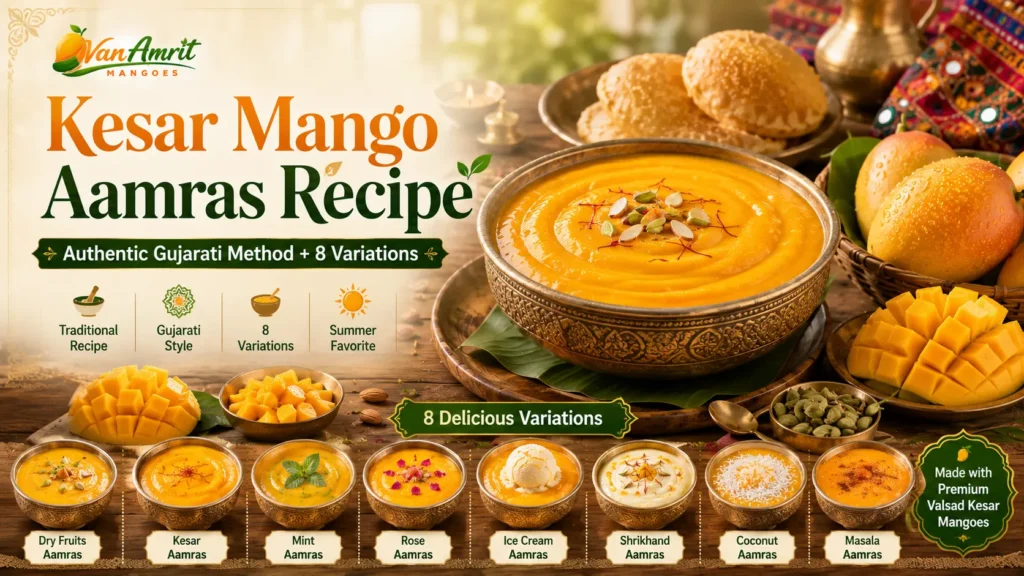
Kesar Mango Aamras Recipe:
Authentic Gujarati Method + 8 Variations
The complete guide to making the best aamras of your life — the traditional keri no ras method, pro tips, 8 variations, and why Valsad Kesar makes the difference you can taste.
That bowl is keri no ras. Aamras. The Kesar mango aamras recipe is not complicated — it never was. But the difference between a truly extraordinary bowl and a mediocre one comes down to two things: the mango and the method. Get both right, and this dish doesn’t need anything else to be perfect.
🟠 Why Kesar — Not Just Tradition, But Science
You can technically make aamras with almost any sweet mango. Alphonso makes a gorgeous, buttery version. Banganapalli works if you strain it well. Even Himsagar produces something worth eating. But Kesar is the traditional Gujarati aamras mango — and when you understand why, it feels less like cultural habit and more like the result of centuries of very sensible quality judgement.
Think about what aamras is asking for from a mango. You want a colour that looks ceremonial — that deep, burning-saffron orange that makes the bowl look like sunset in a dish. You want fiberless texture — completely smooth, no strings, no graininess, nothing that fights the silky consistency you’re creating. You want sweetness that’s complete and self-contained, without any acidity pulling against it. And you want a fragrance powerful enough to survive the blender and still fill the room.
Kesar, particularly Valsad Kesar grown in South Gujarat’s coastal belt, delivers all four. The deep saffron-orange pulp comes from one of the highest beta-carotene concentrations of any Indian variety. The texture is completely fiberless — even more so than Alphonso, which has a slight buttery density. The sweetness at 18–22° Brix is honey-clean with near-zero acidity. And the fragrance — well, if you’ve ever made Kesar aamras in a kitchen, you know that the whole house knows about it before the bowl reaches the table.
Valsad Kesar — grown in South Gujarat’s coastal alluvial soil with Arabian Sea influence — has a slightly mellower, deeper sweetness than Gir Kesar’s more intense, sharper profile. For aamras, where the goal is harmonious, uncomplicated sweetness, this coastal terroir character is specifically ideal. It’s what makes Vanamrit’s aamras taste the way it does.
📜 What Aamras Actually Means — A Brief, Delicious History
Aam is mango. Ras is essence, juice, the most fundamental extract of something. Put them together and you get the most literal, most honest name for a dish in Indian cuisine — the essence of mango. In Gujarat, it’s called keri no ras (keri being the Gujarati word for mango). In Maharashtra, just aamras. In Rajasthan, you’ll sometimes find it enriched with actual kesar (saffron threads), which is where the English confusion between the spice and the mango variety originates.
The dish appears in Ayurvedic texts under the name pakva aam ras — ripe mango essence — recommended as a seasonal, ojas-building nourishing food. It has been documented as a wedding feast staple in Gujarat and Maharashtra for at least 200 years. In traditional Gujarati thalis at weddings and celebrations, aamras occupies the dessert position and simultaneously the fruit position — it’s both at once, a dish that needs no other sweet to accompany it.
The traditional serving is always aamras puri — chilled aamras and hot, freshly fried puri. That combination is not accidental. The textural contrast between the cold, dense, silky aamras and the hot, airy, crispy puri is a full sensory experience. Heat and cold. Dense and light. Sweet and neutral. It’s the kind of pairing that food science would design if it had been paying attention to Gujarati kitchens for two centuries.
- 3–4 medium Kesar mangoes (naturally ripened — deep saffron pulp is the signal)
- ½ tsp cardamom powder (freshly crushed from 3–4 pods is best)
- 1 tsp pure ghee per serving (drizzled on top at serving — traditional)
- 1–2 tsp sugar or jaggery powder — to taste (peak Kesar usually needs none)
- 2–3 tbsp chilled milk (optional — for a creamier, thinner consistency)
- A small pinch of saffron strands soaked in 1 tbsp warm milk (optional — premium version)
👨🍳 How to Make Kesar Mango Aamras — The Traditional Method
There are two ways to make aamras: the blender method and the traditional hand-squeeze (or “masala” extraction) method. Both produce excellent results. The hand method produces a slightly more textured, what Gujarat calls lacchedar ras — aamras with small, soft mango fibres that carry the fragrance differently. The blender method produces the perfectly uniform, silky-smooth version. I’ll walk you through both, but let’s start with the traditional method because it’s the one most recipes skip over and it genuinely produces something special.
Use the fragrance test to confirm ripeness before making aamras. Hold the mango near the stem end and breathe in. If it smells powerfully of saffron and honey, it’s ready. If there’s little to no aroma — even from a golden mango — the aamras will be pale and bland, and no amount of cardamom or saffron will fix it. The fragrance IS the aamras, waiting to come out.
⚡ Pro Tips for Perfect Aamras — What Most Recipes Don’t Tell You
Temperature contrast is the secret, not the flavour alone
The most common mistake in serving aamras is serving it at room temperature alongside puri that’s not quite piping hot. The magic of aamras puri is entirely about the contrast: icy-cold, dense, silky aamras against a puri that’s just come out of the oil — airy, crispy, slightly salted, hot enough to steam when you tear it. If both elements are lukewarm, the dish is ordinary. Get the temperatures right and it becomes extraordinary. Prepare your aamras at least an hour before eating. Fry the puri and serve it immediately.
The sap management technique that most recipes skip
The white milky sap that drips from the stem of a cut mango is what adds bitterness to aamras when it gets into the pulp. The pre-soak removes most of it from the surface. When hand-squeezing, keep the stem end up initially and let any remaining sap drip away before squeezing downward. This single detail is what separates the grandmothers’ aamras from everything else — they knew instinctively to manage the sap, and they built the soaking ritual around it.
Cardamom goes in the blender, not as garnish
Add cardamom to the blender with the pulp, not as a surface sprinkle. Blending distributes the cardamom flavour evenly throughout the aamras rather than leaving concentrated pockets. Use freshly crushed cardamom from whole pods rather than pre-ground powder from a packet — the aromatic intensity difference is significant, particularly with Kesar’s floral fragrance which the cardamom is designed to complement rather than dominate.
Gujarati aamras additionally uses dry ginger powder (sonth) as an alternative or addition to cardamom — it adds a very slight warmth that balances Kesar’s cooling nature and aids digestion. One small pinch is enough to notice without overwhelming the mango flavour.
🎨 8 Kesar Aamras Variations — From Traditional to Modern
🍼 Aamras for Babies and Children — The Most Important Variation
Pure Kesar pulp — completely naturally ripened, carbide-free, blended ultra-smooth — is one of the most nutritionally excellent weaning foods India has to offer. For babies 8 months and older: pure pulp only, no sugar, no salt, no spices, served at room temperature. For children 12 months+: a tiny pinch of cardamom can be introduced. For toddlers 2 years+: regular aamras as made for adults, ghee optional.
The critical qualifier: for any food going to a baby or young child, buying certified carbide-free Kesar isn’t just a quality preference — it’s a safety requirement. Arsenic and phosphorus traces from carbide-treated mangoes are proportionally more harmful to small bodies. Naturally ripened, farm-direct Kesar is the baseline for children’s aamras, not the premium option.
🌶️ Saffron-Spiced Premium Aamras
Soak 8–10 actual kesar (saffron) strands in 2 tbsp warm milk for 15 minutes until the milk turns deep golden. Add to the aamras blender along with a tiny pinch of black pepper and a drop of rose water. This is the restaurant-grade, wedding-occasion version — deeply aromatic, visually magnificent (the combination of saffron mango orange and kesar-stained milk produces an otherworldly colour), typically served in the finest thalis. The black pepper is counterintuitive but correct — it subtly lifts the floral notes without registering as spice.
🧊 How to Make Kesar Aamras All Year — The Frozen Pulp Method
The season for Valsad Kesar runs from May to July. The desire for Kesar aamras runs year-round. The solution exists, and it’s simpler than most people think.
Buy Kesar in volume at peak season — May to June is when Valsad Kesar is at absolute quality prime, fragrance at its highest, colour deepest, price most reasonable. Ripen fully. Extract and blend the plain pulp without any additions — no cardamom, no ghee, no milk. Portion into 200–300ml freezer-safe bags (enough pulp for one aamras batch per bag). Label with the date and variety. Freeze flat. That’s it.
Frozen Kesar pulp, done correctly at peak ripeness, retains approximately 85–90% of its colour, fragrance, and flavour profile for 6–10 months. When you want December aamras or February kulfi, defrost a bag overnight in the fridge (never microwave — heat destroys the most delicate aromatic compounds). Once defrosted, blend briefly to restore smooth texture, add cardamom and ghee fresh, and serve. The colour holds magnificently. The fragrance recovers most of its character. Your family will not be able to tell the difference in a blind tasting.
Always freeze plain pulp — never aamras with ghee or milk already added. Dairy separates during the freeze-thaw cycle and the texture cannot be recovered. Add ghee and milk fresh at serving time, every time. And freeze at peak ripeness — overripe or underripe pulp doesn’t recover as well in the freezer as peak-season, peak-ripe Kesar does.
💊 Why Kesar Aamras Is Actually Good for You
Here’s something that delights me about this dish: aamras is one of the rare traditional desserts where eating more of it is genuinely beneficial rather than guilt-inducing. Per serving of Kesar aamras made from naturally ripened pulp, you’re consuming approximately 100–150g of pure mango — which means concentrated beta-carotene (Vitamin A precursor), Vitamin C, Vitamin B6, folate, potassium, and mangiferin antioxidant, all in one bowl.
The ghee drizzle isn’t just traditional flavour. It’s Ayurvedic food science: beta-carotene and the other fat-soluble vitamins in Kesar (Vitamins A, E, K) absorb significantly better in the presence of dietary fat. Ghee enables the very nutrients you’re eating to actually reach your bloodstream. Traditional Gujarati cooking figured this out centuries before nutritional biochemistry existed as a field.
Cardamom in aamras isn’t only flavour either. As a digestive carminative, cardamom reduces bloating and supports digestion — which counterbalances any heaviness from eating a concentrated mango preparation. And the pre-soaking practice reduces phytic acid content, which Ayurveda identified as responsible for mango’s heating and occasionally skin-aggravating quality. Traditional aamras preparation, done properly, is genuinely thoughtful food science.
→ Full Kesar mango health benefits — all nutrients, science, and Ayurveda explained🔧 Aamras Troubleshooting — When Something Tastes Off
Pale aamras — not the deep saffron orange you expected: This is almost always a sourcing problem, not a recipe problem. The aamras is as orange as the pulp was. Pale, yellowish aamras comes from carbide-treated Kesar whose carotenoids never fully developed, or from an underripe mango. No recipe intervention fixes this — the colour is locked in before the mango reaches your kitchen. The solution is buying naturally ripened, peak-season Kesar from a verified source.
Bland aamras with no fragrance: Same root cause as pale aamras — carbide treatment or underripe mango. Carbide-treated “Kesar” has its skin colour forced without completing the aromatic compound development that gives Kesar its signature fragrance. You cannot add enough cardamom or saffron to compensate. The solution is in the sourcing, not the recipe.
Aamras is too thick: Add 2–3 tbsp chilled milk or a small amount of chilled water, blend briefly again. Refrigerating aamras thickens it further — if it’s too thick after chilling, thin it slightly just before serving.
Aamras is slightly bitter: The sap management step was skipped. The milky stem sap got into the pulp during extraction. For the next batch, soak longer and be more careful about keeping the stem end up during hand-squeezing. For this batch, adding a tiny pinch of salt (⅛ tsp) can counteract bitterness through flavour contrast.
→ Why carbide Kesar produces pale, bland aamras — the full scienceFarm-Direct Valsad Kesar — Deep Saffron Pulp, Honey-Clean Sweetness
Naturally hay-ripened at our Chikhli, Valsad orchard. Carbide-free. Pan-India delivery in 5–6 days. The mango that traditional Gujarati aamras was built on, delivered to your kitchen at peak ripeness.
🥭 Order Valsad Kesar at vanamrit.in →❓ Kesar Aamras Questions — Answered
🌿 The Last Thing About Kesar Aamras
The Kesar mango aamras recipe is not complicated. It has never been complicated. The ingredients are three (mango, cardamom, ghee) if you’re being strict about it, or six if you’re being generous. The technique is a 20-minute soak and a 30-second blend. The result — when you use naturally ripened, peak-season Kesar — is one of the most extraordinary dishes Indian cuisine has produced, anywhere in any category.
The only variable that genuinely matters is the mango. A pale, carbide-treated Kesar makes pale, flavourless aamras that cardamom can’t save. A deep saffron-orange, naturally ripened, fragrant Valsad Kesar makes aamras that fills the room before it reaches the table and tastes exactly like the best version of your childhood summers.
Get the mango right. Everything else follows from there.
“The best Kesar aamras you will ever make is one step away — and that step is choosing the right mango.” 🥭🌿
Farm-Direct Valsad Kesar — The Aamras Mango, Delivered Pan-India
Naturally ripened in hay at our Chikhli, Valsad orchard. Deep saffron pulp. Honey-clean sweetness. Carbide-free. Delivered to your door in 5–6 days. Buy in bulk, freeze the pulp, and make extraordinary aamras through December.
🥭 Order Valsad Kesar at vanamrit.in →Bulk orders or questions: vanamrit.in/contact | WhatsApp: +91 9033595016