
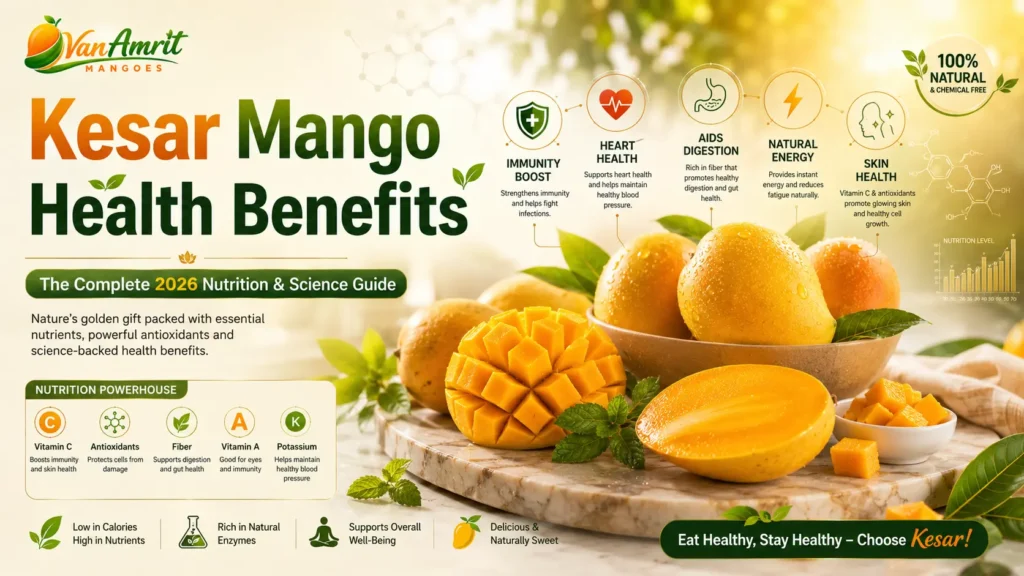
Kesar Mango Health Benefits:
The Complete 2026 Nutrition & Science Guide
Everything your grandmother knew — and everything modern nutritional science has now confirmed — about why Kesar mango is one of the most powerful seasonal health foods India grows.
Here’s what she knew instinctively that nutritional science is now confirming with data: the Kesar mango health benefits are real, measurable, and genuinely significant. This fruit is packed with beta-carotene, Vitamin C, Vitamin B6, folate, potassium, and one of the most powerful plant antioxidants in the natural world — mangiferin. And Kesar, specifically, stands above most other Indian varieties on several of these measures.
This guide covers all of it. The science. The Ayurveda. The specific nutrients per 100g. The honest answers to the diabetes question, the acne question, and the weight loss question. And one critical fact that most mango health articles skip entirely: all of these benefits apply only when the Kesar was allowed to ripen naturally. Carbide-treated Kesar is, nutritionally, a different product.
📊 Kesar Mango Nutrition Facts — What’s in 100g of Naturally Ripened Kesar
Before we get into what each nutrient does for your body, let’s look at what a serving of Kesar mango actually contains. The numbers below are per 100g of ripe Kesar mango, based on USDA FoodData Central data and FSSAI Indian Food Composition Tables.
| Nutrient | Per 100g Kesar Mango | % Daily Value (Adult) | Health Significance |
|---|---|---|---|
| Calories | 60–65 kcal | 3% | Low-calorie, nutrient-dense |
| Carbohydrates | 15–17g | 6% | Natural sugars + starch |
| Dietary Fibre | 1.6g | 6% | Supports digestion + satiety |
| Protein | 0.8g | 2% | Minor, complementary |
| Fat | 0.4g | <1% | Near-zero — no saturated fat |
| Vitamin C | 27–36mg | 30–40% DV | Immune support, collagen synthesis |
| Beta-carotene (Vit A) | ~640mcg | 10–15% DV (RAE) | Highest among Indian varieties |
| Vitamin B6 | 0.12mg | ~7–9% DV — highest of all Indian mangoes | Serotonin synthesis, brain function |
| Folate (B9) | 14mcg | 4% | Cell growth, pregnancy nutrition |
| Vitamin E | ~0.9mg | 6% | Skin antioxidant protection |
| Vitamin K | 4.2mcg | 4% | Blood clotting, bone health |
| Potassium | 168mg | 4% | Blood pressure regulation |
| Magnesium | 10mg | 3% | Enzymatic reactions, heart rhythm |
| Copper | 0.11mg | 12% DV | Red blood cell formation, immunity |
| Glycemic Index | ~51–60 (moderate) | — | Safer for blood sugar than most sweets |
| Mangiferin | Present (significant) | — | Powerful xanthone antioxidant — unique to mango |
One thing stands out immediately: Kesar’s contribution to Vitamin C and beta-carotene from just a 100g serving is genuinely meaningful. This isn’t trace nutrition that only matters in a research paper. In the real world, two to three servings of naturally ripened Kesar a week during peak season contributes meaningfully to your family’s Vitamin A and Vitamin C status at a time when the immune system actively benefits from both.
Kesar has the highest Vitamin B6 content among all Indian mango varieties. Vitamin B6 is essential for neurotransmitter synthesis — including serotonin and GABA. This gives Kesar a neurological health advantage over other varieties that few people know about. It’s one reason why a good mango always seems to improve your mood, and why that improvement has genuine biochemical plausibility beyond just the taste.
🟠 The Beta-Carotene Story — Why Kesar’s Colour Is Actually Nutritional Data
Have you ever noticed that a perfectly ripe Kesar mango, cut open, reveals pulp that looks almost luminescent — a deep, burning saffron-orange that you don’t see in most other mangoes? That colour isn’t just beautiful. It’s your body’s most intuitive nutrition label, printed directly on the fruit by nature.
Beta-carotene is a carotenoid pigment — the same class of compound that makes carrots orange and flamingos pink. In mangoes, it’s also the primary source of provitamin A. Your body converts beta-carotene to retinol (Vitamin A) exactly as needed. Kesar, Amrapali, and Sensation contain the highest beta-carotene content among Indian mango varieties. The deeper the orange, the higher the concentration. A naturally ripened Kesar with intense saffron-orange pulp is giving you significantly more beta-carotene than a pale, carbide-rushed mango wearing the same golden skin.
What does your body do with all that Vitamin A from beta-carotene? Quite a lot, actually:
Eye health: Vitamin A is essential for producing rhodopsin — the light-sensitive pigment in your retinal rod cells that enables night vision and low-light vision. Deficiency is the leading preventable cause of childhood blindness globally. A serving of naturally ripened Kesar mango contributes meaningfully to Vitamin A status — particularly important for growing children during the 2–3 month season when it’s available.
Immune cell function: Vitamin A maintains the integrity of epithelial tissue — the lining of your respiratory tract, gut, and skin. These tissues are your immune system’s first physical barrier against pathogens. Adequate Vitamin A keeps those barriers strong.
The provitamin A safety advantage: Unlike preformed Vitamin A (found in liver, cod liver oil), beta-carotene from plant sources converts to Vitamin A only as the body needs it. You can’t develop Vitamin A toxicity from eating too much Kesar mango the way you theoretically could from excessive supplement use. This makes Kesar a genuinely safe and excellent Vitamin A source for everyone, including pregnant women and young children.
→ Kesar vs Alphonso — nutrition comparison across both premium varieties🛡️ Vitamin C & Immunity — Kesar as Your Summer Immune Shield
Most people don’t think of mango when they think of Vitamin C. They think of oranges and lemon. Which is fair — citrus fruits have excellent Vitamin C profiles. But here’s what they usually don’t know: one cup of Kesar mangoes contains over 60% of the daily recommended intake of Vitamin C. That’s a genuinely significant contribution from a single seasonal fruit, and it’s one of the reasons traditional Indian families have been eating mango through the pre-monsoon season for generations without entirely knowing why it helped.
Vitamin C does several things in your body that are particularly relevant during India’s May–July season:
White blood cell production: Vitamin C stimulates the production and function of white blood cells — particularly neutrophils and lymphocytes — that are your immune system’s first responders to infection. As viruses circulate more freely in the early monsoon, this is exactly when you need them functioning well.
Collagen synthesis: Vitamin C is an essential co-factor for collagen production. Collagen is the structural protein in skin, cartilage, tendons, and blood vessels. Your skin’s integrity as a physical barrier against pathogens depends on adequate collagen — making Vitamin C’s skin benefits a direct immune benefit too.
Iron absorption: Vitamin C dramatically improves the absorption of non-haem iron (the type found in plant foods — lentils, spinach, grains). For vegetarian Indian families eating iron-rich foods, eating a serving of Kesar mango alongside or after a meal can meaningfully increase the iron actually absorbed from that meal. This is practical nutritional synergy in action.
Beyond Vitamin C, the Kesar mango health benefits picture is enriched by mangiferin — a xanthone antioxidant unique to mango. Mangiferin, being a polyphenolic antioxidant and a glucosyl xanthone, has strong antioxidant, anti lipid peroxidation, immunomodulation, cardiotonic, hypotensive, wound healing, antidegenerative and antidiabetic activities. That’s not one function — it’s a whole pharmacological profile in a single compound.
Mangiferin has been studied for over two decades in peer-reviewed research. It scavenges free radicals, inhibits pro-inflammatory cytokines (the signalling molecules behind chronic inflammation), and has demonstrated immunomodulatory effects — meaning it helps regulate immune response rather than simply stimulating it. A 2024 study published in Scientific Reports further confirmed mangiferin’s protective effects on cellular health in pre-clinical models. It’s present in meaningful quantities in Kesar’s pulp — particularly when naturally ripened.
🌱 Digestive Health — The Enzyme Nobody Talks About
If you’ve ever eaten a perfectly ripe Kesar mango after a heavy meal and felt somehow lighter than you expected, there’s a biological reason for that. It’s not imagination. It’s amylase.
Ripe mangoes — and Kesar specifically — contain natural amylase enzymes that help break down complex carbohydrates into simpler sugars in your digestive tract. The enzymes in Kesar mangoes, such as amylases, help break down complex carbohydrates into simpler sugars, and including these mangoes in your diet can help regulate your gut. These enzymes become significantly more active as the mango ripens naturally — which is another reason why natural ripening matters for health, not just taste. A carbide-rushed mango’s enzyme profile looks like an unripe fruit’s.
Beyond enzymes, Kesar’s dietary fibre content supports gut health in the more familiar way. The 1.6g of fibre per 100g adds up meaningfully over a season of regular consumption, supporting gut motility and helping prevent constipation. Kesar mangoes are high in pectin — a type of fibre that helps with lowering cholesterol levels in the blood by forming a gel-like structure in the gut that slows cholesterol absorption from food into the bloodstream.
There’s also growing evidence around mango’s prebiotic potential. Research published in the Nutrients journal has found that mango polyphenols and fibre may nourish beneficial gut bacteria — acting as a prebiotic substrate that supports microbiome diversity. In a country where digestive health is as much a dietary priority as it is a medical one, this matters practically.
❤️ Heart Health — Potassium, Mangiferin & the Cholesterol Math
Indian households eat a lot of salt. That’s not a criticism — it’s a culinary fact that has blood pressure implications for a significant portion of the population. This is exactly where Kesar’s potassium content becomes relevant.
Potassium works in the body as a physiological counterbalance to sodium — it relaxes blood vessel walls and helps the kidneys excrete excess sodium through urine. At 168mg per 100g, a regular serving of Kesar mango contributes meaningfully to potassium intake. Think of potassium as the pressure valve in a system that too much sodium keeps trying to overtighten. Eating mangoes is one of the pleasantest ways to keep that valve working.
The cholesterol picture is also interesting. Kesar mangoes contain pectin — a type of fibre that helps lower cholesterol levels in the blood by slowing cholesterol absorption from food into the bloodstream. And at zero dietary cholesterol and negligible saturated fat, replacing a post-dinner Indian sweet with a serving of Kesar mango doesn’t just taste better — it genuinely improves your heart health metrics for that meal.
Mangiferin adds a third layer here. Research on mangiferin’s cardiovascular properties has found it may help regulate lipid metabolism and reduce LDL oxidation — oxidised LDL being the specific form of cholesterol most associated with arterial plaque formation. The research is ongoing, but the mechanistic basis for mangiferin’s cardioprotective effects is well-established in the literature.
We’re not saying Kesar mango prevents heart disease. We’re saying it contains nutrients — potassium, fibre, and mangiferin — that are associated with cardiovascular health support as part of a balanced diet. Kesar mango supports your heart as one component of healthy eating. It doesn’t replace medication, exercise, or medical care for anyone with a diagnosed cardiovascular condition.
👁️ Eye Health — The Lutein, Zeaxanthin & Macular Protection Story
In 2026, with screen time at all-time highs across Indian families — children doing schoolwork on tablets, adults in 8-hour video calls, evenings on smartphones — the interest in dietary support for eye health has never been stronger. And Kesar mango has something specific to offer here beyond just Vitamin A.
In addition to beta-carotene, Kesar contains lutein and zeaxanthin — two carotenoids that the body concentrates specifically in the macula of the eye. The macula is the central part of the retina responsible for sharp, detailed vision. Lutein and zeaxanthin act as natural “blue light filters” in the eye, protecting macular cells from high-energy light damage. Low levels of both have been consistently associated with increased risk of age-related macular degeneration (AMD) — the leading cause of vision loss in adults over 50 in India.
The combination of beta-carotene, lutein, and zeaxanthin in a single serving of Kesar mango gives you three different carotenoids all working on different aspects of eye protection simultaneously. It’s not that Kesar replaces a dedicated eye supplement — but for a seasonal whole food you’re eating because it tastes extraordinary, the eye health contribution is a meaningful bonus.
✨ Skin & Hair — The Beauty Benefits Science Actually Backs
The traditional Indian observation that mango season brings better skin has always been waved off as coincidence or wishful thinking. It isn’t. There are specific mechanisms behind it.
Vitamin C — in the quantities present in Kesar mango — is an essential co-factor for collagen synthesis. Collagen is what keeps skin firm, elastic, and resistant to premature wrinkles. Without adequate Vitamin C, the body’s collagen production slows. Eating a serving of Kesar two to three times a week through May and June delivers a consistent Vitamin C contribution that directly supports this process.
Beta-carotene adds to the skin picture in a different way. Carotenoids deposit in the skin layer and provide mild photoprotective properties — a natural, food-derived UV protection mechanism. This is the science behind why people with high carotenoid intake often have a warmer, more radiant skin tone. Kesar and Rumani mangoes are two varieties in India that are high in Vitamin E — another antioxidant that fights off skin damage from free radicals and supports hair health by maintaining scalp moisture.
Does Kesar mango cause acne? The honest answer
This question comes up constantly, and it deserves a direct, evidence-based response rather than evasion. Naturally ripened Kesar mango — eaten in moderation — does not typically cause acne. The acne-from-mango connection is real, but it’s almost always linked to one of three things: carbide-treated mangoes (whose phosphorus and arsenic traces can irritate sebaceous glands), excessive consumption (large quantities of any high-glycemic food can potentially worsen acne-prone skin), or not following the traditional pre-soaking practice.
The Ayurvedic practice of soaking mangoes in cool water for 20–30 minutes before eating reduces phytic acid content and the fruit’s thermogenic (heat-generating) quality. Many people who experience reactions to mango find that pre-soaking eliminates those reactions entirely. If you eat naturally ripened, carbide-free Kesar in sensible portions and soak it first — the acne concern largely disappears.
🧠 Brain & Mood — The Serotonin Connection You Didn’t Expect
Here’s a piece of Kesar mango health benefits science that will make you rethink the phrase “comfort food.” Kesar has the highest amount of Vitamin B6 among all Indian mango varieties. And Vitamin B6 is directly involved in the metabolic pathway that converts tryptophan to serotonin — your brain’s primary mood-regulating neurotransmitter.
Serotonin is often called the “feel-good chemical,” but that understates its importance. It regulates mood, sleep quality, appetite, and emotional processing. A sustained diet low in Vitamin B6 is associated with increased risk of depression and mood dysregulation. Adequate B6 keeps this system working as it should.
Folate (Vitamin B9) adds to the brain health picture. Mango provides folate that’s essential for DNA synthesis and is particularly critical during pregnancy for neural tube development. B6 and folate together also support the methylation cycle — a set of biochemical reactions involved in DNA repair, neurotransmitter synthesis, and detoxification.
Is this why eating a perfect Kesar mango makes you feel so genuinely good? Probably not entirely — the taste and fragrance alone release pleasure responses. But the B6 component suggests there’s at least a modest biochemical component to that joy that goes beyond the sensory experience. Which, honestly, is a lovely thing to know.
🌿 Kesar Mango in Ayurveda — 4,000 Years of Nutritional Wisdom
Modern nutritional science is roughly 150 years old. Ayurveda’s understanding of mango goes back at least 4,000 years. Mangifera Indica has been an important herb in Ayurvedic and indigenous medical systems for over 4,000 years. The overlap between what classical texts prescribe and what modern research confirms is striking — not coincidental.
In classical Ayurvedic texts, ripe mango is called pakva aam and classified very differently from its unripe counterpart. Raw mango (kacha aam) is described as Vata-Kapha aggravating, hard to digest, and too heating for daily consumption. Ripe mango — particularly a low-acid variety like Kesar — is described as tridosha-hara: balancing to all three doshas when consumed appropriately.
Rasa (taste): Madhura (sweet) — the primary taste, associated with nourishment and tissue-building
Vipaka (post-digestive effect): Madhura — continues to be nourishing after digestion
Virya (potency): Ushna (warming) — which is why seasonal eating and the soaking practice are both recommended
Dosha effect: Tridosha-hara (balancing to Vata, Pitta, and Kapha) in appropriate quantity and season
Primary classical benefit: Ojas-vardhaka — builds ojas, the Ayurvedic concept of vital immunity and life energy
The soaking tradition deserves special attention. Ayurvedic physicians including Dr. Dixa Bhavsar Savaliya have explained that soaking mangoes in water for 20–30 minutes before eating serves two purposes: it leaches out excess phytic acid (which contributes to the fruit’s heating nature and can cause skin reactions in Pitta-dominant individuals) and it reduces the thermogenic quality of the fruit — making it gentler on digestion and the body’s heat balance. This practice, which modern Indian families often follow out of habit rather than understanding, is a piece of genuine functional nutrition wisdom.
The Ayurvedic description of Mangifera Indica as tridosha-hara aligns mechanistically with modern findings showing mangiferin modulates NF-κB pathways — the master regulatory pathway for inflammation. Balancing doshas and modulating inflammatory pathways are different languages describing a similar biological reality.
👶 Kesar Mango for Children — The Best Summer Nutrition You’re Not Thinking About
If there’s one audience for whom the Kesar mango health benefits are most significant, it’s children. Growing bodies have proportionally higher Vitamin A requirements than adults for immune function, vision development, respiratory health, and cell growth. Seasonal Kesar is one of the most child-appropriate sources of beta-carotene in any Indian diet — naturally sweet, smooth, fiberless, and deeply rich in exactly the nutrients children need most.
There’s a reason Indian families have given children mango at the start of summer for as long as anyone can remember. It wasn’t exclusively about the taste — though the taste is obviously magnificent. It was about the nutritional load arriving at exactly the right seasonal moment, building immunity reserves before the monsoon brought viral infections in its wake.
For infants, naturally ripened Kesar pulp is typically introduced after 6 months. Its smooth, fiberless texture makes it ideal as a weaning food — blended with plain rice porridge or yoghurt, it’s one of the most nutritionally complete early solid food options available in India. Small quantities of peak-ripe Kesar introduce excellent Vitamin C, beta-carotene, and B6 at a developmentally critical time.
The carbide concern matters most here. Arsenic and phosphorus traces from calcium carbide-treated mangoes are proportionally more harmful to small bodies than adult ones — smaller body mass means higher exposure per kilogram of body weight. Choosing certified carbide-free Kesar for children isn’t a preference. It’s the right call.
🩺 Kesar Mango and Diabetes — The Evidence-Based, Honest Answer
Can diabetics eat Kesar mango? This is probably the most-searched Kesar mango health question in India right now, and it deserves a direct answer rather than a hedge.
The short answer: yes, in moderation. The glycaemic index of mango is approximately 51–60 (low-to-medium GI), depending on ripeness. This places Kesar mango in the same GI range as oats, brown rice, and most stone fruits — significantly below white rice (GI ~70), white bread (GI ~75), and the vast majority of Indian sweets and processed foods that diabetics routinely navigate.
Glycemic Load matters more than GI in practical terms. A 100g serving of Kesar mango has a Glycemic Load of approximately 10–12 — within the low-to-moderate range. The fibre content slows sugar absorption, and the natural fructose in whole fruit metabolises differently than added sucrose in processed products.
Mangiferin adds an intriguing angle to the diabetes question. Research published in peer-reviewed literature has demonstrated mangiferin’s ability to inhibit alpha-glucosidase — the enzyme responsible for breaking down carbohydrates into simple sugars in the gut. Inhibiting this enzyme moderates post-meal blood glucose rise — the same mechanism behind certain diabetes medications. The evidence is preliminary and largely from pre-clinical studies, but the mechanism is plausible and the research is active.
One 100–150g serving (roughly half a medium Kesar), 2–3 times weekly, is the conservative approach most nutritionists would support for Type 2 diabetics with reasonable glycemic control. Always test your own blood sugar response — individual variation is real and significant. And always consult your endocrinologist before making any dietary changes. This is nutritional information, not medical advice.
⚗️ The Nutrition You’re NOT Getting from Carbide-Treated Kesar
Every benefit we’ve described in this article — the beta-carotene, the Vitamin C, the enzymes, the mangiferin, the B6, the folate — applies to naturally ripened Kesar. Not to carbide-treated Kesar that wears the same name and the same golden skin but is nutritionally a fundamentally different product.
This isn’t an opinion. It’s documented in peer-reviewed research. A 2024 study published in Scientific Reports (Nature journal) directly compared naturally ripened and carbide-ripened mangoes. The findings were unambiguous: carbide-ripened mangoes had measurably lower levels of iron, zinc, copper, fibre, and protein. The authors concluded that the artificial ripening process significantly altered the nutritional profile of the fruit — specifically because it didn’t complete the biochemical conversion process that makes a mango nutritious, not just colourful.
Why? Because natural ripening is a complex enzymatic and biochemical process that takes 5–7 days. Starch converts to sugar. Beta-carotene and other carotenoids develop. Vitamin C reaches its peak as the fruit completes its cellular metabolic activity. Natural amylase enzymes activate. All 50+ aromatic compounds form. This entire process is driven by the fruit’s own ethylene production — it’s the mango completing the work it started on the tree.
Calcium carbide forces the skin to change colour in 24–36 hours by releasing acetylene gas that superficially mimics ethylene’s colour-change effect. But it doesn’t complete the biochemistry. The mango looks ripe. The inside hasn’t done the nutritional work. The beta-carotene hasn’t fully developed. The Vitamin C hasn’t peaked. The enzymes are still in their unripe profile.
You’re buying a nutritionally incomplete product at premium prices — and feeding it to your children thinking they’re getting the seasonal nutrition boost you intend.
| Nutrition Factor | 🌿 Naturally Ripened Kesar | ⚗️ Carbide-Ripened “Kesar” |
|---|---|---|
| Beta-carotene | Fully developed — deep saffron colour | Incomplete — pale/yellow pulp |
| Vitamin C | At biochemical peak | Significantly lower (peak never reached) |
| Iron, Zinc, Copper | Full nutritional profile | Measurably lower (Scientific Reports 2024) |
| Fibre | Complete — supports digestion | Measurably reduced |
| Digestive enzymes | Activated — amylases fully functional | Incomplete enzyme activation |
| Mangiferin | Present in meaningful quantities | Lower — phenolic development incomplete |
| Shelf life | 5–7 days at peak ripeness | 2–3 days before spoiling |
| Safety | Zero chemical residues | Arsenic + phosphorus traces possible |
🍽️ How Much Kesar Mango Should You Eat Per Day?
The serving question gets surprisingly little practical guidance in most health writing. Here’s a simple framework based on current nutritional guidance.
For a healthy adult: one to two servings per day, where one serving equals 100–150g (roughly half a medium Kesar). This delivers meaningful Vitamin C, beta-carotene, and B6 without an excessive sugar load. Eating fruit in the morning or between meals — rather than immediately after a heavy dinner — allows more efficient metabolisation of natural sugars.
For children: 40–60g for toddlers, 80–100g for school-age children, as a daily seasonal serving during peak Kesar availability is both nutritionally sound and practically delightful.
The pre-soaking practice is simple and well worth building into your routine: submerge your mangoes in cool water for 20–30 minutes before eating. This is the Ayurvedic practice of reducing the fruit’s phytic acid and thermogenic quality — it’s the reason traditional Indian families have always soaked their mangoes and the reason those families reported fewer reactions to eating mango even in large quantities.
→ How to wash mangoes properly before eating — the 5-step guide → How to store Kesar at peak ripeness for maximum nutritional value❓ Kesar Mango Health — Your Questions Answered
🌿 The Full Picture on Kesar Mango Health Benefits
Kesar mango isn’t a superfood in the trendy, overpriced supplement sense. It’s a genuine whole food with a specific, measurable, scientifically validated nutritional profile that has been part of India’s seasonal diet for thousands of years for very good reasons.
Beta-carotene for your eyes and immune system. Vitamin C for collagen, immunity, and iron absorption. The highest Vitamin B6 of any Indian mango variety for your brain and mood. Mangiferin — one of the most researched plant antioxidants in Ayurvedic and modern science. Folate for cell growth and pregnancy nutrition. Potassium for blood pressure. Fibre and enzymes for digestion.
All of it, available for 2–3 months every year in a form that tastes extraordinary and costs far less than the supplements trying to replicate even parts of this profile.
The one condition: buy it naturally ripened. The carbide-treated version is a nutritionally inferior product. The mango that completed its full biochemical ripening journey — starch to sugar, beta-carotene fully developed, enzymes activated, mangiferin at peak concentration — is a different food from the one that was chemically rushed to look yellow overnight. Choose accordingly.
“The healthiest Kesar mango you can eat is the one that was given the time to become itself — on the tree, in the hay, at its own pace.” 🥭🌿
Farm-Fresh Valsad Kesar — Naturally Ripened, Pan-India Delivery
Every Kesar we ship completes its full biochemical ripening journey in hay at our Chikhli, Valsad orchard. No carbide. No chemical chambers. No nutrition lost to shortcuts. The deep saffron-orange pulp on arrival day tells you everything about the beta-carotene inside.
🥭 Order Carbide-Free Valsad Kesar at vanamrit.in →Bulk orders, gifting or questions: vanamrit.in/contact/ | WhatsApp: +91 9033595016