
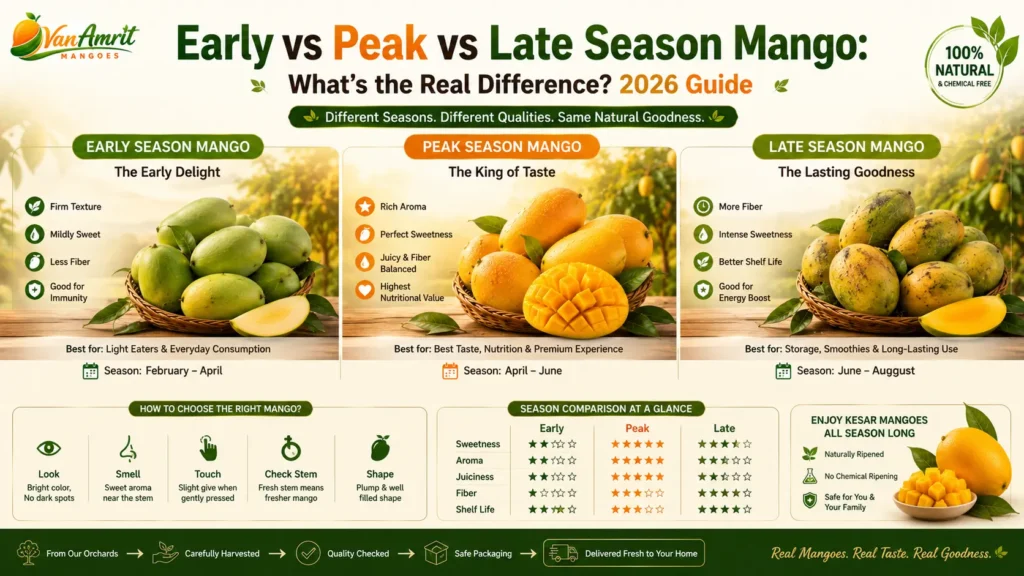
Early vs Peak vs Late Season Mango:
What’s the Real Difference?
The same mango variety can taste dramatically different depending on when in the season you buy it. Here’s the Brix science, the price reality, and the buying logic for all three phases.
That wasn’t a different source. It wasn’t even a different variety. It was the same mango at a different phase of its season. And the difference between a March Alphonso and a May Alphonso is not subtle — it’s dramatic, measurable in Brix degrees, and completely predictable if you understand the three phases every Indian mango season moves through.
Every mango variety has an early season, a peak season, and a late season. Each phase has its own flavour profile, its own Brix range, its own price level, its own carbide risk, and its own buying logic. Understanding these three phases — and which one you’re actually buying from — is probably the single most important mango knowledge upgrade you can make.
🔬 Why the Same Mango Tastes Different in Three Different Months
To understand why phases matter, you need to understand what’s actually happening inside a mango as the season progresses. It comes down to one fundamental process: starch-to-sugar conversion.
When a mango first forms on the tree after flowering, its flesh is almost entirely starch — firm, dense, and completely unsweetened. Over its time on the tree, enzymes progressively convert those starches into various sugars: glucose, fructose, sucrose. The longer the mango stays on the tree (up to its optimal harvest maturity), the more complete this conversion becomes — and therefore the higher its Brix score (the measurement of dissolved sugar percentage in the juice).
An early-harvested mango has not completed this conversion. The starches are only partially converted. The Brix is lower. The sweetness is incomplete. The aroma compounds — which also develop over time on the tree — are less fully formed. Early-season mangoes are said to be deficient in flavour, and it’s not a vague characterisation — it’s a biochemical reality. The fruit was taken off the tree before it finished becoming itself.
AlphonsoMango.in’s 2026 Konkan Harvest Report provides the most specific seasonal Brix data we have from a verified farm source: Early season (February–mid-March) first flush: 18–20° Brix. Peak season (mid-March–May): consistently achieves 18–22° Brix, all size grades. Late season (May–June): often achieves the highest Brix of the year (20–22°+) but in reduced volume. Early-season carbide-treated fruit from unknown sources may only reach 12–15° Brix — the chemical forces colour change without completing sugar development.
There’s also the temperature factor. Early in the season, daytime temperatures are still building toward summer maximums. The mango needs sustained heat to concentrate sugars in the developing fruit — and the 2026 Ratnagiri season benefited from a favourable winter temperature range with good dry summer heat from February onward, allowing proper sugar accumulation. This climate-flavour connection is why the same variety tastes subtly different even within a single season, depending on that year’s weather.
📊 The Three Phases at a Glance — Quick Reference
Before we go deep on each phase, here’s your reference table. Screenshot this for quick in-market decisions.
| Phase | Typical Months | Brix Range | Quality | Price Level | Carbide Risk | Best Strategy |
|---|---|---|---|---|---|---|
| Early Season | March–April | 18–20° | ⭐⭐ Variable | 🔴 Highest | High | Buy Alphonso only |
| Peak Season | May–June | 18–22° | ⭐⭐⭐⭐⭐ Best | 🟢 Lowest | Lowest | Buy everything |
| Late Season | July–August | 20–22°+ | ⭐⭐⭐⭐ Sweet | 🟡 Moderate | Low-Moderate | Chausa, Langra, Neelam |
🌸 Early Season Mango — The Excitement Trap (And the One Exception)
Let me describe the emotional experience of early-season mango buying, because it’s a very specific feeling. The crates appear in March. You haven’t had a fresh mango since August of last year. Seven months of mango deprivation have built up into something that feels less like hunger and more like longing. When you see that first “Kesar” or “Alphonso” at the stall, you hand over the money before logic has a chance to intervene.
And that’s exactly what early-season vendors are counting on. Because here’s the uncomfortable truth: most of what you’re buying in March and April is not at its best, and you’re paying the highest prices of the entire season to find this out.
Early-season mangoes are available in the market in these months — Karnataka, Andhra Pradesh, Telangana, and Maharashtra begin first. But FarmSe’s March 2026 mango season guide is explicit: these early mangoes “are said to be deficient in flavour and may not be naturally ripened.” That qualification — “may not be naturally ripened” — is where the real problem lives. When natural supply is thin and demand is high, calcium carbide enters the picture.
The gap between market demand (high from March) and genuine natural supply (low until April–May for most varieties) is exactly where carbide ripening fills in. Carbide forces colour change in the skin without completing the internal sugar development — a mango that looks ripe but has never finished becoming one. The result is flat, flavourless fruit at premium early-season pricing. This is why the carbide risk is highest in early season. Our guide to identifying real Kesar mango explains every test you can run to detect this before you buy.
The One Genuine Early-Season Exception: GI-Tagged Alphonso
Here’s where I want to be fair, because early season isn’t a complete wasteland. Ratnagiri Hapus starts from mid-February and Devgad Hapus from early March 2026. These are genuinely in-season at this point — not forced early, not mislabelled. The 2026 Konkan Harvest Report confirms first-flush early Alphonso achieves 18–20° Brix with excellent aroma, often rated as some of the most aromatic fruit of the entire season. The aroma comes from first-of-season aromatic compound development that is actually more pronounced in first flush — even if the Brix isn’t yet at its peak-season maximum.
So early Alphonso from a verified GI-tagged source is genuinely worth buying — not because it’s the best Alphonso you’ll ever eat, but because it’s legitimate, it’s good, and if you can’t wait until May, it’s your best option.
What to Avoid in Early Season
- Any “Kesar” in March or April — Gir Kesar season starts in mid-April at the earliest. Valsad Kesar starts in May. April “Kesar” is almost certainly mislabelled, early-harvested, or artificially ripened
- Any “Dasheri” or “Langra” before June — these varieties genuinely peak in June–July. April Dasheri isn’t a bargain; it’s a different, inferior fruit wearing Dasheri’s name
- Cheap early-season mangoes from unverifiable sources — the price-quality relationship in early season is inverse to every other market: highest price, lowest quality. Discounted early-season fruit means the seller knows it’s not premium
For the complete guide to which variety is genuinely available when — and which months to avoid for which varieties — our best time to buy mangoes in India guide has the full calendar.
⭐ Peak Season Mango — The Phase Worth Waiting For
Peak season is the season’s equivalent of a restaurant kitchen firing on all cylinders. Every dish is available. Every ingredient is at its best. The dining room is full, the margins work, and the chef is doing exactly what they were trained to do. Everything in peak season is working simultaneously — maximum supply, maximum variety, maximum flavour development, most competitive pricing.
FarmSe’s 2026 mango season guide makes it plain: during peak season, “the best mangoes are available during these months. The flavour, aroma, and texture are at their best during this time.” This isn’t marketing language — it’s the biological reality of what happens when harvest timing aligns with full flavour development across multiple premium varieties at once.
The Peak Season Brix Difference
AlphonsoMango.in’s 2026 Harvest Report gives us the most specific data available: peak-season Alphonso “consistently achieves 18–22° Brix” — the full range, not the lower end. Early-season fruit was stuck at 18–20°. Late season often goes higher. But peak season is where the full range is reliably achievable on most fruit, not just the best pieces.
The Kesar picture is similar. GirKesar.com’s 2026 season guide confirms: “We expect May and June 2026 to be particularly good months for quality and availability.” The first two weeks of June specifically — when Valsad Kesar is at its prime — represent the calendar’s highest concentration of Brix, fragrance, and deep saffron-orange pulp colour. This is the Kesar that makes aamras you’ll remember in December.
The Price Paradox of Peak Season
This is the counterintuitive truth that most buyers never learn: peak season is when mangoes cost less. Not a little less — significantly less. Prime Valsad Kesar in June typically runs ₹600–950 per 10kg, compared to ₹1,200–1,800 for early-season April fruit (when genuine Kesar is even available in April, which it rarely is).
Think of it like airline pricing but backwards. Early season is like buying the last few tickets at last-minute premium prices — scarce supply, inelastic demand, sellers have all the leverage. Peak season is like buying when flights are abundant and every carrier is competing for your business. The market works in your favour at exactly the moment the product is also at its best. This almost never happens in luxury goods. In mango season, it happens every June.
June is when multiple premium varieties peak simultaneously for the only time in the year: Valsad Kesar (prime), Dasheri from Malihabad (opens second week of June), Langra (starts third week), Neelam (starts), Mallika (peak). The widest variety selection at the highest quality at the lowest pricing — all in a single four-week window. The months of June and July are when mangoes reach their zenith in terms of flavor, quality, and abundance. Buy Valsad Kesar in bulk in June for pulp-freezing and you’re securing peak-quality, peak-Brix mango at peak-value pricing for 6–8 months of off-season aamras.
- Peak season buying strategy: Order Valsad Kesar in bulk for fresh eating and pulp-freezing — the absolute prime window
- Pre-book peak batches in advance: The best farm-direct peak-season batches sell out quickly. Pre-ordering in late May for June dispatch ensures you get the prime batch
- Low carbide risk: Maximum natural supply means vendors don’t need to artificially ripen fruit. Natural ripening can keep pace with demand. Farm-direct brands at full production mean maximum authenticity
- Maximum storage potential: Peak-season fruit has the best cell wall integrity and highest Brix — meaning frozen pulp from June Kesar retains the best flavour for the longest time
Valsad Kesar at Prime — Maximum Brix, Maximum Fragrance
The science says June is the best month for Kesar. Our orchard agrees. Vanamrit’s Valsad Kesar is at peak Brix (18–22°), peak saffron fragrance, and peak availability right now — carbide-free, naturally ripened in hay, farm-direct from Chikhli, Valsad to your door in 5–6 days.
Order Valsad Kesar Mangoes Now →🌧️ Late Season Mango — The Season’s Sweetest Secret
Late season is India’s mango secret that casual buyers often miss — dismissed as the season winding down, when actually it contains some of the year’s most genuinely sweet fruit. The science tells a story that surprises most people: late-season fruit often achieves the highest Brix of the year because it has had the maximum time on the tree for starch-to-sugar conversion.
AlphonsoMango.in’s 2026 Konkan Harvest Report is explicit about this for Alphonso: “Late season (May–June for Alphonso) fruit often achieves the highest Brix of the year (20–22°+) but in reduced volume as the season closes.” For late-season varieties like Chausa, this same maximum-time-on-tree phenomenon is literally built into its variety character — Chausa genuinely needs its July timing to reach the honey-pure sweetness it’s famous for.
FarmSe’s March 2026 guide confirms: “Late-season mangoes are said to be sweet. The mangoes are available in fewer quantities.” That’s the honest picture — sweeter per piece, but narrower selection. The late season is a concentrated experience rather than a broad one. You’re not choosing from twenty varieties. You’re choosing from the five that are still genuinely in season.
The Late-Season Varieties Worth Pursuing
- Chausa (peak July): This variety genuinely needs July. ZZ Mango’s season update confirms Chausa is expected to start end of June and finish end of July. Near-zero acidity, 20–22° Brix, and the pure honey sweetness that makes it “the Emperor of Mangoes.” Buy it, eat it today. Its 2–3 day post-peak window is not a flaw — it’s the price of maximum sweetness
- Langra (peak July): Banarasi Langra peaks in July. Its tangy-sweet citrus notes are unlike anything else in India’s mango calendar. The Langra complication: it stays green even when fully ripe. Never use colour — use the press and smell tests only
- Valsad Kesar (through mid-July): Valsad Kesar’s biggest practical advantage over Gir Kesar (which ends mid-June) is its extended season into mid-July. Late July Kesar is naturally in season — not forced, not stored. Still 18–20° Brix, still excellent. This is the last call for Kesar pulp-freezing
- Neelam (June–August): India’s longest naturally-available premium variety. Late July to August Neelam is genuinely sweet with solid shelf life — the best final pulp-freezing batch if you missed June and July Kesar
The Critical Distinction: Late Season vs Off Season
This is where buyers get confused — and where disappointment happens. Late season (July–August) and off season (September onwards) are completely different things. Late season is naturally harvested fruit that is genuinely in season for its specific variety. Off season is cold-stored, potentially months-old, nutritionally compromised fruit being sold because there’s nothing genuinely fresh available.
If you see “Alphonso” in August, it’s off-season cold-stored fruit — Alphonso’s genuine season closed in June. If you see “Kesar” in September, same story. Late season means the variety is genuinely still in its natural harvest window. The season calendar is your authentication tool here as much as any physical test.
Our shop shows current season availability — order last-batch Kesar in July while the window remains open.
🥭 The Kesar Case Study — All Three Phases From One Variety
Let me use Kesar as the concrete example of how dramatically one variety changes across the three phases — because it’s the variety we know best at Vanamrit, and because its extended season makes all three phases accessible.
- Early Kesar (April–May): GirKesar.com confirms Kesar season starts mid-April. Early Kesar is real but not prime. Brix is approximately 16–18° — the starch-to-sugar conversion is underway but incomplete. The saffron aroma is present but lighter than peak. Fragrance is the most reliable indicator here — if the stem-end fragrance doesn’t fill your hand, it’s not yet at its best
- Peak Kesar (June — prime): This is the mango that earned Kesar its “Queen of Mangoes” title. Full Brix (18–22°). The saffron fragrance that fills a room before you’ve cut it. Deep orange pulp that’s completely fiberless. Honey sweetness without a single note of acidity. GirKesar.com 2026: “We expect May and June 2026 to be particularly good months for quality and availability.” The first two weeks of June at Vanamrit’s Chikhli, Valsad orchard is when we’re harvesting the fruit at this precise specification
- Late Kesar (mid-July — Valsad only): Gir Kesar ends by mid-June. Valsad Kesar’s extended season (from its alluvial coastal microclimate) continues through mid-July. Late July Valsad Kesar is still naturally in-season — not stored, not treated. Brix remains 18–20°. This phase is ideal for buyers who missed June’s prime and need a last pulp-freezing batch before next season
Understanding the Valsad-versus-Gir timing difference is one of the most useful pieces of Kesar knowledge a buyer can have. The full comparison — soil, season, flavour, and Brix differences between the two — is in our Valsad Kesar vs Gir Kesar comparison guide. And for the week-by-week deep dive into Kesar’s season timing, our Kesar season timing guide covers exactly when each phase begins and ends.
🔍 How to Know Which Phase You’re Actually Buying From
Market vendors aren’t going to announce “this is early-season substandard fruit at premium pricing.” You need to figure out the phase yourself. Here are the tests that work:
- The season calendar cross-check (most powerful): Before you buy any variety, confirm it’s actually in season right now. “Kesar” in March, “Alphonso” in August, “Dasheri” in April — these are not early purchases of real varieties. They’re either different fruit with familiar names or cold-stored off-season stock. The calendar doesn’t lie
- The fragrance test: Peak-season mangoes have the most powerful, complex, unmistakable aroma near the stem. Early-season fruit has lighter aroma (first-flush Alphonso is the notable exception). No fragrance at all = carbide-treated early season or off-season cold storage
- Weight and density: Peak-season mangoes are consistently heavier relative to their size. Maximum flesh development, maximum juice content. Early-season fruit is often lighter — the interior hasn’t fully filled out yet
- The price cross-check: If the price is at a scarcity premium for a variety that should be at peak abundance, something is wrong. June Kesar should be significantly cheaper than April “Kesar.” If the price pattern doesn’t match the expected phase pricing, question the phase claim
- Source transparency: A farm-direct brand that tells you the specific harvest date, orchard district, and natural ripening method is giving you phase transparency. They’re telling you exactly where in the season this fruit was harvested. A market stall that can’t tell you the harvest date or the district of origin is asking you to trust a claim with no verifiable information behind it
📦 How Storage Differs Across All Three Phases
The phase of the season also affects how you should handle and store your mangoes after purchase. Peak-season fruit performs best across all storage methods. Early-season fruit needs more careful monitoring.
- Early season storage: Ripen slowly at room temperature — never rush early-season fruit. Its incomplete sugar development means rushed ripening (rice method, banana trick) can tip it to soft before it’s genuinely sweet. More gentle room-temperature ripening gives the Brix more time to develop
- Peak season storage: Ideal for all storage methods — freezing slices, pulp-freezing, refrigeration. Peak-season fruit has the best cell wall structure when green-mature, meaning it freezes beautifully and retains excellent flavour. The June bulk-buy for pulp-freezing strategy only works because peak-season fruit has the Brix worth preserving
- Late season storage: Process quickly — late-season fruit should move from ripe to refrigerator or freezer fast. The high Brix means excellent frozen pulp quality. Don’t delay storage for late-season fruit; the season is closing and the window for processing it properly is narrower
For the complete storage guide covering every method — room temperature, fridge, freezer slices, pulp-freezing — our how to store mangoes properly guide has everything. And for ripening guidance across all phases, our home ripening guide covers the specific techniques for early, peak, and late-season fruit.
❓ Season Phase Questions, Answered
🏁 Buy Smart Across All Three Phases
🥭 The Phase-Smart Mango Buyer’s Rulebook
Early season: patience beats impulse. Buy GI-tagged Alphonso if you can’t wait. Wait for everything else. Peak season: this is the phase worth your full attention and your biggest orders. Maximum Brix, maximum variety, minimum price — buy everything, freeze the best. Late season: Chausa, Langra, and last-batch Kesar are your targets. Sweeter per piece, but act quickly — the window is closing.
The one insight that changes everything: the most expensive phase delivers the worst quality, and the most affordable phase delivers the best. Once you understand this, early-season FOMO stops driving your purchases and patient, informed buying takes over. You start ending every mango season with the memories you wanted — and enough frozen Kesar pulp to make aamras through December.
For the complete variety-by-variety guide to when each mango peaks and exactly which month to buy — our Best Time to Buy Mangoes in India guide is the complete reference for every variety, every month, every region.
“The mango season rewards patience twice — once with better flavour, and once with a lower price.” 🥭🌿
Peak-Season Valsad Kesar — Farm-Direct, Maximum Brix
Vanamrit harvests and ships Valsad Kesar at precisely its peak phase — June prime, naturally ripened in hay, carbide-free, maximum Brix and fragrance. Not early season compromise. Not cold-stored off-season. The real thing, at the right time, from our Chikhli orchard to your door.
🥭 Order Peak-Season Kesar at vanamrit.inBulk orders, gifting or questions about our season: vanamrit.in/contact/ | WhatsApp: +91 9033595016