
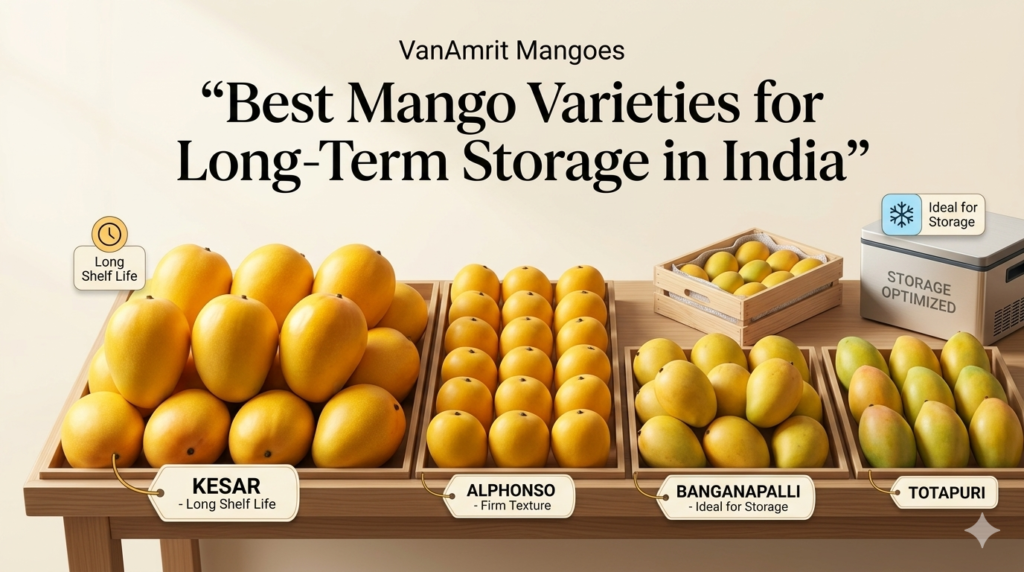
Best Mango Varieties for Long-Term
Storage in India — 2026 Ranked Guide
Which Indian mango lasts the longest? We ranked 9 varieties by shelf life, freezing quality, and storage performance — so you can buy smarter this season.
The answer is yes — dramatically. The difference between the best and worst Indian mango varieties for long-term storage is the difference between a batch that stays perfect for two weeks and one that turns to mush in 48 hours. Buy Chausa in bulk and you’ll be in a full-scale eating emergency within two days. Buy Banganapalli and you’ve got a comfortable 2-week window. Buy Kesar and you can freeze the pulp in June and be making aamras from it in December.
That’s not luck or storage technique — that’s variety selection. And once you understand why certain mangoes last longer than others, you’ll never buy the wrong one for the wrong purpose again.
🔬 Why Some Mangoes Last 2 Days and Others Last 2 Weeks
Before we get to the rankings, let me explain the actual biology here — because it makes everything else click. A mango’s shelf life isn’t random. It’s determined by a handful of very specific structural and biochemical characteristics that vary significantly between varieties.
The first factor is skin thickness and the natural wax layer. Think of a mango’s skin like packaging. A thick, waxy skin slows moisture loss and creates a physical barrier against surface pathogens. Thin-skinned varieties like Himsagar and Chausa have almost no such barrier — they’re like perishable luxury products in tissue paper, designed to be consumed immediately, not stored. Banganapalli and Kesar, by contrast, have skins sturdy enough to handle real transit and storage time.
Second is flesh firmness and cell wall density. Firmer flesh means the cell structure stays intact longer before breakdown. Loose, high-moisture flesh (Chausa, Himsagar) collapses quickly. Dense, fiberless flesh (Kesar, Banganapalli) holds its structure for days longer.
Third is the ethylene production rate. Ethylene is the plant hormone that drives ripening — the faster a variety produces it, the faster it moves from ripe to overripe. Low ethylene producers like Kesar give you more time to work with. High ethylene producers like Chausa sprint from peak to past-peak in a matter of hours.
Research published by the International Society for Horticultural Science found that Kesar mango harvested at 106–110 days after fruit set achieved shelf life up to 21 days — exceptional performance for a premium flavour variety. Early-harvested Kesar (86–90 days) showed significantly shorter shelf life and inferior quality. This is why harvest timing matters as much as variety selection.
One more factor that most home buyers never consider: cold storage temperature requirements differ by variety. A 2025 technical guide from Rinac cold chain solutions confirmed that optimal cold storage temperatures vary — Dasheri needs 12°C, Langra 15°C, Chausa 10°C. Most household fridges run at 4–8°C — fine for Kesar and Banganapalli at peak ripeness, but potentially causing chilling injury in varieties with higher temperature requirements if stored pre-ripe.
This is why you can’t just pick up any mango and apply the same storage strategy. For the complete guide on how to store mangoes correctly at every stage, check out our How to Store Mangoes Properly guide — it covers room temperature, fridge, freezer, and pulp methods in detail.
📊 India’s Top Mango Varieties Ranked by Storage Life
Screenshot this table. Send it to your family WhatsApp group before the season starts. This is the reference you wish you’d had before that last batch of Chausa turned into a race against time.
| Variety | Region | Room Temp | Fridge (ripe) | Frozen | Bulk Buy? |
|---|---|---|---|---|---|
| Kesar (Valsad/Gir) 🥇 Best | Gujarat | 5–8 days | 7–10 days | 12 months | ✓ Yes |
| Banganapalli (Safeda) 🥈 | Andhra Pradesh | 5–7 days | 7–14 days | 12 months | ✓ Yes |
| Neelam | TN / AP / MH | 5–7 days | 7–10 days | 12 months | ✓ Yes |
| Dasheri | Uttar Pradesh | 4–6 days | 5–7 days | 10–12 months | ✓ Yes |
| Totapuri | Karnataka / AP | 5–7 days | 7–10 days | 12 months | ✓ For processing |
| Alphonso (Hapus) | Ratnagiri / Devgad | 3–5 days | 3–4 days (ripe) | 12 months | ⚠ Fresh only |
| Langra | UP / Bihar | 3–5 days | 5–7 days | 10 months | ⚠ Limited |
| Chausa | UP / Haryana | 2–3 days | 2–4 days | 8–10 months | ✗ No |
| Himsagar | West Bengal | 1–2 days | 2–3 days | 8 months | ✗ Never |
Farm-Fresh Valsad Kesar — Perfect for Storing, Gifting & Freezing
Order in June, ripen the batch naturally, freeze the pulp, and enjoy authentic Vanamrit Valsad Kesar flavour through the year. Carbide-free. Handpicked at the right maturity stage. Farm-direct from Chikhli, Valsad to your door.
Order Valsad Kesar Mangoes Now →🥇 #1 — Kesar: India’s Best Mango for Long-Term Storage
Kesar isn’t just India’s most-exported premium mango — it’s also the most storage-intelligent variety in the country. And those two facts are directly connected. The reason Kesar dominates India’s export basket to the UK, US, Canada, and Gulf countries isn’t just its flavour. It’s because Kesar can handle 15–35 days of cold-chain transit and arrive in excellent condition. Alphonso — as prestigious as it is — simply cannot do that consistently.
What makes Kesar such a storage performer? Its thick, waxy skin provides excellent surface protection. Its flesh is dense and fiberless — structurally robust enough to resist breakdown for days longer than soft, high-moisture varieties. And its ethylene production rate is moderate — meaning it doesn’t sprint from ripe to overripe the way Chausa or Himsagar does.
The peer-reviewed research backs this up. The International Society for Horticultural Science found that Kesar harvested at the right maturity stage (106–110 days after fruit set) achieves shelf life up to 21 days under proper conditions. That’s exceptional for a premium dessert mango.
Valsad Kesar vs Gir Kesar — Does the Growing Region Affect Storage?
Both are the same Kesar variety, but the growing region gives Valsad Kesar a subtle structural advantage. South Gujarat’s alluvial, mineral-rich coastal soil produces slightly denser cell walls than Gir’s red laterite. Combined with Valsad Kesar’s extended season (May–July vs April–June for Gir), this means Valsad Kesar gives home buyers more purchase flexibility without compromising on shelf life. You don’t have to scramble to buy and store in a narrow April–June window.
For the complete flavour, season, and storage comparison between the two, read our Valsad Kesar vs Gir Kesar detailed guide.
Kesar for Frozen Pulp — Why It’s the Best Indian Variety for This
Kesar’s low fibre content means the blended pulp is completely smooth with no stringy texture. Its high carotenoid content (the same pigments responsible for its deep saffron-orange colour) is exceptionally stable at −18°C — meaning frozen Kesar pulp doesn’t lose its brilliant colour the way some varieties do. And the aromatic compounds that create Kesar’s signature saffron-sweet fragrance survive freezing and thawing at a level that Alphonso, Dasheri, or Banganapalli simply don’t match.
- Best for: Bulk purchase for pulp-freezing, gifting, online delivery orders needing 5–7 day transit resilience, and premium aamras
- Peak buying window: Late May to mid-June for Valsad Kesar. Full 2026 Kesar season timing guide here
- Storage strategy: Ripen at room temperature → fridge for up to 7–10 days → freeze pulp in portions for 12 months
🥈 #2 — Banganapalli: The Commercial Storage Champion
If Kesar is India’s best overall storage mango, Banganapalli is the one with the single longest fresh eating window. Mahindra Nursery’s 2026 commercial farming guide is explicit about this: Banganapalli has a shelf life of 2–3 weeks — one of the longest natural fresh shelf lives of any Indian variety. It’s the reason this GI-tagged Andhra Pradesh variety sets the daily mango pricing at India’s two largest mango markets (Gaddiannaram in Hyderabad and Koyambedu in Chennai). Market traders can buy large quantities without pressure to sell immediately.
What gives it that exceptional window? Banganapalli is one of India’s largest mangoes — weighing 500–800g per fruit — and its oversized surface area comes wrapped in thick, firm skin that’s much more protective than most premium varieties. Combined with fibre-free, firm flesh that holds its structure extremely well, you get a mango that simply ages more gracefully than almost everything else on the market.
In flavour terms, Banganapalli is sweet, clean, and milder than Kesar or Alphonso. It’s not going to make you write poetry. But it will stay in excellent eating condition for nearly two weeks after it ripens — and for home buyers who want to stock up without daily urgency, that practical advantage is enormously valuable.
- Best for: Bulk home purchases where you want a 2-week eating window, raw mango pickle (firm flesh holds shape perfectly in oil-submerged pickle)
- Peak buying window: April–June. One of the earliest season mangoes — it arrives before Kesar and Alphonso
- Storage strategy: Can stay at room temperature slightly longer than Kesar before needing refrigeration. Use the 2-week fridge window for planned family consumption
🕐 #3 — Neelam: The Late-Season Storage Star
If your goal is extending the mango season in your home as long as possible, Neelam is your answer. Multiple sources including the Dial4Trade mango varieties guide specifically call out Neelam’s “great shelf life, making it ideal for transport and export.” Mahindra Nursery’s 2026 guide notes that commercial farmers plant Neelam alongside Banganapalli specifically to extend their harvest window into June–July when most other varieties have finished.
Think of Neelam as the mango season’s closing act — the variety that arrives when Alphonso and Gir Kesar are memories and Valsad Kesar is winding down. Smaller than most premium varieties, intensely fragrant, with a balanced sweet-tangy flavour and a strong aroma that persists longer after ripening than many varieties. It’s not the most celebrated Indian mango, but serious mango buyers know that a well-stored Neelam in July is better than a poorly stored Alphonso in March.
- Best for: Late-season bulk buying for pulp freezing (July–August), extending your home mango season past Kesar and Alphonso
- Freezing note: Neelam freezes very well — its compact size and firm flesh blend into smooth, strongly-flavoured pulp
- Season advantage: Still available in August when every other premium variety is done — the last call for natural mango pulp until next year
🌟 #4 — Dasheri: North India’s Premium Storage Choice
In North India, Dasheri is what Kesar is to Gujarat. GI-tagged from Malihabad, Lucknow — the self-proclaimed “mango capital of the world” — Dasheri is long, oval, fibre-free, and sweetened to a candy-like intensity that makes it a household favourite from Delhi to Lucknow every June.
From a storage perspective, Dasheri performs reasonably well — certainly better than Chausa and Langra, which are its main North Indian competitors. Its optimal cold storage temperature is 12°C (the same as Kesar), which means it responds well to standard household refrigeration at the pre-ripe stage. Frozen Dasheri pulp retains good flavour for 10–12 months, and households across UP and Delhi routinely freeze seasonal Dasheri pulp as a year-round kitchen staple.
The main limitation: Dasheri bruises more easily than Banganapalli and requires careful handling during storage. Don’t stack them. Don’t squeeze them. Treat them with the same respect you’d give Alphonso.
- Best for: North Indian households as a premium Kesar equivalent, pulp freezing, June–July bulk buying
- Storage tip: Refrigerate in the crisper drawer once ripe — same protocol as Kesar. Optimal cold storage temperature matches standard fridge settings
- Season: June–July. Don’t buy “Dasheri” in April — it’ll be something else entirely
🔱 #5 — Totapuri: The Preservation and Processing Champion
Totapuri is the mango world’s practical joker. You’d never win a flavour contest against Kesar or Alphonso with its tangy, slightly tart flesh. But when it comes to raw staying power — how long it sits at room temperature without drama, how well it survives as a preservation base — Totapuri quietly outperforms almost everyone.
Its extremely firm flesh (tangy even when ripe), high acidity, and thick skin are structural storage advantages. The same characteristics that make it less exciting for fresh eating make it bulletproof for preservation applications. Its natural acidity slows bacterial activity. Its firmness means raw Totapuri can stay at room temperature for nearly 2 weeks without spoiling. And it’s the backbone of India’s industrial mango pulp industry — Totapuri pulp contract farming arrangements with pulp factories exist across Karnataka and Andhra precisely because of its processing suitability and reliable shelf life.
- Best for: Annual pickle batch (raw firm Totapuri makes excellent long-shelf-life pickle), industrial-scale pulp, aam panna concentrate, cooking-grade frozen pulp
- Not for: Fresh eating, premium aamras, or anywhere flavour complexity is the priority
- The bulk buyer angle: If you want cheap, plentiful mango for processing — pickle, chutney, frozen cooking pulp — Totapuri is the most cost-effective choice available
👑 Alphonso — The Flavour King With a Short Storage Clock
Here’s where I have to be completely straight with you, because Alphonso deserves an honest assessment rather than the usual uncritical reverence. Alphonso is extraordinary — a genuinely magnificent eating experience at peak ripeness. But it is, objectively, a terrible choice for long-term storage or bulk buying.
Its thin, delicate skin provides minimal protection. Its high moisture content means rapid deterioration once peak ripeness is passed. And a 2026 analysis from ZZ Mango noted that about 30% of Alphonso suffers from “spongy tissue” — an internal disorder where the seed absorbs nutrients from surrounding pulp, leaving ruined flesh that you discover only when you cut it open. That 30% variability alone makes bulk buying Alphonso a gamble you often lose.
The cold storage data tells a nuanced story. Commercial Alphonso stored at 12.7–15.0°C and 85–89% relative humidity can achieve 24–26 days shelf life. But that requires professional cold chain infrastructure, not your household fridge running at 4–8°C (which risks chilling injury). At home, ripe Alphonso in the fridge lasts 3–4 days before quality noticeably declines.
If someone offers you a great deal on a large quantity of Alphonso — think very carefully. The spongy tissue disorder, the narrow storage window, and the variety’s general fragility mean even careful handling can result in significant losses. For immediate family eating when quality is guaranteed: buy Alphonso freely. For bulk buying or storage: choose Kesar.
Where Alphonso excels: Frozen pulp. Alphonso’s exceptional flavour and aroma profile is remarkably well-preserved by freezing. Buy it fresh to eat, freeze pulp from the mangoes just past peak eating quality, and use it in cooked applications through the year. That’s the optimal Alphonso strategy.
⛔ The “Never Buy in Bulk” Group — Chausa, Himsagar & Langra
These three varieties produce some of the most intensely pleasurable eating experiences in the entire Indian mango calendar. They’re also completely wrong for storage, bulk buying, or delivery orders. Let me explain why — with love and clarity.
Chausa — Sweetest, Shortest Window
Chausa is India’s sweetest commercial mango by sugar content. It’s been described as tasting “like liquid honey with wings.” It’s also, as ZZ Mango’s February 2026 analysis noted, “prone to spoilage with a low shelf life.” Its optimal cold storage temperature is 10°C, and even under good conditions, ripe Chausa deteriorates within 2–4 days. At room temperature on a hot July afternoon, you might have 36–48 hours from perfect ripeness to fermentation. Buy it and eat it the same day. Never order it online unless you’re home to receive it immediately and eating it that evening.
Himsagar — The Most Perishable Premium Mango in India
West Bengal’s prized Himsagar (also called Khirsapat) is extraordinary — saffron-coloured pulp, completely fiberless, intensely sweet, one of the most celebrated regional mangoes in all of India. It is also the most perishable. 1–2 days post-peak at room temperature before it tips toward overripe. Its extremely high juice content, thin skin, and intense sweetness create a feedback loop of rapid deterioration. Himsagar is a seasonal celebration — a moment, not a supply. Buy it when you’re in Kolkata in May and eat it there. Don’t attempt delivery. Don’t attempt bulk buying. Just eat it, immediately, and be grateful for the experience.
Langra — Better Than the Above, Still Not for Storage
Langra is the most storage-capable of this group. It can hold 5–7 days refrigerated — but it creates a unique challenge that trips up buyers constantly: Langra stays green even when fully ripe. You can’t use colour to judge ripeness with Langra. If you rely on your eyes, you’ll either eat it too early (tart and starchy) or wait past peak while it quietly overripens inside its deceptively green skin. If you love Langra and want to buy it in quantity, learn to use the press and smell tests exclusively — colour means nothing here.
❄️ Which Indian Mango Variety Freezes Best?
For most Indian households, frozen mango pulp is actually more valuable than fresh mango — because it represents peak-season quality available in months when fresh mangoes simply don’t exist. Getting the variety selection right for freezing matters as much as the technique itself.
For detailed step-by-step instructions on freezing slices, pulp, and the ice cube tray method, visit our complete mango storage guide. And for everything you need to know about ripening your mangoes to the right stage before freezing, our home ripening guide has you covered.
📅 Season Calendar — When to Buy Each Variety for Maximum Storage Value
Storage value peaks when you buy at variety peak season. Buying any mango outside its natural window gives you inferior fruit with compromised shelf life regardless of how well you store it. Here’s your month-by-month guide for 2026:
For a detailed breakdown of the exact Kesar season window — including early vs peak vs late-season quality and price data for 2026 — see our Best Time to Buy Kesar Mangoes in Gujarat — 2026 guide.
❓ Storage Variety Questions, Answered
🏁 Your Annual Mango Storage Strategy — Simplified
🥭 The Strategic Mango Buyer’s Calendar
Buy Kesar in June for pulp-freezing — it’s the single best Indian mango for frozen storage quality. Buy Banganapalli in April–May when you want a large stock with a generous eating window and no urgency. Buy Totapuri in May for your annual pickle batch. Buy Dasheri in June–July if you’re in North India and want the regional premium storage equivalent of Kesar. Buy Neelam in July–August for your final late-season pulp batch.
And when Chausa and Himsagar appear? Buy those too — but buy them to eat today and tomorrow, not to store. They’re seasonal celebrations, not supply chain decisions. There’s a time for joy and a time for planning, and the good news is that India’s mango calendar is generous enough to accommodate both.
One final principle: the storage technique matters, but it’s completely secondary to the quality of what you start with. A naturally ripened, properly harvested Valsad Kesar frozen at peak quality will produce aamras in November that tastes like June. A carbide-ripened market mango of the same variety, handled carelessly, will disappoint you at every stage — fresh, stored, and frozen.
“Choose your mango like you choose your investments — with a plan, at the right time, from a source you trust.” 🥭🌿
Valsad Kesar — Farm-Direct, Peak Maturity, Ready to Store
Order Vanamrit’s Valsad Kesar at peak season in June — handpicked at 106–110 days maturity for maximum shelf life, naturally ripened in hay, and shipped carbide-free to your door anywhere in India. Ripen it, eat some fresh, freeze the rest as pulp. Six months from now, you’ll still be enjoying June’s finest mango.
🥭 Order Valsad Kesar Mangoes — VanamritBulk orders, gifting enquiries, or questions about our farm: vanamrit.in/contact | WhatsApp: +91 9033595016