
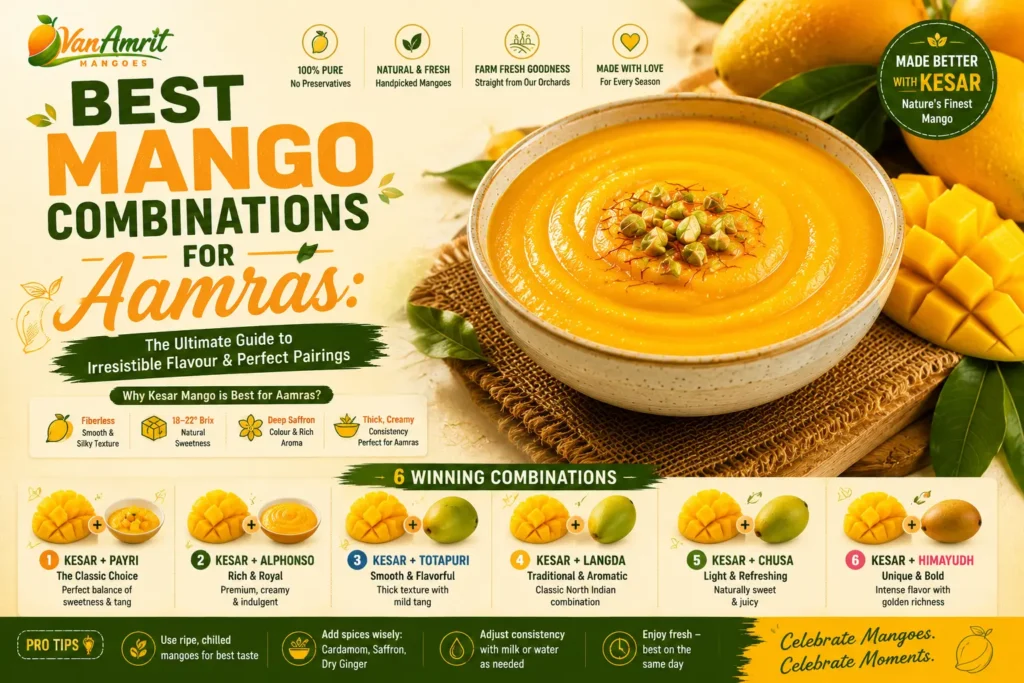
Best Mango Combinations for Aamras:
The Ultimate Kesar Guide
Which mango makes the best aamras — and which flavour combinations take it from good to unforgettable? Six winning combos, four regional styles, and the one truth every aamras lover needs to know.
Then you tasted it. Pale yellow. Watery. Barely sweet enough. Nothing like the vivid saffron-orange, honey-thick aamras you’d been dreaming about since March.
What went wrong? Not the technique. Not the saffron or the cardamom or the amount of sugar. The mango. The mango went wrong. Because aamras is not a recipe that forgives an average mango — it’s a recipe that amplifies everything the mango is. Great mango = great aamras. Mediocre mango = no amount of seasoning saves it.
That’s the central truth this guide is built on. We’re going to cover which mangoes actually deliver — and which disappoint — for making mango combinations for aamras, and then walk through six winning flavour combos, all four regional styles, and every pro tip that separates a memorable bowl from a forgettable one. And if you want to start with the right mango before you read another word — our farm-fresh Valsad Kesar is right here.
🎯 What Makes a Mango Great for Aamras? The Four Non-Negotiables
Before we compare individual varieties, let’s set up the criteria. Not every mango makes great aamras — and understanding why helps you pick correctly at the market, online, or from whatever arrives at your door during mango season.
Think of aamras like a mirror. It reflects the mango’s true character with nowhere to hide. Unlike a mango salsa where you add heat, citrus, and coriander to build complexity, or a mango chutney where spices do the heavy lifting — aamras is just the mango, maybe a little sugar, maybe a whisper of cardamom or saffron. The mango’s flavour is exposed completely. So what makes a mango great for this dish?
- Zero or minimal fibre: Fibre creates stringy, textured aamras that either strains out badly or sits unpleasantly in the mouth. The ideal aamras mango blends into perfect smoothness without needing to be strained at all. Any mango variety where you pull the flesh and see strings between your fingers is going to make problematic aamras
- Natural sweetness at 18° Brix or higher: Brix measures total dissolved sugars. The higher the number, the less added sugar you need — and the deeper the flavour. A truly ripe, peak-season Kesar registers 18–22° Brix. That’s the range where aamras tastes like mango concentrate, not diluted pulp
- High pulp-to-stone ratio: A mango where the seed takes up 40% of the fruit gives you far less aamras per rupee than one where the seed is small and flat. Kesar has one of the best pulp-to-stone ratios of any Indian variety — which is why the pulp processing industry pays contract premiums specifically for it
- Colour depth: Pale yellow aamras looks thin and unappetising even if it tastes decent. Deep saffron-orange aamras looks luxurious before anyone has tasted it. The colour comes from carotenoid concentration — the same pigments that give the Kesar its name. For the best mango combinations for aamras, you want a variety that gives you that deep, rich colour without adding artificial colour
According to Mahindra Nursery’s 2026 commercial grower guide, Kesar has the highest pulp-to-seed ratio and deepest colour of any Indian mango, which is why it is the preferred variety for the aamras, frozen pulp, and juice processing industry. Pulp factories in Valsad, Vapi, and Chittoor pay a contract premium specifically for Kesar — not Alphonso, not Totapuri, not Banganapalli. Kesar. That industrial preference is the ultimate endorsement.
🥭 The Great Aamras Mango Showdown: Five Varieties Compared
Here’s the honest breakdown of how India’s most popular mango varieties actually perform when you make them into aamras. This isn’t about which mango tastes best fresh — it’s specifically about which makes the best mango for aamras.
| Variety | Fibre | Colour | Natural Sweetness | Pulp Yield | Aamras Rating |
|---|---|---|---|---|---|
| Kesar (Gujarat) | Zero — perfectly smooth | Deep saffron-orange | 18–22° Brix | Excellent (high ratio) | ⭐ Best Overall |
| Alphonso / Hapus | Minimal — nearly fiberless | Golden-amber | 20–22° Brix | Good | ⭐ Premium Choice |
| Payri / Pairi | Slight — needs straining | Yellow-orange | High, tangy-sweet | Moderate | ✓ Good (blend with Kesar) |
| Banganapalli / Safeda | Low — mostly smooth | Pale golden | Moderate (~16° Brix) | Very good (large fruit) | ✓ Good (mild flavour) |
| Himsagar (Bengal) | Minimal | Yellow-orange | High (18–20°) | Good | ✓ Good (East India) |
| Langra (UP/Bihar) | High — very fibrous | Green (stays green) | High, tangy | Moderate | ⚠ Avoid — too fibrous |
| Totapuri | Low fiber | Pale yellow | Low-moderate, tangy | Good | ⚠ Avoid — too tangy for aamras |
Why Kesar Wins the Aamras Mango Contest
The short version: Kesar mango for aamras is the natural choice because it scores highest on every criterion that matters for this specific dish. Zero fibre means perfect, strain-free smoothness. Deep saffron-orange colour means visual impact that no other variety matches. Natural sweetness at 18–22° Brix means you often need zero added sugar. And the flavour — that intensely sweet, saffron-warm, slightly tangy profile — translates directly into aamras that’s complex and layered, not just sweet.
Vanamrit’s own 2026 aamras guide puts it plainly: “We’ve compared five varieties across five factors — pulp yield, fibre, natural sugar, colour, and post-blend flavour. The data points one way: Kesar is the best mango variety for aamras, and it’s not particularly close.” When your own farm’s research backs it, and when the entire aamras processing industry agrees — that’s not marketing, that’s the conclusion of the evidence.
Why Alphonso Is the Excellent Second Choice
Alphonso gives you richer, butterier, more intensely aromatic aamras with a golden-amber colour. The sweetness is comparable (20–22° Brix). The fibre is minimal. So why doesn’t Alphonso top the list? Two practical reasons: its season is shorter (March–May, versus Kesar’s April–July), and it’s significantly more expensive. If you’re making aamras for a large family gathering or want to freeze a season’s supply of pulp, Kesar’s price-to-quality ratio and longer availability window make it the smarter choice by a considerable margin.
For very special occasions — a wedding, Holi, or a festive meal where you want the absolute most indulgent aamras possible — Alphonso is your premium option. For everyday family aamras and for bulk making, Kesar is simply unbeatable.
Wondering how Kesar stacks up against Alphonso across even more dimensions? We’ve done a detailed comparison in our Valsad Kesar vs Gir Kesar guide that also touches on how the two Kesar growing regions produce slightly different aamras results.
Valsad Kesar — The Aamras Mango of Gujarat
Zero fibre. Deep saffron-orange colour. 18–22° Brix natural sweetness. Naturally ripened in hay at our Chikhli, Valsad orchard and delivered farm-direct across India. This is the mango that makes aamras worth making.
Order Farm-Fresh Valsad Kesar →🔀 The Secret the Best Aamras Makers Know: Blending Two Varieties
Here’s something most aamras recipes don’t tell you. The finest mango combinations for aamras sometimes aren’t a single variety at all — they’re a thoughtful blend of two. Think of it like a blended whisky. The master blender combines different single malts to create something more nuanced and complete than any individual component.
The same principle applies to mango pulp. Kesar provides the colour, the saffron-orange depth, the smooth fiberless texture, and the foundation sweetness. A secondary variety like Payri or Alphonso provides a different flavour dimension — more tang, more richness, more aromatic complexity. Combined, you get an aamras that’s deeper, more interesting, and harder to put down than either variety alone.
According to Vanamrit’s 2026 aamras variety guide, the classic blending combination is 70% Kesar + 30% Payri — Kesar’s depth and colour with Payri’s traditional tangy character that many Gujarat families associate with childhood aamras. For festive occasions, 60% Kesar + 40% Alphonso gives you the Alphonso’s richness amplified by Kesar’s brilliant colour and natural sweetness. Both combinations outperform any single variety on their own when executed at peak ripeness.
The rule for blending: always use both varieties at identical ripeness stage. A perfectly ripe Kesar blended with an underripe Payri will produce disappointing aamras — the underripe component pulls the whole batch toward sourness and flat colour. Ripen both varieties fully before blending. Our home ripening guide shows you how to bring both to perfect readiness together.
✨ Six Winning Mango Combinations for Aamras
Now we get to the combinations themselves — the specific flavour additions that transform your Kesar base into six distinct, memorable aamras experiences. Each one has a different character, a different regional tradition behind it, and a different occasion it’s perfect for.
If your Kesar mango is genuinely peak-season and perfectly ripe, this is the combination that makes every addition feel like an insult. Nothing but the mango and a whisper of saffron-warmed milk. That’s it.
Why does it work? Because a great Valsad Kesar at 18–22° Brix already tastes like dessert by itself. It already has saffron-like warmth in its aftertaste. Adding saffron-infused milk simply amplifies what’s already there — the way a good amplifier makes a live instrument sound more like itself, not differently. The saffron in the milk and the saffron-like character of the Kesar create a resonance that’s extraordinary.
- 4 ripe Kesar mangoes
- 2 tbsp warm milk
- 6–8 saffron strands
- 1 tsp sugar (optional — taste first)
- Warm 2 tbsp milk (not boiling — just warm). Add saffron strands and let them soak 8–10 minutes until the milk turns golden
- Peel and chop mangoes. Blend until completely smooth
- Add saffron milk to the blended pulp. Taste before adding any sugar — peak Kesar needs none
- Chill for 1 hour. Serve in small bowls with fresh hot puris
✦ Best served with: Hot puri | Best for: Traditional Gujarati family meals, Holi celebrations
This is the version that shows up at wedding banquets, festival thalis, and every grandmother’s most impressive meal. Kesar’s base, doubled saffron fragrance from both the mango and the soaked strands, and cardamom’s floral warmth weaving through every spoonful.
Saffron and cardamom are the classical Indian dessert duo — the same pairing you find in kheer, rasmalai, and shrikhand. They work with Kesar for the same reason they work in those dishes: cardamom’s citrus-floral notes lift sweetness without competing with it. The result is aamras that tastes genuinely elegant, not just sweet. Add a pinch of nutmeg for a Maharashtrian touch that adds subtle warmth in the finish.
- 4 ripe Kesar mangoes
- 10–12 saffron strands in 3 tbsp warm milk
- ¼ tsp cardamom powder
- Tiny pinch of nutmeg (optional)
- 1 tsp sugar if needed
- Soak saffron in warm milk for 10 minutes
- Blend mangoes until smooth. Add saffron milk and cardamom powder
- Blend briefly to combine. Add nutmeg if using
- Chill 1 hour. Garnish with 3 saffron strands. Serve in brass katoris for the full effect
✦ Best served with: Hot puri or as standalone dessert | Best for: Festive meals, dinner parties, Navratri
Refined sugar is neutral — it sweetens without adding any flavour of its own. Jaggery is the opposite. Organic jaggery brings a deep, caramel-molasses earthiness that wraps around Kesar’s honey-saffron sweetness in a way that white sugar simply cannot replicate. The combination is richer, more complex, and more satisfying on a gut level.
This is the version favoured by traditional Gujarati kitchens that avoid refined sugar, and by anyone who grew up eating aamras made with the jaggery their family had delivered directly from the khandsari. It’s also the most nutritionally complete version — jaggery retains iron, magnesium, and potassium that refined sugar loses entirely in processing. One practical note: jaggery shifts the colour from bright saffron-orange to a slightly deeper amber. Use the lightest organic jaggery you can find if colour matters for the presentation.
- 4 ripe Kesar mangoes
- 1–2 tsp grated organic jaggery (taste first)
- ¼ tsp cardamom powder
- 2 tbsp cold milk (optional, for consistency)
- Blend mangoes until smooth. Taste — add jaggery only if the mango isn’t sweet enough on its own
- Add cardamom. Blend briefly. The jaggery will dissolve fully in the blending process
- Add cold milk if consistency is too thick. Chill and serve
✦ Best served with: Phulka roti or puri | Best for: Everyday family meals, health-conscious eating, fasting days
Ask any Gujarati grandmother what her aamras secret is and there’s a good chance she says two words: sonth and ghee. Dry ginger powder (sonth) adds a gentle, warm spice kick that plays brilliantly against Kesar’s sweetness — not overpowering, just enough to create contrast. And the few drops of warm ghee floated on top add a richness that rounds out every spoonful in a way that’s almost indulgent.
Sumeet Jhariya, a third-generation Kesar mango farmer near the Gir forest, told Slurrp.com in July 2025: “Add some ginger powder and ghee to the aamras, since that aids with the digestion of the mango.” This isn’t just flavour — it’s a practical wellness tradition passed through Gujarati families for generations. In Ayurvedic food principles, mango generates heat and is considered heavy. Dry ginger and ghee both act as digestive aids — so this combination is simultaneously the most flavourful and the most traditional Gujarati version of aamras.
- 4 ripe Kesar mangoes
- ¼ tsp dry ginger powder (sonth)
- ½ tsp warm ghee (per serving)
- 1 tsp sugar if needed
- Blend mangoes smooth. Add dry ginger powder and mix gently — don’t over-blend after adding dry spices
- Chill the aamras. Serve in small bowls
- Just before eating, add a few drops of warm (not hot) ghee on top. Let each person swirl it in at the table — the ghee melts into the aamras as you eat, creating shifting richness in every spoonful
✦ Best served with: Hot puri or phulka | Best for: Traditional Gujarati family meals, daily mango season lunch, puja days
In Karnataka and coastal South India, what Gujaratis call aamras is called Mango Rasayana or Seekarane — and it has one distinctive addition that the North doesn’t typically use: coconut milk. The result is a thicker, creamier, more tropical version of the same basic concept, and it’s stunning.
Full-fat coconut milk adds a richness and natural sweetness that wraps around Kesar’s saffron character in a genuinely luxurious way. Combined with jaggery and cardamom, this version is arguably the most dessert-like of all the aamras combinations — it looks beautiful, eats incredibly, and happens to be completely dairy-free and vegan. It’s also the version that works best served alongside dosa or chapati, not just puri.
- 4 ripe Kesar mangoes
- ½ can full-fat coconut milk
- 1–2 tsp grated jaggery
- ¼ tsp cardamom powder
- Tiny pinch of salt
- Blend mangoes smooth. Add coconut milk gradually — you control the consistency
- Add jaggery, cardamom, and tiny pinch of salt (salt amplifies sweetness in a dish like this)
- Blend briefly to combine. Chill. Garnish with a few pieces of fresh coconut or toasted coconut flakes
✦ Best served with: Dosa, chapati, puri, or as standalone dessert | Best for: Vegan meals, South Indian-style serving, summer dinner parties
Sometimes aamras needs to be a showstopper, not just a dessert. This combination takes the classic Kesar aamras and turns it into something that deserves to be photographed before anyone eats it — a celebration of both the fruit and the season.
The principle is straightforward: silky smooth Kesar aamras served in a clear glass bowl (so the saffron colour shows through), garnished with slivered almonds, chopped pistachios, a few cashew halves, and 3–4 saffron strands carefully placed on top. The crunchy nuts against the silky mango pulp create a textural contrast that elevates the whole experience. A teaspoon of rose water in the base adds a Mughal-inspired fragrance that makes it genuinely special. This is the version for weddings, Holi, Akshaya Tritiya, and any occasion where the aamras needs to match the grandeur of the moment.
- 4 ripe Kesar mangoes
- 10 saffron strands in warm milk
- ¼ tsp cardamom
- 1 tsp rose water
- Slivered almonds, pistachios, cashew halves
- 4 saffron strands for garnish
- Blend Kesar mangoes with saffron milk and cardamom until perfectly smooth
- Add rose water. Mix gently — don’t blend again or the rose water fragrance disperses too quickly
- Pour into a clear glass serving bowl. Scatter the nuts evenly. Place saffron strands carefully on top
- Chill for 1 hour before serving. Serve with a dessert spoon — this version is eaten slowly, not scooped with puri
✦ Best served with: Dessert spoon, standalone | Best for: Weddings, festivals, special occasion meals, gifting
Before you make any of these combinations, make sure your Kesar is genuinely authentic and naturally ripened. Our 5-sign guide to identifying real Kesar mango tells you exactly what to check before you cut open a single fruit.
🗺️ How Aamras Differs Across India — Four Regional Styles
Aamras isn’t one dish — it’s a family of related dishes that change character depending on where in India you are. Here’s how the four main traditions approach the same fundamental concept of sweet mango pulp:
The through-line across all four traditions: the mango is always the star. The spices are supporting characters. And every version — from the simple Gujarati Keri No Ras to the elaborate Rajasthani saffron version — tastes infinitely better when made from a genuinely great, naturally ripened mango.
🍽️ What to Serve Aamras With — Beyond the Classic Puri
Aamras Puri is a perfect pairing — the contrast of cold, sweet, thick mango pulp against hot, airy, freshly fried puri is one of India’s great food combinations. But it’s not the only way to eat aamras, and depending on your mood and the occasion, other options might actually suit better.
- Aamras Puri — the classic: Chilled aamras + hot freshly fried puri. Eat immediately — the puri deflates quickly and the magic lives in the temperature contrast. Never serve with cold or room-temperature puri
- Aamras with phulka or rotli: The everyday Gujarati approach. Less indulgent than puri but deeply satisfying. A summer lunch of phulka, aamras, and small helping of dal is a Gujarati childhood memory in one meal
- Aamras with Puran Poli: The Maharashtrian festive combination — sweet stuffed flatbread with sweet mango pulp. Both rich, so serve in small portions. This defines Gudi Padwa and Holi meals in Maharashtra
- Aamras as a standalone dessert: Chilled in small glass bowls, garnished with saffron strands and nuts. No bread required. Works beautifully as a light dessert after a full meal
- Aamras with pancakes or crepes: A modern pairing that works surprisingly well — vanilla-flavoured aamras as a sauce over thin pancakes or crepes for a weekend brunch with a twist
💡 Pro Tips: What Separates Good Aamras From Unforgettable Aamras
These are the details that most recipes don’t mention — the small things that make a visible difference in the final bowl.
- Ripen your mango fully before blending — no exceptions: An unripe or carbide-ripened Kesar gives you flat, watery, pale aamras that no seasoning can save. See our complete home ripening guide for the paper bag, rice, and banana methods that bring Kesar to perfect readiness in 2–4 days
- Chill the mangoes before blending: Refrigerate whole mangoes for 2 hours before peeling and blending. You get immediately cold aamras without adding ice cubes — which dilute the pulp and weaken the flavour. Cold blending also keeps the colour brighter
- Always taste before sweetening: Peak Kesar at June season often needs zero added sugar. Taste the blended pulp before adding anything. If you’re reaching for sugar automatically, you’re not letting the mango speak first
- Saffron prep matters more than the amount: Six properly soaked saffron strands give you more flavour and colour than twenty dry ones added directly to the blender. Always soak in warm (not boiling) milk or water for at least 8–10 minutes first
- Control consistency with cold milk, not water: If the aamras is too thick, add cold milk one tablespoon at a time. Water thins the consistency but dilutes the flavour. Coconut milk is the best choice for the South Indian version — it thins without diluting
- Serve the same day: Aamras is best made and consumed within the same day. The colour dulls and the saffron fragrance fades within 24 hours even in the fridge. For long-term storage, freeze the plain blended pulp before adding spices — frozen Kesar pulp retains excellent quality for 6–8 months. Make the aamras fresh from the frozen pulp when you want it
- If using Payri or other fibrous varieties — always strain: Pour the blended pulp through a fine-mesh sieve and press through with a spatula. Fibrous aamras ruins the texture experience regardless of how well everything else was done
❓ Aamras Questions You Were Going to Google Anyway
🏁 Great Aamras Starts Long Before You Reach for the Cardamom
🥭 The Mango Is 90% of the Outcome
We’ve covered six winning combinations, four regional styles, blending ratios, serving pairings, and all the pro tips that separate a forgettable bowl from one people ask you to make again and again. But all of it — every technique, every spice choice, every temperature trick — serves one central truth:
The best mango combination for aamras is a great Kesar mango, paired with very little else. The mango does 90% of the work. Your job is to not get in the way. Choose the right variety, ripen it fully, chill it before blending, taste before sweetening, and trust the fruit. When the Kesar is genuinely great — naturally ripened, peak season, deep saffron colour, 18–22° Brix sweetness, zero fibre — aamras practically makes itself.
The only thing that can go wrong at that point is starting with the wrong mango. So don’t.
“The best aamras you’ve ever had was 90% the mango and 10% the person who knew that.” 🥭🌿
The Mango That Makes Aamras Worth Making — Delivered to Your Door
Farm-fresh, naturally ripened Valsad Kesar mangoes — zero fibre, deep saffron-orange colour, peak sweetness — harvested from our own orchard in Chikhli, South Gujarat and delivered pan-India within 5–6 days. This is the mango the aamras industry uses. Now it can be the mango your family uses too.
🥭 Order Valsad Kesar for Aamras SeasonBulk orders for aamras season, corporate gifting, or questions? Contact us or WhatsApp: +91 9033595016