
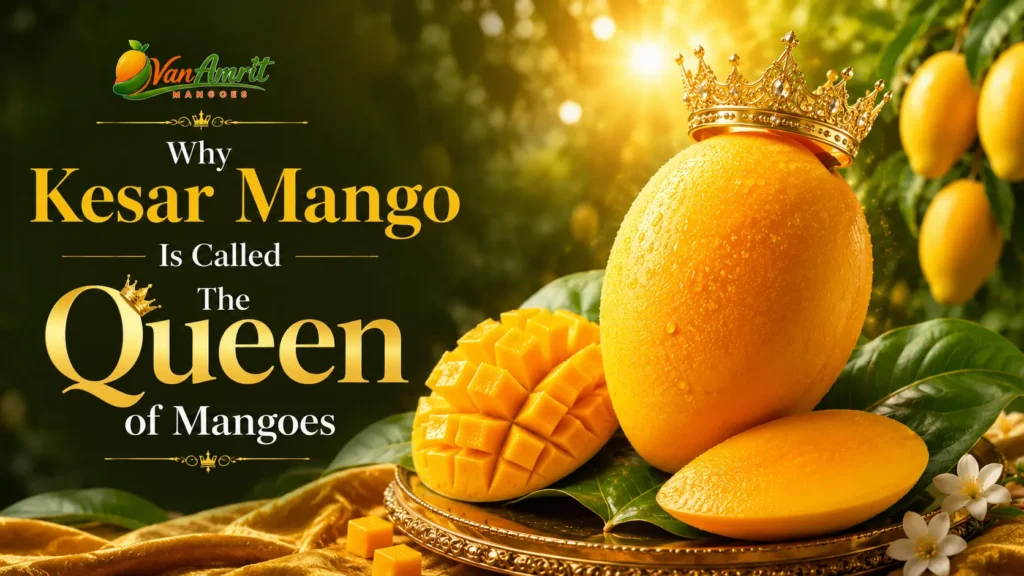
Why Kesar Mango Is Called
the Queen of Mangoes
The 1931 origin story, the Nawab’s royal naming, the saffron colour, the GI tag, and seven powerful reasons why this crown was earned — not assigned.
That’s not a casual affection or a clever marketing line. A title like “Queen” needs to be earned. It needs the colour, the fragrance, the flavour, the history, and the legacy to justify it. So — why does the Kesar mango wear that crown? That’s exactly what we’re going to explore today.
Ready to order while you read? The Queen arrives at your door from our Valsad orchard — browse our Kesar mango shop here. Otherwise, let’s start at the very beginning.
🏰 The Royal Birth: A 1931 Gujarat Origin Story
Every great title has a story behind it. The Kesar mango’s story begins not in a palace but in a modest mango orchard in Vanthali, a small town in Junagadh, Gujarat, sometime in the early 1930s.
According to research by the botanic team of Junagadh Agriculture University (JAU), the first cultivar of what we now call Kesar was spotted and cultivated by Junagadh Wazir Sale Bhai in Vanthali in 1931. Sale Bhai’s palace was there, and within his grounds stood a remarkable mango tree unlike any variety the region had seen. The fruit was unusual — strikingly coloured, intensely fragrant, and with a sweetness that made people stop mid-bite and wonder what exactly they were eating.
Word spread the way only good things do — person to person, mouth to mouth. The Wazir shared the fruits with Sheikh Jehangir Mia of Mangrol, who was so impressed that he sowed the seeds in his own garden and named the variety “Sale Bhai ni Aamdi” (Sale Bhai’s mango in Gujarati). He also gave the Wazir the honorary title “Sale Hind.” A mango so good it generates its own honors — that’s how you know you’re dealing with something special.
When Nawab Muhammad Mahabat Khan III of Junagadh heard about this extraordinary mango, he tasked his garden superintendent, Mr. Iyengar, to study the variety and propagate it properly. Iyengar supervised the transport of 80 saplings to the Rajwadi farm in Junagadh — located on the foothills of the sacred Girnar mountains — where they were grafted and planted. Of those 80, 75 survived. For four years, those trees were nurtured, tended, and watched. Then, in 1934, the trees bore fruit for the first time and the mangoes were offered to the Nawab.
What happened next is the moment that gave the Kesar mango its name and its destiny. The Nawab looked at the beautiful deep orange pulp of the fruit — vivid, glowing, almost luminous — and said four words: “This is Kesar.” Kesar means saffron in both Hindi and Gujarati. With that single sentence, Nawab Babi named the mango after the most precious, most royal spice in his kitchen. He didn’t call it sweet. He didn’t call it juicy. He reached for saffron — a spice worth its weight in gold, used only for the most regal of occasions. That comparison tells you everything about how the fruit landed on his palate.
From that 1934 moment, the variety spread across Gujarat — from the Gir belt in Saurashtra to the alluvial coastal orchards of Valsad and Navsari in South Gujarat. The Queen of Mangoes had found her throne, and she’s never left it. Curious about how the same variety grows differently across these regions? Our Valsad Kesar vs Gir Kesar comparison guide breaks down exactly what changes when the same mango grows in different soils.
🧡 Reason 1: The Colour That Named a Mango
You know you’re dealing with an extraordinary mango when its most distinctive quality is the same thing that gave it its name. The word “Kesar” doesn’t just describe a variety — it describes a colour. And that colour, when you see it for the first time in a ripe, naturally ripened Kesar, is genuinely startling.
Slice open a perfectly ripe Kesar mango and what greets you is a pulp that’s deep saffron-orange — vivid, consistent, and almost luminous from skin to seed. This isn’t amber, it isn’t golden-yellow, it isn’t light orange. It’s the colour of premium saffron threads soaked in warm water — that rich, saturated, glowing saffron-orange that you only encounter a few times in nature. And the Kesar delivers it reliably, consistently, every single season.
Why does the Kesar mango produce this specific colour? Science gives us a clear answer: high concentrations of carotenoids — particularly beta-carotene and zeaxanthin — which accumulate in the flesh during the fruit’s development. The specific mineral composition of Gujarat’s soils, combined with the region’s intense summer heat and dry conditions, drives carotenoid production to levels that other growing environments simply don’t replicate in the same variety. The colour is, in a very literal sense, the direct expression of Gujarat’s terroir through the fruit.
This colour is also your most reliable quality indicator. A naturally ripened, genuinely authentic Kesar is deep saffron throughout. Pale pulp — light yellow or thin orange — is almost always a sign of carbide-ripening, premature harvest, or a different variety entirely being sold under the Kesar name. Want to know the other four signs that verify authenticity? Our complete guide to identifying real Kesar mango has everything you need.
🌸 Reason 2: The Fragrance That Announces Itself
A queen doesn’t wait to be noticed. She announces herself. The Kesar mango does exactly this — and if you’ve ever brought a box of genuine, naturally ripened Kesar into your home, you know precisely what I mean. The fragrance arrives before you’ve even opened the box. Sometimes before you’ve walked through the front door.
A ripe Kesar mango’s fragrance is not the mild, generic sweetness of most supermarket mangoes. It’s a full-bodied, room-filling aroma that’s been described as saffron-sweet, warmly floral, and intensely tropical — all at once. The scent doesn’t just hit you once; it lingers. On your hands after eating, in the kitchen hours after the fruit has been cut, on the fabric near where you kept the box. This persistence is a marker of genuine quality — the fragrance compounds responsible are volatile organic molecules called terpenes and esters, produced at unusually high levels in the Kesar variety when naturally ripened.
Krishijagran captured it perfectly when writing about Kesar after Cyclone Tauktae devastated the crop: “Cyclone Tauktae may have destroyed the mango harvest, but not the popularity of this mango. No wonder, it’s the queen.” Even when the fruit is gone, the legend — and the memory of that fragrance — remains.
Here’s a practical test you can run right now if you have a Kesar at home: hold the mango about three inches from your nose and breathe normally near the stem end. A genuine, naturally ripened Kesar mango should register a powerful saffron-sweet fragrance within two breaths. No fragrance? Either not ripe yet, or not genuine Kesar. A chemical smell? That’s a carbide-ripened imitation. Once you’ve smelled the real thing, you’ll never be fooled again.
👅 Reason 3: Sweetness With a Sophisticated Edge
If the colour and fragrance are what earn the Kesar mango its royal entrance, the taste is what seals the deal and ensures she never gives up the crown.
A ripe Kesar mango registers between 18 and 22 degrees Brix (Total Soluble Solids) — placing it firmly in the highest sweetness tier of any mango variety globally. For context, a typical imported supermarket mango reads 12–14 Brix. Kesar is nearly double that. Marathwada Kesar varieties — grown in Maharashtra with similar techniques — have been recorded at up to 24 Brix, the highest measured sweetness level of any Indian mango variety. That’s not a marketing claim; that’s chemistry.
But here’s what separates the Queen of Mangoes from simply being a “very sweet mango”: the taste isn’t one-dimensional. Underneath all that sweetness is a subtle tangy brightness — a gentle acidity that lifts the flavour, prevents it from becoming cloying, and gives it a layered complexity that makes you reach for another slice almost involuntarily. It’s the same principle that makes the finest wines interesting — a balance of sugar and acid that creates something more sophisticated than either element alone.
And the aftertaste. A Kesar mango doesn’t just taste good and disappear. The flavour lingers — warm, saffron-like, faintly spiced — for a surprisingly long time. This is why Kesar is the premier choice for aamras, shrikhand, and mango lassi across Gujarat. The flavour survives blending, survives the cold, survives mixing with cream or yoghurt, and still announces itself with the same characteristic saffron warmth. Most mango varieties fade into the background when processed. The Kesar amplifies. Our Valsad Kesar delivers this exact flavour profile — the alluvial coastal soil of South Gujarat extends the season and adds a honey-smooth mellowness to the already remarkable taste.
🏷️ Reason 4: The GI Tag — The Government Agreed She’s Royalty
If the Nawab of Junagadh gave the Kesar mango her name, the Government of India gave her a legal crown in 2011.
In that year, Gir Kesar became the first agricultural product from Gujarat and only the second mango variety in all of India to receive a Geographical Indication (GI) tag — registered under India’s Geographical Indications of Goods Act, 1999, through the GI Registry in Chennai. The application was originally proposed by the Gujarat Agro Industries Corporation Ltd. (GAIC) and later filed by Junagadh Agriculture University in 2010. The 2011 registration made it official: the name “Gir Kesar” now legally belongs exclusively to the Gir region of Junagadh and Amreli districts in Gujarat.
A Geographical Indication tag is the legal equivalent of a royal seal. It means no mango grown outside the designated geographic area can legally be sold as “Gir Kesar.” The GI protection is similar to how only sparkling wine produced in the Champagne region of France can legally be called Champagne — no matter how similar the grapes or method, if it’s not from that place, it’s not that thing. The first Indian mango to receive a GI tag was Dasheri from Uttar Pradesh. Kesar followed, cementing its place as one of only two legally protected premium mango varieties in India at the time of registration.
The GI tag covers approximately 20,000 hectares of orchards across the talukas of Junagadh and Amreli districts — including Talala, Vanthali, Mendarda, Kodinar, Maliya, Visavadar, and Una in Junagadh district, and Khambha taluka in Amreli. That’s the precise geography of the Queen of Mangoes’ official kingdom. Want to understand how GI-tagged Gir Kesar compares to the equally authentic but differently grown Valsad Kesar? We’ve laid it out in detail in our Valsad vs Gir Kesar guide.
🌍 Reason 5: Gujarat’s Soil Is the Real Secret
A queen is inseparable from her kingdom. And for the Kesar mango, that kingdom is Gujarat — specifically the unique terroir of two distinct but equally magnificent growing zones.
Gir Kesar’s terroir: The Girnar foothills around Junagadh and Talala sit on red laterite, volcanic soil formed over millions of years. The climate is semi-arid — hot, dry summers with just 70–80 cm of rainfall annually. The Girnar mountains create a specific microclimate where warm days and cool nights force the mango tree to concentrate sugars, aromatic compounds, and carotenoids in each fruit rather than distributing them across a large, water-saturated crop. The result is a bold, intense, beautifully sharp-edged Kesar flavour.
Valsad Kesar’s terroir: Move 300 kilometres south to the coastal districts of Valsad, Navsari, and Pardi in South Gujarat, and the same Kesar variety grows in alluvial, loamy coastal soil fed by rivers and 150–200 cm of annual rainfall. The longer growing season — May through mid-July versus April through June for Gir — gives the fruit more time to build its sweetness slowly, producing a Kesar that’s more honey-mellow and smooth. Think of it the way wine lovers think about terroir: the same grape variety (Kesar), two different soils and climates, two beautifully distinct expressions of the same remarkable flavour potential.
This inseparability from its home soil is precisely why the GI tag matters so much. You cannot grow Kesar mango just anywhere and get the same result. The Queen needs her kingdom to be her best self.
💊 Reason 6: Nutritional Royalty — This Mango Is Also Medicine
Being the Queen of Mangoes isn’t just about looking and tasting spectacular. There’s a nutritional case for the Kesar’s crown that stands entirely on its own.
- Vitamin C: A significant source of Vitamin C per serving — directly supporting immune function and collagen synthesis. The same antioxidant properties that give the Kesar its disease-fighting reputation
- Beta-carotene (Provitamin A): The very compound responsible for the Kesar’s signature deep saffron-orange colour is also one of its most powerful health compounds — a potent antioxidant linked to eye health, skin health, and immune support. The deeper the colour, the higher the beta-carotene. This is why Kesar’s saffron pulp isn’t just beautiful — it’s nutritionally dense in a way pale mango varieties aren’t
- Pectin: Kesar mangoes are high in pectin, a soluble fibre that helps lower LDL cholesterol, supports digestive health, and slows sugar absorption into the bloodstream
- Potassium, iron, zinc, and magnesium: Essential minerals deposited in the fruit by the mineral-rich soils of Gujarat’s growing zones
- Natural hydration: High water content makes Kesar a natural summer electrolyte source during India’s peak heat months — a practical health benefit that goes beyond simple taste
A ripe, naturally ripened Kesar mango isn’t just dessert. It’s a genuinely nutritious fruit — and one whose health benefits are most fully expressed when it’s allowed to ripen naturally rather than being forced with chemicals. Want to make sure the Kesar you receive always reaches peak ripeness properly? Our home ripening guide covers every method from the traditional newspaper wrap to the 24-hour rice technique.
🌍 Reason 7: The Queen Travels — Global Reach That’s Growing Fast
A queen’s reputation doesn’t stop at her kingdom’s borders. And in 2025–26, the Kesar mango’s international reputation is growing faster than ever.
According to Freshdi trade data, export requests for Kesar mangoes surged 38% in Q2 2025 — driven by the variety’s longer shelf life, sturdier skin, and consistent sweetness that give it a genuine logistical advantage over more fragile premium varieties. Where Alphonso needs to travel by air freight and arrives in a narrow window, Kesar mango can handle more varied shipping conditions without quality compromise — a practical advantage that matters enormously to international buyers in the UK, USA, Canada, UAE, and Gulf countries.
In India’s processed food and beverage industry, Kesar is what one export guide calls “the gold standard for the beverage industry” — its brilliant, stable saffron colour and sweet taste make it the top choice for mango juices, nectars, aamras concentrates, and lassi manufacturing worldwide. Kesar purchases in the domestic market also increased significantly in Q2 2025, driven by younger consumers preferring naturally ripened fruit for use in desserts and milkshakes. The Queen is not just holding her throne — she’s expanding her court.
Farm-Fresh Valsad Kesar — The Queen, From Our Orchard to Your Table
At Vanamrit, we grow the Queen of Mangoes on our own farm in Chikhli, Valsad — harvested green-mature, naturally ripened in hay, carbide-free, and delivered to your door anywhere in India within 5–6 days. No middlemen. No compromises. Just the real thing.
🥭 Order Valsad Kesar at vanamrit.in👑 The Queen and the King — How Kesar and Alphonso Differ
You can’t talk about the Queen of Mangoes without acknowledging the King. Alphonso (Hapus) from Ratnagiri, Maharashtra wears the “King of Mangoes” title — and deservedly so. But the way Kesar and Alphonso relate to each other isn’t competition. It’s complementary royalty. The King and Queen of a court aren’t rivals; they reign together, each supreme in their own domain.
| Feature | 👑 Kesar — Queen of Mangoes | 🏆 Alphonso — King of Mangoes |
|---|---|---|
| Taste Profile | Intensely sweet, honey-mellow, subtle tang, saffron aftertaste | Rich, buttery, intensely tropical, sharp aromatic punch |
| Pulp Colour | Deep saffron-orange — vivid and consistent | Golden-amber, slightly paler than Kesar |
| Texture | Fiberless, smooth, densely pulpy, clean cut | Creamy, buttery, slightly more yielding |
| Fragrance | Saffron-sweet, floral, room-filling | Rich, tropical, intensely complex |
| Season | April – July (Valsad extends to mid-July) | March – May (narrow 6–8 week window) |
| Shelf Life | Longer — sturdier skin, better transport | Shorter — fragile, requires careful handling |
| Sweetness (Brix) | 18–22° (Kesar), up to 24° (Marathwada Kesar) | High Brix — comparable but slightly different profile |
| Price | More accessible, especially June–July | Premium — highest price in Indian mango market |
| Best Use | Fresh eating, aamras, lassi, ice cream, pulp, processing | Fresh eating, gifting, premium applications |
| GI Tag | Yes — Gir Kesar, 2011 (Junagadh/Amreli) | Yes — Ratnagiri/Devgad Alphonso |
At Vanamrit, we grow both. Read about how we farm these two extraordinary varieties on our About page — and why our Valsad soil produces something genuinely special in both.
🔍 How to Know Your Kesar Is Actually the Queen
Since the Queen of Mangoes title commands premium prices, it also attracts the most mislabelling in Indian markets. Other varieties sold as Kesar, carbide-ripened fruit dressed in Kesar packaging, and off-season imposters are common enough that every buyer needs to know the five tests.
- The fragrance test (most reliable): Hold the mango near the stem end and breathe normally. A genuine ripe Kesar announces itself with a powerful saffron-sweet fragrance. No smell = not ripe or not real. Chemical smell = carbide-treated
- The saffron colour test: Cut the mango. Deep saffron-orange pulp all the way through, consistent from skin to seed, fiberless = authentic. Pale yellow, uneven, or stringy = not genuine Kesar
- The shape check: Small to medium size, roundish with a gentle curved tip, red blush at the shoulders = right. Unusually large, perfectly oval, blunt tip = red flag
- The season check: Genuine Kesar is only available April to July. Any “Kesar” sold in February or October is definitively not the real thing
- The source test: Buy from traceable, farm-direct sources where you know the orchard name, the district, the harvesting method, and the ripening process
Our full 5-sign guide to identifying real Kesar mango covers each test in detail — including the water test for carbide detection and what carbide ripening actually looks like inside the fruit. And once you’ve received your authentic Kesar, our home ripening guide gives you every method to bring it to perfect readiness.
❓ The Questions Everyone Asks About the Queen of Mangoes
🏁 The Crown Stays on Kesar’s Head
🥭 Seven Reasons. One Undisputed Queen.
The Kesar mango is called the Queen of Mangoes not because someone decided she needed a title, but because she earned it through seven generations of proof. The saffron colour that named her. The fragrance that announces her before she arrives. The 18–22 Brix sweetness balanced by a sophisticated tangy brightness. The fiberless, silk-smooth pulp. The 2011 GI tag that made the Government of India agree. The specific Gujarat terroir — Girnar’s red laterite and Valsad’s alluvial coast — that makes her irreplicable anywhere else. The 38% global export surge in 2025 that shows the rest of the world is finally catching up to what Gujarat has always known.
The best way to understand why the Kesar mango is the Queen of Mangoes is not to read about it — though I hope this has given you the full picture. The best way is to taste it. One perfectly ripened Kesar, at peak June season, from a farm that harvested it at the right stage and ripened it in hay the way South Gujarat farmers have done for a century — that experience makes every argument in this article completely unnecessary. The fruit makes its own case.
“You can write a thousand words about why Kesar is the Queen. One bite of the real thing makes them all redundant.” 👑🥭🌿
Taste the Queen of Mangoes — From Vanamrit’s Valsad Orchard
Farm-direct, carbide-free, naturally hay-ripened Valsad Kesar mangoes delivered to your door anywhere in India. Every box we ship carries the guarantee of our name, our farm, and our alluvial South Gujarat soil. The Queen, delivered to your table — as she deserves to arrive.
🥭 Order the Queen of Mangoes NowBulk orders, corporate gifting, or questions? Contact us here or WhatsApp: +91 9033595016