
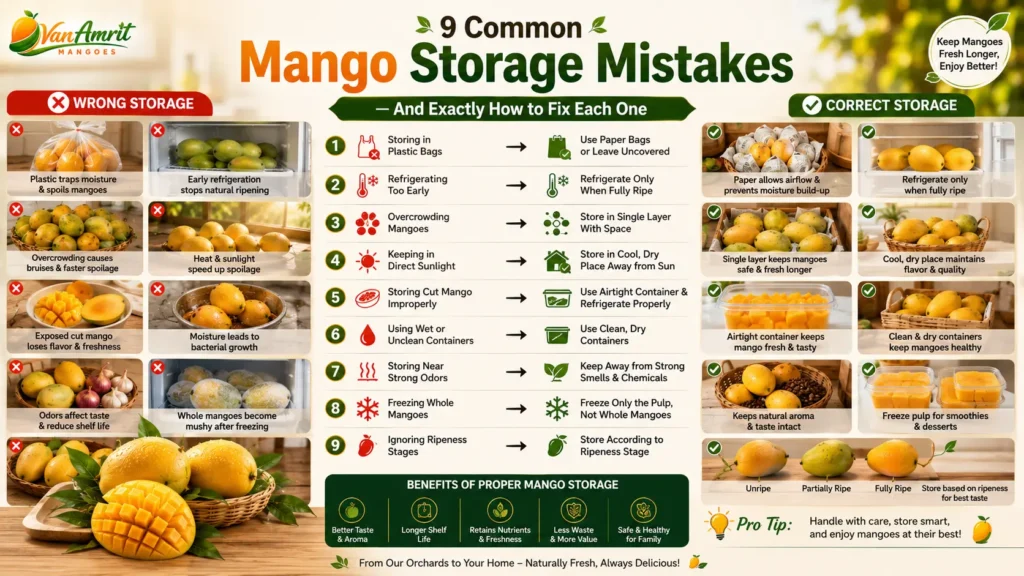
9 Common Mango Storage Mistakes
And Exactly How to Fix Each One
The complete, honest guide to why mangoes go bad too fast — and the specific, science-backed fixes for every mistake most Indian households make every single season.
You put the rest in the fridge. Two days later they come out cold, slightly rubbery, and tasting like a pale version of what you remembered. You wonder what went wrong.
Nothing catastrophically unusual happened. You made the same common mango storage mistakes that most households make — the ones nobody ever explained because “it’s just fruit.” But mangoes have specific, slightly counterintuitive rules. They’re tropical fruit with a biochemistry that responds badly to cold at the wrong moment, poorly to moisture, and dramatically to how much space you give them.
This guide covers 9 of the most common mango storage mistakes — the science behind why each one damages your mango, and the exact fix.
Let’s start with the most common mango storage mistake in India — and the most damaging. You bring home a box of mangoes. They look firm and green. Your instinct says “preserve them” and you put them straight in the fridge. They sit there for five days. They stay perfectly green and perfectly hard, and never become anything more delicious than an expensive paperweight.
What happened? Chilling injury. This is a real, documented physiological disorder — not food myth. Mature mango fruit are susceptible to chilling injury at storage temperatures below 12°C. Below this threshold, the enzymes responsible for ripening — the ones that convert starch to sugar, develop beta-carotene, and build the aromatic compounds responsible for that saffron-sweet fragrance — are permanently disrupted. Not paused. Not slowed. Disrupted.
Chilling disrupts enzyme activity and volatile aroma development, permanently flattening sweetness and muting the complex, tropical character of a properly ripened mango. The key word there is “permanently.” Even if you take that cold-shocked mango back to room temperature, the biochemical cascade that makes a mango ripen properly has been broken. The fruit will deteriorate rather than develop from that point. It cannot recover.
When do you refrigerate? When the mango passes what we call the ripeness trinity: a gentle give when you press near the stem (like a ripe avocado), a powerful sweet fragrance when you hold it near the stem end, and the skin colour developing from green toward golden-saffron. All three together = ready for the fridge.
Once genuinely ripe and refrigerated, mangoes last 5–7 days in the fridge according to multiple storage guides verified in 2025–2026. That’s a comfortable window — but only if the mango was allowed to complete its ripening before you chilled it.
This one feels like good hygiene practice. The delivery box arrives, you unpack everything, you wash the whole batch at once to have them “clean and ready.” It feels responsible. In mango terms, it’s one of the most common mango storage mistakes that nobody talks about.
Here’s the problem. A mango’s waxy outer skin is a natural, functional protective barrier — not just packaging. It slows moisture loss from the flesh, regulates ethylene exchange during ripening, and critically, it prevents mould spore germination. When you wash mangoes and leave moisture on the skin, you compromise this barrier directly. Mould spores that are present on any surface in your kitchen — and they’re always present — find the damp skin perfect for establishing themselves. In the warm temperatures of an Indian kitchen in May or June, that can happen within 24–48 hours.
The correct washing practice is simple: right before you eat a mango, hold it under cool running water for 20–30 seconds while gently rubbing the surface. Pat it completely dry with a clean cloth. Then cut. That’s the entire protocol — and it should never happen before storage at any stage.
“Mangoes need warmth to ripen, so a sunny windowsill must be ideal.” This logic is understandable. It’s also the reason a lot of mangoes end up with hot, slightly cooked skin on one side and a cold hard interior on the other.
Direct sunlight creates uneven heat distribution. The surface facing the sun gets significantly hotter than the interior or the shaded side. The result is a mango that ripens unevenly — soft, slightly fermented skin on the sun side, hard flesh near the seed. That’s not flavour development. That’s differential heat damage masquerading as ripening.
The ideal mango ripening environment is the temperature where you’re slightly warm but comfortable — a warm Indian kitchen away from the windows and away from the stove. Consistent, ambient warmth allows the mango’s own ethylene production to drive ripening uniformly from the inside out. No shortcuts, no uneven heating, no solar intervention required.
The delivery box arrives. You open it, see the mangoes are still green, and slide the whole box into a corner thinking you’ll deal with it in a day or two. This seems like reasonable storage. It’s actually two separate problems happening simultaneously.
Problem one — ethylene buildup: Ripening mangoes produce ethylene gas. In a sealed box, this gas accumulates rapidly and creates a concentration that aggressively accelerates all the mangoes at once — including the ones that weren’t ready. The result is your entire batch ripening in 24–36 hours simultaneously and immediately beginning to overripen together. Nothing gradual, nothing manageable.
Problem two — pressure bruising: The bottom mangoes bear the weight of the entire stack. Bruise damage is invisible on the skin but creates brown, soft areas in the flesh that spread quickly. A bruised mango doesn’t last — the damaged cells start decomposing immediately. This is why the bottom layer of a stacked crate almost always goes bad first, even when the top ones are still fine.
When you open the box, do a quick sort: most ripe (gentle give, some aroma) → eat today or tomorrow. Medium-firm → ripen at room temp, 3–4 days. Very firm → newspaper wrap to accelerate by 1–2 days. This active 3-minute sorting session when the box arrives prevents virtually all the avoidable waste that happens later.
Some mangoes from your sorted crate reach peak ripeness on day two or three. Instead of moving them, you leave them on the counter alongside the still-firm ones. They’re all mangoes. Shouldn’t they be fine together?
No — and this is where the banana analogy is genuinely useful. You’ve probably heard that putting a banana in a paper bag helps fruit ripen faster. The mechanism is ethylene: bananas (and ripe mangoes) are prolific ethylene producers. A ripe mango sitting next to three unripe ones isn’t just coexisting with them — it’s actively releasing a ripening hormone that aggressively accelerates its neighbours. Your 3-day mangoes become 1.5-day mangoes. Your planned eating window collapses.
Check your mangoes once daily during peak season. Moving individual mangoes from the counter to the fridge as they ripen takes thirty seconds. That thirty seconds saves you from the “everything ripe at once” chaos that turns a planned week of mango eating into a frantic two-day consumption race.
Patience with mangoes is genuinely difficult. You’ve been waiting four days. You pick one up, give it an optimistic squeeze, and decide to cut into it “just to check.” The inside is pale, hard near the seed, and tastes like an expensive version of disappointment.
The frustrating part is that you’ve now committed this mango to a fate it can’t escape. A cut mango doesn’t ripen further. The natural ripening is a whole-fruit biological process driven by internal ethylene production. Once you cut through the skin, the exposed flesh immediately begins oxidising, bacterial contamination starts, and the ripening chemistry is over. What you cut is permanently what you get.
And what if you do cut one too early? Don’t waste it. Wrap tightly in cling film, refrigerate, and use within 1–2 days as raw mango (kairi) — raw mango chutney, kairi rice, raw mango pickle, or a kairi lassi with salt and cumin. Unripe mango has its own culinary character. Just don’t pretend it’ll ripen further in the fridge. It won’t.
Valsad Kesar — Farm-Direct, Carbide-Free, 5–7 Day Natural Shelf Life
Every mango storage technique works better with naturally ripened Kesar that has its full biochemistry intact. Vanamrit’s hay-ripened Valsad Kesar arrives green-mature, carbide-free, and ready for a 5–7 day room-temperature ripening window.
🥭 Order Valsad Kesar at vanamrit.in →You have four mangoes ripening faster than you can eat them. You put them whole in the freezer, thinking you’ve bought yourself weeks. A month later, you defrost one — and what comes out is a mushy, waterlogged, brownish mess that smells vaguely of mango but has the texture of wet tissue paper.
Here’s what happened inside the freezer. The water inside every cell of the mango’s flesh formed ice crystals when frozen. Ice crystals are sharp, jagged structures — and as they expand, they physically puncture the cell walls they’re surrounded by. Every single cell wall in that whole frozen mango is now compromised. When the ice melts during defrosting, the punctured cells release their contents in an undifferentiated waterlogged collapse. Mushy, watery, structurally destroyed. The aromatic compounds responsible for flavour also degrade significantly during the freeze-thaw cycle when done in whole-fruit form.
The correct method: blend ripe Kesar pulp smooth, portion into freezer-safe bags, label with the date, freeze flat. Defrost overnight in the fridge or 2 hours at room temperature in a sealed container. Never microwave — the microwave destroys the most delicate aromatic compounds, and the difference between microwave-defrosted and naturally-defrosted Kesar pulp is noticeable to anyone who’s tasted both.
A scoop of June Kesar aamras in December, pulled from the freezer, is one of the genuinely lovely payoffs of planning ahead. But only if you did the pulp extraction step first.
This is the most underappreciated common mango storage mistake — because it isn’t really a storage mistake at all. It’s a purchasing mistake that presents as a storage failure, and it’s responsible for a lot of frustrated buyers who blame their fridge or their storage system when the actual problem happened before they ever got home.
The reality: naturally ripened Kesar has a room-temperature shelf life of 5–7 days. Carbide-treated mangoes — ones that were rushed to yellow-skin appearance in 24–36 hours using calcium carbide — last 2–3 days regardless of how you store them. You cannot storage-engineer your way out of this. You can do everything else on this list perfectly and your carbide mango will still collapse in two days.
Why? Because carbide treatment forces only a surface colour change without completing the internal ripening biochemistry. The starch-to-sugar conversion was never fully driven. The cell walls were never properly softened through enzymatic action. The fibre and protein structure is weaker — a 2024 study in Scientific Reports (Nature) confirmed carbide-ripened mangoes have measurably lower fibre and protein than naturally ripened ones, both of which contribute to structural integrity and shelf life. The mango looks yellow on the outside but has the internal biochemistry of an unripe fruit. It can only deteriorate from there.
The fragrance test at the stem end takes five seconds and tells you everything you need to know about expected shelf life. No smell — even from a perfectly golden mango — means carbide. Plan your storage expectations accordingly, or better yet, buy from a verified carbide-free farm-direct source so the question never arises.
You waited correctly. Your Kesar reached full fragrant peak. You moved it to the fridge. But you put it on the top shelf at the back — the coldest zone of most refrigerators — or you wrapped it in plastic before refrigerating. Two days later it’s slightly mushy in some spots, the skin has dark patches, and the flavour is somehow diminished. The timing was right. The location wasn’t.
Mangoes are tropical fruit. Even when ripe, the ideal storage temperature is not standard refrigeration cold. The ideal temperature for prolonging the life of mangoes is between 4°C and 10°C — which in most home refrigerators is the crisper drawer, not the back of the top shelf where temperatures can drop well below 4°C. Below 12°C is the chilling injury threshold for unripe mangoes. Ripe mangoes are more tolerant, but prolonged exposure to the coldest zones still damages texture and accelerates lenticel discolouration on the skin.
One extra rule for cut mango in the fridge: always use an airtight container. Exposed mango flesh is extraordinarily porous and absorbs fridge odours — onions, fish, leftover curries — within hours. If you’ve ever eaten cold mango that tasted slightly savoury or strange, that’s what happened. Always seal it.
⚡ 3 Bonus Storage Mistakes Nobody Mentions
The 9 above are the big ones. These three are the subtle ones that trip up even experienced buyers.
Bonus A — Storing at wildly different temperatures: Moving mangoes repeatedly between a warm room and a cool room, or between different temperature zones, accelerates ripening unpredictably. Temperature fluctuation disrupts the steady enzyme-driven process. Find a spot and leave them there.
Bonus B — Storing cut mango without checking for odour first: Before you seal cut mango in the fridge, smell it. If there’s any fermented or alcoholic note already, don’t refrigerate — that deterioration will continue in the cold. Use it immediately in a smoothie or aamras, or discard. Refrigerating already-turning mango doesn’t stop it — it just slows the inevitable.
Bonus C — Using plastic wrap for room-temperature storage: Plastic traps moisture and blocks the ethylene gas exchange the mango needs for natural ripening. Paper wrapping for room-temperature ripening acceleration is correct — it traps ethylene while still allowing some breathability. Airtight plastic at room temperature promotes anaerobic conditions that cause fermentation rather than ripening. Save the airtight plastic for the fridge stage only.
✅ The Correct Mango Storage System — Start to Finish
Now that you know what not to do, here’s the complete, positive version. This is the 6-step system that works for any box of naturally ripened mangoes.
📋 Mango Shelf Life — Quick Reference Table
Screenshot this. Send it to the family WhatsApp group before someone puts the green mangoes in the fridge again.
| Mango State | Storage Method | Shelf Life | Key Rule |
|---|---|---|---|
| Unripe / Green-mature | Room temperature, 22–28°C, dry | 4–7 days to ripen | NEVER refrigerate |
| Ripe (whole) | Room temperature | 2–4 days at peak | Move to fridge at exact peak ripeness |
| Ripe (whole) | Crisper drawer fridge, unwrapped | 5–7 days | Only after complete natural ripening |
| Cut mango | Airtight container, fridge | 1–3 days | Always airtight — absorbs odours |
| Frozen pulp | Freezer-safe bag, −18°C | 6–10 months | Pulp only — NEVER whole |
| Carbide-treated | Any method | 2–3 days maximum | No storage method can fix this |
Every single storage tip above works significantly better when applied to naturally ripened mangoes. A carbide-treated mango will spoil in 2–3 days no matter how perfectly you execute every step on this list. The common mango storage mistakes that matter most are the ones you make at the point of purchase, not just in your kitchen.
❓ Your Mango Storage Questions — Answered
🌿 What These 9 Common Mango Storage Mistakes Actually Have in Common
If you look at all nine mistakes, they share a single underlying theme: treating mangoes like most other fruit. Like apples (which you can fridge immediately). Like grapes (which you wash on arrival). Like bananas (which you can stack and ignore for a week).
Mangoes are tropical, climacteric fruit with a specific, active biochemical ripening process that responds badly to the wrong temperature, badly to moisture during storage, and dramatically to ethylene exposure from neighbouring ripe fruit. They need to ripen at their own pace, at room temperature, with dry skin, in a single layer, separated once ripe.
Once you understand the why behind each rule — chilling injury, ethylene buildup, protective wax barrier, ice crystal damage — the rules stop feeling arbitrary and start feeling obvious. And the common mango storage mistakes on this list stop being the inevitable result of buying mangoes and start being things that simply don’t happen in your kitchen any more.
One last thing: every technique above works best when the mango you’re storing has its full natural ripening biochemistry intact. A carbide-treated mango won’t respond to the newspaper wrap. It won’t ripen gradually with its crate mates. It won’t last 5–7 days in your fridge. Give your storage skills the mangoes they deserve.
“A mango stored correctly is a mango eaten at its absolute best. Thirty seconds of attention each day is all the difference between a wasted crate and two weeks of peak-season joy.” 🥭🌿
Farm-Fresh Valsad Kesar — Carbide-Free, Naturally Ripened, Pan-India
Every box arrives green-mature from our Chikhli, Valsad orchard — its full 5–7 day natural ripening window ahead of it when it reaches your kitchen. No carbide shortcuts. No 2-day shelf life surprise. Just naturally developed Kesar that responds beautifully to every tip on this page.
🥭 Order Valsad Kesar at vanamrit.in →Bulk orders, gifting or questions: vanamrit.in/contact | WhatsApp: +91 9033595016