
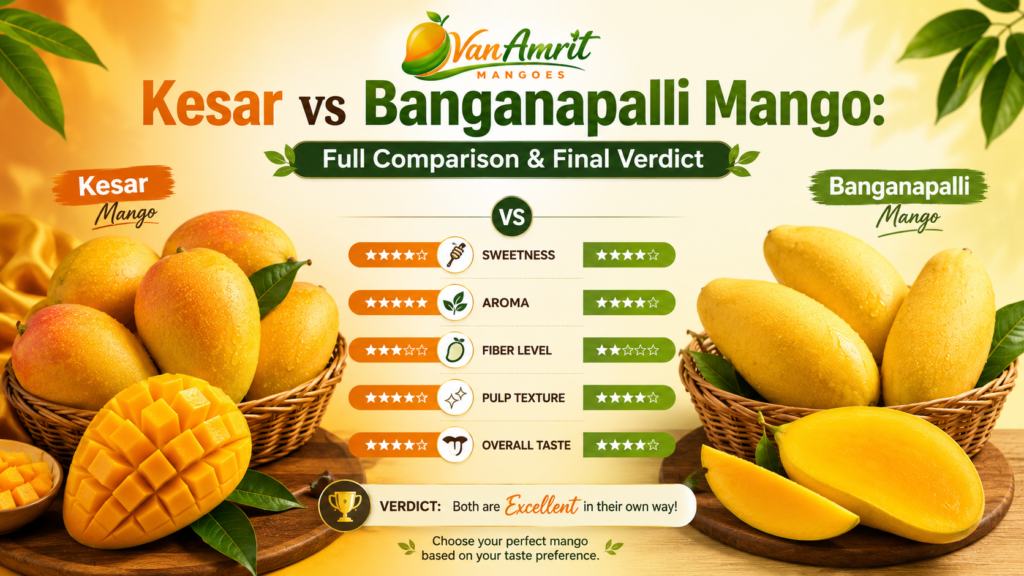
Kesar vs Banganapalli Mango:
Full Comparison, Verdict & Guide
Gujarat’s saffron-scented Queen against Andhra Pradesh’s gentle giant. We compare everything — taste, Brix, size, shelf life, uses, and price — so you can choose confidently.
The honest answer: they’re completely different mangoes serving completely different purposes, and choosing between them isn’t really a quality decision — it’s a priorities decision. Kesar is intimate, aromatic, saffron-complex, the kind of mango you make aamras from and remember for the season. Banganapalli is the reliable everyday champion — large, mild, impressively long shelf life, and consistently good whether you’re eating it fresh, juicing it, or buying in bulk for the household.
Neither is better. Each is irreplaceable in its specific context. This guide breaks down exactly what makes them different — the Brix, the aroma, the texture, the size, the shelf life, the price, the uses — so you can make the right call for what you actually want.
📊 Quick Reference — Kesar vs Banganapalli at a Glance
Here’s your comparison table. Bookmark it, screenshot it, use it every time you’re deciding between the two.
| Feature | 🟠 Kesar (Gujarat) | 🟡 Banganapalli (AP) | Winner |
|---|---|---|---|
| Brix (sugar content) | 18–22° | 18–22° | Tied |
| Acidity / tang | Very low — honey clean | Very low — mild | Tied |
| Aroma intensity | 🔥 Exceptional — saffron-floral | 🌸 Gentle, subtle | Kesar wins |
| Pulp colour | Deep saffron-orange | Golden-yellow | Kesar wins |
| Fibre content | Almost zero | Almost zero | Tied |
| Fruit size | Small-medium (200–300g) | Large (400–700g) | Bangan wins |
| Skin thickness | Moderate, waxy | Thick, protective | Bangan wins |
| Fridge shelf life (ripe) | 7–10 days | 7–14 days | Bangan wins |
| Season (peak) | June (Valsad prime) | April–May (AP peak) | Overlap May–Jun |
| GI tag | Yes — Gir Kesar | Yes — Kurnool AP | Both GI-tagged |
| Price level | Premium | Moderate | Bangan wins |
| Best for aamras | ✓ Exceptional | Good (milder) | Kesar wins |
| Best for fresh slices | Great | ✓ Ideal | Bangan wins |
| Online delivery | ✓ Excellent | ✓ Excellent | Both excellent |
🥭 Meet the Mangoes — Kesar and Banganapalli in Profile
Farm-Fresh Valsad Kesar — Saffron-Honey Sweetness, Farm-Direct
The Kesar that wins every aamras comparison. Vanamrit’s Valsad Kesar is at peak season — naturally ripened in hay, carbide-free, harvested from our Chikhli orchard at full green-maturity. Delivered pan-India in 5–6 days.
Order Valsad Kesar Mangoes →👅 Taste, Aroma & Texture — Where the Real Difference Lives
If you want to understand these two mangoes, start with the nose, not the tongue. That’s where Kesar and Banganapalli diverge most dramatically — and once you understand the aroma difference, everything else about them makes immediate sense.
The Aroma — Kesar’s Biggest Differentiator
Kesar’s signature is its room-filling saffron fragrance. It’s detectable through the skin before you cut it. Swadeshi Mangoes’ April 2026 comparison describes it perfectly: Kesar “delivers a honeyed sweetness with a distinct saffron-like aroma that perfumes the room when you cut one open.” This is not subtle. It’s the kind of fragrance that announces itself the moment you bring the box into your kitchen, before you’ve touched a single fruit.
Banganapalli, by contrast, has a gentle floral scent — present, pleasant, and notably lighter. Banganapalli provides a gentle floral scent and a subtly sweet taste that is pleasant but less intense than the other two. The scent is there, just quieter. You need to hold it near your nose to appreciate it, rather than the Kesar approach where the mango announces itself from across the room.
Why does this matter beyond aesthetics? Because aroma directly enhances perceived sweetness. The neuroscience is straightforward: olfactory input (smell) amplifies taste perception. Your nose and tongue work together. A mango with powerful saffron fragrance will register as sweeter to your brain than an equal-Brix mango with lighter aroma — because the olfactory enhancement adds to the sweetness you taste on the palate. This is a significant reason why Kesar consistently tastes more intense to most people despite having similar Brix to Banganapalli.
Sweetness — Same Brix, Different Experience
Both mangoes hit 18–22° Brix at peak ripeness. On paper, they’re equally sweet. In practice, the eating experience feels different — and not just because of the aroma. Kesar’s sweetness has a specific character: honey-clean, saffron-warm, with a lingering aftertaste that stays pleasantly in the mouth. FarmSe’s March 2026 comparison confirms: Kesar’s “sweetness feels pronounced due to the absence of the sharp tang, giving an overall lighter but equally satisfying sweetness.”
Banganapalli’s sweetness is purer in a simpler sense — clean, golden, direct, without Kesar’s layered complexity. Swadeshi Mangoes’ April 2026 guide puts it well: Banganapalli suits “anyone seeking a mild, refreshing mango with larger slices for easy snacking.” That word “refreshing” is key — Banganapalli’s sweetness is bright and clean, not warm and complex. It finishes quickly and cleanly, which many people actually prefer, especially for eating multiple slices.
Texture — Both Win, But in Different Ways
Here’s where these two varieties actually agree completely: both are essentially fiberless. The HtecFarming March 2026 Banganapalli guide describes it plainly: “one of the most fiberless mangoes you’ll find. No strings. No chewy bits. Just clean, smooth mango flesh.” Kesar is the same — smooth, silky, and completely fiberless. You won’t spend any time picking threads from between your teeth with either variety.
The texture difference is subtler: Kesar’s pulp feels silkier and denser. Banganapalli’s pulp is described as buttery — it “practically melts” (HtecFarming). Both sensations are excellent, just different. Kesar is more vibrantly orange and has a slightly firmer body that holds its shape well when sliced. Banganapalli is softer and more yielding at peak ripeness, which actually makes it ideal for cutting large clean slices for fresh eating.
📏 Size, Shape & Appearance — Two Very Different Looking Mangoes
If you put a Kesar and a Banganapalli side by side, you wouldn’t be confused about which is which. They look completely different, and that visual difference matters practically.
Kesar is small-to-medium — a typical Kesar weighs 200–300g, occasionally pushing to 350g for a large specimen. It has a roundish, slightly oblong shape with a distinctively curved tip and a characteristic reddish-orange blush at the shoulders when ripe. The skin colour shifts from green toward golden-yellow with that signature red blush — a visual you’ll learn to recognise immediately once you know what to look for.
Banganapalli is large-to-very-large — a typical fruit weighs 400–700g and the biggest commercial fruits can exceed 800g. It’s one of India’s biggest commercial premium mangoes. Uniform golden-yellow skin at ripeness with almost no green patches. Oblong shape with a blunt, smooth tip — no curved tip and no red shoulder blush. If a Kesar is the size of a cricket ball, a Banganapalli is the size of a small softball. Two Kesars roughly equal one Banganapalli in volume.
Why does size matter beyond aesthetics? Pure pulp economics. A Banganapalli gives you significantly more eating and juicing volume per fruit. If you’re buying for household slicing and sharing, Banganapalli’s large slices make it dramatically more practical. If you’re making aamras and want the depth of flavour that makes it the best possible version — Kesar wins regardless of size, because the flavour intensity compensates for the smaller quantity.
Kesar carries its GI tag as Gir Kesar from Junagadh and Amreli districts (granted 2011). Banganapalli carries its GI tag from Kurnool and Kadapa districts of Andhra Pradesh. Both varieties have formal geographic authentication — meaning when you buy from verified sources, you know the mango was grown in its correct home region. Both are the real thing. To understand the full Kesar variety landscape — including how Valsad Kesar differs from Gir Kesar — our Valsad Kesar vs Gir Kesar comparison covers everything.
🕐 Shelf Life & Storage — Banganapalli’s Biggest Advantage
If there is one dimension where Banganapalli definitively beats Kesar — and every other premium Indian mango except Neelam — it’s shelf life. And not by a small margin.
A ripe Banganapalli in the refrigerator lasts 7–14 days. Commercially, it can hold for up to 2–3 weeks with good storage conditions. This is extraordinary for a premium fresh mango — and it’s the direct structural reason why Banganapalli sets daily prices at India’s largest mango mandis (Gaddiannaram in Hyderabad, Koyambedu in Chennai). Market traders can buy large quantities without the pressure to sell immediately, because Banganapalli doesn’t race toward overripe the way most varieties do. If you want reliable large fruit and shelf life: Banganapalli. That’s the Quora consensus among experienced mango buyers, and it’s accurate.
Kesar’s shelf life is solid — 7–10 days refrigerated. Kesar tends to have a slightly better shelf life of 7-10 days, making it more practical for transportation and retail. That’s better than Alphonso, better than Himsagar or Chausa, but shorter than Banganapalli’s window. For a household that wants a two-week stress-free eating schedule from one purchase, Banganapalli offers more flexibility.
Frozen Pulp — Where Kesar Reclaims the Lead
For long-term preservation as frozen pulp, the positions reverse. Kesar pulp frozen at peak June quality retains its deep saffron-orange colour, its complex aromatic profile, and its honey sweetness at a level Banganapalli simply doesn’t match when thawed. Kesar’s high carotenoid content — the same pigments that produce its vivid colour — is exceptionally stable at −18°C. Banganapalli pulp freezes adequately but thaws into a milder, less aromatic product because its lighter flavour profile has less to preserve.
For the full storage ranking of Indian mango varieties — including where both Kesar and Banganapalli land compared to every major variety — our best mango varieties for long-term storage guide has the complete analysis.
📅 Season Timing — Two Different Windows With One Overlap
The season timing difference between these two varieties is practically significant for buyers — particularly for those ordering online and planning purchases.
Banganapalli is an early-season variety. It starts appearing in late March from Andhra Pradesh and peaks in April–May. By June, it’s entering its final weeks. Banganapalli fills a genuine gap in the early mango calendar — it’s available and excellent when Kesar hasn’t yet hit prime and Alphonso is at its seasonal peak. If you want a good mango in April, Banganapalli is genuinely the right answer.
Kesar starts in mid-April (Gir Kesar) and May (Valsad Kesar), peaks in May (Gir) and June (Valsad prime), and extends through mid-July for Valsad. The single most important timing advantage Kesar has over almost every premium variety: Valsad Kesar’s season extends 3–4 weeks past when Gir Kesar and Banganapalli have both finished. That July window is uniquely Valsad Kesar’s.
The May–June overlap is when both varieties are simultaneously at quality — and this is the most interesting buying period. If you’re ordering in May for premium aamras-making and pulp-freezing, you have a genuine choice between the two. June onward, the choice is made for you: Valsad Kesar is still prime and Banganapalli is winding down.
For the precise week-by-week Kesar season guide — including exactly when Valsad vs Gir peaks and when to place your order for the best delivery timing — see our Kesar season timing guide for 2026.
🍽️ Best Uses — Each Mango Has a Domain Where It’s Supreme
For Aamras — This Is Not Even Close
Aamras is where Kesar is simply irreplaceable. The deep saffron-orange colour alone — that vivid, almost luminous pulp colour that pours into the bowl — is what authentic aamras is supposed to look like. Swadeshi Mangoes’ April 2026 comparison puts it plainly: Kesar is “the traditional choice for aamras (sweetened mango pulp served with puri), mango lassi, and any preparation where you want intense mango flavor. It purees beautifully and holds its color.” Kesar and Banganapalli mangoes are best for juices and smoothies because they are naturally sweet, less fibrous, and blend well into a smooth consistency. But for aamras specifically, the fragrance and colour make Kesar the undisputed choice.
For Everyday Fresh Eating — Banganapalli Is the Practical Winner
When you want to cut a mango into slices and eat it after lunch every day for a week, Banganapalli is exactly what you want. Its large size gives you substantial, satisfying slices — not the small delicate pieces a Kesar produces. Banganapalli is one of India’s most popular mango varieties. It is loved for its large size, golden-yellow skin, smooth texture, and pleasant sweetness. It has good keeping quality, which makes it useful for both home use and commercial supply. It’s the mango equivalent of a reliable family car — not the most exciting thing you’ve ever experienced, but deeply satisfying and exactly right for everyday use.
For Gifting — Kesar Makes the Impression
When you want the person opening the box to say “wow” before they’ve tasted anything — the fragrance that escapes when a Kesar box is opened is Kesar’s most powerful gifting asset. No other mango creates that sensory moment quite as reliably. Banganapalli’s gentle scent doesn’t create the same first impression. If the gift is supposed to communicate premium quality and genuine care, Kesar is the right choice. For the full gifting and delivery guide for Kesar across India, our Valsad Kesar online delivery guide covers timing, packaging, and what to expect.
For Raw Mango Pickle — Banganapalli’s Firm Flesh Wins
Raw Banganapalli has large, firm, thick-skinned fruit that holds its shape beautifully in oil-submerged pickle. The pieces stay intact, absorb spices evenly, and the mild flavour takes the masala without the raw Kesar’s more assertive taste competing with the spice blend. Early April Banganapalli — bought raw and firm — is genuinely ideal pickle material.
💰 Price — Which Is Better Value?
Let’s talk honestly about money, because this is a real factor in the decision.
- Kesar pricing 2026: Kesar is relatively more affordable while still being a premium variety. Peak season June Valsad Kesar runs approximately ₹600–950 per 10kg. Premium variety, premium pricing — but accessible relative to Alphonso
- Banganapalli pricing: Generally 20–35% less expensive than Kesar at comparable quality levels. Widely available at market mandis across South and North India, which means competitive pricing through natural market forces
- Size-adjusted value: A Banganapalli gives you significantly more pulp per rupee than a Kesar — larger fruit, lower per-kg price. If you’re buying purely for volume and consistent household eating, Banganapalli’s per-rupee value is objectively better
- Frozen pulp economics: For the purpose of making the best frozen aamras — where flavour intensity is the whole point — Kesar’s premium price is justified. Commercial pulp factories specifically pay contract premiums for Kesar pulp because its colour, aroma, and flavour can’t be replicated by cheaper varieties
📦 Online Delivery — Both Are Excellent, Here’s Why
One of the practical questions online mango buyers often ask is whether a variety can actually survive 5–6 days of delivery and arrive in good condition. Both Kesar and Banganapalli pass this test comfortably — which is more than can be said for Alphonso (fragile), Chausa (too perishable), or Himsagar (1–2 day window makes delivery almost impossible).
Kesar’s transit resilience comes from its firm flesh, moderately thick waxy skin, and moderate ethylene production rate. This is actually why Kesar dominates India’s mango export basket to the UK, US, and Gulf — it can survive 15–35 days of cold-chain international transit and arrive in excellent condition. A 5–6 day domestic delivery is well within its comfort zone.
Banganapalli’s transit resilience comes from its thick, protective skin and dense, firm flesh. Its long shelf life means even after 5–6 days in a delivery box, the fruit’s eating window is barely dented. Both varieties arrive green-mature and ripen beautifully at room temperature over 2–4 days.
🎯 The Decision Guide — Which Mango Is Right for You?
- Choose Kesar if you want a specific, aromatic, saffron-complex eating experience. If aamras is on your agenda. If you’re gifting someone who will appreciate a wow-moment when the box opens. If you’re buying in bulk in June for pulp-freezing and want the best possible off-season aamras. If the flavour complexity and fragrance of a premium variety are what you’re paying for
- Choose Banganapalli if you want reliable, consistent, mild sweetness for everyday eating over an extended period. If you’re buying in April–May when Kesar hasn’t hit prime yet. If you want the most forgiving shelf life for household eating — 2-week refrigerator window is genuinely valuable for busy households. If you’re buying in bulk for pickling, juicing, or commercial applications. If per-rupee value matters more than flavour intensity
- Buy both if you’re a serious mango buyer — and I mean this genuinely, not as a fence-sitter’s non-answer. Buy Banganapalli in April–May for household eating during early season. Buy Kesar in June in bulk for aamras and pulp-freezing. These varieties don’t compete; they complement each other across different times and uses within the same season
Want to know how to spot genuine Kesar mango before you buy — particularly important when comparing to varieties that might be mislabelled as Kesar in early season? Our 5-sign Kesar authentication guide gives you every test you need.
❓ Kesar vs Banganapalli — Questions Answered
🏁 Gujarat’s Queen vs Andhra’s Giant — The Verdict
🥭 Two Champions, Different Rings
Comparing Kesar and Banganapalli is like comparing a Ferrari to a Land Rover. Both are exceptional machines. Neither is better than the other in any absolute sense. They’re built for completely different missions, and the “right” choice depends entirely on which mission matters to you right now.
Kesar is the mission you choose when you want an aromatic, saffron-complex, emotionally resonant mango experience — aamras that looks brilliant and smells extraordinary, frozen pulp that makes December feel like June, and gifting that creates a wow-moment before the first bite. Banganapalli is the mission you choose when you want reliable, mild, large, and practical — the mango you can buy in April when Kesar isn’t ready yet, eat comfortably for two weeks without rush, and use for everything from pickle to everyday juice without worrying about the window closing.
Buy both. Eat Banganapalli in April. Buy Kesar in June. Use each one for what it’s actually best at. That’s the smart mango buyer’s seasonal strategy.
“The best mango isn’t the one that wins a head-to-head ranking. It’s the one that’s right for what you’re doing with it right now.” 🥭🌿
Farm-Fresh Valsad Kesar — Gujarat’s Queen at Peak Season
When aamras quality, saffron fragrance, and gifting impact matter — Vanamrit’s Valsad Kesar is the answer. Naturally ripened in hay, harvested at peak green-maturity from our Chikhli, Valsad orchard. Carbide-free. Pan-India delivery in 5–6 days.
🥭 Order Valsad Kesar at vanamrit.inBulk orders, gifting or questions: vanamrit.in/contact | WhatsApp: +91 9033595016