
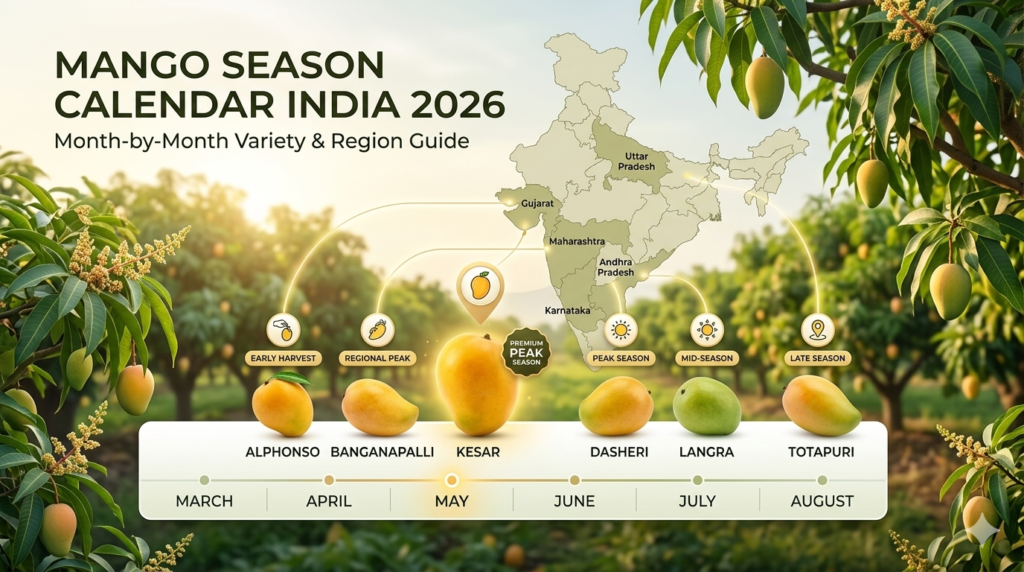
Mango Season Calendar India 2026:
Month-by-Month Variety & Region Guide
When does every Indian mango peak? From Alphonso in February to Fazli in August — your complete variety-by-variety, state-by-state mango season calendar for 2026.
The challenge? Most people buy mangoes with no understanding of this calendar. They see a crate of “Kesar” in March and buy it. They miss Himsagar entirely because they didn’t know it only lasts three weeks in May. They eat subpar Alphonso in July because nobody told them it ended in June. The mango season calendar is not a piece of trivia — it’s the difference between a season of genuinely extraordinary eating and one of recurring disappointments.
This guide is your complete mango season calendar for India 2026 — every major variety, every growing region, every peak window. Bookmark this page. Share it with your family WhatsApp group before the season starts. And never miss the right window for your favourite mango again.
🌏 Why India’s Mango Season Doesn’t Start on the Same Day Everywhere
If you’ve ever wondered why Alphonso is already in Mumbai markets in March while Dasheri doesn’t show up in Delhi until June, this section is for you. It’s not about variety preference — it’s about geography and climate.
India is a big country. The mango season doesn’t begin on a single date nationwide. Instead, it follows a regional timeline based on climate, temperature, and local cultivation practices. The season begins in the south and moves north like a slow sunrise — Kerala and Tamil Nadu warming up first, then Andhra Pradesh and Maharashtra, then Gujarat, then the great Indo-Gangetic plains of UP and Bihar, and finally Bengal with its late-season treasures.
Here’s the science behind it. Mango trees need a cool, dry winter to set flower — typically December through January. After flowering, the developing fruit needs heat to complete its growth. Southern India gets warm earlier (February–March), which is why southern varieties like Totapuri, Badami, and Banganapalli are ready by March–April. The Gangetic plains of North India stay cool longer, which pushes their mango harvest into June–July. It’s not a scheduling preference — it’s the monsoon progressing backwards through the country, fruit by fruit.
Meteorological patterns for 2026 indicate mango cultivation will follow the usual timeline, with southern and coastal regions harvesting first, followed by central and northern regions. Gir Kesar’s 2026 forecast is particularly positive — the Gir region had good winter temperatures, strong flowering, and adequate rainfall, with expectations that May and June 2026 will be particularly good months for quality and availability. The 2026 Kesar season is expected to be one of the better recent vintages.
📆 India’s Complete Mango Season Calendar — 2026 at a Glance
Here’s your quick-reference calendar. Screenshot this, save it to your gallery, send it to every mango-loving person you know before March next year. This is the information that ends bad mango purchases.
| Variety | Home Region | Season Start | Peak Window | Season End | Deliver Online? |
|---|---|---|---|---|---|
| Alphonso (Hapus) | Ratnagiri, Maharashtra | Mid-Feb | April–May | June | Moderate |
| Banganapalli (Safeda) | Andhra Pradesh | March | April–May | June | Excellent |
| Totapuri / Badami | Karnataka / AP | March | May–June | July | Good |
| Imam Pasand (Himayat) | AP / Tamil Nadu | April (2nd wk) | May–June | Early July | Moderate |
| Himsagar (Khirsapat) | West Bengal | May | May (2–3 weeks) | Late May | Not suitable |
| Gir Kesar | Junagadh, Gujarat | April | May | Mid-June | Excellent |
| Valsad Kesar Vanamrit | South Gujarat | May | June (prime) | Mid-July | Best choice |
| Mallika | Pan India | June | June–July | July | Good |
| Dasheri (Malihabad) | Lucknow, UP | Early June | June (2nd wk) | July | Good |
| Langra (Banarasi) | Varanasi, UP | Late June | July | July | Good |
| Neelam | TN / AP / MH | June | July | August | Excellent |
| Chausa (Chaunsa) | UP / Haryana | Late June | July | August | Not suitable |
| Fazli | Malda, WB / Bihar | July | July–August | August | Good |
The Crown Jewel of the June Calendar — Farm-Direct Across India
June is prime time for Valsad Kesar and we’re shipping it. Vanamrit’s Valsad Kesar is at peak Brix, peak fragrance, and peak availability right now — carbide-free, naturally ripened in hay, delivered from our Chikhli orchard to your door in 5–6 days anywhere in India.
Order Valsad Kesar Mangoes →🌸 March–April: The Season’s Opening Act (South India First)
March and April are India’s mango season warm-up. The first variety to appear isn’t even from April — Alphonso (Hapus) opens in mid-February for Ratnagiri and early March for Devgad, according to AlphonsoMango.in’s updated April 2026 guide. This is India’s earliest premium mango, and it starts its journey on the Konkan coast months before the rest of the country even thinks about trees flowering.
The March–April landscape looks like this: the south wakes up first. States like Kerala and Tamil Nadu often begin their mango harvest as early as March, continuing through May. The harvest then shifts to the western states — Maharashtra and Gujarat — where peak season typically runs April into June. Totapuri and Badami from Karnataka make their quiet appearance in March, followed by Banganapalli from Andhra Pradesh. Early mango varieties begin to appear in Karnataka, Andhra Pradesh, Telangana, and Maharashtra — Salem Alphonso, Imam Pasand, and Totapuri all start their journeys this month.
But here’s the truth about March–April that most buyers learn the hard way: early-season mangoes are said to be deficient in flavour and may not be naturally ripened. That’s not my opinion — that’s from FarmSe’s March 2026 mango season guide, written by people who track this professionally. The exception, and it’s an important one, is GI-tagged Alphonso from Ratnagiri and Devgad. Their production controls mean quality is maintained even early in the season. Everything else? Wait.
- Buy: GI-tagged Alphonso from Ratnagiri/Devgad (mid-February onwards — Ratnagiri starts at ₹2,249/dozen, Devgad at ₹2,499/dozen)
- Buy: Banganapalli from Andhra Pradesh — genuine April variety with excellent shelf life
- Buy: Raw Totapuri for pickling — firm, tangy, April Totapuri is ideal for mango pickle
- Buy: Imam Pasand from Salem (starts April 2nd week in Salem district)
- Don’t buy: Any “Kesar” in March or April — its genuine season doesn’t start until May at the earliest
- Don’t buy: “Dasheri” or “Langra” in April — both are genuinely a June–July variety
- Don’t buy: Cheap early mangoes from non-traceable sources — carbide ripening is most prevalent in April when supply can’t meet demand
For a detailed guide on how to spot whether the Kesar you’re being offered in April is genuine or mislabelled, our guide to identifying authentic Kesar mango gives you five specific tests to run before you buy.
🌿 May: Peak Season for South India — Alphonso at Its Finest
May is when India’s mango season stops being a regional preview and becomes a national event. Mangoes become widely available across most states — Alphonso, Imam Pasand, Kalapadi, Mallika, Dasheri, Langra, and Totapuri all either peak or begin in May. The variety selection in Indian markets in May is broader than any other month, and for Alphonso lovers, this is your definitive window.
Alphonso at peak ripeness in May is not the same fruit as early-March Alphonso. By May, Ratnagiri and Devgad orchards are at full production, the fruit has achieved its maximum Brix (20–24°), its cream-thick pulp is at maximum development, and its signature aroma is filling crates before they’re even cut open. This is what Alphonso was meant to taste like. Buy your Alphonso in May — not March, not July.
What About Kesar in May?
Early Valsad Kesar starts appearing in May, and it’s genuinely good. Best time to order Kesar is May–June 2026 for the finest quality fruit at its natural peak. But think of May Kesar as the opening act before the main event. The same orchard, the same variety — but June Kesar has had more time to develop its Brix, more time for those saffron aromatic compounds to concentrate, more time to become exactly what makes Kesar the Queen of Indian mangoes. If you’re ordering Kesar for fresh eating, May works well. If you’re buying in bulk for pulp-freezing, wait two more weeks for June’s prime batch.
Don’t Miss Himsagar in May
Bengal’s most celebrated mango peaks in May with a window so brief it should probably be classified as a seasonal event rather than a purchasing opportunity. Himsagar is available for perhaps 2–3 weeks in May — intensely sweet, completely fiberless, saturated with juice to the point where eating one is closer to drinking concentrated mango nectar than eating solid fruit. If you’re in Bengal in May, eat it immediately. This is one of India’s greatest seasonal experiences and it closes before June begins. No advance planning, no delivery orders — just presence and timing.
- May is the month for: Alphonso (absolute peak — buy now), Imam Pasand, Himsagar (if you’re in Bengal — eat same day), Banganapalli, early Kesar
- Pre-book: Your June Kesar delivery from Vanamrit’s farm — prime batches sell out as the season hits peak
⭐ June: The Crown Jewel of India’s Mango Calendar
If India’s mango season were a symphony, June would be the third movement — the one where every instrument in the orchestra plays simultaneously at full volume, the conductor is barely needed, and the audience forgets to breathe for a few minutes. The months of June and July, in particular, are when mangoes reach their zenith in terms of flavor, quality, and abundance. The June half of that zenith is when you have the maximum variety at peak quality at the most competitive pricing. July begins to narrow — fewer varieties, some at declining quality. June is the fullness of the season.
What’s happening in June? Prime Valsad Kesar — absolute peak quality, first two weeks of June being the most coveted batch of the entire year. Dasheri from Malihabad begins its peak in the second week of June. Langra arrives from Varanasi in the third week. Neelam starts its long late-season run. Mallika peaks. And Alphonso closes its final chapter — after June, Alphonso mangoes are no longer available.
Valsad Kesar in June — This Is the Batch
The first two weeks of June represent the highest point of the entire mango season for our Chikhli, Valsad orchard. The fruit harvested at this stage has achieved full green-maturity — 106–110 days after fruit set — and every biochemical process that creates Kesar’s famous saffron-honey sweetness, room-filling aroma, and deep orange pulp is at its maximum. This isn’t incremental improvement over May Kesar. It’s a different tier of quality entirely.
This is also the batch that makes the best frozen pulp. Buy June Kesar in quantity, ripen it all naturally, extract and freeze the pulp, and you have authentic peak-season Kesar flavour available through December. To understand exactly what makes Valsad Kesar’s June timing different from Gir Kesar’s May peak, our Valsad Kesar vs Gir Kesar comparison covers the soil, climate, and season differences in depth.
Peak supply pushes prices to their most competitive level. Prime Valsad Kesar in June is typically priced at ₹600–950 per 10kg, compared to ₹1,200–1,800 for early-season April mangoes. The irony of the mango market: highest quality and lowest price arrive at the same time in June. The buyers who understand this spend less money and eat better mangoes. The buyers who don’t know this spend more in April for worse fruit.
- June’s premium varieties: Valsad Kesar (prime), Dasheri (peak from 2nd week), Langra (starts 3rd week), Neelam (starts), Mallika (peak)
- June strategy: Order Valsad Kesar in bulk for pulp-freezing. Buy Dasheri for fresh eating. Pre-book Langra for late June delivery
- Alphonso farewell: End of June is your final window for genuine Alphonso. After June, it’s gone until next February
- Langra warning: Stays green even when ripe — never use colour to judge Langra. Use the press test and smell only
🌧️ July: North India’s Grand Finale — Chausa, Langra, and the Season’s Last Kesar
July belongs to North India. While Maharashtra’s Alphonso is a memory and Gujarat’s Gir Kesar has wound down, the UP–Bihar–Haryana belt is at full throttle with three remarkable varieties: Chausa, Langra (peak), and the tail-end of Valsad Kesar. The monsoon has broken, the humidity is oppressive, and somehow mangoes taste especially good in that context — perhaps because summer heat intensifies the craving, or perhaps because the late-season varieties really do develop exceptional sweetness from their longer growing period.
Chausa — July’s Liquid Honey
Chausa is expected to start end of June and finish end of July. This is the variety India’s mango enthusiasts in UP and Haryana have been waiting for since March — the one with near-zero acidity and 20–22° Brix that delivers pure sweetness without a single tangy note to interrupt it. July is Chausa’s month. Buy it fresh from a trusted market. Eat it today. Don’t store it, don’t refrigerate it unripe, don’t try to order a week’s supply online. Chausa lasts 2–3 days after peak ripeness and doesn’t apologise for disappearing quickly.
Last Window for Valsad Kesar
Unlike Gir Kesar (which ends in mid-June), Valsad Kesar extends through mid-July — one of its most practical advantages for buyers. After June, Kesar from Gujarat extends through July. This means if you missed your June bulk-buying window for pulp-freezing, early July is your final opportunity. Order by July 10–15 for the last good Valsad Kesar batch before next season.
Want to secure your July Kesar order before batches close? Check current availability at vanamrit.in/shop.
- July peak varieties: Chausa (eat immediately), Langra (peak), Late Valsad Kesar (until mid-July), Neelam (continuing)
- July strategy: Buy Chausa and eat same day. Order last Kesar batch by July 10. Experience Langra’s tangy-sweet complexity before it closes
- July reminder: Langra stays green when ripe — check with smell and press, not colour
🌦️ August: The Season’s Quiet Final Chapter
August is India’s mango season saying its quiet goodbye. The choices are narrow — late Neelam from Tamil Nadu and Andhra Pradesh, Fazli from Malda and Bihar, and late Chausa still trickling in from parts of UP. The variety selection is thin, but the late-season mangoes available have one quality their earlier counterparts often lack: maximum sweetness from maximum growing time.
Fazli — Bihar and Bengal’s large, mild, often overlooked late variety — is worth knowing about for bulk buyers seeking inexpensive pulp material. It’s not a flavour champion, but it’s abundant, affordable, and its late August availability fills a practical gap. Late Neelam, however, is genuinely delicious — firm, fragrant, with solid shelf life. If you’re buying a final pulp-freezing batch and Kesar is no longer available, late July–August Neelam is a very respectable choice.
And then, by September, the curtain falls. The 8-month wait begins. The Kesar orchard goes quiet. The Alphonso trees are just sticks in the ground. The crates at the market are filled with cold-stored or imported fruit that tastes like a pale memory of what was possible three months ago. This is when the wisdom of buying in bulk and freezing your pulp in June or July reveals itself completely — every bowl of aamras made from frozen Kesar between October and March is a direct consequence of buying at the right time in the right window.
For everything you need to know about freezing mango pulp correctly so your off-season supply tastes as close to fresh as possible, our complete mango storage guide covers every method in detail.
🗺️ State-by-State Mango Season Guide — When Your State’s Mangoes Peak
Your location determines which varieties are locally available and when. Here’s the state-wise breakdown:
The regional pattern is clear: South India → West India → North India, April through July, like a relay baton passing from one great mango tradition to the next. No region holds the crown alone — each gives you its own extraordinary gift in its own window.
🥭 Quick Season Profile — Every Major Variety at a Glance
Here’s your cheat sheet for all major Indian mango varieties. The column that matters most is “Peak Window” — that’s the two-to-four week period when this variety is at its absolute highest quality.
- Alphonso (Hapus): Feb–June. Peak April–May. Ratnagiri/Devgad, Maharashtra. GI-tagged. Eat fresh immediately. 3–5 days shelf life. Don’t buy after June
- Kesar (Valsad): May–mid July. Peak June (prime). South Gujarat. Excellent for fresh eating, aamras, and bulk pulp-freezing. 7–10 days ripe. Best for online delivery pan-India
- Kesar (Gir): April–mid June. Peak May. Junagadh/Amreli, Gujarat. GI-tagged. Ends 3–4 weeks before Valsad Kesar
- Banganapalli (Safeda): March–June. Peak April–May. Andhra Pradesh. GI-tagged. Longest fresh shelf life (7–14 days ripe). Good for bulk buying
- Imam Pasand (Himayat): April 2nd week–July. Peak May–June. AP/TN/Salem. Honey-cream sweetness with coconut-lime aftertaste. 3–5 days shelf life
- Himsagar: May only (2–3 weeks). West Bengal. Eat same day, never order online. 1–2 days shelf life. Most perishable premium Indian mango
- Dasheri (Malihabad): June 2nd week–July. Peak June–July. Lucknow, UP. GI-tagged. Candy-floral sweetness. 5–7 days ripe
- Langra (Banarasi): Late June–July. Peak July. Varanasi, UP. Stays green when ripe — use smell and press only. Tangy-sweet. 5–7 days ripe
- Chausa: Late June–August. Peak July. UP/Haryana. Purest sweetness (zero acidity). 2–3 days shelf life. Never buy in bulk
- Neelam: June–August. Peak July. TN/AP/MH. Excellent shelf life for late season (7–10 days). Best for late pulp-freezing batch
- Totapuri: March–July. Peak May–June. Karnataka/AP. Tangy and firm. Best for pickling, cooking pulp, industrial use. 7–10 days shelf life
- Fazli: July–August. Peak July–August. Malda (WB) / Bihar. Large, mild, late. Good shelf life. Season’s final significant variety
- Mallika: June–July. Pan India. Hybrid (Neelam × Dasheri). Balanced sweet-tangy. 5–7 days ripe
For the complete analysis of which of these varieties offers the best shelf life and storage potential — including which ones are worth buying in bulk and which ones require immediate consumption — see our guide to best mango varieties for long-term storage in India.
🎪 India’s Mango Festivals — Where the Calendar Becomes Culture
The mango season isn’t just an agricultural cycle — it’s a cultural event. And India celebrates it with genuine festivals that make the season feel like what it actually is: one of the most anticipated five-month periods of the year.
- Delhi International Mango Festival: Expected late June 2026 at Dilli Haat (venue TBC). 500+ varieties on display — India’s most comprehensive single-event mango showcase. If you’ve never understood why India takes its mango culture so seriously, one afternoon at this festival will answer the question permanently
- Bengaluru Lalbagh Mango Mela: Mid-April to early May 2026 (tentative). Lalbagh Botanical Garden. Multiple varieties, farmer stalls, food and juice. Entry ₹30 (free before 8AM). Best time: 9–11AM for fresh stock, 4–6PM for a quieter visit. Perfect for comparing varieties side by side before committing to a seasonal favourite
- Malda Mango Festival (West Bengal): Typically July–August. Malda district showcases 150+ varieties including the rare Fazli and seasonal Himsagar. The “Mango City” of India lives up to that name at this event
- Lucknow Mango Fair (UP): Government-hosted event showcasing GI-tagged Dasheri, Langra, and Chausa from Malihabad and Varanasi. Typically June–July. Historic varieties including Mughal-era cultivars are displayed
🛒 How to Use This Calendar to Buy Smarter Every Season
A mango season calendar is only useful if it changes how you buy. Here’s how to translate this information into decisions that actually improve your season:
- Cross-check before every purchase: Is this variety actually in season right now? If someone is selling “Kesar” in March, what you’re holding is an impersonation. The calendar is your authentication tool as much as it is a timing guide
- Buy each variety 2–3 weeks into its season, not the first day: Early-season availability does not equal early-season quality. Wait for the second or third week of any variety’s window for flavours to fully develop
- June is your bulk-buying month: Maximum quality, maximum variety, minimum price. This is the window to buy Kesar in quantity for pulp-freezing. One June bulk order can provide six months of off-season aamras
- Online orders need lead time: 5–6 day delivery plus 2–4 days home ripening means you order 7–10 days before you want to eat. For peak-window delivery, place your order before the window opens, not inside it
- For the complete guide on what to do when your mango delivery arrives: Our guide on ripening mangoes at home covers every method from room temperature to the traditional hay-bed technique
FSSAI’s calcium carbide ban is most frequently violated in April–May when natural supply can’t meet demand. Mangoes available outside their genuine season window are the highest-risk category. A mango with no fragrance, uniform artificial colour, and soft exterior but hard interior is almost certainly carbide-ripened. The calendar tells you when fruit should be naturally available — anything outside that window deserves extra scrutiny. Our Kesar authentication guide explains the full set of tests in detail.
❓ Mango Season Calendar India — FAQ
🏁 The Calendar Is the Guide — Season Intelligently
🥭 Your 2026 Mango Season at a Glance
India’s mango season is a 6-month relay race from south to north. Kerala and Tamil Nadu hand the baton to Maharashtra. Maharashtra hands it to Gujarat. Gujarat passes it to UP and Bihar. Bihar passes the final leg to Bengal with late Fazli. Every region gets its turn, every variety has its window, and the entire magnificent procession happens in a fixed annual order that repeats itself with the precision of a natural calendar — because it is a natural calendar.
The rules are simple: Alphonso in May, Kesar in June, Dasheri and Langra in late June–July, Chausa in July and eat it today, Neelam for your late-season pulp batch in July–August. Never buy premium varieties outside their season. Never buy cheap mangoes in April from unverifiable sources. And whatever you do, don’t miss the June Kesar window — it’s the calendar’s crown jewel, and it waits for no one.
“India’s mango season doesn’t ask for your convenience. It follows its own ancient calendar. Your only job is to show up at the right time.” 🥭🌿
Valsad Kesar at Peak Quality — Farm-Direct Across India
The calendar says June is the best month for Kesar. We agree. Vanamrit’s Valsad Kesar is currently at prime — naturally ripened in hay, harvested at peak green-maturity, and shipped carbide-free from our Chikhli, Valsad orchard to your door in 5–6 days anywhere in India. The season is short. Order before the window closes.
🥭 Order Valsad Kesar at vanamrit.inBulk orders, gifting, or farm questions: vanamrit.in/contact | WhatsApp: +91 9033595016