
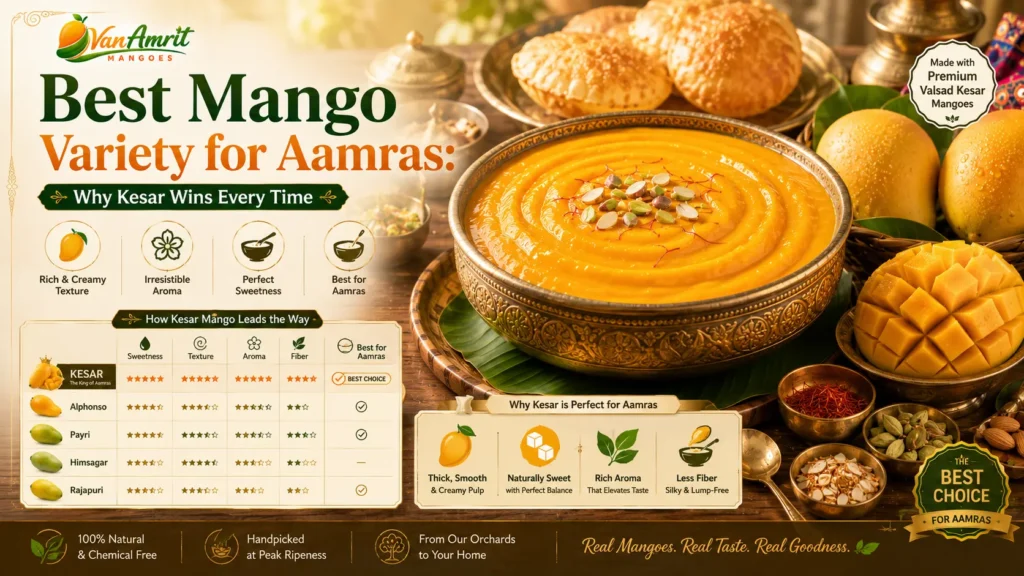
Best Mango Variety for Aamras:
Why Kesar Wins Every Time
Kesar, Alphonso, Payri, Himsagar — which mango actually gives you the deepest colour, the highest pulp yield, and the sweetest bowl of aamras? We ran the numbers, and the answer might not surprise you.
Then you tasted it. Pale yellow. Watery. Barely sweet enough. Absolutely nothing like the vivid saffron-orange, honey-thick aamras you’ve been dreaming about since March.
The recipe wasn’t wrong. The technique wasn’t wrong. The mango was wrong.
This is the single most overlooked decision in aamras-making: not how you blend it, not what spices you add, but which mango variety you start with. The right mango variety for aamras can give you a bowl so deep orange it looks almost impossible. The wrong one gives you the kind of aamras that needs three tablespoons of sugar just to taste like summer. Today, we’re fixing that — once and for all.
🔬 What Actually Makes a Mango Good for Aamras?
Before we rank varieties, let me give you the five things that genuinely separate an outstanding aamras mango from a mediocre one. Because knowing the framework makes the verdict make sense — you’re not just taking my word for it, you can apply these criteria yourself the next time you’re standing at the market wondering which crate to buy from.
1. Pulp-to-Seed Ratio
Think of this as the yield efficiency of the mango. A large flat seed buried in the middle of the fruit is essentially dead weight — beautiful to look at from the outside, but robbing you of 30–40% of what you paid for. The best mango variety for aamras has a thin, compact seed and a high proportion of pure edible pulp. For a 1kg box of quality Kesar, you’re typically extracting 700–750g of pure pulp. For fibrous, large-seeded market varieties, you might struggle to get 500g from the same box weight. The maths on that is devastating.
2. Fibre Content
Fibre in a mango is fine when you’re eating it fresh — some people actually love that clean, toothy pull. But in aamras? It’s a disaster. Fibrous mangoes produce aamras with a stringy, throat-coating texture that no amount of blending fully fixes. The best aamras mango varieties — Kesar, Alphonso, Himsagar — have pulp so smooth it flows like liquid silk once blended. You shouldn’t need to strain your aamras. If you do, you started with the wrong mango.
3. Natural Sugar Levels (Brix)
Brix is the measurement of dissolved sugar content in fruit. The higher the Brix, the naturally sweeter the mango — which means less or zero added sugar in your aamras. Kesar registers between 18–22 Brix at peak ripeness. Alphonso reaches 20–22 Brix. A well-sourced, fully ripe Valsad Kesar often needs absolutely zero sugar — the mango brings all the sweetness it needs. Varieties below 16 Brix need significant sugar addition, which thins the aamras consistency and adds unnecessary calories. Good aamras should be all mango, minimum intervention.
4. Colour Intensity
The colour of aamras isn’t just visual — it’s nutritional. That deep saffron-orange in a bowl of Kesar aamras comes from extraordinarily high carotenoid concentrations. The same pigments responsible for the colour are also powerful antioxidants. A pale yellow aamras isn’t just less beautiful — it’s less nutritionally dense than deep orange aamras from a genuine Kesar or Alphonso. And practically speaking, vivid saffron aamras is the one that earns gasps at the table. Pale yellow aamras doesn’t earn gasps.
5. Post-Blend Flavour Stability
Some mangoes taste spectacular when you eat them fresh but lose their personality the moment they hit a blender. The volatile aromatic compounds that give a mango its fragrance and complexity can be heat-sensitive and texture-sensitive. The best aamras mangoes — particularly Kesar — actually hold and even intensify their fragrance when blended. The saffron-sweet aroma concentrates in the bowl. Varieties that taste watery or “flat” in blended form are telling you something: they weren’t built for this application.
| Variety | Pulp Ratio | Fibre | Brix | Colour | Blend Flavour | Overall |
|---|---|---|---|---|---|---|
| Kesar | ⭐⭐⭐⭐⭐ | Near zero | 18–22 | Deep saffron | Intensifies | 🥇 Best |
| Alphonso | ⭐⭐⭐⭐⭐ | Zero | 20–22 | Saffron-gold | Excellent | 🥈 Premium |
| Payri | ⭐⭐⭐⭐ | Low | 16–18 | Pale yellow | Good | Traditional choice |
| Himsagar | ⭐⭐⭐⭐ | Near zero | 19–21 | Golden yellow | Good | East India gem |
| Rajapuri | ⭐⭐⭐ | Medium | 15–17 | Yellow-orange | Flat | Budget bulk only |
🏆 The Top 5 Mango Varieties for Aamras — Ranked
Let’s go through each variety properly, because every ranking deserves an explanation rather than just a number.
If you’ve ever had a bowl of aamras that made you close your eyes involuntarily on the first spoonful, it was almost certainly made with Kesar. This mango variety was designed — by the particular combination of Gujarat’s soil, heat, and humid summer air — specifically to become the kind of aamras that Gujarati weddings are built around.
Kesar is widely considered the best variety for making aamras because of its high juice content and lack of tough fibres. That single line from the April 2026 food guide cuts right to it — this isn’t a matter of regional preference or nostalgia. It’s about what the fruit actually delivers when you put it in a bowl.
Pulp factories in Valsad, Vapi and Chittoor pay a contract premium for Kesar specifically for frozen pulp, aamras concentrate, and mango ice cream production. When professional food manufacturers choose a mango for commercial-scale aamras production, the market answer is almost always Kesar. That’s the commercial proof that what we’re saying about home aamras is accurate at scale.
The deep saffron colour of Kesar aamras is particularly worth mentioning. Kesar’s deep orange colour makes it the best variety for vibrant aamras — no artificial colour needed, just pure saffron-hued mango pulp. That colour comes naturally from the fruit’s extraordinary carotenoid content. You don’t add food colouring. You don’t even need to add saffron strands. The mango does all of it on its own.
And the sweetness? A properly ripe Valsad Kesar aamras typically needs zero added sugar. In Gujarat, Kesar Mangoes are available in abundance and are softer. They are less likely to cut cleanly which is why they are the most commonly used type of mango in keri no ras. That softness — that complete ripeness — is what delivers the natural sweetness that makes Kesar aamras the kind of thing people remember decades later.
Order your Kesar for peak-season aamras at Vanamrit’s shop →
Alphonso is the most intensely flavoured mango in India, and that intensity carries directly into aamras. Alphonso offers an excellent pulp-to-seed ratio, with a thin seed and thick, dense pulp. This makes it highly efficient for both direct consumption and commercial pulp extraction. The Brix is slightly higher than most Kesar at peak — 20–22° — and the flavour is richer, more complex, and more assertive.
So why is Alphonso second on this list rather than first? Honestly, it comes down to economics and availability. For aamras where you’re extracting pulp from 6–10 mangoes per batch, the price premium of Alphonso — typically 3–5 times more per kg than Kesar — is very difficult to justify when Kesar delivers 90% of the same result. Restaurant chefs making a showpiece dessert for a special tasting menu? Use Alphonso. A Gujarati household making aamras for Sunday lunch? Kesar is the smarter, more authentic choice every time.
Alphonso also has a shorter and earlier season (March–May peak) compared to Valsad Kesar (May–July). That extended Kesar season actually matters for aamras-making — June Kesar is at absolute flavour peak, and it gives you the longest window to buy, ripen, and process in bulk.
Before Kesar became the dominant aamras mango in Gujarat, Payri held that crown. Many older Gujarati households still swear by it, and there’s real tradition behind that loyalty. Payri makes decent aamras — light, slightly tangy, with a more watery consistency than Kesar. It pairs well with dry ginger powder (sonth) in the traditional Keri No Ras style.
The honest limitation: Payri’s Brix is lower (16–18°) and the colour significantly paler than Kesar. A Payri aamras will need sugar addition in most cases, and the final bowl will be pale yellow rather than the vivid saffron that makes people reach for their phones to photograph it. For a traditional, budget-conscious aamras, Payri absolutely works. For the best aamras of the summer, step up to Kesar. Many households blend 70% Kesar + 30% Payri, which is a genuinely excellent combination that honours tradition while maximising the yield and colour of the final product.
If you live in West Bengal, Odisha, or Bangladesh, Himsagar is your aamras mango. Himsagar (also called Khirsapat) is the premium variety of West Bengal, Odisha and Bangladesh. Saffron-coloured pulp, fibreless, and one of the sweetest mangoes in India. The Brix is excellent — 19–21° — and the pulp is nearly as fiberless as Kesar. It makes smooth, sweet, beautiful aamras.
Its limitation in this ranking is purely practical: Himsagar is extremely difficult to find outside its home region. If you’re in Gujarat, Maharashtra, or most of central and western India, you’re not going to encounter genuine Himsagar at the local market. When you can get it fresh from a trusted source in Bengal, it makes world-class aamras. For everyone else, Kesar remains the answer.
Rajapuri (ranked #5) — Large, widely available in Gujarat, good for bulk processing. Decent yield but medium fibre content, lower Brix (15–17°), and flat post-blend flavour make it a budget option rather than a quality one. Best for aam papad and commercial mango concentrate where volume matters more than premium taste.
🧡 Why Kesar Is the Undisputed Aamras Champion
We’ve established Kesar at the top, but let me go deeper into exactly why — because understanding the reasons helps you buy better Kesar, ripen it correctly, and extract the maximum possible aamras from every box.
The Commercial Proof: Processors Don’t Lie
Here’s one of the most compelling arguments for Kesar as the best mango for aamras that most people never think about: the commercial food processing industry. Major pulp factories in Valsad, Vapi, and Chittoor have been running contract-farming arrangements specifically for Kesar for decades. They pay premium above-market prices for the variety. These are businesses whose entire operation depends on getting the highest possible quality pulp yield — and they’ve collectively concluded that Kesar is the best mango variety for aamras and frozen pulp production. When food scientists and procurement managers with millions of rupees at stake make this call unanimously, it’s worth paying attention to.
The Colour That Doesn’t Need Help
Every bowl of aamras deserves to look like it was made in a palace kitchen. And the only way to achieve that is by starting with Kesar. The deep saffron-orange comes from carotenoid pigments that develop specifically in Kesar due to the combination of Gujarat’s intense summer heat and the mineral content of its growing soil. You don’t add food colouring to Kesar aamras. You don’t add saffron strands to achieve colour (though you can for flavour). The mango is already doing that work before it’s even cut open. A bowl of genuine Kesar aamras is so vividly orange it almost glows.
The Sweetness That Needs No Backup
One of the most practical advantages of using Kesar for aamras is this: at peak ripeness, you often need zero added sugar. Zero. The natural Brix of 18–22° in fully ripe Kesar means the fruit has developed enough natural sweetness to stand completely on its own. This matters not just for taste — it matters for texture. Adding sugar to aamras thins it. Properly ripe Kesar aamras stays thick, velvety, and beautifully dense because you’re not diluting it with dissolved sugar syrup. That thickness is the soul of great aamras.
The Valsad Kesar Advantage for Aamras
Within the world of Kesar, Valsad Kesar has a specific advantage for home aamras-making that most people don’t realise. Because it grows in South Gujarat’s alluvial coastal soil with higher moisture and rainfall, Valsad Kesar tends to be slightly sweeter and more mellow than its Gir counterpart. That mellowness means the aamras is naturally approachable — no sharp tangy notes that need to be balanced, no need to add as much cardamom or sonth to round out the flavour. It’s the “crowd-pleaser Kesar” — the one that everyone at the table loves immediately.
For a deep comparison of Gir Kesar versus Valsad Kesar and how they differ for fresh eating and cooking, see our Valsad vs Gir Kesar guide.
Farm-Fresh Valsad Kesar — Built for the Perfect Bowl
At Vanamrit, we grow our Kesar in Chikhli, Valsad’s alluvial coastal belt — the same naturally mineral-rich soil that gives our mangoes the deep saffron colour, high natural Brix, and fiberless smooth pulp that Kesar aamras demands. Naturally ripened in hay. Carbide-free. Delivered fresh across India.
🥭 Order Aamras-Grade Kesar at Vanamrit →👐 How to Extract Maximum Pulp from Your Kesar Mangoes
Choosing the right mango variety for aamras is step one. Extracting the pulp correctly is step two. Even with perfect Kesar, poor technique can cost you 20–30% of your yield or damage the flavour. Here’s how to do it properly.
First — and this is non-negotiable — your mango must be perfectly ripe before you extract. An under-ripe mango produces watery, low-Brix pulp with significantly less volume and completely underdeveloped flavour. If your Kesar isn’t yet fragrant at the stem end and slightly yielding when pressed, give it one more day. The difference in aamras yield and quality between an under-ripe and perfectly ripe Kesar is dramatic. Not sure how to ripen your mangoes optimally? Our complete home ripening guide covers every method step by step.
The Traditional Hand Method (For the Purist)
Hold the mango firmly with your thumb on the stem and fingers underneath. Gently squeeze and massage the mango while rotating it to soften the flesh inside. Once the flesh feels soft and mashed evenly, remove the stem and squeeze the pulp into a bowl. Turn the skin inside out and squeeze to extract the remaining juice. This is the method that produces what Gujaratis call lacchedar aamras — slightly textured, hand-extracted pulp with a more rustic, traditional consistency. It’s the way grandmothers made Keri No Ras before blenders existed, and many purists argue it produces a better result.
The Modern Blender Method (For Smooth Aamras)
- Peel the perfectly ripe Kesar mangoes and cut the cheeks off each side
- Squeeze all remaining pulp from the seed section by hand — don’t waste a drop
- Place all pulp in a blender and blend at medium speed for 30–45 seconds. Not high speed — over-blending incorporates air (makes aamras foamy) and heats the pulp (destroys volatile aroma compounds)
- Taste immediately. With peak-season Valsad Kesar, you likely need zero sugar. Add cardamom (elaichi) for the Maharashtrian style, dry ginger powder (sonth) and a spoon of ghee for the authentic Gujarati style
- Refrigerate for 45–60 minutes before serving. Chilled Kesar aamras is a fundamentally different experience from room-temperature aamras — the cold concentrates the sweetness and thickens the texture
A useful rule for planning your batch: 1kg of ripe Kesar mangoes typically yields 600–750g of pure aamras pulp. For a family of 4–6, you want roughly 800ml–1 litre of aamras. That means buying 1.5–2kg of Kesar per batch. Buying in bulk? Order from Vanamrit and extract pulp from the whole batch — freeze what you don’t use immediately. Frozen Kesar aamras keeps beautifully for 6–8 months and makes off-season aamras (October, November) genuinely extraordinary.
🌿 Valsad Kesar vs Gir Kesar for Aamras — Which One?
We’ve established that Kesar is the best mango for aamras. Now let’s settle the sub-question: when you’re buying Kesar specifically for aamras, does it matter whether you choose Gir Kesar or Valsad Kesar?
Gir Kesar aamras is bolder, more intense, and has that beautiful slight tangy brightness that adds complexity to the bowl. It’s the choice for someone who wants an assertive, characterful aamras — one that demands attention. Its season peaks in May and begins tapering in June. Price per kg is higher due to the GI designation.
Valsad Kesar aamras is sweeter, more mellow, and more approachable. Because Valsad Kesar grows in alluvial coastal soil with 150–200cm of rainfall annually — nearly double the Gir belt — the fruit develops more slowly and accumulates more sugars without the sharp citric tang that Gir’s drier terroir produces. This makes Valsad Kesar aamras naturally balanced — sweet-forward, honey-smooth, with zero harshness. It typically needs no sugar addition at all. Its extended season into July means more time to buy and more competitive pricing at peak, making it the smarter choice for bulk aamras production.
The practical aamras-maker’s verdict: for a large family batch where everyone from age 5 to 85 is at the table, Valsad Kesar is the better call. Its natural sweetness and mellow balance wins over the full table every time. For a small, sophisticated serving where you want the most intense Kesar character possible, reach for Gir.
See the full flavour, season, and price comparison in our dedicated Valsad Kesar vs Gir Kesar guide →
🚫 Mango Varieties You Should NOT Use for Aamras
Just as important as knowing the best mango for aamras is knowing which ones will disappoint you every time — and what to do with them instead.
- Totapuri: Exceptional for raw mango preparations, industrial juice, mango concentrate for beverages. But its high acidity and medium fibre content make for sharp, stringy aamras that tastes more like mango drink than dessert. Use it for rasam, chutney, and pickle — not aamras
- Langra: A magnificent fresh-eating mango with complex, nutty, resinous notes. But that resinous quality doesn’t work in aamras — it makes the bowl taste slightly bitter and astringent. The fibre content is also higher than ideal. Eat it fresh, savour every bite, but don’t blend it
- Dasheri: Beautifully sweet and aromatic when eaten fresh, but produces thin, low-body aamras when blended. Its high water content means the pulp doesn’t hold up — the aamras is too runny and loses its dessert character. Better enjoyed fresh or in a milkshake where the thinner consistency isn’t a problem
- Banganapalli (Safeda): A wonderful fresh-eating and cooking mango, but its large size comes with a large seed and the pulp, while sweet, lacks the flavour concentration of Kesar or Alphonso for aamras. The colour is also significantly paler. Good for mango chutney, better for fresh eating. Not the right choice for aamras
- Generic “Kesar” from unknown sources: This is the most dangerous one. Every mango season, mangoes of entirely different varieties get mislabelled as “Kesar” at markets because the name commands a premium. Carbide-ripened imitations look yellow but taste watery and flat in aamras — pale colour, no fragrance, needs excessive sugar. The mango equivalent of ordering premium scotch and getting served brown water. Always verify your Kesar is genuine before making aamras from it
Here’s something most people never connect: a lot of disappointing home aamras — pale, watery, tasteless despite using “Kesar” — is actually the result of carbide-ripened mangoes. Calcium carbide artificially yellows the skin while leaving the internal flesh underdeveloped, with far lower sugar levels, reduced aroma compounds, and significantly less pulp yield. FSSAI has banned its use under the Food Safety and Standards Act, but it remains common in unregulated market supply. If your aamras keeps disappointing despite using Kesar, the mango wasn’t truly Kesar — or it wasn’t naturally ripened. Buy from traceable, farm-direct sources only.
🛒 How to Buy the Right Kesar for Aamras in 2026
Knowing that Kesar is the best mango for aamras is only useful if you can actually get your hands on genuine, properly ripened Kesar. Here’s how to shop smart this season.
When to Buy
For Valsad Kesar specifically — the variety we recommend for bulk aamras — June is the prime aamras-making month of 2026. The fruit is at absolute peak sugar development, supply is at maximum (which means better pricing), and the season still has 4–6 weeks left giving you time to reorder if your first batch was magnificent and you want more. Buying in mid-April gives you early-season fruit that hasn’t fully developed its Brix yet. Our 2026 Kesar season timing guide has current pricing, availability, and the exact windows for both Gir and Valsad Kesar.
How Much to Buy for Aamras
- Family of 2–3, single batch: 2–3kg → approximately 1.2–2 litres of aamras
- Family of 4–6, Sunday lunch: 4–5kg → approximately 2.5–3.5 litres of aamras
- Bulk buying for pulp freezing: 10–15kg → extract all pulp, freeze in 500ml portions for off-season aamras through December
What to Look for When Buying for Aamras Specifically
For aamras, you can actually buy slightly riper than you would for fresh eating — the more developed the sugars, the richer the aamras. A mango that’s perfectly ripe for fresh eating makes excellent aamras. A mango that’s one day past fresh-eating peak is actually ideal for aamras extraction — more flavour, higher Brix, slightly more yielding flesh that releases pulp more completely. As long as the mango isn’t fermented or overripe to the point of off-flavours, it’s fair game for aamras.
And most importantly — buy from sources you can verify. Farm-direct from Vanamrit means you know the variety is genuine Valsad Kesar, the ripening was natural in hay beds, and the fruit was harvested at the right maturity stage. That traceability directly produces better aamras. Order your aamras-grade Kesar from Vanamrit →
❓ Your Aamras Questions, Answered
🏁 The Best Mango for Aamras Has a Name
🥭 It’s Always Been Kesar. It Always Will Be.
We’ve compared five varieties across five factors — pulp yield, fibre, natural sugar, colour, and post-blend flavour. The data points one way: Kesar is the best mango variety for aamras, and it’s not particularly close. The commercial food industry agrees. Generations of Gujarati households agree. Multiple food publications in 2026 have said it explicitly.
The framework we built at the start of this guide — pulp ratio, fibre, Brix, colour, blend stability — wasn’t designed to lead to a predetermined answer. It was designed to help you think clearly about what aamras actually needs from a mango. And when you think clearly about what aamras needs, Kesar emerges as the answer every time.
The recipe is simple. The technique matters, but not as much as the mango. The spices are lovely additions, but they can’t rescue a bad starting ingredient. Buy the right mango — genuine, naturally ripened, farm-fresh Kesar at peak season — and your aamras will do the rest of the work on its own.
“Your aamras is only as good as the mango you start with. Start with Kesar — the rest takes care of itself.” 🥭🌿
Order Aamras-Grade Valsad Kesar From Vanamrit
At Vanamrit, our Valsad Kesar grows in Chikhli’s alluvial soil, naturally ripened in hay beds — the same farm-to-table process that gives our mangoes the deep saffron colour, 18–22 Brix sweetness, and fiberless smooth pulp that makes the best aamras of your season. Farm-direct delivery across India. Carbide-free. Always genuine.
🥭 Order Kesar for Aamras at vanamrit.inQuestions about which Kesar to choose for aamras? Contact us or WhatsApp: +91 9033595016