
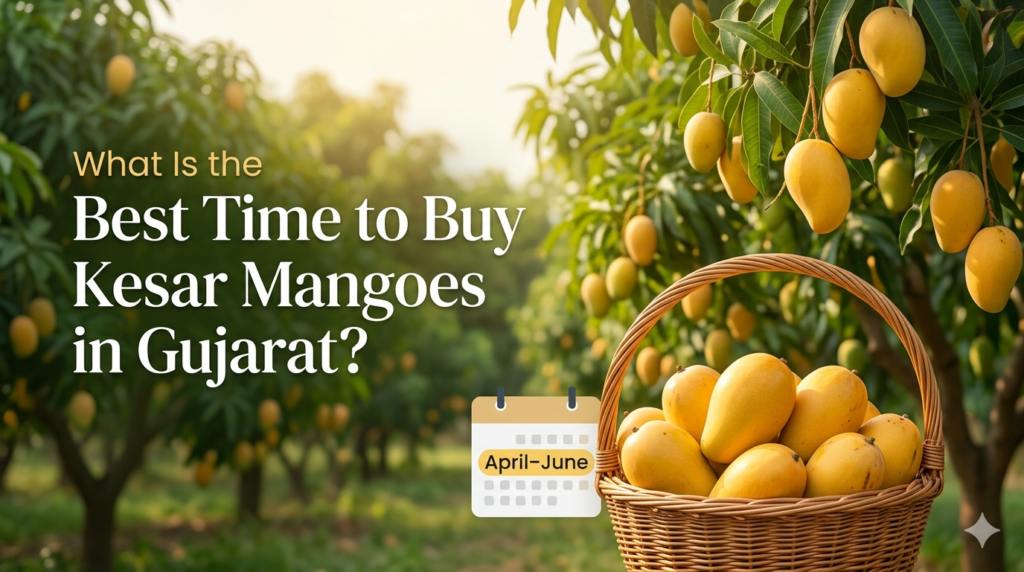
What Is the Best Time to Buy
Kesar Mangoes in Gujarat?
The complete 2026 buyer’s guide — covering peak season, Gir vs Valsad timing, price phases, how to spot a naturally ripened mango, and the exact week to order.
Good news for 2026: By end of December 2025, around 60% of mango trees across Gir-Somnath, Junagadh, and Amreli had already flowered — well ahead of the usual timeline. Farmers in Amreli report predominantly green flowering this season, which has a much higher fruit-setting rate than red flowers. If the coming weeks remain dry and warm, first batches of Kesar could reach markets by mid-to-late April 2026 — earlier than a typical year. Additional processing centres are also being set up in Ahmedabad and Gir to improve logistics this season. It’s shaping up to be a strong year. 🌟
What went wrong? Timing. You bought too early. And don’t worry — almost everyone makes this mistake at least once.
Here’s the truth: Kesar mangoes technically arrive in markets from mid-April onwards, but that doesn’t mean you should rush to buy them. There’s a clear, definable window — a golden few weeks — when Gujarat’s Kesar is at its absolute best. That’s what this guide is about. By the time you finish reading, you’ll know exactly when to buy, what to pay, which region to buy from, and how to tell a genuinely ripe, naturally ripened Kesar from one that was rushed to your plate before its time.
👑 Before Timing, Let’s Talk About Why Kesar Is Worth Waiting For
If you already know and love Kesar, feel free to skip ahead. But if you’re relatively new to this variety, let me take 60 seconds to convince you why the timing matters so much more for Kesar than for, say, a Totapuri or a Langra.
The Kesar mango — officially known as Gir Kesar when grown in the Junagadh and Amreli belt of Saurashtra — earned its name from the Nawab of Junagadh himself. In 1934, Nawab Muhammad Mahabat Khan III looked at the glowing orange pulp of this newly cultivated fruit and simply said: “This is Kesar” — Kesar being the Gujarati and Hindi word for saffron. The name stuck, and nearly a century later, it remains one of the most celebrated mangoes in the world.
Gir Kesar received its Geographical Indication (GI) tag in 2011 — making it the first agricultural product from Gujarat and the second mango variety in India (after Dasheri from UP) to receive this honour. Today, Kesar is grown across approximately 20,000 hectares in Junagadh and Amreli districts alone, with an estimated annual production of around two lakh metric tonnes from the Gir belt. Across all 11 Kesar-growing districts of Gujarat, the state produces approximately one million metric tonnes of mangoes annually.
What makes Kesar so special is that perfect combination: fiberless pulp so smooth it melts before you’ve finished chewing, a deep saffron-orange colour that glows like a sunset in the Girnar foothills, an aroma so powerful it fills the room before you’ve even cut the fruit, and a sweetness that’s intense without being cloying. A peak-season, naturally ripened Kesar is one of the finest things you can eat anywhere in the world. But here’s the catch — all of that magic only happens when you buy at the right time.
🌸 Understanding the Mango Season: It Starts in November, Not April
Here’s something most mango buyers don’t know: the Kesar season really starts in November. Not when mangoes hit the market — but when the mango trees begin flowering. And what happens in those early winter months determines everything you’ll experience in May and June.
Think of a Kesar mango tree like a careful craftsman. Between November and January, it flowers. Between February and March, tiny raw mangoes develop on those branches. Between April and July, they mature and hit the market. Every step of that journey is shaped by weather, soil, and care. Disrupt any stage and the whole season changes.
Why Cool Winters Are the Kesar Farmer’s Best Friend
Mango trees need cool nights — ideally below 15°C — during the flowering window. These cool temperatures trigger healthy flower production and, more importantly, help those flowers actually set into fruit rather than dropping off. As Janak Padasar, a farmer from Abhrampar village in Amreli’s Savarkundla taluka, explained to reporters: “There are two kinds of flowering — green and red. Green flowering has a much better chance of fruit setting, while red flowers tend to drop.”
This is why warm winters are every mango farmer’s nightmare. A warm winter in 2023–24 led experts at Junagadh Agricultural University to project a staggering 40–50% decline in Kesar output. That year, South Gujarat’s 85,000+ acres of mango orchards saw only 35% of their usual yield. And of course, that translated directly into higher prices for consumers.
The signs for 2026 are genuinely encouraging. By the end of December 2025, roughly 60% of mango trees across Gir-Somnath, Junagadh, and Amreli had already flowered — easing concerns that the extended 2025 monsoon (which lasted into October) might delay the crop. Farmers report that daytime temperatures have been ideal, and the predominantly green flowering this season significantly improves fruit-setting prospects. Dr Sanjay Patil of the Indo-Israel Centre of Excellence for Kesar mangoes also confirms uniform flowering in Marathwada Kesar orchards — another good sign. If coming weeks stay dry, first batches could reach markets by mid-to-late April 2026.
What can disrupt even a promising season? Unseasonal rain in February–March is the biggest villain. As farmers describe it, sudden fog or rain at this stage works like acid on the mango plant — it forces the tree to shed the small developing fruits, wiping out weeks of potential harvest in a single rainy night. Cyclones are another risk: Cyclone Tauktae in May 2021 devastated mango crops across Junagadh, Amreli, and Gir-Somnath, causing losses estimated between ₹390–500 crore to Gujarat’s mango industry alone.
The practical takeaway for you as a buyer? Always check current-season news before planning your Kesar purchase. The “general” April–June window can shift significantly based on any given year’s weather story.
📅 The Kesar Season Timeline: From First Flower to Last Fruit
Let me walk you through what happens at each stage of the Kesar season — and what it means for you as a buyer.
Farm-Fresh Valsad Kesar, Delivered at Peak Season
At Vanamrit, we grow Kesar mangoes on our own farm in Valsad, South Gujarat — and we harvest only when the fruit is at peak ripeness. No early picking. No carbide ripening. No cold storage shortcuts. Just naturally ripened Kesar, delivered farm-direct to your door during the exact golden window described above.
Pre-Order Your 2026 Kesar Mangoes →⚖️ Early Season vs Peak Season: The Numbers Tell the Story
Let me be really direct here because this is the section that’ll save you the most money and the most disappointment. Early-season Kesar and peak-season Kesar are not the same product. They wear the same label, but the experience inside is completely different. Here’s why:
🟡 Early Season Kesar (Mid-April)
🏆 Peak Season Kesar (May)
Do the maths here. You’re paying 30–60% more for early-season Kesar, and getting 20–30% less flavour in return. That’s a terrible deal any way you look at it. The only reason to buy in mid-April is if you specifically need to gift something at an occasion that falls in that window, or if you’re the kind of person who genuinely can’t wait — and I understand that, by the way. But for everyone else, patience is almost always rewarded.
🗺️ Gir Kesar vs Valsad Kesar: Do Their Seasons Differ?
Yes — significantly. And understanding this difference could be the single most useful piece of information in this entire article for South Gujarat buyers.
The same Kesar variety, grown in two different climate zones, follows two slightly different season rhythms. It’s like how the same grape variety produces wine that tastes different in Bordeaux versus Napa Valley — the terroir shapes everything, including timing.
Gir Kesar
Saurashtra Region
Valsad Kesar
South Gujarat Coast
Here’s the practical implication: if you miss the peak Gir Kesar window in May, don’t panic. Pivot to Valsad Kesar. The South Gujarat coastal belt — where Vanamrit’s farm is located — gives us a season that starts in May and often extends well into July. Higher rainfall and alluvial soil mean the trees develop fruit more slowly and steadily, resulting in a mango with exceptional sweetness and a season that’s 3–4 weeks longer than Gir Kesar.
In 2026 particularly, with new processing centres being set up in Ahmedabad and Gir, the logistics for Kesar delivery are expected to improve significantly — meaning farm-direct buyers will benefit from faster, fresher delivery from both regions.
💰 The 2026 Kesar Mango Price Guide: When Is It Cheapest?
Let me give you a realistic sense of what you’ll pay at different stages of the 2026 season. Keep in mind these are indicative ranges — prices vary by grade, seller, and whether you buy from a wholesale market, online platform, or farm-direct brand.
| Month / Phase | Typical Price (10kg Box) | Price Per Dozen | Quality | Best For |
|---|---|---|---|---|
| Mid-April (Early) | ₹1,200 – ₹1,800 | ₹1,500+ | ⭐⭐ | Novelty, urgent gifting |
| Late April (Pre-Peak) | ₹900 – ₹1,300 | ₹1,200 | ⭐⭐⭐ | Taste-testing, small orders |
| May (Peak — Gir) | ₹700 – ₹1,100 | ₹900 – ₹1,100 | ⭐⭐⭐⭐⭐ | Everything — best value + quality |
| June (Prime — Valsad) | ₹600 – ₹950 | ₹800 – ₹1,000 | ⭐⭐⭐⭐⭐ | Bulk buying, pulp-making, gifting |
| July (End of Season) | ₹400 – ₹700 | ₹600 – ₹800 | ⭐⭐ | Pulp extraction only — check quality |
| Bad Year (any month) | ₹1,100 – ₹1,600 even at peak | ₹1,400 – ₹2,000+ | Variable | Monitor season news before buying |
The sweet spot — and I mean this literally and financially — is the first two weeks of May. You get maximum supply, maximum quality, and the most competitive pricing of the entire season. If you want Valsad Kesar, the same logic applies to the first two weeks of June.
One important note about online vs market buying: farm-direct platforms like Vanamrit cost slightly more per box than buying wholesale at a mandi. But that premium buys you something the mandi can’t guarantee — natural ripening, no carbide, verified source, and delivery to your door. For most home buyers and gifters, that’s absolutely worth the difference.
🔍 How to Spot a Naturally Ripened Kesar Mango
This is possibly the most important section in this entire article. Because it doesn’t matter when you buy if you’re bringing home a chemically ripened mango. And unfortunately, the problem is real — especially in the early season when natural supply can’t keep up with excited demand.
Calcium carbide is a chemical used to artificially ripen mangoes overnight. It’s illegal in India under the Food Safety and Standards Act, yet it remains widely used, especially in early-season mangoes. Carbide-ripened mangoes ripen uniformly in 24–48 hours (vs 3–5 days for natural), smell of nothing or chemicals, have pale or uneven pulp, and taste watery and bland. Regular consumption of carbide-ripened produce has health implications. Always know what you’re buying.
Here’s your practical checklist for identifying a genuinely ripe, naturally ripened Kesar mango:
- The fragrance test — always first: Bring the mango close to your nose near the stem end and inhale. A naturally ripe Kesar has a powerful, sweet, saffron-like fragrance that is unmistakable and deeply inviting. Carbide-ripened mangoes have no fragrance, or worse, a faintly chemical smell. If it doesn’t smell like something you want to eat, don’t eat it
- Colour and gradation: A naturally ripe Kesar transitions from greenish at the tip to golden-yellow at the shoulders — a natural colour gradient. Carbide-ripened mangoes are uniformly, unnaturally bright yellow all over, with no variation
- The press test: Gently press near the stem end with your thumb. A ripe Kesar gives slightly — firm but yielding, like pressing a tennis ball that’s lost just a little air. Rock hard = not ripe. Mushy = overripe. Carbide-ripened mangoes often feel soft on the surface but are still raw inside
- The 3–5 day rule: A naturally harvested green-mature Kesar takes 3–5 days to ripen properly at room temperature. If a seller claims the mango is “ready to eat today” and it arrived that same morning, something is off
- Pulp colour test: Cut a peak-season naturally ripe Kesar and the pulp should be deep, vivid saffron-orange — thick, uniform, and vibrant. Pale, uneven, or washed-out pulp signals either an early-season mango or chemical intervention
- Buy from traceable sources: The single most reliable guarantee is knowing where your mango came from. Farm-direct brands, APMC-certified sellers, and GI-certified vendors eliminate most of the risk in one step
📦 How to Store Kesar Mangoes After Buying
You’ve timed your purchase perfectly. You’ve got a box of peak-season, naturally ripened Kesar at home. Now don’t ruin it with poor storage. Here’s what you need to know:
- Never refrigerate unripe mangoes. Cold temperatures halt the ripening process and permanently damage flavour development. Always ripen at room temperature first
- Single layer, not stacked. Store unripe mangoes in a single layer on a flat surface with space between them. Stacking causes bruising and uneven ripening
- Traditional method — the penda (straw/hay bed): Farmers and older Gujarati households still swear by wrapping mangoes in newspaper or placing them in a bed of dry straw. The trapped ethylene gas helps ripen mangoes evenly and naturally
- Once ripe, refrigerate and eat within 2–3 days for the best flavour experience. Beyond that, quality drops quickly
- Bulk buying tip — freeze the pulp: Buy a large batch at peak season in May–June. Allow all the fruit to ripen fully, extract and blend the pulp, pour into airtight containers or zip-lock bags, and freeze. You’ll have exceptional Kesar mango pulp for aamras, lassi, and ice cream all the way through December. This is the smartest way to extend your mango season indefinitely
- Shelf life advantage: Kesar has notably longer shelf life than Alphonso — one of the primary reasons it dominates India’s mango export basket to the UK, US, UAE, and Canada
No Carbide. No Cold Storage Games. Just Honest Mangoes.
When you order from Vanamrit, you’re not buying from a middleman who bought from another middleman who bought from a market. You’re buying directly from our farm in Valsad, South Gujarat. We grow, harvest, and deliver our own Kesar — harvested green-mature at the right stage, naturally ripened, and at your door within days. That’s how mango should work.
🥭 Order 2026 Season Kesar from Vanamrit🛒 Where to Buy Kesar Mangoes in Gujarat: Your Options
Knowing when to buy is half the battle. Knowing where to buy seals the deal. Here are your main options — each with honest pros and cons:
Talala Gir APMC Mango Market
The famous Talala Gir Mango Market Yard — located 45 km from Gir National Park in Junagadh district — is the largest dedicated Kesar auction market in India. About 33% of all Gir Kesar production flows through here. If you’re in Gujarat and can visit in person, this is where you’ll find the widest selection of grades, the most competitive wholesale pricing, and the thrill of watching the season unfold in real time. Ideal for bulk buyers, businesses, and the truly dedicated mango pilgrim.
South Gujarat Markets (Valsad, Navsari, Pardi)
For Valsad Kesar, the local markets in the South Gujarat coastal belt are your best bet. These markets are especially valuable from May through July when Gir Kesar has peaked and Valsad Kesar is at its best. Great quality, accessible pricing, and the extended season advantage that Saurashtra buyers miss out on.
Farm-Direct Online (Recommended)
For most home buyers, the smartest option in 2026 is ordering directly from a farm-based brand. In 2026, direct-to-consumer (D2C) mango brands are more active and more accessible than ever — making it genuinely easy to get farm-fresh, naturally ripened Kesar delivered to your home anywhere in India. Vanamrit (vanamrit.in) ships Valsad Kesar directly from our orchard — no carbide, no cold storage delay, no retail markup chain. This is especially valuable during peak season when freshness is everything.
Major Online Grocery Platforms
BigBasket, Zepto, Blinkit, and Amazon Fresh carry Kesar mangoes during the season. Convenient, yes. Consistent quality? That depends entirely on their sourcing. These platforms are fine for casual purchases during peak season (May–June) when good-quality fruit is widely available. Avoid using them in mid-April or July when their mango quality tends to be the most inconsistent.
🎁 Planning Around Special Occasions in 2026
Here’s a practical calendar tip for those buying Kesar for specific occasions this year. Timing your order around festivals and events can make the difference between getting genuinely peak-season fruit or scrambling at the last minute:
- Akshaya Tritiya / Gudi Padwa (April): These festivals fall in early-to-mid April — smack in the middle of early season. If you want Kesar for these occasions, you’ll be paying premium prices for below-peak quality. Consider gifting pre-orders for May delivery instead
- Mother’s Day (second Sunday of May): This falls perfectly inside the Kesar peak window. Order your box 10–14 days in advance from a farm-direct brand. Peak flavour, peak occasion — it doesn’t get better than this
- Eid (expected late May/June 2026): Falls right in peak Kesar season. Premium mango gift hampers make exceptional Eid gifts. Order 2 weeks ahead to ensure availability of premium grades
- School summer holidays (May–June): The best news is that India’s school summer break coincides almost exactly with peak Kesar season. Buy in bulk, freeze the pulp, and stretch mango season through the holidays
- Export demand peak (April–June): Kesar forms roughly 25% of India’s total mango export basket. Export buyers compete with domestic supply especially in early May — this can create temporary price bumps in the first week of May. If budget matters, wait until the second week of May
❓ Quick Answers: Your Kesar Season Questions
🏁 The Verdict: When Exactly Should You Buy in 2026?
🥭 Clear, Simple, Final Answer
If you want Gir Kesar at its absolute peak — buy in the first two weeks of May 2026. Full supply, maximum sweetness, deepest saffron colour, strongest aroma, best prices of the season. In 2026 specifically, early flowering signals mean the season could kick off slightly ahead of schedule — so stay alert from mid-April onwards, but don’t jump until the flavour is truly there.
If you want Valsad Kesar — June is your golden month. The South Gujarat coastal season runs behind Gir by about 3–4 weeks, and that coastal-grown, alluvial-soil sweetness is absolutely worth the wait. It also gives you an extended window if life gets in the way of your May plans.
And if you want to enjoy mango season in December? Buy in bulk during May–June, freeze the pulp, and thank yourself six months later when everyone else is stuck with imported bananas.
“The Queen of Mangoes is patient. And she rewards every single person who waits for her moment.” 🥭🌿
Found this guide helpful? Share it with someone who needs it before mango season begins!
🌐 Order your 2026 Kesar mangoes at: vanamrit.in